
It was from a WeChat group of more than 100 Chinese residents in Chico that I learned that Project Tea had launched the Pork Belly Rice Bowl.
My eyes lit up when I saw the photo taken by someone who had already tried it: The red braised pork belly with a perfect balance of fat and lean, white sesame seeds scattered over the meat, and the soy-based sauce soaking into jasmine rice.
It looked so unmistakably Chinese.
The lack of authentic Chinese food has always been my biggest complaint about Chico. Sometimes I scroll through delivery apps for an hour without knowing what to order. Those moments drive me crazy. I drive to Sacramento or Davis once almost every two weeks to eat authentic Chinese food.
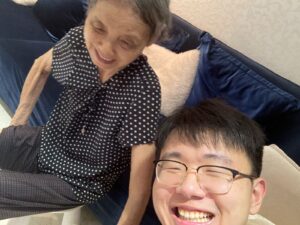
A few days after seeing the photo in the WeChat, I bit into pork belly at the Project Tea boba shop. I heard myself utter an “ahhhhhh.” It reminded me of my grandmother back home.
My grandmother loves making red braised pork belly. “Red braising” is a cooking technique from Chinese cuisine, and refers to slow-cooking food in a soy sauce–based mix until it turns dark reddish brown.
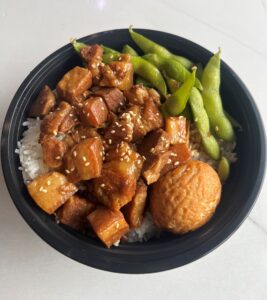
When I was little, if I didn’t want to finish my jasmine rice, Grandma would pour some of the soy-based sauce from the red-braised pork belly onto my dish and let me mix in. Kids don’t like plain jasmine rice. But with soy-based sauce, the rice suddenly becomes flavorful.
Project Tea’s Ashley Liu later shared my reaction with her employees, two American women. They were so touched they were moved to tears, Liu said.
If I had to give one suggestion for improving this rice bowl, I would say to use Bok choy rather than edamame as the paired vegetable. Co-owner Tom Zhang told me that he had indeed considered using Bok choy. However, he believes edamame is more popular in the United States. In addition, Bok choy is harder to keep fresh.
He initially decided to pair the pork belly with edamame, an example of blending Chinese and American culinary practices. Now it seems that Zhang and Liu are considering my suggestion by letting customers choose which to pair with pork belly when they order.
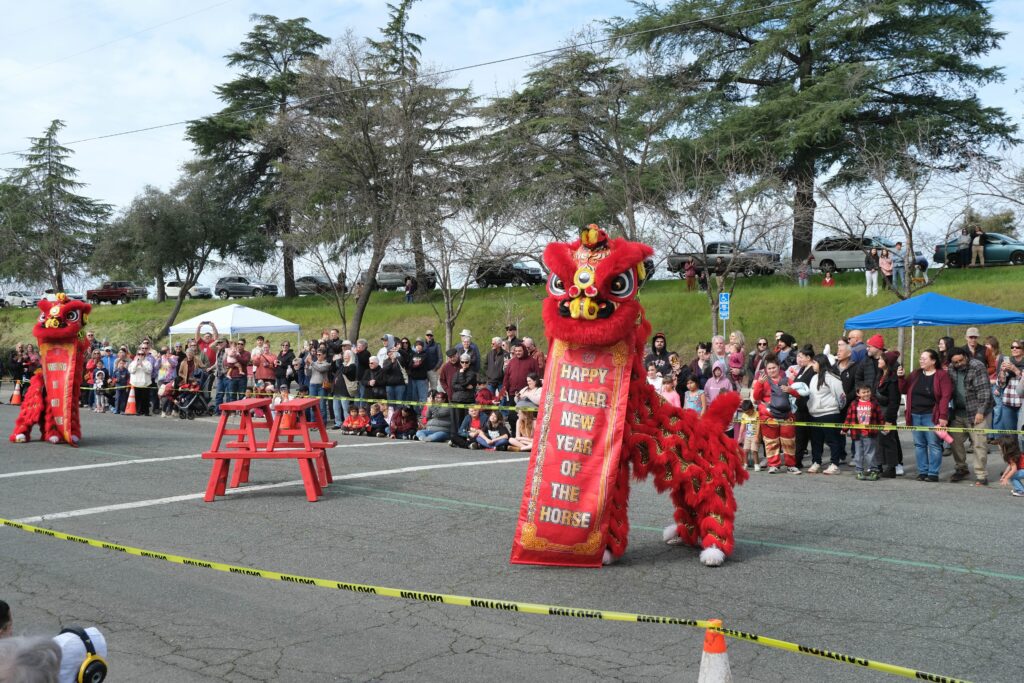
During the interview, Liu told me there was an upcoming 2026 Lunar New Year Celebration in Chico, a Chinese celebration that happens most years. On Feb. 21, I saw members of the local Chinese community gather together for the first time for the gala. What had felt hidden suddenly surfaced.
To be honest, I’m not sure if “hidden” is the right word. It seems more like people live in bubbles that rarely overlap. In a town where Asians comprise only about 5 percent of the population, it’s entirely possible to live without meeting many Asian people — or even any at all.
Even my editor had no idea of the size of the Chinese community here and exactly how tightly knit it is. I knew there were Chinese employed as professors, restaurant owners, waiters and massage therapists, but I had never thought of those dots forming a community, nor had I ever heard about the gala.
I learned that the tradition of holding a gala during the Chinese New Year began in 1976, paused for several years during the pandemic and resumed in 2025 — Yucheng Tang.