
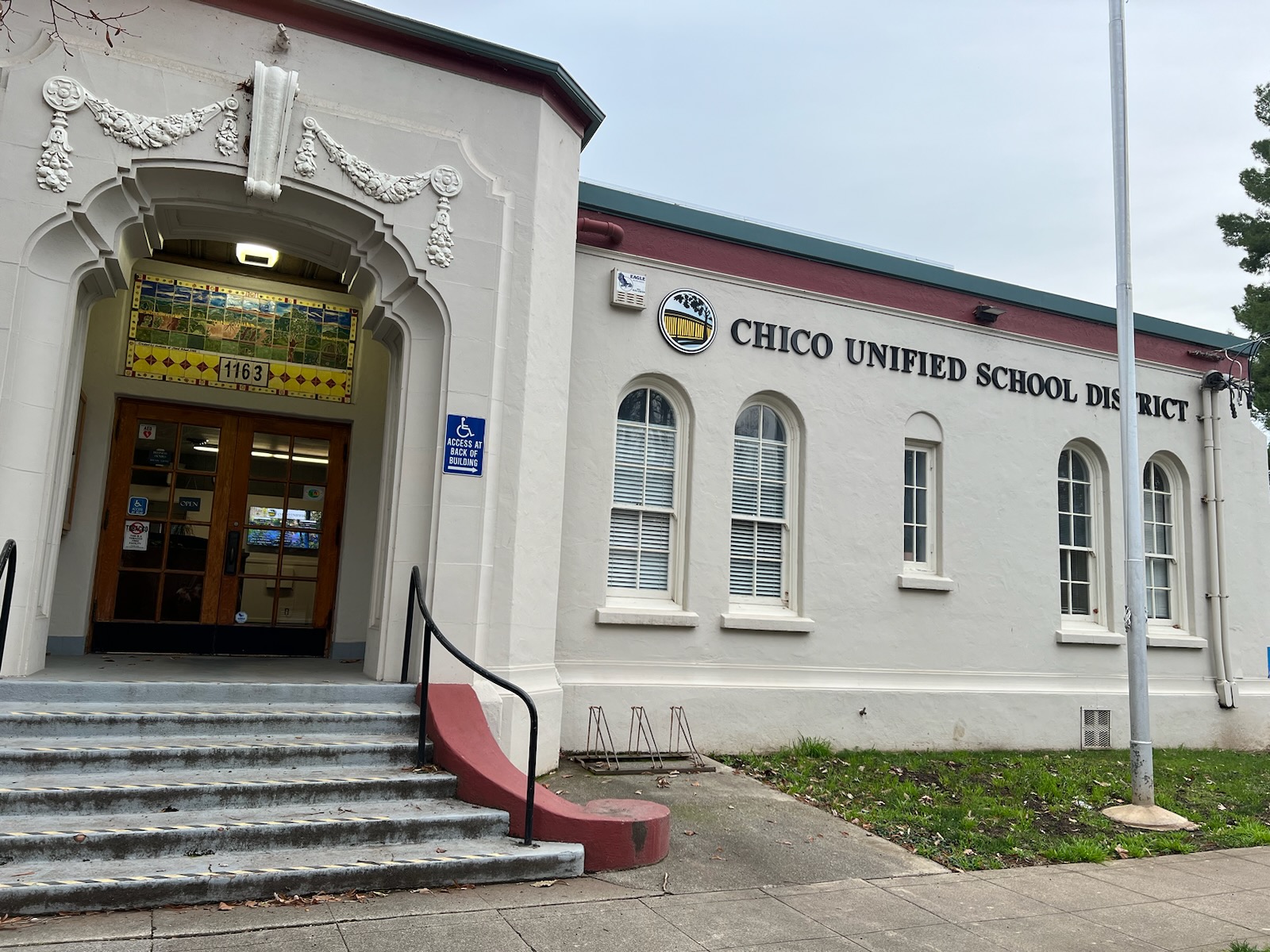
Declining enrollment is driving what will be a slight budget decline at Chico Unified, the school district says.
District staff presented a mid-year budget proposal to the Chico Unified School District (CUSD) Board of Trustees at a March 11 meeting, predicting a coming budgetary decline amid declining student enrollment numbers. The board accepted the presentation without suggesting alternatives.
Jaclyn Kruger, the district’s deputy superintendent of Business Services, told the board that looking ahead, the district will “break even” next year with an unrestricted general funds budget of $58.3 million.
However, it will then see “a small decrease” in 2027-28 to $57.8 million. CUSD is in a second year of declining enrollment, and is expected to lose 131 children next year and about 160 in the next.
Kruger told ChicoSol there are complex reasons for declining enrollment across public schools.
“Declining enrollment isn’t only about students disenrolling and leaving the district,” Kruger said. “Declining enrollment can be related to the number of new incoming kindergarteners being smaller than the cohort of graduating 12th graders; as a result, the overall enrollment is smaller.”
This trend has been reported across the state. EdSource in 2025 reported that new state data showed enrollment declining since the pandemic. State officials largely attributed the decline to demographic factors, such as a declining birth rate.
However, some counties near Butte saw enrollment growth, such as Yuba by 4% and Glenn by 3%. Enrollment in charter schools has steadily increased at the same time, according to the California Department of Education.
Kruger told the board during the meeting that her staff uses the expected average attendance of students to build a budget, which is based on the number recorded in the previous year. CUSD’s ending general fund balance is projected to be $86.1 million as of June 30.
“Right now, we’re looking at enrollment,” Kruger said. “We’re looking at our Local Control and Accountability Plan and what those priorities are, as well as from a fiscal perspective, waiting for the governor’s budget revision in May.”
She referred to the mandated plan California school districts must make to set goals and leverage funding to improve student outcomes, focusing on equity for high-needs students, including foster youth, English learners and low-income students.
Given current and expected enrollment, Kruger said the interim budget shows an additional $534,093 above what was expected for the district’s unrestricted programs – which are funded by local control dollars for any purposes the district chooses. The interim budget shows a loss of $4.88 million for restricted programs, which are specialized, often state-funded initiatives targeting specific student populations, such as special education.
“The change in fund balance on the unrestricted side of the budget has improved due to increased average district attendance in (the) prior year that will be used for current year funding as well as an overall tightening of budgets district-wide, based on current spending,” Kruger wrote in her report. “The negative change in fund balance on the restricted side of the budget is largely due to one-time dollars received in prior years, which will be spent in the current year.”
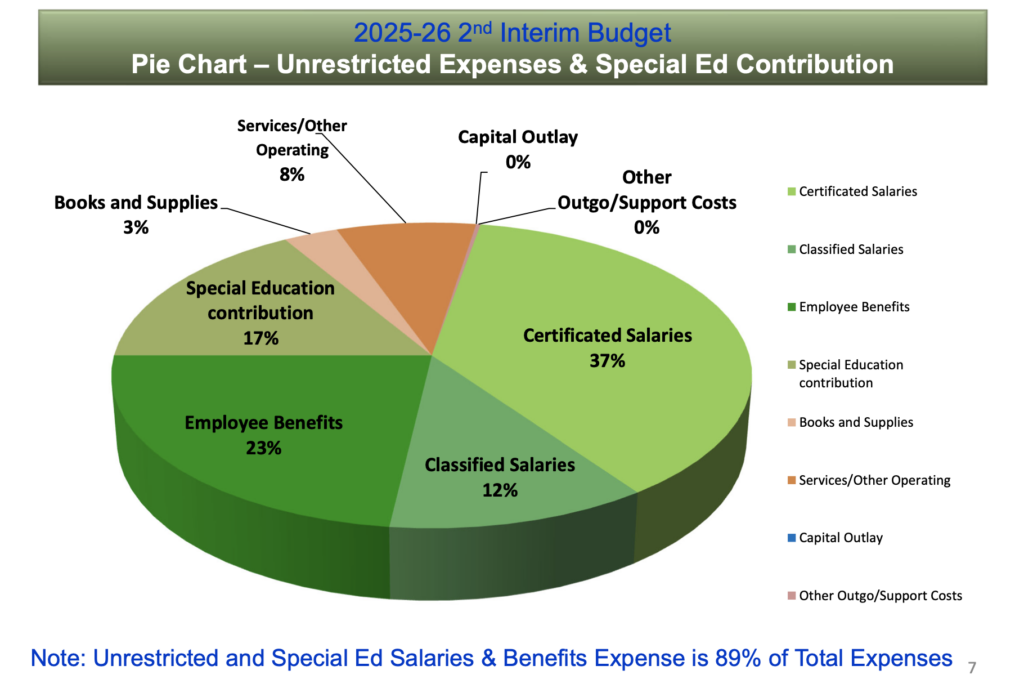
Kruger presented a pie chart showing that the highest percentage in unrestricted funds — or 37% — is spent on paying certificated staff, followed by employee benefits at 23%. The district also contributed nearly $34 million to restricted programs, largely to special education at $27 million.
The district’s financial team will return to the board in June following Gov. Gavin Newsom’s state budget revision in May. In a June meeting the board will consider the budget for 2026-27 and make final decisions and amendments.
Newsom’s draft budget this year signals an unexpected boon for schools, despite a gloomy outlook for the state’s finances, according to Ed Source. For K-12 schools, $40 million has been earmarked to continue screening all students in kindergarten, first and second grades to identify students at risk of reading difficulty. The governor’s budget proposal raises the total spent per student to at least $27,000, or 61% higher than the $17,014 spent per student in 2018-19.
Newsom presented his final state budget as governor with several education policy goals: Trimming past debt, fulfilling guaranteed increases for ongoing expenses and committing money to landmark programs to ensure they continue after he leaves office in November.
Natalie Hanson is a contributing writer to ChicoSol.
1 Comment
Thanks for covering what’s up with CUSD. It’s important information for our community.
Eileen Robinson District 5 representative.
Students are showing improvement and our after school programs are expanding.
Three of our older schools get upgraded and remodeled to improve the teaching and learning environment. Thanks Chico voters for passing our bond measures.