
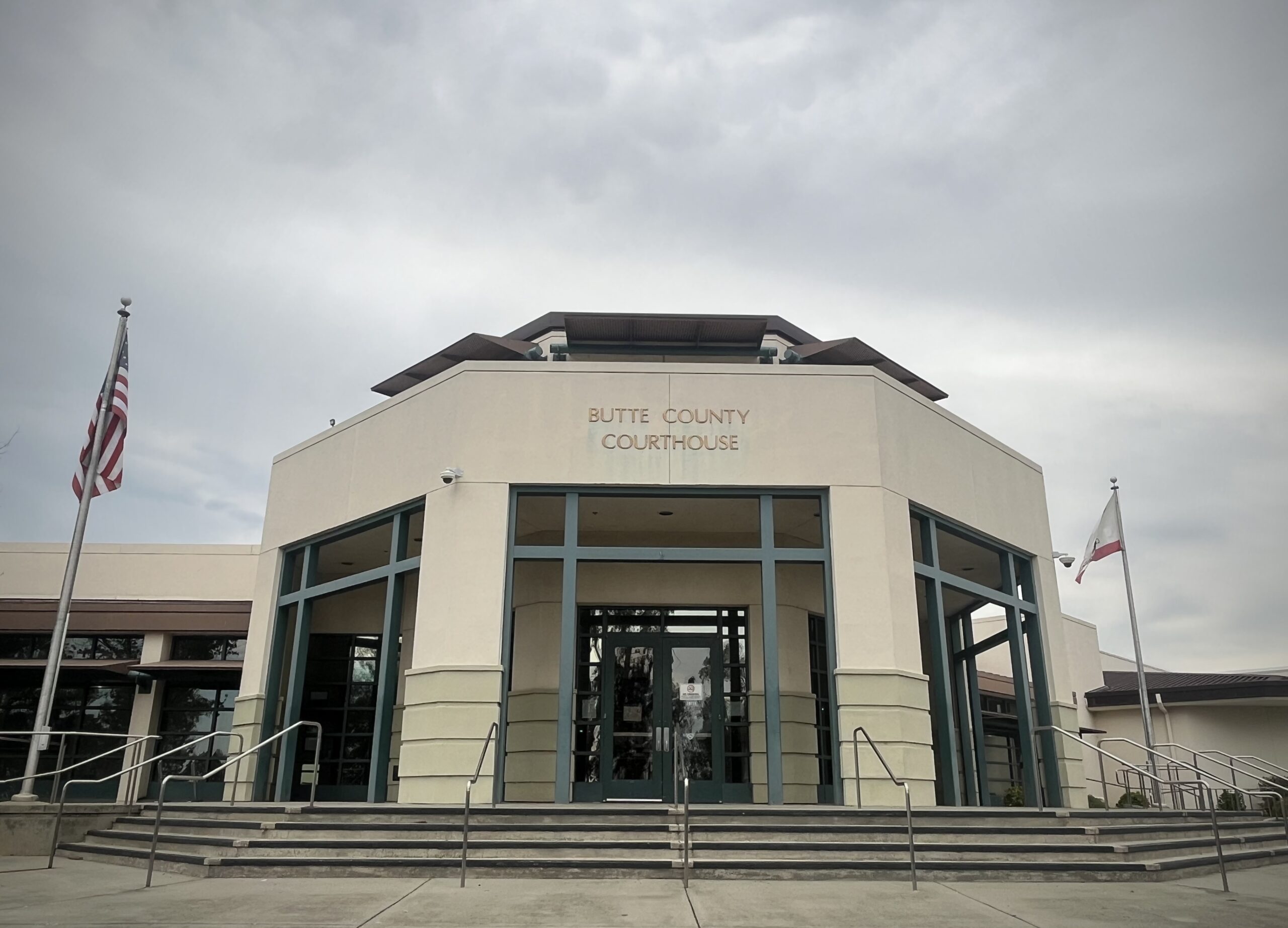
Butte County District Attorney Mike Ramsey is urging the California Legislature to amend the Mental Health Diversion (MHD) law to restrict eligibility and expand court discretion.
Assembly Bill 46, legislation that is supported by the California District Attorneys Association, won unanimous approval by the Senate’s Public Safety Committee today, according to media reports. It was introduced by Assembly Member Stephanie Nguyen, a Sacramento-area Democrat, and now moves forward to another Senate committee.
Mental Health Diversion, a program launched in Butte County in 2019, allows some defendants to receive court-ordered mental health treatment instead of incarceration. MHD participants follow a treatment plan approved by the court through Behavioral Health or private providers, and monthly court check-ins are designed to ensure they meet requirements.
Ramsey said in a March 13 press release that focuses on public safety that AB 46 “restores judicial discretion to ensure the program provides treatment to non-violent criminals while protecting community safety.”
The California Public Defenders Association spoke against AB 46 today, and some Chico defense attorneys believe the program should be expanded, arguing that the approval rate for petitioners is small in comparison to the number of people who are arrested.

From July 2019 through December 2025, the petition approval rate in Butte County was less than 29%, according to data ChicoSol obtained from the California Judicial Council. (About 64% petitions are pending for a variety of reasons.)
As the law is written now, judges have some autonomy in deciding whether a petition can be granted — though Ramsey argues that it’s not enough.
“In fact, a court may deny diversion where the court finds ‘substantial evidence’ that the person will pose an ‘unreasonable risk of committing a super-strike offense,’” wrote local defense attorneys Elizabeth Latimer and Kevin Sears in a co-authored statement. “Super strike offenses include murder and many sex-related crimes.”
Latimer and Sears said the law as it is written “permits judges to consider several factors” when deciding whether to deny a petition.
Those factors include criminal record; severity of the charged crime; recommendation from qualified mental health professions regarding the defendant’s likely response to treatment; and structure and security of the proposed treatment program.
However, Ramsey said proving that there is “unreasonable risk” a defendant might commit a super strike offense can be an “extremely difficult task.”
Furthermore, Ramsey noted that “super strikes” do not cover offenses such as attempted murder, arson, assault with a deadly weapon or domestic violence.
How AB 46 increases court discretion
AB 46 would add a clause specifying that a court retains discretion to deny diversion — even if a defendant is otherwise suitable — upon finding that “it is more likely than not that the defendant will pose an unreasonable risk to the physical safety of another person.”
The bill would require the court to state the reasons for denial on the record.

Andrea Crider, a former public defender who has researched the program in California and now teaches at UC Berkeley law school, said in an email to ChicoSol that the danger of expanding discretion for the court is that mental health diversion becomes a “luxury” rather than a standard of care.
“History shows us that judicial discretion is rarely applied uniformly,” Crider said. “When laws are vague or give broad power to deny diversion based on ‘public safety’ feelings rather than strict criteria, we consistently see an increase in systemic disparities.
“One judge might view a history of substance use as a treatable symptom of trauma, while another — under this new legislation — could use that same history as a reason to deny diversion entirely,” Crider said, adding that without a strong legal presumption in favor of diversion, defendants of color and those without stable housing are statistically more likely to be labeled “dangerous” or “unpredictable” by the system.
A loophole in the law or a failure of the system?
Ramsey sent this reporter information about four cases in which people faced new violence-related charges during diversion or after graduation from MHD, in addition to the case of Kai Perrelli that he described in the press release.
Perrelli, 28, shot his neighbor to death after “claiming a diagnosis of schizophrenia” and while on mental health diversion, according to the DA’s press release. Perrelli had been charged previously with felony assault with a deadly weapon.
“While on unsupervised diversion, Perrelli’s treatment provider reported just before the murder that Perrelli was ‘fully compliant’ with his medications and claimed Perrelli had been doing ‘excellent’ in his treatment program,” the DA’s statement said. “The homicide investigation revealed Perrelli had been acting oddly for weeks and had been off his medications for an extended period.
“Perrelli was later found not guilty by reason of insanity for the murder and has since been committed to the state hospital, where he remains today,” the statement says.
Ramsey told ChicoSol that he is most concerned about “dangerous people” being given diversion out of the criminal justice system, where there are provisions to supervise individuals after incarceration. For example, he wrote, probation and parole officers can monitor mental health treatment as well as criminogenic factors that could undermine recovery, such as substance use, lack of housing and unemployment.
“In the current diversion system, the only real supervision is the treatment provider, who is narrowly focused on treatment and not on more holistic factors for success, like supervision of housing, drugs, jobs, etc,” Ramsey added.
“Incarceration is not the only way to go in order to keep community members protected” — Latimer & Sears
Crider said that in her opinion, the Perrelli case doesn’t exemplify a loophole in the law.
“It was a failure of the support and monitoring infrastructure locally,” Crider said. “Restricting access to diversion for everyone doesn’t fix a broken supervision at the local level.”

Ron Reed, a Butte County public defender, believes that the Mental Health Diversion court is an important step in the right direction toward a safer community, and agrees that the example given in the press release is related to failures in evaluation and treatment.
“The answer is not in increasing the criminal process but in building the treatment resources, including LPS conservatorships and residential treatment facilities,” Reed said. “There is no doubt that this is a serious problem to be addressed by serious, robust treatment, not by criminalizing the mentally ill. It needs money, creativity, focus and commitment, not a return to the old ways.”
In the statement by Latimer and Sears, they stressed that participation in Mental Health Diversion court requires more discipline and medication compliance than any other form of oversight within the criminal justice system.
Diversion program participants can be and are often required to participate in programs like substance abuse education, prevention, and testing; in a one year domestic violence/battery prevention class; in GPS tracking, and in anything “a judge believes will support a person’s rehabilitation as it relates to mental health improvement and stability,” the attorneys wrote.
“Anyone who has worked with, known, or loved a person living with mental illness knows that it can be a long, rough road to stability, and that people living with mental health disorders are community members as well,” they added. “The Mental Health Diversion legislation acknowledges that incarceration is not the only way to go in order to keep community members, both those who live with mental illness and those who don’t, protected and treated.”
Yucheng Tang is a California Local News fellow reporting for ChicoSol.
2 Comments
Thank you for this important article. Unfortunately in Butte County Ramsey inevitably gets his way. I hope this is an exception. and that good sense will prevail. Perelli‘s worker failed him as well as the person that he killed.
The expression on Ramsey’s face suggests a great deal. He is exerting pressure on the courts, alongside the relatively small group of 58 members of the California District Attorneys Association, who wield disproportionate influence over the lives of 40 million Californians.
It appears that Ramsey considers himself more knowledgeable than the judges, particularly those who support providing individuals with mental health challenges an opportunity for treatment rather than subjecting them to costly and counterproductive prison incarceration.
Ramsey is neither a psychiatrist, therapist, counselor, nor a medical doctor; he is an attorney who possesses significant political authority to punish individuals. His purported good intentions should be viewed with skepticism.