
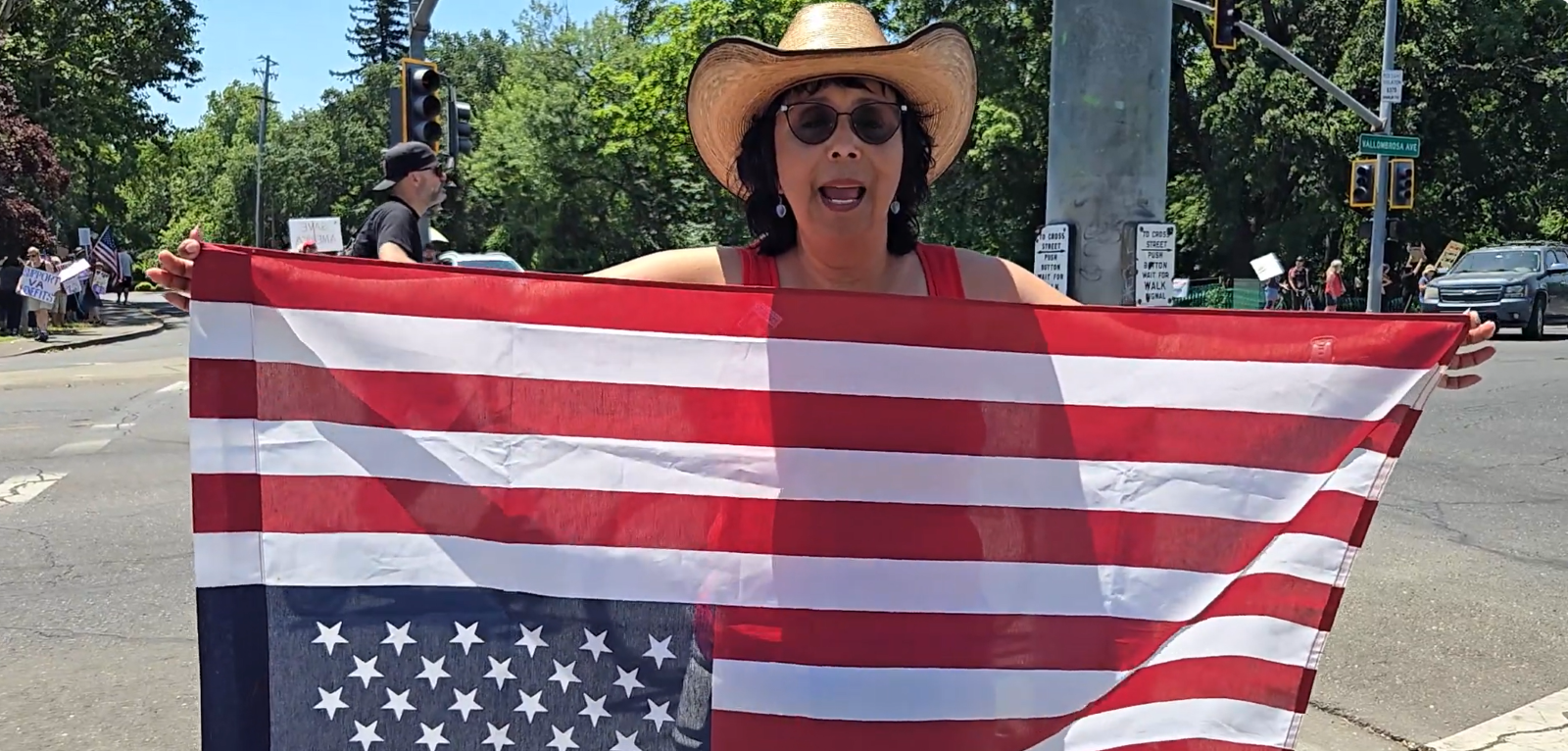
Chico’s Lupita Arim-Law was born to an immigrant parent and a Mexican American father in Southern California and has called this state ‘home’ since birth. She knows the importance of immigration to California and believes in the right of citizenship for children born to immigrants.
Now, thanks to the June 30 U.S. Supreme Court ruling in Trump v. Barbara, that path to citizenship remains intact.
“I think it was a wonderful ruling,” Arim-Law says. “I think it’s a travesty that it even went to the Supreme Court.”
Arim-Law has lived in Chico for more than 20 years, when she and her husband moved here from the Bay Area to work and raise a family. A self-identified community organizer, Arim-Law has served on the Chico Housing Action Team, the Planning Commission and in other public service positions. She now works for the Episcopal Diocese of Northern California, where she says her faith and public advocacy work hand-in-hand.
Before Trump v. Barbara, Arim-Law would have considered it “absurd” to question the right to citizenship for people who were born and raised in this country. Now, she finds herself defending her own American identity, faced with the case’s central question: How American are you?
Trump v. Barbara was filed in response to Executive Order 14160: Protecting the Meaning and Value of American Citizenship, which was signed by President Trump on Jan. 20, 2025 — hours after inauguration. The order declared American-born children of non-naturalized residents to be ineligible for American citizenship. This particular way to citizenship is provided by mainstream interpretations of the 14th Amendment.
Trump v. Barbara suggested that there’s kind of an ethnic basis for American citizenship — Professor Tinkler
The practice of birthright citizenship is an American tradition, says Robert Tinkler, professor of American history at Chico State University. “Before the 14th Amendment, the Constitution didn’t say how you became a citizen,” Tinkler says. The 14th Amendment evoked an English common law that held those born in England subject to the king of England.
“If you’re born in the United States, you are a citizen of the United States,” Tinkler says. “No matter where your parents were from or who they once owed allegiance to.”
When the 14th Amendment was ratified in 1868, this common law tradition of birthright citizenship wasn’t novel — rather, Tinkler calls the 14th Amendment a “clarification” of the long held legal tradition.
What Trump v. Barbara sought was to redefine the American cultural and legal institution of birthright citizenship, Tinkler explains. Trump v. Barbara “suggested that there’s kind of an ethnic basis for American citizenship,” similar to the citizenship process in many European nations.

“Being an American is not about ethnicity,” says Tinkler. “It’s about ideals.”
This lack of ethnic basis for American citizenship is what makes America so exceptional, says Susan Green, professor of Ethnic, Gender, and Queer Studies at Chico State.
“We’ve always said that America is exceptional,” Green says. “Why on earth would we compare ourselves to other European countries and what other countries do?”
The right to citizenship for people born in this country has had an enormous impact on California demographics. Roughly 10 million of the state’s 39 million residents are U.S.-born citizens of immigrant parents.
This tradition of naturalization at birth has been vital for the state’s development, Green says. The ability for naturalization has “made California into what it is,” Green adds, pointing to the role immigration has played in culturally and economically developing modern-day California. Without immigration, “it would be hard to imagine the state of California looking like it does now.”

Green, who specializes in Mexican-American history, is concerned that Trump v. Barbara won’t be the last attack on birthright citizenship. In a concurring opinion, Justice Brett Kavanaugh, who sided with the majority, opined that birthright citizenship was not protected by the 14th Amendment but rather by federal statutes.
“For the moment, it is what it is,” says Green. “But the justices,” she says, “have indicated how Congress could craft legislation that would allow the elimination of some people born on U.S. soil from becoming U.S. citizens automatically.”
“We’ll have more cases,” Green says. “This isn’t the end. It’s just a moment of reprieve.”
For Lupita Arim-Law, this ruling echoed what she loves about America.
“We’re not all the same, and that’s what makes our existence so vibrant and exciting,” Arim-Law says. She sees America’s mixture of cultures and traditions as “vital,” saying it shows “how exciting being an American is.”
“But if we become a country that starts separating ourselves or judging one another, we’re going to fail as a country,” Arim-Law says.
“Empires rise and empires fall, and I hope that we get back on track. We must move on and become a more perfect union — because we’ve lost control.”
Elias S. Myers is a freelance contributor to ChicoSol and a recent graduate of the University of California, Berkeley.
2 Comments
The ruling is good news. The observations of the professors added to round out a great article.
My mother was born in Canada and was “naturalized” as a U.S. citizen at the age of 16. But no one’s going to bother me, because I’m white. This “birthright citizenship” controversy is just one more example of the over racism of the Trump regime.