
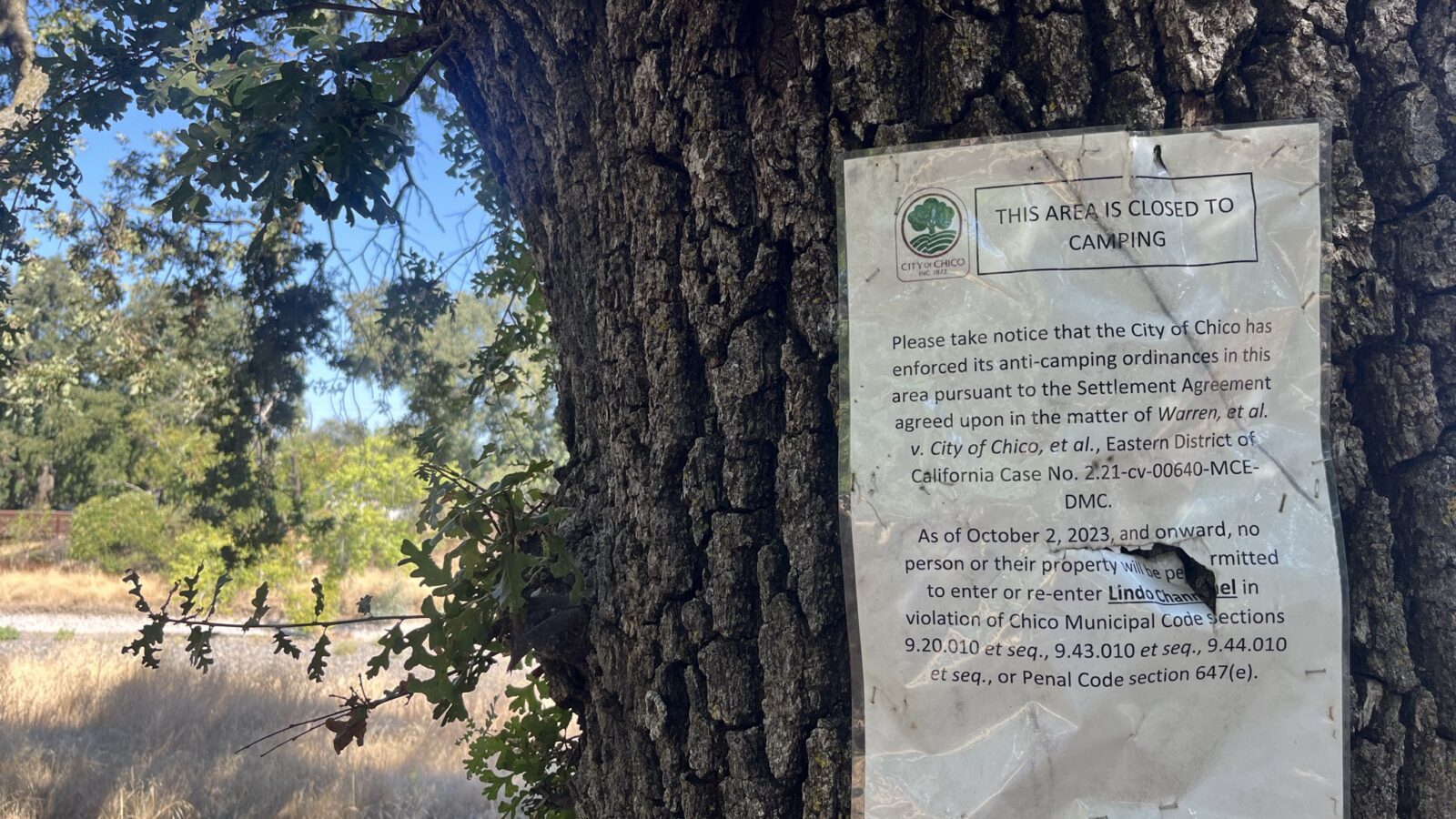
An emergency declaration that could accelerate enforcement of Chico’s anti-camping ordinances in the Lindo Channel area was approved by the City Council on a 6-1 vote at a special meeting Aug. 3. Exactly how quickly enforcement could proceed, however, remains unclear.
The emergency declaration that cites fire danger relates to the possibility that lighting cooking or warming fires in encampments where unhoused people live could get out of control.
Over the past three years, Chico firefighters have responded to 831 outdoor fires related to encampments, Fire Chief Wes Metroka said. More than half of the 143 incidents that have occurred so far this year occurred in major greenway corridors identified as priority wildfire hazard areas.
“We focused on the Lindo Channel, primarily due to the concentrated increase in fire activity in the area, the dense fuel, and the critical exposure to the residential neighborhoods,” Metroka said.
Assistant City Manager Erik Gustafson said there are 50 encampments in the Lindo Channel and the city had initiated the notification process last week. He also said that the emergency declaration will allow the Council to direct all city departments to prioritize fire prevention and suppression activities in that area, including accelerating enforcement of the anti-camping ordinances.
Councilmember Bryce Goldstein cast the lone dissenting vote, saying she wanted to ensure the city’s response did not simply push unhoused people into other neighborhoods. She argued for “actual tangible action,” such as opening additional pallet shelters or creating an alternative site.
Councilmember Tom van Overbeek asked whether, if the Council approved the declaration, there could be an immediate clearing of encampments.
Gustafson responded that he does not believe the emergency declaration will completely “circumvent” the federally recognized Warren v. Chico Settlement Agreement. The Settlement Agreement that governs homeless encampment enforcement mandates seven-day notice to Legal Services of Northern California prior to enforcement planning, seven-day notice to homeless people who are camping on public property, and finally, a 72-hour notice prior to enforcement.
“But I think it (the emergency declaration) certainly gives some momentum to do so (clearing encampments),” Gustafson said.
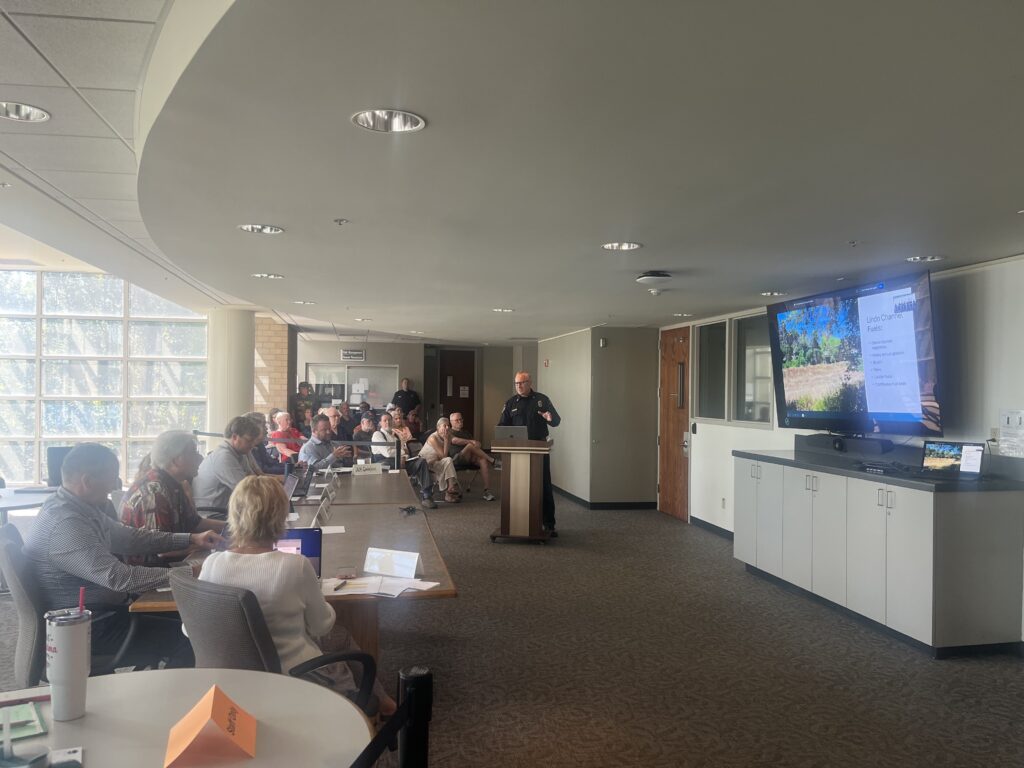
Councilmember Michael O’Brien later asked City Attorney Ryan Jones whether the emergency declaration would supersede any portion of the Settlement Agreement in allowing the city to remove people from fire-prone areas.
“We’re not going to contravene the Warren Settlement,” Jones responded.
Instead, Jones said that emergency declarations provide the city with “new avenues and abilities to address things in a more immediate way to protect people.”
Jones added that the primary legal question was not whether the situation constitutes an emergency but what type of enforcement actions can legally follow.
He said he will work closely with the fire chief, code enforcement staff and other officials to ensure the city adheres to the Warren Settlement while carrying out the Council’s direction to protect local residents.
Councilmember Addison Winslow insisted the city continue to protect the rights of unhoused residents.
“I just want to make abundantly clear that no matter how urgent we feel, we can’t make people just disappear,” Winslow said. “We have the Settlement Agreement. We also have just the laws of physics, and human rights that do exist. We cannot banish people from the city of Chico.”
Winslow tried to introduce an amendment after the vote that would direct staff to loosen the assessment criteria so the vacant pallet shelters could be used, or to direct people to the Alternative Site, during enforcement. The amendment was not included in the resolution because it fell outside the scope of the agendized item.
Much of the Council’s discussion centered on two questions: whether the city should focus only on the Lindo Channel corridor or consider fire risks in other areas, and whether addressing the needs of unhoused residents should be part of the city’s long-term fire prevention strategy.
Councilmember Dale Bennett, whose district encompasses most of the Lindo Channel area, said his friends and neighbors in the area are “very concerned” about the fire hazard and repeatedly ask him to do something.
He agreed the city needs to look at a broader picture when it comes to fire prevention, but also said that Lindo Channel’s problem should be solved first.
“Today, this morning, we’re talking about Lindo Channel,” Bennett said. “So let’s make a decision about Lindo Channel, and we can look at the rest of this in the situation we have with the fire danger in Chico in the future, hopefully soon.”
Following the meeting, Ashley-Michelle Arnold, communications director for Safe Space Chico, told ChicoSol she believes emergency declarations like this one are “reactive rather than responsive” to the broader issues surrounding housing and public health.
“A responsive policy would expand upon the points raised by both councilmembers Goldstein and Winslow and also acknowledge that we cannot ignore the need, which includes those who are unhoused, to be able to cook and shelter safely,” said Arnold, who had attended the meeting but did not speak publicly.
Yucheng Tang covers city government for ChicoSol.
6 Comments
Will they stop at the channel? … Or will they use it as an excuse to move on other camps in town … Who will handle the enforcement? We do not need to invite any federal agencies into this situation… and the threat of incarceration needs to stop … Dignity starts with respect
Scotty: Chico PD will handle the enforcement.
Great reporting, Yucheng!
Are we really concerned about an out of control fire in Lindo Channel? If we really were we might look at successful programs in other towns; That provide many small, well managed, tiny home programs. They are far less expensive than our current strategy. They reduce the calls for emergency services. We could do better with a few more tiny home programs.
How about the cooking fires set up by the City? The two barbecues at the City Alt-Site camp are without a canopy. So when it rains they are useless. This has created a situation where many of our unsheltered Chico citizens, out of necessity, have become used to making outside cooking fires. You like what you are used to. It will likely rain before the end of the Warren Settlement. So if this Council is serious about this issue of fewer outside fires, a prudent strategy would be to provide a structure for adequate weather protection for the Alt-Site barbecues before the rains of November.
“Food,clothing,and shelter for all” Benazir Bhutto
“When all is said and done and the laws are laid down, who gets Love, how, and how much?” Arundhati Roy
“To do injustice, as a select few are above the law and no down trodden souls will be spared from its cruel, crass, corrupt, persecution” ???? ??????