Lawsuit claims law enforcement agencies withhold public documents
by Leslie Layton | Posted December 22, 2025
The lawsuit was filed Dec. 22, 2025.
ChicoSol contributor Dave Waddell today sued Butte County District Attorney Mike Ramsey — as well as the Chico Police Department, the City of Chico and the sheriff — over withheld public records related to officer-involved shootings.
The lawsuit filed in Butte County Superior Court states that it “arises from the repeated and ongoing failure of the leadership of the law enforcement community” to comply with the California Public Records Act.read more
Chico PD records show sex acts ‘escalated’ after sex-related demotion
by Dave Waddell | Posted October 30, 2025
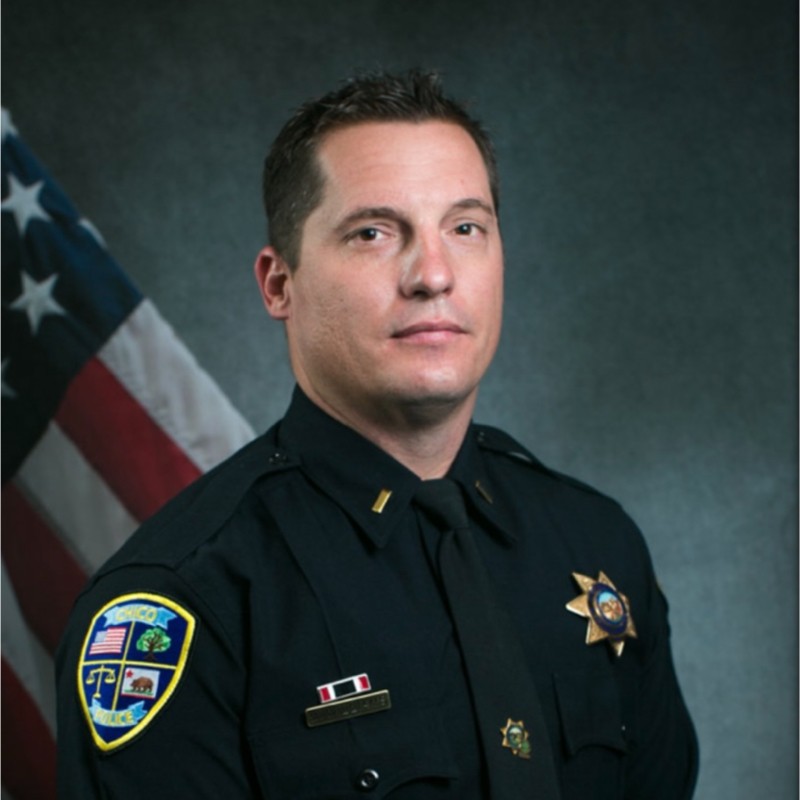
Former Chico PD Sgt. Mike Williams
Chico police Sgt. Michael Williams began having “a lot” of sex on duty just a couple of months after he was demoted from lieutenant for engaging in sexual relations with a subordinate, according to Williams’s former girlfriend.
The ex-girlfriend’s timeline, provided to a police investigator, means Williams was having sex on the clock nearly three years before leaving the payroll of the Chico Police Department. Her revelations suggest the department’s disciplinary action failed to curb his behavior and may have instead provided increased opportunities to escalate misconduct that continued uninvestigated for nearly two years.read more
Woman speaks out about sex with on-duty Chico PD sergeant
by Dave Waddell | Posted September 29, 2025
One of five women, text messages show, who was engaged in a sexual relationship with an on-duty sergeant. Photo by Dave Waddell.
A Chico woman who believes she was groomed for on-duty sex by a “sex-obsessed” police sergeant says she was “treated like a whore” when questioned about the relationship by a Chico Police Department investigator.
The woman, 38, asked that her name not be disclosed. The sergeant, Michael Williams, was fired early this year after five women reported sexual relations with him while he was on duty in 2023. (See four-year timeline that led to Williams’s firing here.)read more
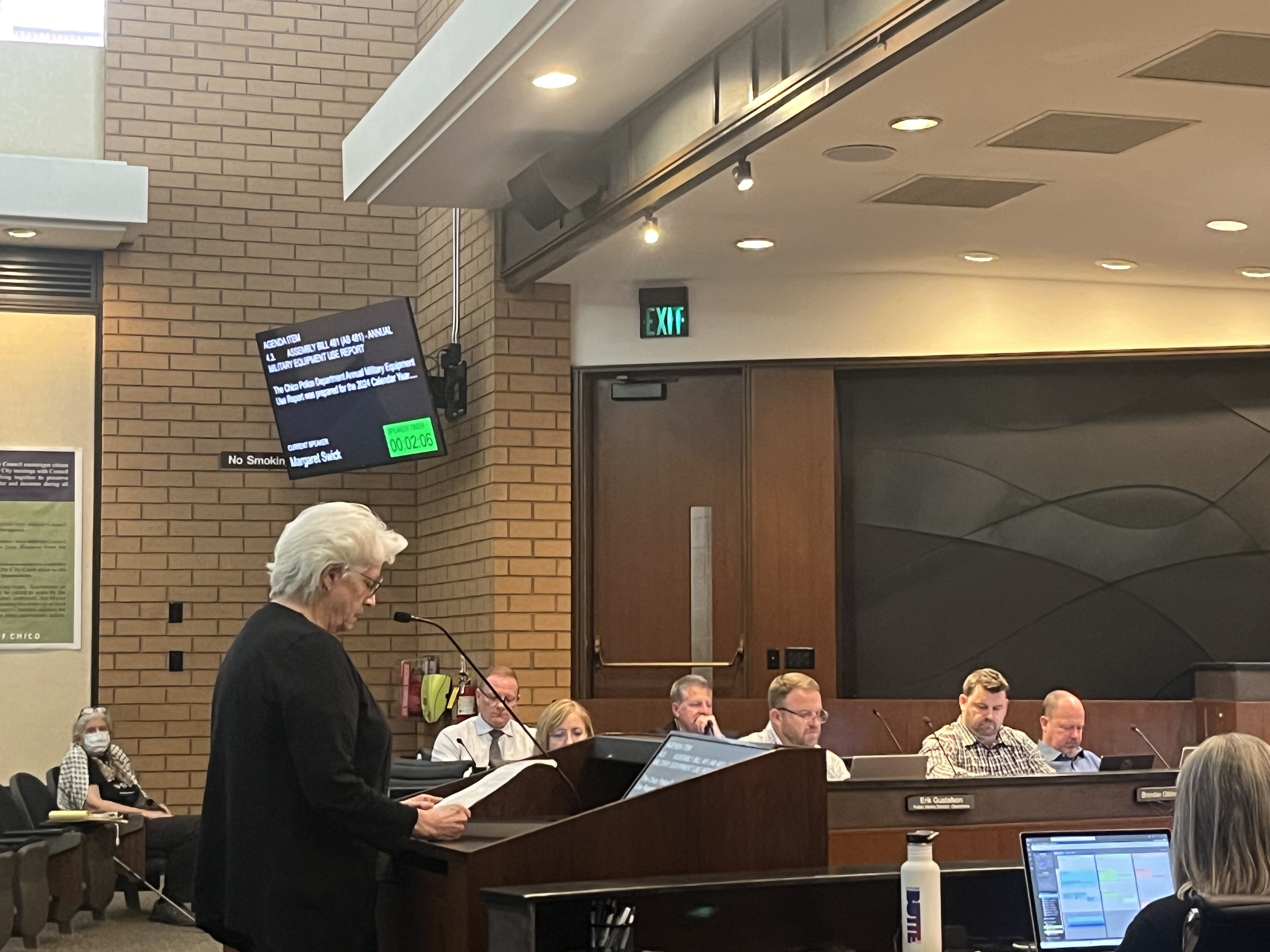
Chico’s Margaret Swick spoke at the April 15 City Council meeting, suggesting that the money allocated for military equipment could go elsewhere.
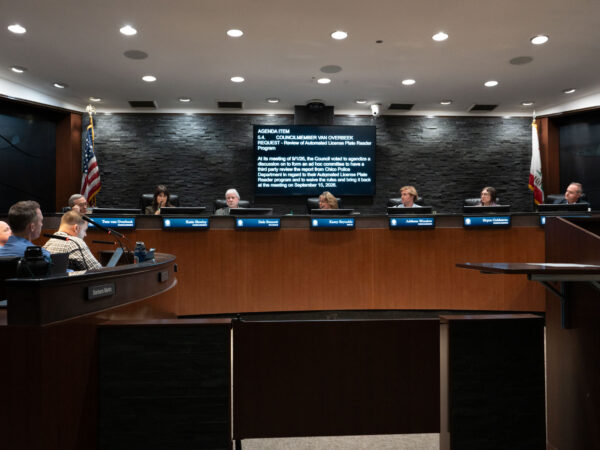
The City Council voted 4–3 to approve the Chico Police Department’s proposed purchase of more than half a million dollars in additional military equipment.
The acquisitions will include three drones, four remote-controlled cars, a launcher that can fire projectiles, two sniper rifles to replace two old ones, 15 police patrol rifles, and three incident command vehicles that can provide a mobile on-site platform for command, control and communications during major incidents.
The total estimated cost is $562,955, not including maintenance fees, according to Chico PD’s military equipment policy.
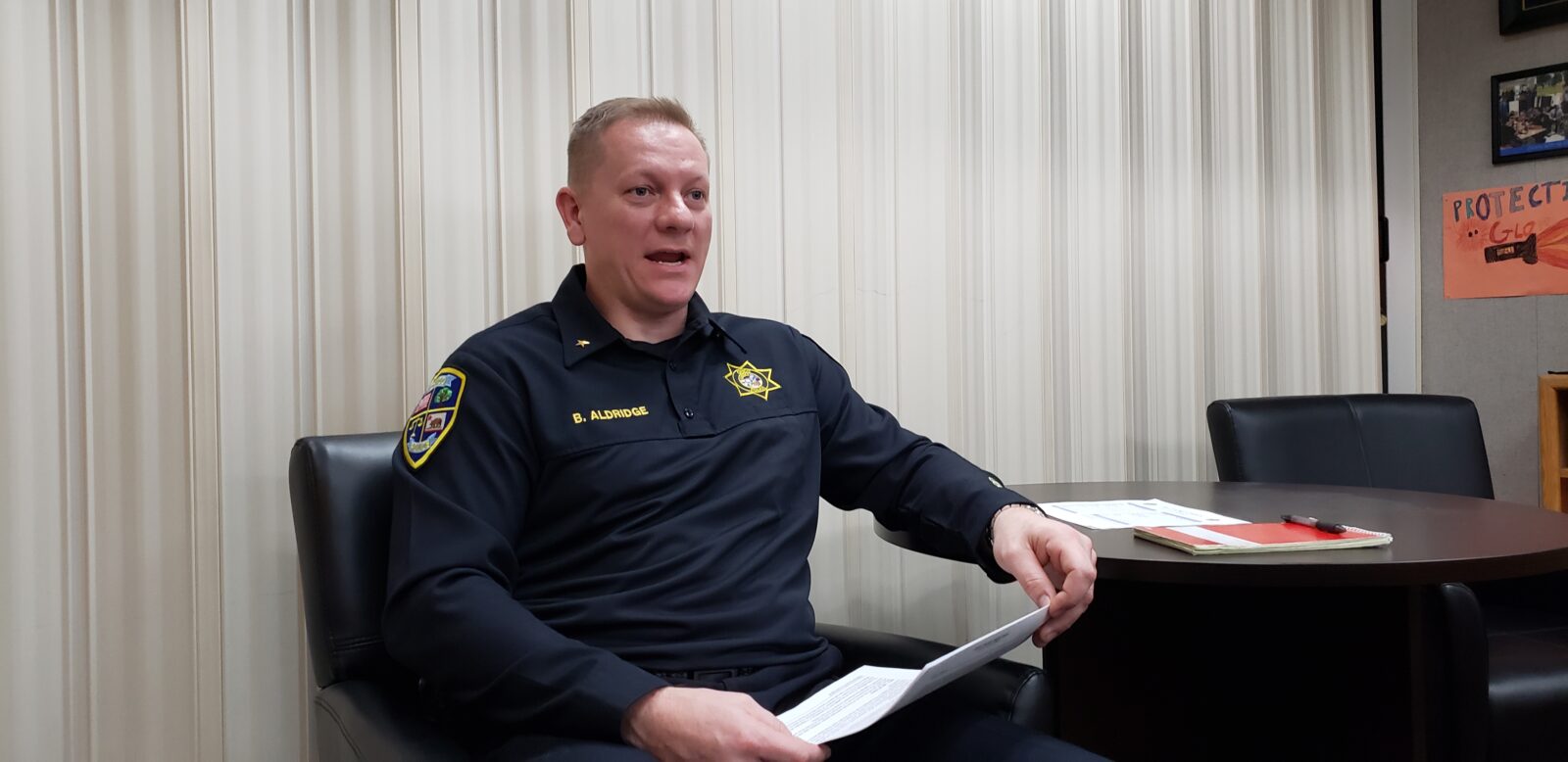
“Your continued approval will ensure that the community’s police department stands ready to protect them while also keeping your police officers safe,” Police Chief Billy Aldridge told councilmembers prior to the vote.
“The purpose of those,” Aldridge said, “is they have multiple options for sensors on those – bomb detection, chemical detection, camera systems, audio systems – [so] you can put them into places where you wouldn’t necessarily want to put a human.
“And it’s a robot,” he said, “so no danger to a human in what they’re doing.”
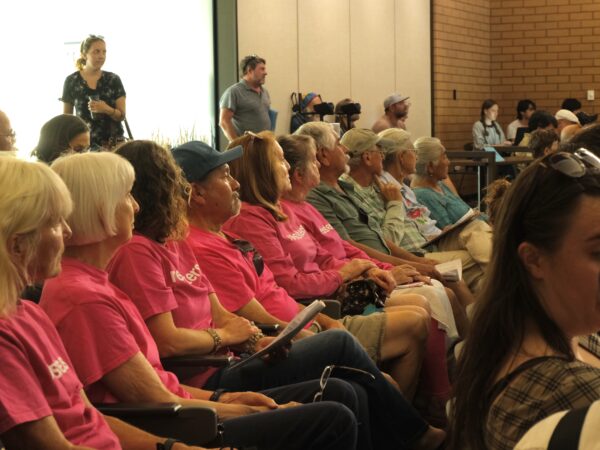
Several members of the community expressed their concern about the City’s purchase of military equipment during the public comment session.
“The goal of AB 481 is for elected officials to curb and regulate the militarizing of our police,” said Chico resident Margaret Swick. “It is not to celebrate the growth of a military-style arsenal,” she said.
Assembly Bill 481 was passed by the California Legislature and signed into law in 2021, in part to “give strong consideration to the public’s welfare, safety, civil rights, and civil liberties” the text states. The law calls for “meaningful public input” prior to the purchase of what it defines as military equipment, and requires California law enforcement agencies to obtain approval from their governing body for the funding, acquisition, or use of that equipment.
“Chico has plenty of issues we could solve by redirecting money to perhaps painting and improving crosswalks so that children, bicycles, and pedestrians are safe,” Swick added.
Diane Suzuki-Brobeck, a member of Concerned Community for Justice, voiced concern about the potential use of the equipment on peaceful protesters. She asked Aldridge to make a public statement “reassuring us that Chico PD will follow the law, … which restricts law enforcement’s use of less-lethal munitions to disperse protests, and also increases the frequency of mandatory use-of-force reporting.”
Councilmember Bryce Goldstein echoed her sentiment. “I’m also concerned in our current political climate about the potential for military equipment being used against people exercising their First Amendment rights,” she said.
Goldstein added that she supports public safety but wants to “make sure that we’re investing our taxpayer dollars into proactive public safety measures.”
Councilmember Tom van Overbeek expressed support for the purchase of the equipment: “My take on this … is that almost every one of those items, it protects … the police officers, and it protects citizens, because it gives you (the police) more non-lethal options when you’re dealing with a difficult situation.”
Councilmember and former Chico Police Chief Mike O’Brien said this equipment “mostly is defensive in nature and designed to save lives.”
After O’Brien motioned to approve all the items requested by Aldridge, Councilmember Katie Hawley introduced a substitute motion to remove several items from the acquisition list.
They included one of the three incident command vehicles, the police patrol rifles that “were only used once in 2024,” and the Boston Dynamics robot.
“Boston Dynamics is a $75,000 piece of equipment,” Hawley told ChicoSol on March 20. “Even if that is awarded with grant funds, upkeep and maintenance of that would be extremely expensive and specialized. It is an erroneous spending allowance in my opinion.”
Hawley’s substitute motion failed 3–4, and O’Brien’s motion passed 4–3. Mayor Kasey Reynolds, Vice Mayor Dale Bennett and van Overbeek voted in favor of O’Brien’s motion.
During the March 31 community forum held by Chico PD to collect public opinions about the military equipment purchases, Aldridge said, “I disagree with the terminology that they use in this law (AB 481), because nothing that we have in our inventory is truly military equipment. It makes it sound like you went to the military and said, ‘Hey, can I buy your tank?’ But that’s not the case.”
According to Chico PD, most of the “military equipment” in their possession is commercially available and made for civilian or law enforcement use.
AB 481 designates in its text a dozen categories of items as “military equipment,” including any firearm or firearm accessory designed to launch explosive projectiles, “Flashbang” grenades and Humvees.
Aldridge specifically addressed concerns over the use of drones — one of the items mentioned in the law that Chico PD utilizes.
Anytime they’re launched, their flights are logged into so-called “air data,” which is posted on the police department’s website.
“Typically, they’ll do a report on why they flew that drone,” Aldridge said. “Then it goes through a review process for that supervisor, and then a manager who will review it, [and] say this was in policy or not in policy.
“Obviously, if we find someone out of policy,” Adridge said, “then we start the investigation into why they violated that policy.”
Yucheng Tang is a California Local News Fellow reporting for ChicoSol.
Two SWAT sergeants were involved in previous fatal incidents
by Dave Waddell | Posted March 22, 2025
photo by Leslie Layton
Chico Police Chief Billy Aldridge called the shooting that killed Michael Oxley a “traumatic incident.”
While few details have been disclosed about the fatal shooting March 2 by Chico police of 43-year-old Michael Oxley, quite a lot is known about two SWAT team sergeants who fired their assault rifles.
The sergeants, Alex Fliehr and Nick Bauer, were each involved in a previous fatal shooting incident, while Fliehr’s unorthodox use of a taser in yet another case led to a civil rights trial in federal court.
Police say Oxley was killed after four SWAT team members returned his fire. In addition to Fliehr and Bauer, officers Tyler Hernandez and Gabe Durney shot at Oxley, said Chico Police Chief Billy Aldridge.
The police were attempting to arrest Oxley for allegedly shooting George Ramirez III, 43, a well-known downtown barber. Ramirez was shot in the neck, head and shoulder after getting into his car in a downtown parking lot about 6 p.m. Feb. 28. Ramirez was soon after air-lifted in critical condition to an out-of-area hospital, but is “making an amazing recovery and talking about returning to work in a few weeks,” said Butte County District Attorney Mike Ramsey.
Oxley is thought to have been living for at least a month as an Airbnb resident at The Post on Nord, a large apartment complex of mostly college students at 1200 Nord Ave. When the SWAT team attempted to arrest Oxley as he was leaving his apartment about 6 p.m. March 1, “he evaded police by retreating back into the building and his apartment,” Ramsey said.
That prompted a lockdown affecting other residents.
Chico PD, in a press release, said the fact that Oxley was armed “necessitated the use of distractionary devices by search teams. These devices, when deployed, emit very loud noises which sound like explosions or gunshots.”
The booming sounds prompted false social media claims of an active shooter, creating additional fear, according to Chico State’s police department.
Oxley eventually fled to the building’s parking structure, where he was contained on a ramp connecting the fourth and fifth floors. Police negotiated his surrender for a couple of hours before Oxley stood from a crouch and fired at officers using “a pistol with an extended magazine,” Ramsey said.
Aldridge said the incident resulted in the “tragic death of a community member and [is] a traumatic incident for the involved officers, their families, the community, and the organization.”
Ramsey said he hoped to provide more information about the shooting before the end of March.
On St. Patrick’s Day 2017, Fliehr had been a Chico cop for just a couple of years when he and Jeremy Gagnebin, an officer with even less experience, shot and killed Desmond Phillips, a 25-year-old Black man in mental crisis.
Phillips was tasered to the floor of his living room but was able to get up. Within a few seconds, the two officers fired 16 times, with two rounds going into an adjoining apartment and another nearly hitting officers near the front door. Phillips was hit by 11 bullets. Fliehr was the first to fire and shot nine times.
Just three months later, with other officers, Fliehr tasered Tyler Rushing in the back after he lay motionless in his own blood. Before the tasering, Rushing, who was in mental crisis, had been shot a total of three times by a private security guard and a police sergeant.
A police practices expert providing court testimony, Roger Clark, said Fliehr showed “imaginary fear” in considering the prone Rushing a threat.
After the federal court trial in October, a jury ruled Fliehr did not use excessive force in the tasering of Rushing.
After the Rushing incident, Fliehr was reportedly reassigned from patrol to the department’s TARGET team. Aldridge promoted him to sergeant in 2024, a few months before the Rushing trial.
Bauer, an investigator
A 19-year law enforcement veteran, Bauer was promoted to sergeant in 2018 by then-Police Chief Mike O’Brien, who is currently a member of the Chico City Council.
Sgt. Bauer was involved in a previous fatal shooting incident, the October 2020 killing of 30-year-old Stephen Vest. Bauer was commanding sergeant when he and officer Tyler Johnson shot Vest, who appeared to be in psychosis and holding a knife.
At the time, bean-bag shotguns were standard equipment in the sergeants’ patrol SUVs. But Bauer’s regular vehicle, on the day Vest died, was in the shop. When the sergeant went to grab the beanbag shotgun, to his surprise there was only a regular shotgun in his replacement vehicle, Ramsey said.
That left officers with just one “less-lethal” option — a taser blast was deployed by another officer. The deployment, however, had little noticeable effect on Vest, who reacted by slightly changing direction and walking toward Johnson.
Johnson was the primary shooter, firing nine rounds, including into Vest’s back multiple times after he had been shot to the ground. Bauer joined the shooting and his two rounds hit Vest, though neither was fatal, according to Ramsey.
Bauer did not turn on his body-worn camera until after Vest was shot.
Before his promotion to sergeant, Bauer, while a Chico PD detective, participated in multiple officer-involved shooting investigations under Ramsey’s direction, including the Rushing case. After Bauer shot Vest, Ramsey brushed off conflict-of-interest concerns raised by the police reform group Concerned Community for Justice (CC4J).
CC4J argued, to no avail, that a state attorney general’s office investigation into the shooting would be more impartial than Butte County’s standard process.
Dave Waddell writes about law enforcement in Butte County.