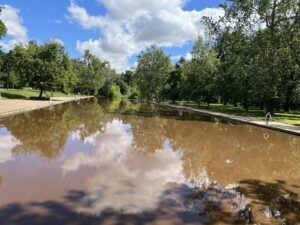
Sycamore Pool in the One Mile Recreation Area, which was built around Big Chico Creek, turned brown early this week.
Big Chico Creek turned chocolate brown earlier this week after a light May 12 rain washed vegetation and eroding bank sediment from the Park Fire burn scar into the water. Today the water look somewhat clearer.
Environmental studies professor Mark Stemen said the wash-off has environmental benefits, but also poses potential danger.
“We should be seeing this happen for a while,” Stemen said. The dry weather that followed rain “freed up much more sedimentation.”
Some of the sedimentation “will end up in the creek and provide good sediment for spawning.” But if there’s too much, he warned, “it could suffocate [salmon] eggs. One of the things that’s really striking is how much of our watershed has burned and destabilized the sediment.”read more
Given weather-related disasters, does the City focus enough on climate change?
by Natalie Hanson | Posted August 13, 2024
photo by Leslie Layton
The City’s updated Climate Action Plan.
Butte County, facing the Camp Fire, the Dixie Fire, the Park Fire and extreme heat, has been on the frontlines of climate change in recent years. But the City of Chico has not made policies reflecting the urgency of these crises, some say.
Chico’s Climate Action Commission’s role has over time been cut dramatically, and the plans staff put together over years to help plan for a future of climate change have not been properly implemented, say some Chico residents. In their view, a lack of planning for climate change is symptomatic of the City’s unwillingness to make climate change the focus of policy or even fund the work to do so.
Community Development Director Brendan Vieg disagrees with this view, pointing to progress on plans like the Urban Forest Master Plan. “Combatting climate change provides an opportunity to build a healthy, equitable and resilient community,” Vieg states on the Climate Action Plan update (CAP) website page.
Climate Action Commission chair a critic
Climate Action Commission Chair Brian Scott Kress said that he doesn’t think the City’s strategies, as they stand today, properly incorporate an understanding of how to mitigate climate change or that the City prioritizes his panel’s work. “Our policies and approach to governing should reflect the immediacy of these challenges,” Kress said.
The Commission helped craft the CAP, which was completed in 2018 and updated in 2020. It contains measures to ensure the City meets the state goal of a 40% reduction in greenhouse gasses by 2030 and eliminates them by 2045.
While the City’s master plans for managing its urban forest, wildland vegetation and heat risks acknowledge climate’s role in past wildfires, the plans don’t contain a strong connection with climate change as a cause, Kress said. He finds that alarming because Chico is required to align with state targets for reducing greenhouse gas emissions to get certain kinds of state funding. Those funds cannot only help lower energy bills, improve transportation networks and electrify homes and businesses, but aid in mitigating dire climate consequences already underway in the region, Kress said.
“We should be adamant about integrating a climate lens into our actions – the consequences of inaction are already here,” Kress added. “Chico has the responsibility to become a model for resilience and proactive climate action, demonstrating effective strategies that can be replicated across the region, if not the country.”
The City Council changed the Commission from holding standing monthly meetings to meeting “as needed” in November 2023. City staff last called the Commission to meet in April with a limited agenda. Fewer meetings have limited the Commission’s ability to guide efforts to address climate change and keep the City on target to accomplish the CAP goals, he said.
Kress is a founder and principal at a Chico venture studio called Dayani that designs digital services to address climate change. He worries that many local elected officials do not discuss climate change or propose ways to address it within official strategies. The City Council has a lot of influence, as those elected leaders set the priorities and direction for staff.
“When we see local climate action, vulnerability, and scenario planning largely missing from crucial plans like our wildfire mitigation strategy, it’s clear that those plans are leaving our community members vulnerable to climate risks,” Kress said. “We need all our city leaders to be vocal, clear-eyed, and proactive about climate action.”
City official disagrees
Vieg, though, vouched for his team, noting that staff work hard to incorporate the Commission’s work — with consideration of the changing climate — into master plans.
Vieg said the City followed the CAP’s recommendation to implement an Urban Forest Master Plan to maintain a healthy urban forest for the next 40 years. The plan includes work to add to the City’s forest canopy, manage open spaces and natural resources and keep a public tree inventory. He also noted that the City’s Fire Department developed a Community Wildfire Protection Plan in 2022 to “assess wildfire threats, community preparedness, defensibility, and potential hazard mitigation measures.”
The City’s 2018 Climate Change Vulnerability Assessment contains lots of information about extreme heat and increased wildfire risks, and cites Bidwell Park’s woodland and savanna ecosystems as being most at risk of suffering the effects of climate change.
“Many of these areas are biologically rich in species and can be easily be disturbed by changes in the number of extreme heat days, heat waves, and overall increased temperatures,” according to the assessment.
Stemen: Climate not a City focus
However, Chico State professor of geology and environmental studies Mark Stemen says that mentioning climate change in City plans is not as effective as making it the focus of official policy.
Stemen has spent a lot of time with City staff to craft official plans. But he told ChicoSol that he’s worried that City leaders don’t take climate change seriously enough to use those plans to proactively handle the impacts of drought and extreme heat on the city and parks.
Stemen formerly sat on the Climate Action Commission. He said that since the pandemic began, the City has not financially supported efforts to reach stated climate goals. The City also hasn’t been completing reports on efforts to reduce greenhouse gas emissions, despite being required to do so under its CAP procedures. And the parks division does not file reports on any efforts to sequester carbon in its plans for managing public lands, he added.
Stemen said these problems point to an unwillingness to make climate change the center issue around which strategies revolve. For example, he said that Chico and Butte County officials do not name conditions arising from climate change — including hotter, longer, drier summers — as the real driver of catastrophic fires. The City hasn’t touched the Commission’s plan to handle extreme heat due to climate change, which has sat in Internal Affairs since 2021, he said.
Stemen also said the City has not made enough movement toward transitioning from fossil fuels and planning around vehicles and taking action on cutting greenhouse gas emissions.
“It’s easier to blame someone else than admit we’re the ones that are doing it,” Stemen said, referring to human-induced climate change.
Progress at the County
There’s some progress on the way, as Butte County this month announced that it will partner with a Rocklin firm to restart its own Community Choice Aggregation (CCA). The CCA is a program that allows cities, counties and other qualifying governmental entities to purchase and/or generate electricity for residents and businesses, Stemen said. (Chico hasn’t been sending its representative to the county’s CCA meetings, he said.)
That countywide effort will be crucial to stop taking a reactive approach to climate crises, and instead start learning from other cities’ work.
The City’s Climate Action Commission took notes from the city of Albany, Calif.’s work on issues like carbon sequestration, Stemen said. There’s no reason why the City can’t do as well, if not better, he added.
Although discussions locally in recent weeks have revolved around controlled burns as a method of wildfire prevention, efforts to address climate change require many types of proactive work, Stemen said. “We can’t just control burn our way out of climate change,” he added.
Natalie Hanson is a contributing editor to ChicoSol.
Sergio Arellano and Jahaira Zaragoza, representing Cal Fire’s public information office, explain the fire map at the agency’s Chico command center.
By 11:30 p.m. on July 24 – the day that some Chicoans heard that a fire had started near Upper Park’s Alligator Hole, an area that hadn’t burned in a very long time – the blaze had devoured 6,465 acres.
The next morning, Cal Fire reported that by 6:46 a.m. the scorching-hot fire, driven by south winds, covered 45,550 acres. The fire had moved at a speed so stunning that while most Chico-area residents slept, it had covered on average almost 6,000 acres an hour.
The Park Fire is one of the fastest-moving — perhaps the fastest — of the so-called catastrophic fires that have occurred in Northern California in recent years. But speed isn’t the only characteristic it shares with megafires. Like other explosive wildfires, it doesn’t sleep.
“It used to be that fires went to sleep at night, and that’s often when [firefighters] made the most gains on them,” said Mark Stemen, a Chico State University environmental studies professor. “The Park Fire’s greatest gains were between 1 a.m. and 3 a.m. on the first morning. It ran big that night.”
As this summer closed in on the hottest July ever, night-time humidity has been low most nights, accompanied by winds that have been “stronger and steady,” said Sergio Arellano, who is working with Cal Fire’s public information office and has 18 years of experience in fire service.
“This is the trend – lower relative humidity at night with stronger gusts of wind,” Arellano said. “That’s why you’re seeing more activity at night.”
The Park Fire is a stunningly fast night stalker. “This is a rate of spread we’ve not seen before – 5,000 acres an hour,” Arellano said. “This is the fastest fire I’ve seen.”
The speed of the Park Fire has made it – in a mere six days – one of the seven largest wildfires in the state’s history.
Stemen says the conditions described by Arellano – the low humidity and the windy, hot nights – are because of climate change. For decades, Chico had an average of four days a year with temperatures over 104 F. This summer, there have so far been 29.
Cal Fire said today the Park Fire is more than 370,000 acres in size and only 12 percent contained. Five structures have been damaged and 109 destroyed in what is a mostly rural area north of Chico. Officials are describing the fire as unstable and unpredictable.
“We’ve been seeing activity day and night,” said Jahaira Zaragoza, a Cal Fire public information officer. “You wake up in the morning and it’s doubled overnight. Our fires have evolved. A few years ago, we would consider a large destructive fire to be less than 13,000 acres.”
Zaragoza, speaking early today with ChicoSol, noted that Cal Fire is concerned that the Park Fire on July 28 jumped Highway 32, and conditions for firefighting were likely to worsen after a day or two of cooler temperatures. “Smoke is clearing out and that is going to allow the wind to fuel the fire,” Zaragoza said. “They are preparing and anticipating for some battles today.
“There’s a lot of lava rock in the northern section of the fire,” Zaragoza said. “It’s very difficult terrain. We had winter storms just a few seasons ago, so those dead and dying logs that were knocked over by the wind, they’re now on the ground. There were extensive rains just a few years ago; that created a lot of fuel. There are annual grasses to full-on timber on the ground.”
Officials say Cal Fire has been successful in halting the fire on the lower and west sides.
But climate change has produced a whipsaw of weather extremes in California, Stemen says, that can make fire control difficult in some areas. This year is a dry year after two wet ones. “We have wet years that produce all this vegetation, and then dry years,” he said.
A study funded by the National Integrated Drought Information System showed that most of the increase in huge wildfires during the past 50 years “is due to human-caused climate change.” And the science journal Nature shows in a recent article that “night-time fire intensity has increased, which is linked to hotter and drier nights.”
Stemen said fires are burning faster, hotter and at night because of what’s called, in scientific terms, “vapor barrier deficit.”
“As the air gets thirstier, it sucks the moisture right out of the ground,” he said. “The air is so thirsty that it literally starts pulling moisture from the soil.”
Stemen said the man who has been accused of pushing a car into the creek ravine created a problem that exploded because of climate change. “While some yahoo drove his mom’s car into a ravine, climate change drove the fire all the way to Tehama County,” he said. (Ronnie Dean Stout II was charged with arson today in Butte County Superior Court and hasn’t entered a plea in connection with the incident.)
Retired Chico State political science professor Beau Grosscup lost his Cohasset home Friday – probably in the middle of the night, he says – and blames firstly the man accused of pushing the burning car. But he knows climate change played a part in the fire’s voracious nature.
“We’ve been affected not just by [climate change],” Grosscup said today, referring to him and his partner, “but also by the ideological challenge to science.”
There hasn’t been the “political will” by those in power to undertake the “fundamental change” needed to confront human-induced climate disaster, he said.
Cal Fire’s Zaragoza didn’t want to discuss climate change, but said one important tool for firefighting is prescribed or controlled burns – fires set deliberately to eliminate ground cover in an area that can then act as a firebreak. A fire that is kept low and slow can also help regenerate vegetation, such as ponderosa pines.
A prescribed burn can prevent a wildfire from “going up into the canopy of the trees,” she said.
But while the Park Fire inadvertently produced some “clean burn” areas, it is largely what fire officials call a “dirty burn.”
“This is a catastrophic fire,” Zaragoza said. “Catastrophic in the sense that it’s a massive wildfire that outpaced us, that outgrew us, and of course we have a lot of damage to the wildlife, forested areas, and homes as well.”
A correction was made to this story on July 30 in the paragraph on the “whipsaw of weather extremes” to correct and clarify the quote and show what Stemen calls the “increasing frequency and severity of the swings from wet years to dry years.”
Vice mayor: Evacuation planning for homeless encampment underway
by Leslie Layton | Posted July 25, 2024
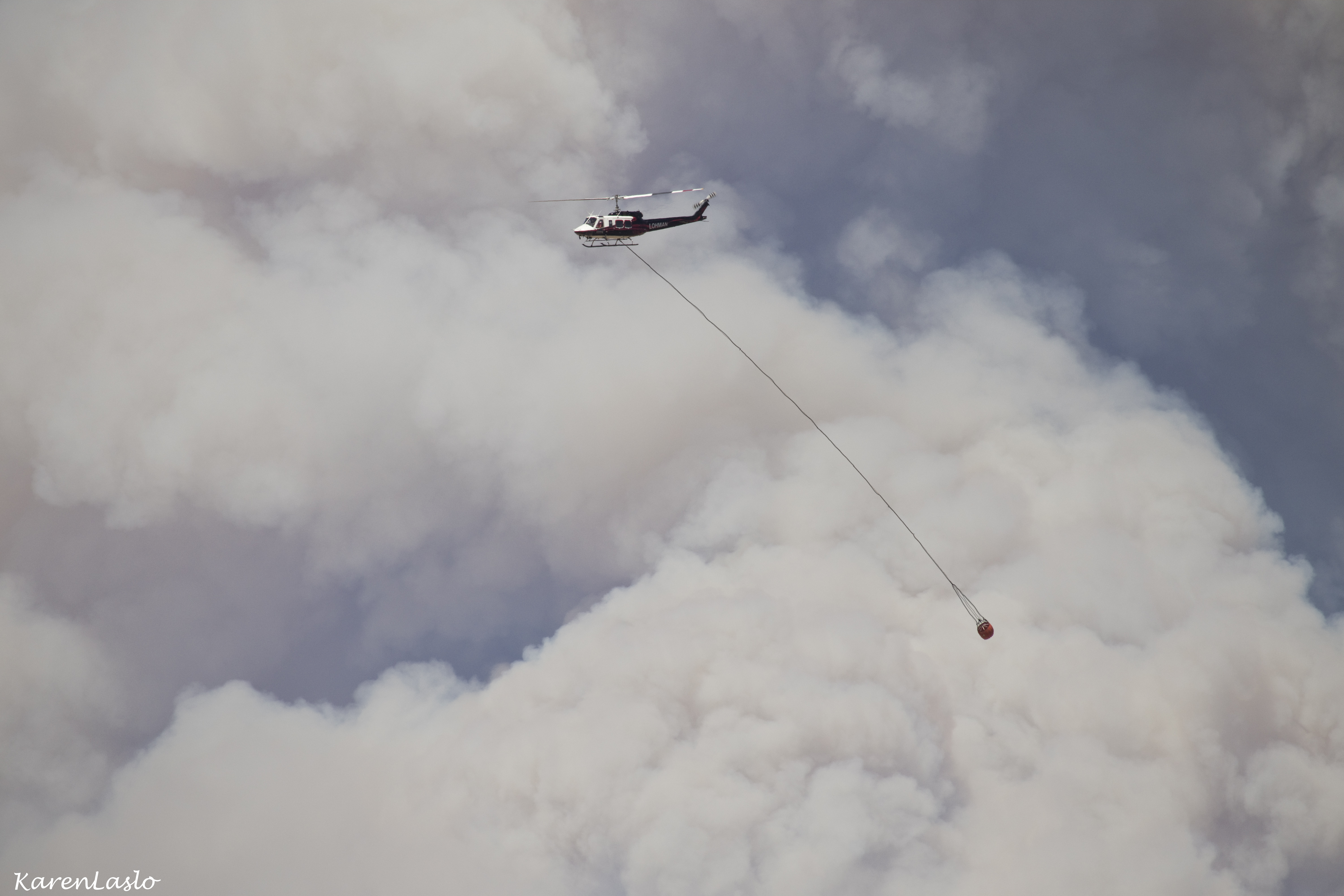
photo by Karen Laslo
The Park Fire
12:30 p.m. update July 26: Cal Fire says the Park Fire has burned 178,000 acres and 134 structures. Evacuation orders have been expanded and can be checked here.
by Leslie Layton
posted July 25
The Park Fire in Upper Bidwell Park east of Chico city limits reached almost 71,500 acres by midday today with only 3% containment.
It continues to be hot and windy, thousands of people are under evacuation order or warning and air quality for most city residents has slid from good to moderate.
Vice Mayor Kasey Reynolds said today that she confirmed, at 1 a.m. this morning, that the Butte County Association of Governments (BCAG) has buses on standby if the residents of the Alternate Site homeless encampment at Eaton and Cohasset roads have to be evacuated.
Reynolds, noting that she’s the City representative on BCAG, said, “City staff has worked with county staff and is well aware of the situation and will have an alternative place they can transfer everybody if the wind changes, and, God forbid” that becomes necessary.
For the moment, City Manager Mark Sorensen said the City-sanctioned encampment was outside the mandatory evacuation zone in response to early-morning inquiries from Angela McLaughlin from the Stand Up for Chico political action group.
“What is the plan to evacuate residents of that site if needed?”, McLaughlin said in an email to Sorensen and members of the City Council. “Does the city have a bus or similar available? What about N95 masks to protect them from smoke?”
In response, Sorensen said the encampment, where about 90 unhoused people live, is on the side of Sycamore Creek that is not within the evacuation zone. Vice Mayor Reynolds then responded to McLaughlin.
McLaughlin commented later to ChicoSol on the conversation, estimating that the encampment is less than 100 feet from the bridge that crosses Sycamore Creek. “It’s literally on the other side of the creek,” she said. The fire isn’t “likely to get there today unless the wind shifts.”
The point, she said, is the lack of advance emergency planning.
Butte County Sheriff’s spokesperson Megan McMann says 4,000 Butte County residents are under mandatory evacuation order. Several zones in Tehama County to the west are also under order to evacuate.
Cal Fire says on its website that there’s an evacuation center at the Neighborhood Church at 2801 Notre Dame Blvd. in Chico. Two animal shelters are listed in Oroville.
Butte County District Attorney Mike Ramsey, meanwhile, says in a press statement today that a 42-year-old Chico man, Ronnie Dean Stout II, has been arrested on suspicion of starting the fire. The press release says the suspect “was seen pushing a car that was on fire into a gully near the Alligator Hole in upper Bidwell Park shortly before 3:00 p.m. yesterday.
“The car went down an embankment approximately 60 feet and burned completely, spreading flames that caused the Park Fire.”