
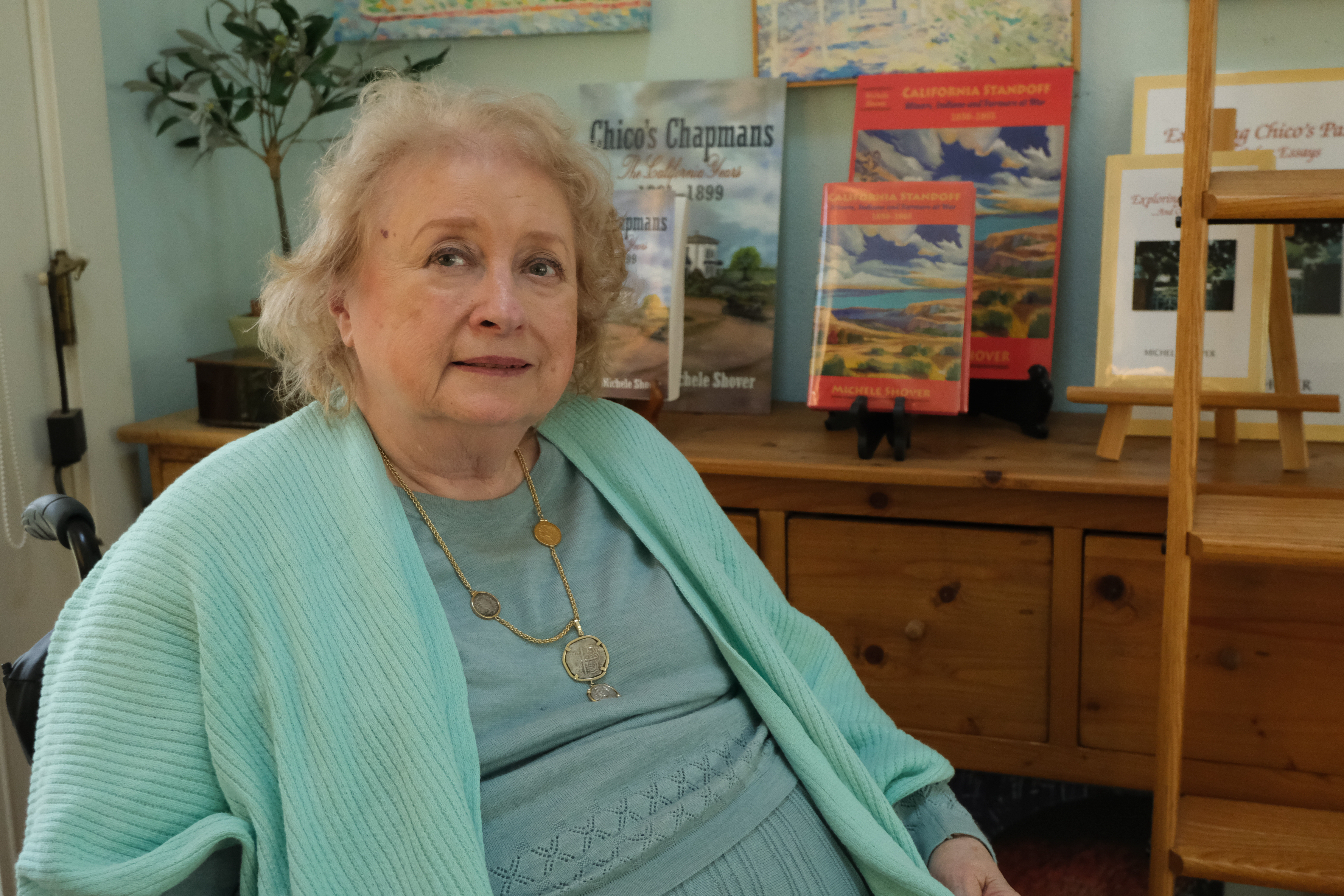
Historian Michele Shover’s effort to tell a more nuanced story of John Bidwell, considered the founder of Chico, began in 1989 when a footnote in a book caught her by surprise.
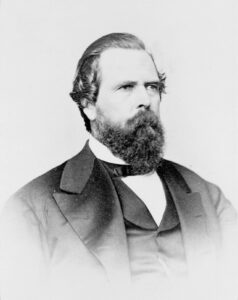
“I found it diametrically opposed to what people thought about Bidwell,” Shover said of the passage containing the footnote.
Shover, now 83, is retired from Chico State where she served as chair of the Department of Political Science. Her research on John Bidwell and Northern California Indian-settler conflicts of the 1850s has often been cited; she published articles based on primary research on Butte County history during more than four decades.
Over 20 years, Shover gathered all the historical data that she could find about Native Americans from this area from various sources, “whether it was newspapers, academic studies, correspondence, diaries,” she said.
At the beginning, she found it difficult to understand the reports written by local Indians, even though these had been recorded in English, “because they had a different sense of narrative. They have a different sense of time.”
She described her research as comparable to putting together a puzzle and refrained from reliance on work by present-day writers. Shover to this day is proud of this approach: “In my experience, some of the modern writers had tapped into a few of these sources, but no one I found had done as broad and deep a search as mine.”
After years of research, Shover published a book, “California Standoff: Miners, Indians and Farmers at War,” in 2017.
One of the nuanced stories Shover tells is about the treaty that was known as the U.S. Treaty of 1851. People often think that Bidwell, who helped organize a treaty meeting in 1851, played an important role in advancing the contract that reserved a 227-square-mile tract for the tribes.
But Shover found a different story through her research. She said Bidwell wrote a letter to California Congressman Joseph McCorkle and U.S. Sen. William Gwin after the meeting, recommending they not ratify the treaty. “He wrote it from a perspective as if he was protecting the Indians, but he was really protecting his control (of his Indian labor force),” Shover said.
“Should the Mechoopdas move to a reservation, he would lose a great asset — his substantial, cheap, available and usually stable Indian workforce,” Shover wrote in her 2017 book.
The Mechoopda Indian Tribe website explains that the U.S. Senate secretly rejected treaties signed during the 1851-52 period.
In a 2011 speech at Chico State, Shover shared a heart-wrenching detail about the labor exploitation on Bidwell’s ranch.
During the wheat harvest on the ranch, the wheat was spread in a huge circle and was separated from the chaff by having massive herds of horses racing around on top of the wheat. “The way they stopped the horses was, they sent the Indians out in front of them,” Shover said, pausing for a few seconds with a solemn expression after sharing detail of this dangerous work.
“He did things that I really regret,” Shover told ChicoSol on an early spring afternoon in the study of her Chapmantown home where, when this reporter arrived, she had been watching television news. However, Shover also thinks it’s important to recognize the good things Bidwell did and said she considers his “larger impact more positive than negative.”
Shover agrees with many community residents who note that the Mechoopda people were not well represented in the previous Bidwell Mansion State Historic Park, and would also like to see two new memorial structures on the park property. (Read our story on the Bidwell Mansion rebuild here.)
According to her, Bidwell moved the indigenous valley village “sort of more behind” the headquarters of the ranch to protect its residents from attack by the mountain Maidu, another subgroup of local Native Americans; on one occasion he brought a doctor from Sacramento to save the life of a Mechoopda tribal member, who had been shot by mountain Maidu.
“He taught them skills. He never demanded that they stay. They could have left. But most of them stayed,” Shover noted. “When I started this (research), I was pretty skeptical about John Bidwell. The more I did it, the more I saw the complexity of the situation.”
When Shover was growing up, there was a common belief in white culture that Indians were bad and settlers were good, and when the counterculture emerged decades later, the settlers became evil and the Indians became “good,” she said.
But Shover tried to sidestep such simplifications in her work, and in her book, shows the complexity of the interplay between groups.
Her efforts were rewarded when she says she was thanked on two occasions by local Native people. In one case, a young man came up to her when she was shopping in a store downtown. The man said he was a member of the mountain Maidu group, and told Shover, “I want to thank you. You were so fair in writing this book.”
This is the third story in a three-part series on the fire that destroyed Bidwell Mansion and the role the Mansion played in our community. Read the first story here and the second here.
Yucheng Tang is a California Local News Fellow reporting for ChicoSol.

Yucheng Tang is a California Local News fellow who began reporting full-time for ChicoSol in September 2024. Tang completed an MFA at New York University in narrative nonfiction writing and covers city government at ChicoSol. He received a national health fellowship from the University of Southern California after arriving that funded a two-part series on Butte County’s mental health diversion court.
1 Comment
Thank you for this article. A more balanced view of our local history is important to our current experiences of our civil rights.