
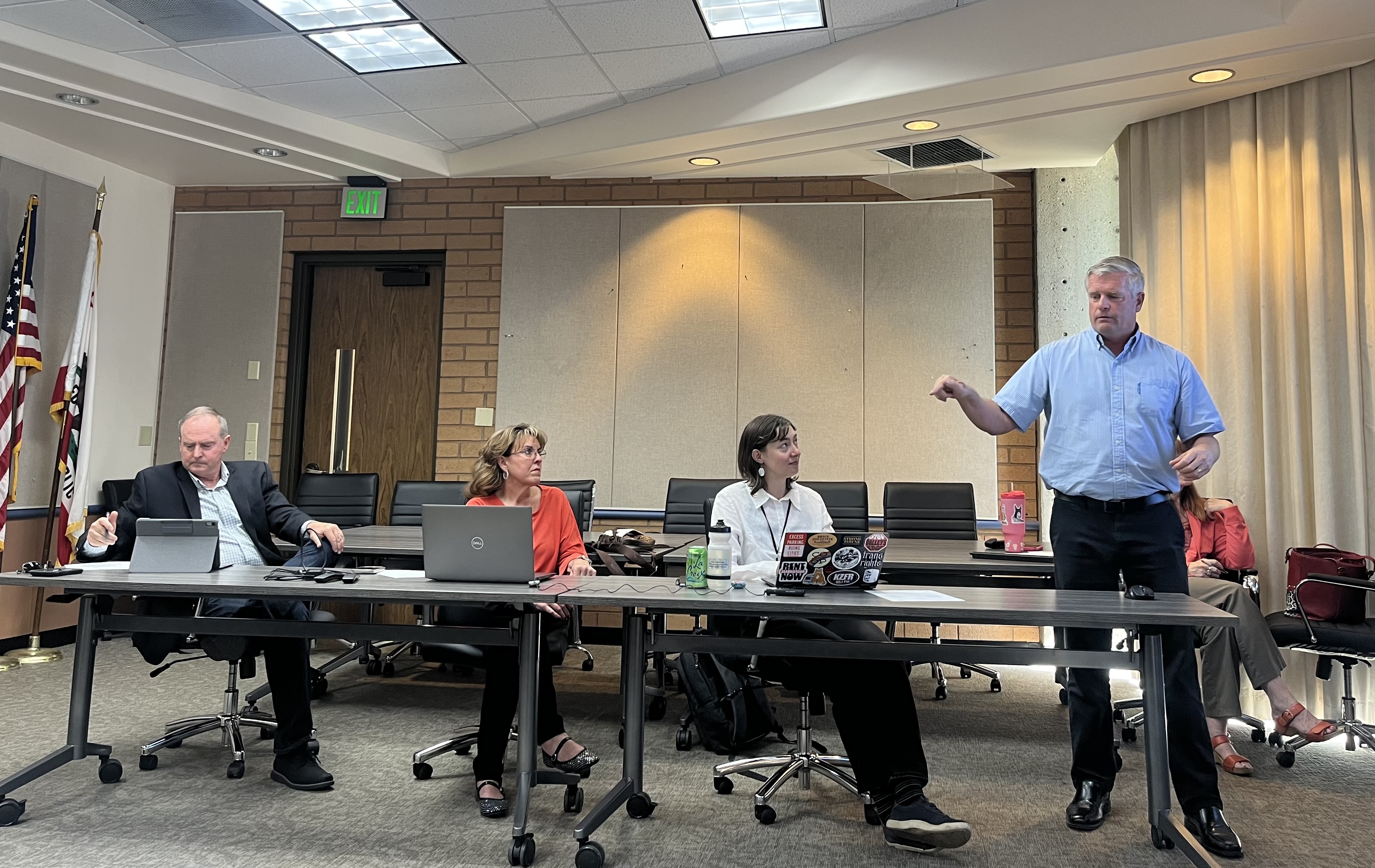
At the first meeting of the City’s ad hoc committee on homelessness, the discussion touched on the overlap between homelessness, substance abuse and mental health. It also raised two related questions: how to address the problem of shelter-resistant homeless individuals, and whether compelled treatment is sometimes necessary.

Scott Kennelly, the director of Butte County Behavioral Health, said homeless outreach teams have worked to convince unhoused people to take advantage of services and have tried to connect them with services, but there are always people who say, “Leave me the hell alone.”
In his view, homeless people who refuse to go to shelters can generally be divided into three groups: those severely addicted to drugs like Fentanyl and Xylazine who are solely focused on their next hit and refuse any care; those with severe mental illness who are psychotic and unaware of their condition; and those who prefer a rule-free lifestyle.
“There’s almost no one left out there who is not severely addicted to a substance, is severely mentally ill, or has (not) made a lifetime style choice,” Kennelly said.
But Charles Withuhn, president of the North State Shelter Team, said that beyond the categories Kennelly mentioned, there is also a group of people “who will be OK with accountability.” He said he talked to a man who was sleeping in the bushes the other day, and that man told him while crying, “All I need is a door that locks and a little bit of job training, and I will go to work.”
Withuhn, who advocates for smaller programs where homeless people can build and find community, said there are still some unsheltered individuals who want help. “There’s too many people having too many bad experiences in big programs, and they feel like they lose their autonomy.”
Amber Abney-Bass, CEO of the Jesus Center, shared statistics about the people who have been served at the Genesis emergency pallet shelter housing. Since April 2022, 423 people have been served. During 2024, 69% reported having a disability, 33% had a chronic health condition, and 39% reported a mental health disorder, she said. Additionally, 51% said they struggled with addiction, alcohol use or both.
Julian Zener, a community member who was attending the April 30 meeting, asked whether some of the people who seem to be shelter-resistant could be persuaded otherwise, warning against what he called “writing off all the people out there.”
“People who currently turned down offers, you related to three categories that seemed to be sort of irredeemable, and I wonder if there’s part of that fourth category, as Charles suggested, that if we could find out more of their story, and build trust, and they might turn around,” Zener said.
Michael O’Brien, one of three councilmembers on the committee, commented on his impression of the service-resistant population.
“Getting them help is really the challenge,” O’Brien said. “And when you have someone who is not thinking correctly, it’s really difficult to get [something] across to them. You just have to understand how powerful these [drugs] are that are dominating their life.”
The new ad hoc committee is chaired by Mayor Kasey Reynolds, with councilmembers Bryce Goldstein and O’Brien as the other members.
Goldstein asked Kennelly how the underlying issues that are keeping people from accessing services can be addressed.
“You have to pair the treatment and the housing at the same time,” he said.
In terms of treatment, he said he has, over time, shifted his philosophy.
“I’m at a point where I say, ‘You have the opportunity through every possible resource to get help,'” Kennelly said. “You’re not willing or you’re not able to see you need it. Now someone has to come in and help support you like a parent or a big brother or a conservator.”
He mentioned mental health diversion court, drug court, and Stepping Stones Perinatal Program — three programs that can compel or press people to receive treatment — and said he saw the most powerful graduation in Stepping Stones.
Behavioral Health hopes to purchase a motel or hotel in the community to house people who are facing felony charges but have been found incompetent to stand trial, where they can receive support and intensive treatment to restore competency. Such a program would typically last about 18 months, said Kennelly, adding, “At least they won’t be on the streets.”
Kennelly also mentioned that a mental health rehabilitation center will be established this year.
The committee will meet biweekly on Wednesdays from 3-4:30 p.m. until summer, when it will report its findings and recommend action to the full City Council panel. The next meeting is scheduled on May 14 in the city hall conference room.
Yucheng Tang is a California Local News fellow reporting for ChicoSol.
2 Comments
This entire thing is just a fact finding mission to see how you can better incarcerate people who are undesirable. I’d be embarrassed to be a party to it.
This Committee is introducing a new avenue of discussion on this topic, that we have not had until now. This can be the road to a recommendation to the Council to approve a tiny home village or a Safe Spot Community, (tiny homes in a church parking lot) and or a safe car park. After I made my comment about an additional group of unsheltered people. Scott Kennelly, later, agreed, and said that there were other categories of people living outside, and that he was just mentioning the groups he comes in contact with. Most of the people who spoke mentioned trying a new shelter program. We got a discussion going. That is new.