
Councilmember Addison Winslow, at the next City Council meeting, says he will push for a study of Gov. Gavin Newsom’s ordinance designed to guide cities that are struggling to manage homeless encampments.
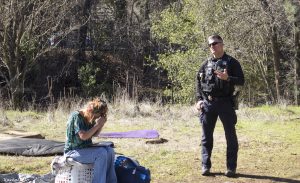
Last week, Gov. Newsom released what he called a “model ordinance” that can be used to “address unhealthy and dangerous encampments.” The ordinance provides a framework local jurisdictions can use to remove encampments from public spaces, and permits speedier enforcement than the framework the City uses now under the Warren v. Chico Settlement Agreement.
For example, the so-called model ordinance requires that officials or officers post a notice 48 hours before taking enforcement actions, “except in exigent circumstances involving an imminent threat to life, safety, health, or infrastructure.” In contrast, the Settlement Agreement mandates 7-day notice to Legal Services of Northern California prior to enforcement planning, 7-day notice to homeless persons who are camping on public property, and finally, a 72-hour notice prior to enforcement.
Newsom’s ordinance, if adopted as written, would make it unlawful to camp on public property for more than three consecutive days or nights in the same location without a permit. On one hand, say some observers, the ordinance could allow homeless individuals to stay in one location for up to three days even while a City anti-camping ordinance prohibits their camping. But others see the model ordinance as an explicit order to cities to clear encampments every three days.

There are other differences as well between the requirements that have been imposed on this City and the governor’s model ordinance. The Settlement Agreement requires that the City store property that was confiscated in an eviction sweep for 90 days, while the model ordinance requires a minimum of only 60 days.
City Manager Mark Sorensen told Action News Now that the City can’t act on the governor’s proposed ordinance because of constraints imposed by the Settlement Agreement. For example, Sorensen pointed out that the agreement restricts the City from enforcing clear-outs on more than three public properties at the same time.
The Settlement Agreement is set to expire on Jan. 14, 2027, and Winslow will move to open a preliminary discussion at the May 20 Council meeting.
The ordinance and the Settlement Agreement share a piece of common ground in opposing eviction sweeps unless there is somewhere for unhoused people to go. The model ordinance would require that the City “make every reasonable effort to identify and offer shelter” to persons living in an encampment prior to a sweep — even though it doesn’t offer a definition or an example of “every reasonable effort.”
“Policies that prohibit individuals from sleeping outside anywhere in the jurisdiction without offering adequate indoor shelter, effectively banishing homeless individuals from the jurisdiction’s borders, are both inhumane and impose externalities on neighboring jurisdictions…” the model ordinance states.
The Warren Settlement Agreement goes further, requiring that the City provide outreach and individual assessment that can lead to shelter referrals prior to an eviction sweep.
Winslow says there’s room to build on the governor’s proposed ordinance; the model ordinance states that it is “not intended to be comprehensive or to impose a one-size-fits-all approach for every city.”
“It’s really good and worth discussing because we can feel like there’s backing from the state to follow this,” he said. “Practices around offering of shelters and outreach are things that we only have guaranteed in our Settlement Agreement. I think it’s important that we think ahead to when we don’t have the Settlement Agreement.”
Yucheng Tang is a California Local News Fellow reporting for ChicoSol.
5 Comments
I don’t understand how the fundamentally anti homeless settlement or the governors anti homeless law is worth supporting. Housing and health care should be the only focus on any political figure calling themselves “progressive” etc. anything less is capitulation to a right wing framework of a failure of government to address the issue on its own terms and causes.
The real issue is people not having enough appropriate places to be. Housing is a goal that takes so long. Failing housing for all in the next few days is housing denied. We know there are attractive and successful shelter programs that we have seen in other towns. Conestoga Huts have been satisfactory for hundreds of people for years in the Eugene area. We have yet to try a program like 14 Forward in Marysville. They got an award for having helped so many people get off the street. We have a wide range of people. We need a wider range of shelter options. Why not a managed campground that is so nice you would pay to stay there? Programs of tiny homes in church parking lots are popular in many cities on the West Coast. Write the City Council to look at more shelter options. P.O. Box 3420, Chico 95927
Charles (his comment above) has been offering program designs for addressing housing and shelter solutions for years now. It is about time that the city either partner or come up with better plans. My favorite addendum to Charles and the North State Shelter Team (See previous story: https://chicosol.org/2024/05/25/north-state-shelter-team-hits-landmark-2000th-shower/) is to take to heart a statement Ed Mayer is rumored to have said: to paraphrase – “that to address the problem realistically, Chico needs three (3) supervised and monitored legal campgrounds (north, south, and central)”. The three day proposal would work as one of those and could serve both free and paid camping. “good enough that people would pay to camp there” as Charles states. , But again, it should be supervised and monitored and an entry into the other two campgrounds. At least one of those would offer campers the opportunity to work and get paid. Zeke Lunders has some cool ideas on that if anyone cares to ask . If left to itself the three day rule is just a new rule to add to the fruitless “wack-a-mole” game the city has been diddling themselves with for the last 10 years. To be clear, the recent signalling that the city is interested in hearing any new ideas is a great and welcomed step forward. We will have to see if anything really pans out from it.
vagrancy which still is a law needs to be Implemed. cant just live for free on the street and not work for it. especially when over 90% of homeless defecate, litter, menses, real problem was and is the allowance of such there’s programs and plenty of them. but cant use and cant drink so they hang in the creek with no rules. over 50 % of the homeless is due to laziness. cities should use vagrant law to put homless to work cleaning up the mess they make.and to all who read this there is no help cause theres a street bond and free food and food stamps . ….put them to work cleaning up!!!!!!
Our group has been meeting with and talking to the unhoused for four years in the Chico area. We consult with other service providers on what is going on and how to get people off the street into “positive placement.” I don’t doubt observations of anti-social behavior of the conspicuous unhoused. There are also the hidden unhoused. According to research nearly half of the unhoused are employed. A recent topic of discussion of the Chico Chapter of the American Association of American Women was, “Why are elderly women the fastest growing segment of the homeless population,” Many (about 80 we know) of the unhoused people in Chico are elderly Chicoan women who have an income; just not enough to rent an apartment. Among the reasons for so much anti-social behavior in Chico is our lack of a wide enough variety of shelter options. Cities with more options have fewer problems.