

Three “significant” regional fires last year – including the Park Fire – contributed to an almost 9 percent increase in the number of Butte County residents experiencing homelessness this year, according to a new county report.

The 2025 Point-In-Time (PIT) survey also suggests that a shortage in the supply of affordable housing and more eviction proceedings contributed to the sharp increase.
The PIT survey, required by the U.S. Department of Housing and Urban Development (HUD) and conducted by local continuums of care (CoCs), informs funding for homeless services and offers insight into homelessness. The 2025 Butte County PIT survey was conducted on Jan. 29, and this reporter participated in the count as a volunteer.
The number of people experiencing homelessness in Butte County rose to 1,392 in 2025, an 8.8 percent increase from 2023, says the report. Chico also witnessed a 15 percent increase in the number of unhoused people.
Although HUD has not posted the 2025 homeless population count for the State of California yet, in the previous year nationwide homelessness reached a record high. In 2024, homelessness increased at a higher rate nationwide than in California compared to 2023.
The 2025 PIT report, in the Community Insights session, touched on the possible reasons for the increase.
Three fires in 2024, including the Park Fire, “led to an exhaustion of already limited resources, displacement of thousands of community members, and additional loss of limited housing stock,” the report explains.
The lack of affordable housing is also highlighted.
According to the report, the average income of a person experiencing homelessness is between $501 and $1,000 per month. “A majority of respondents reported having no income (31%), followed by those who reported ‘$1,001-$1,500’ (19%), and ‘$1-$150’ (11%),” says the report.
“An affordable unit for people earning $1,000 per month would be no more than $300 for rent and utilities, or 30% of their income,” the report adds. “There continues to be a shortage of units with rents that are considered affordable for households with this income level.”
The report notes that the housing inventory in Butte County became especially low after the string of devastating wildfires, and the “current vacancy rate of all rental units in Butte County is 2.2%, compared to 4.3% in California, and 5.5% Nationwide.”
A wave of evictions followed what had been a backlog in court proceedings, according to the report, which might have caused more people to become homeless after the 2023 PIT.
Chico Mayor Kasey Reynolds shared her concern about the increase.

“The persistence of the homeless situation, as measured by the PIT survey, is a clear indication that despite the enormous resources and effort to implement state policies to address homelessness, [the City] has failed to make a significant impact on the numbers.”
“Perhaps it is time to examine our approach and make some changes,” wrote Reynolds in an email to ChicoSol.
Chico boasts increase in number of sheltered unhoused
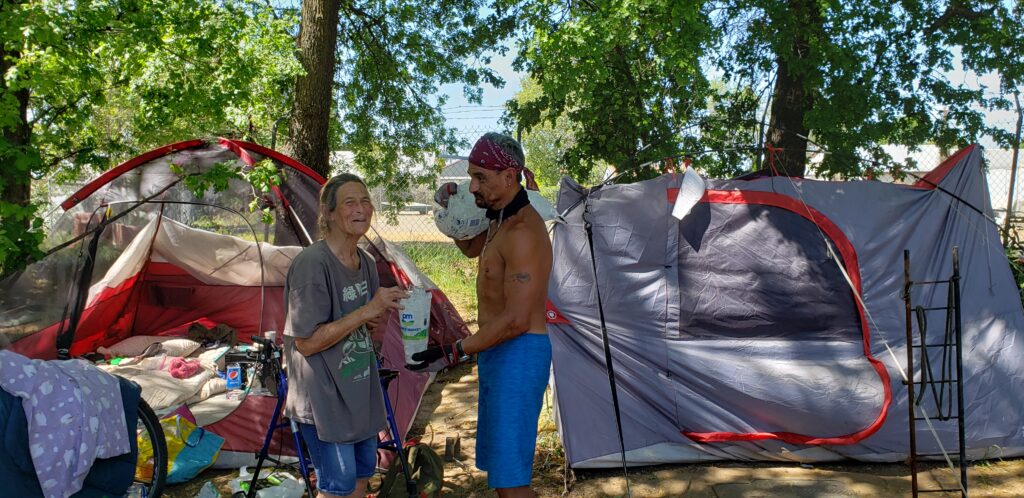
The PIT survey categorizes unhoused people as either sheltered or unsheltered. Sheltered homeless individuals live in emergency or transitional housing, while unsheltered individuals live outdoors, in vehicles, under bridges and in other places not meant for habitation.
In Chico, 66 percent of people experiencing homelessness are sheltered, a six percent increase from the 2023 survey.
The increase in shelter availability for unhoused people in Chico came as a piece of good news to Reynolds.
“This is due to the work of the many organizations that have stepped up to address the challenge of unsheltered homelessness in our community, including the City of Chico with the opening of Genesis,” she said.
Hilary Crosby, executive director of Safe Space, said she was surprised and glad to see that the number of homeless people who identify as a person of color has decreased. She also noticed this change in the Safe Space program last year.

“It shows that there’s been some work done on the equity piece and making sure that our vulnerable populations are being addressed,” Crosby said.
Another positive surprise Crosby noted was the decrease in veterans who are on the streets, which she attributes to the expanded efforts of veterans’ associations and service programs in the last few years.
Non-congregate shelter options could help
The 2025 PIT report also tries to provide insights into a frequently debated topic: Why are some homeless people “shelter-resistant?”
Some of the unhoused people interviewed by PIT volunteers — 149 to be exact — said they feel overwhelmed in congregate shelters. Some people –107 — said they feel unsafe in the those shelters. Some 170 said there are too many rules, or they didn’t want to use a congregate shelter. Some noted that shelter locations were difficult to reach, or they were unable to make it for intake times, or they wanted privacy.
“The increased availability of non-congregate shelter models would likely resolve a lot of the reasons people do not access emergency shelters, including there being too many people, fear of getting sick, and noise,” the report states.
There were additional findings:
- People aged 35 to 44 account for the largest share of the unhoused in Butte County, about 25 percent. People older than 65 and younger than 18 make up 8 percent and 7 percent, respectively.
- Most respondents — 78% — said they were Butte County residents at the start of their homelessness, which means most of the homeless people in Butte County lost their housing within the county.
- The survey also examined the causes of homelessness. About one third of respondents cited employment or financial reasons, 26 percent pointed to a family crisis, such as the death or serious illness of a family member, divorce, or other familial problems, 17 percent attributed their homelessness to alcohol or substance use, and 12 percent to domestic violence or partner abuse.
Addiction, mental illness, domestic violence as factors
Of the 1,150 respondents, almost 40 percent had experienced domestic violence at some point in their lives.
Of those who responded, 46 percent reported substance use disorders, chronic health conditions, mental health conditions, or any combination of the three, and 40 percent reported having physical disabilities.
“Increasing affordable housing stock and offering individualized support in areas of key need is fundamental to ending homelessness,” the 2025 PIT report concludes. “Health problems and other disabling conditions are pervasive for those who are unhoused, and without at least a minimal level of housing stability and safety, it is likely these conditions will worsen.”
Crosby was frustrated to see the percentage of people experiencing homelessness for the first time increase to 41 percent – up from 30 percent in 2023.
“We’re making good progress, but not enough and not fast enough,” Crosby said. “There’s just not affordable housing out there. Once people have an eviction on their record or anything like that, it just makes it incredibly hard to house people.”
Crosby said she hopes the City will consider more sheltering options that are non-congregate – that allow people individual spaces.
“Homelessness is such a slippery slope. You don’t just go into homelessness one day,” Crosby added. “We just don’t have a lot of good options for safe car parking, manage campgrounds or things that would allow people to kind of stabilize some of those steps” before they live in encampments on the streets.
Staking out a future path
Observers like Mayor Reynolds and Crosby note that survey capacity may have been a factor in the outcome.
Crosby said the increase might be related to the increase in the number of volunteers for the PIT count so that “more unhoused people could be reached compared to 2023.”
Reynolds, who chairs the ad hoc committee on homelessness, said one of her goals is to continue to hear from experts in the field. Reynolds wants to know about the services that are now provided, as well as the challenges to service provision in order to decide what next steps the City should take.
Yucheng Tang is a California Local News Fellow reporting for ChicoSol.
2 Comments
Yes, we need more non-congregate shelter options. North State Shelter Team has spent 4 years and traveled to several successful non congregate programs up and down the west coast to get their Operations Handbooks and Business Plans. NSST has provided to the City our (48 page) Safe Spot Community (SSC) (tiny homes in church parking lots) Proposal, and has available our (39 page) revised Managed Campground/Tiny Home Village Proposal. This is a pivotal moment. Contact the Mayor and ask her to offer an opportunity for NSST to make their 18 minute and 24 slide Power Point presentation to her Ad Hoc Committee on this issue. NSST has the data. This programs will save us money and make our streets safer. kasey.reynolds@chicoca.gov
Thank you for this thorough reporting on homelessness in Butte County and the Chico area. The article breaks a lot of stereotypes that allow some folks to feel it’s okay to criminalize homelessness (such as not allowing a person to sit or lie down in public spaces), with the excuse that “they are all just criminals” or that they are coming into Chico from other places because they are attracted by the services Chico provides. The majority are our neighbors who have extremely low incomes. And for the many who have substance addiction or mental health issues, or both, it is virtually impossible to improve their situation while unhoused. I suspect that for many, the challenges of substance use and mental illness are exasperated by being unhoused.
It sounds like Mayor Reynolds is softening her tone on how Chico might more effectively address the multi-layered societal concerns so strongly in our face with the accelerating need for LOW INCOME housing, and for multiple innovative options for low -barrier shelter. I’m sure this City task force will come up with a variety of solutions.
Two solutions I urge them to consider are:
1) provide a low barrier parking area for folks living out of their vehicles, with clean potable water source, showers, adequate garbage service, and the availability of case management services for those who are open to it.
2) to support Safe Space in finding a facility where they can provide shelter 24/7. Safe Space folks know how to do this, and their one option several years ago was ripped away by the elite powers of NIMHT-ism. “Not in my home town” A most shameful chapter in Chico’s recent history.