
“The landlord’s here to visit/They’re blasting disco down below/Says, ‘I’m doubling up the rent ’cause the building’s condemned/You’re gonna help me buy City Hall‘/But we can/You know we can/Let’s lynch the landlord man” — the Dead Kennedys
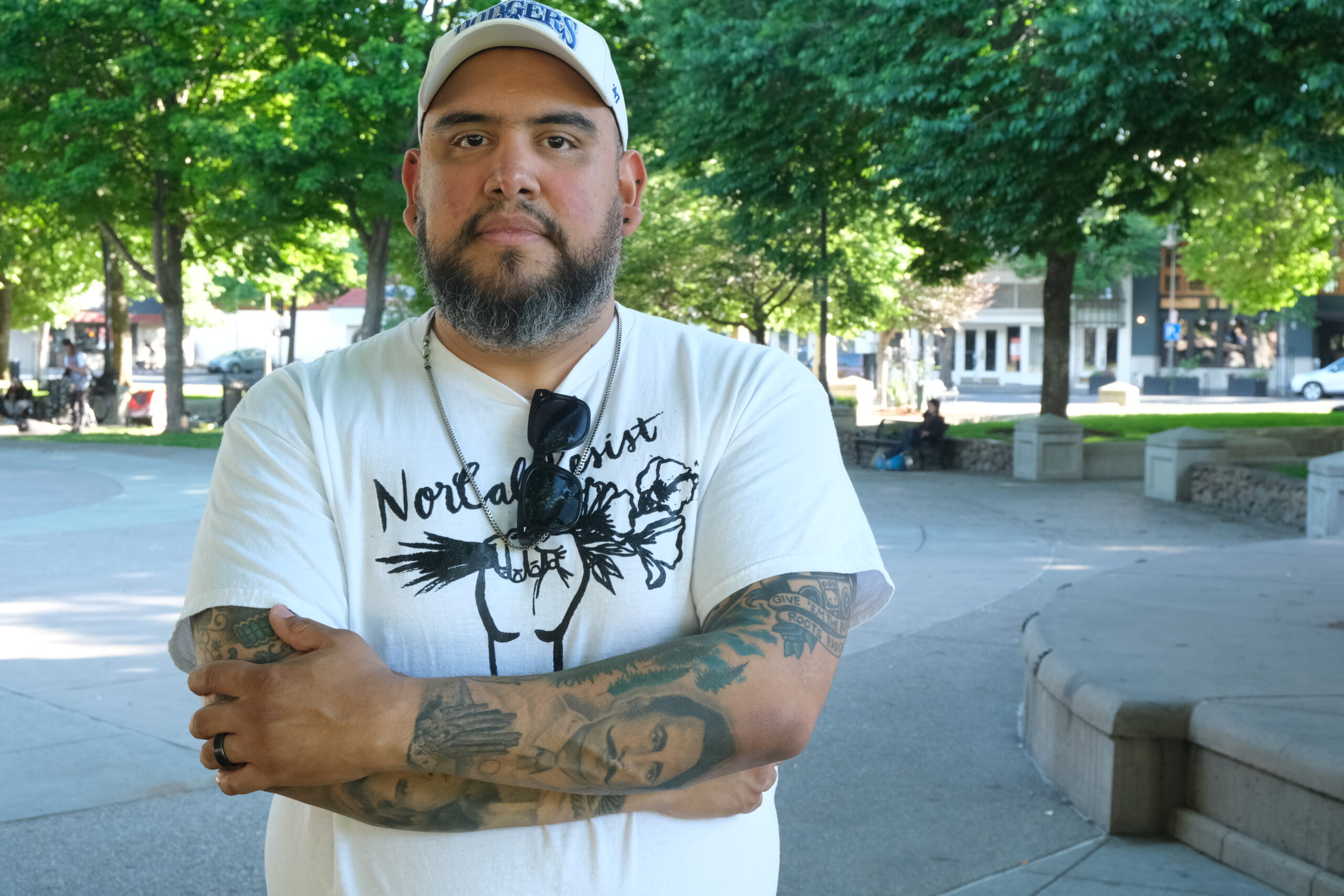
At age 17, Juan Araujo-Sariñana discovered punk rock music that now, 20 years later, still influences his life.
Fresh Fruit for Rotting Vegetables, one of his favorite albums by one of his favorite singers, Jello Biafra, was something he listened to often back in high school. In that album, there’s a song called “Let’s Lynch the Landlord.”
Biafra’s song planted the seed for the cause Araujo-Sariñana is dedicated to now: Distributing food and resources to those who have lost their homes. “Jello Biafra was one of the influencers in my early life and radicalized me,” he said.
Araujo-Sariñana, a Chico State biology lecturer, envisions a society built on mutual support. He chooses to help people directly rather than participate in electoral politics.
He executes his philosophy in what he says is a “non-hierarchical” organization, NorCal Resist Chico Chapter. There’s no president or vice president, and all members have equal standing.
The Chico chapter organizes weekly food distribution for the unhoused, a periodic car light repair clinic, and a rapid response network addressing Immigration and Customs Enforcement (ICE) activity in the region. Araujo-Sariñana, who immigrated from Mexico when he was a child, said his experiences fuel his empathy for the immigrant community.
When the pandemic hit the city in 2020, many shops and stores shut down. Araujo-Sariñana joined a mutual aid group delivering groceries and medicine to vulnerable residents, like the elderly, the disabled and the immunocompromised.
By late summer that year, Araujo-Sariñana recalled, as pandemic conditions slightly improved, someone in the mutual aid group noted that socks were among the most requested items in homeless shelters. “Why don’t we deliver socks to those encampments on the streets?” they suggested.
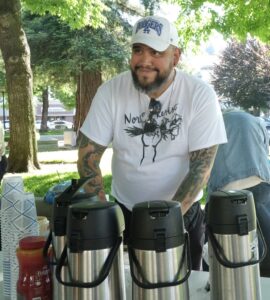
The group launched its support program for the unhoused.
That group later became the Chico chapter of NorCal Resist, which is a Sacramento-based nonprofit dedicated to addressing social injustice by, in part, distributing food and clothing to unhoused and low-income individuals.
Araujo-Sariñana added that he is working among people who want to provide “direct action and direct support” to the community. Supply distribution is one of the main events for the Chico chapter.
NorCal Resist also holds brake light repair clinics. Araujo-Sariñana said volunteers repair brake lights, headlights, turn signals, any device on people’s cars “that might give the police probable cause to pull you over.”
“Anybody can be the recipient of mutual aid,” he said, noting that the clinic is open to anyone who might need the assistance.
Last December, Araujo-Sariñana led a march for the homeless who died on the streets, starting at Children’s Park and ending at the Our Hands sculpture.
“The pandemic showed a lot of cracks in capitalism” — Juan Araujo-Sariñana
Araujo-Sariñana shared with ChicoSol his views on the differences between a charity model – like that of the Jesus Center – and a mutual aid approach used by NorCal Resist.
“Charities are very hierarchical,” Araujo-Sariñana said. “They are top down. There’s donors, then there’s funders that demand that things be a certain way,” he said. “And that’s not always the way that is best for the people that need that assistance.”
Araujo-Sariñana explained that activism is generally important to him, and mutual aid is the value and concept that guides his activism.
“It’s important for all of us to live our lives the way that we want the world to be shaped,” he said. “To me, society should be organized in a mutually beneficial manner. We should be working towards the benefit of everyone, not just the bosses and the landowners and people in power.”
Araujo-Sariñana was presented with the “Walk the Line Award” by Chico State in 2022, which “recognizes that the work to achieve social justice can be demanding and risky, and that many who take it on do so without the protection of privilege or a safety net such as tenure or full-time employment.”
In high school, Araujo-Sariñana said, he was very political, and even had a little punk rock band that helped him express his views about the world. But after entering college, he focused more on schoolwork and college life. COVID-19 was the “catalyst” that reignited his activism, he said.
“The pandemic showed a lot of cracks in capitalism and how, in times of crisis, it would abandon people who were less able or more dispossessed.”
Araujo-Sariñana grew up “bilingually and biculturally” in Mexicali and Calexico, two border cities in Mexico and the United States that are home to large Latino populations.
He was born in Mexicali and immigrated to the U.S. when he was 4. He went back and forth a lot between both cities when he was a kid, and still thinks of both places as his hometown.

When he described the two places, the first thing that came to mind was the fence that separates them. “Their streets are side by side, but there’s a border wall, there’s a big fence, maybe a 25-foot fence,” he said, pointing to the digital map.
For him, Calexico is almost an extension of Mexico, and “culturally, it has its own little life.” He remembered his first impression when he moved to Chico in 2005 for college: “I have never seen so many white people in my life.”
As he grew up near the border, he saw migrants trying to hop the fence and make a run for it, and “witnessed so much violence” required to maintain borders, he said.
“I feel like maintaining that border is imperialism,” Araujo-Sariñana said. “Creating conditions where people in South America have to flee their countries because of the interventionism that America has done in South America, then treating immigrants the way that they do here … that’s imperialism to me.”
This concept drove him to work on behalf of the immigrant community. NorCal Resist is working to build a rapid response network for ICE activities. Volunteers will be sent to verify or observe reported ICE activity. If the activity turns out to be a rumor, the organization can help reduce panic within the immigrant community. If the report is confirmed, volunteers can stay to observe and witness.
Araujo-Sariñana trains the volunteers who want to join the network once every two weeks, mainly informing them of their basic rights when encountering ICE.
“We’re not asking people to do anything else than just observe,” he added. “Someone will go out, they’ll go check it out. A lot of times, they don’t see anything.”
Liz Johnson, a new volunteer for NorCal Resist Chico Chapter, moved to Chico from Sacramento last year. NorCal Resist Chico became a welcoming organization and felt like a family to her, she said.
On a recent Tuesday afternoon, members were distributing food to the homeless in City Plaza. At 5 p.m., a dozen unhoused people from the plaza and surrounding area began to gather around the long table set up by Araujo-Sariñana and his colleagues, including wife Melys Araujo-Jerez.
Araujo-Sariñana met Araujo-Jerez in 2020 in the mutual aid group. She had been involved in activism earlier than he and would become not only his inspiration, but also his colleague and companion on the mutual aid journey. They enjoy karaoke, movie nights, and most importantly, discussing work that will benefit those in need.
“Sometimes I think maybe it takes up too much of our conversation,” he said with a laugh.
Araujo-Jerez remembered that before they were dating, she saw many plants that were well cared for in Araujo-Sariñana’s garden.
“That’s a green flag,” Araujo-Jerez said.
Araujo-Sariñana gave Araujo-Jerez a potted tomato plant as a gift. “I’d never grown anything in my life, and he was like introducing me to that,” Araujo-Jerez recalled.
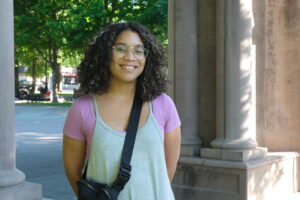
They nurtured the plant together and eventually ate all three tomatoes it produced. Last year, they married after dating for more than three years.
Araujo-Jerez says her relationship with Araujo-Sariñana and the work they have done together are all about “nurturing.”
“Not only are we trying to be out there and help people, it kind of helps us both grow as a couple,” Araujo-Jerez said. “And it also teaches us to nurture each other, just like how he helped me nurture that plant and nurture people.”
Araujo-Sariñana said he feels satisfied when he sees happy faces from people who have received the group’s help and support, but he also occasionally feels powerless. He believes the work he does and the supplies he delivers to the homeless can make changes, but he also knows “no amount of giving people toothbrushes is going to get them a house.”
“It’s very tough,” Araujo-Sariñana said. “We see the impact of the work and when we are out there. It’s also tough to know that there needs to be more. We need to do more to get people housed.”
This story is one in a ChicoSol “changemaker” series that profiles community members.
4 Comments
What an inspiring story. Juan and Melys are showing a way to have a more effective community. Join us at the Plaza Tuesdays at 5:30 pm.
A wonderful story about people who are making a difference. The mutual aid concept is key to resisting the dangerous, authoritarian events in this country. Bravo to Juan, Melys, and their colleagues!
What a great couple! Thank you both and your volunteers for the wonderful service you have and are providing our community.
I’ve got Tuesdays at 5:30pm in my calendar. I highly recommend people take the La Migra Watch trainings through Nor-cal Resist. Look on FB for the next one.