
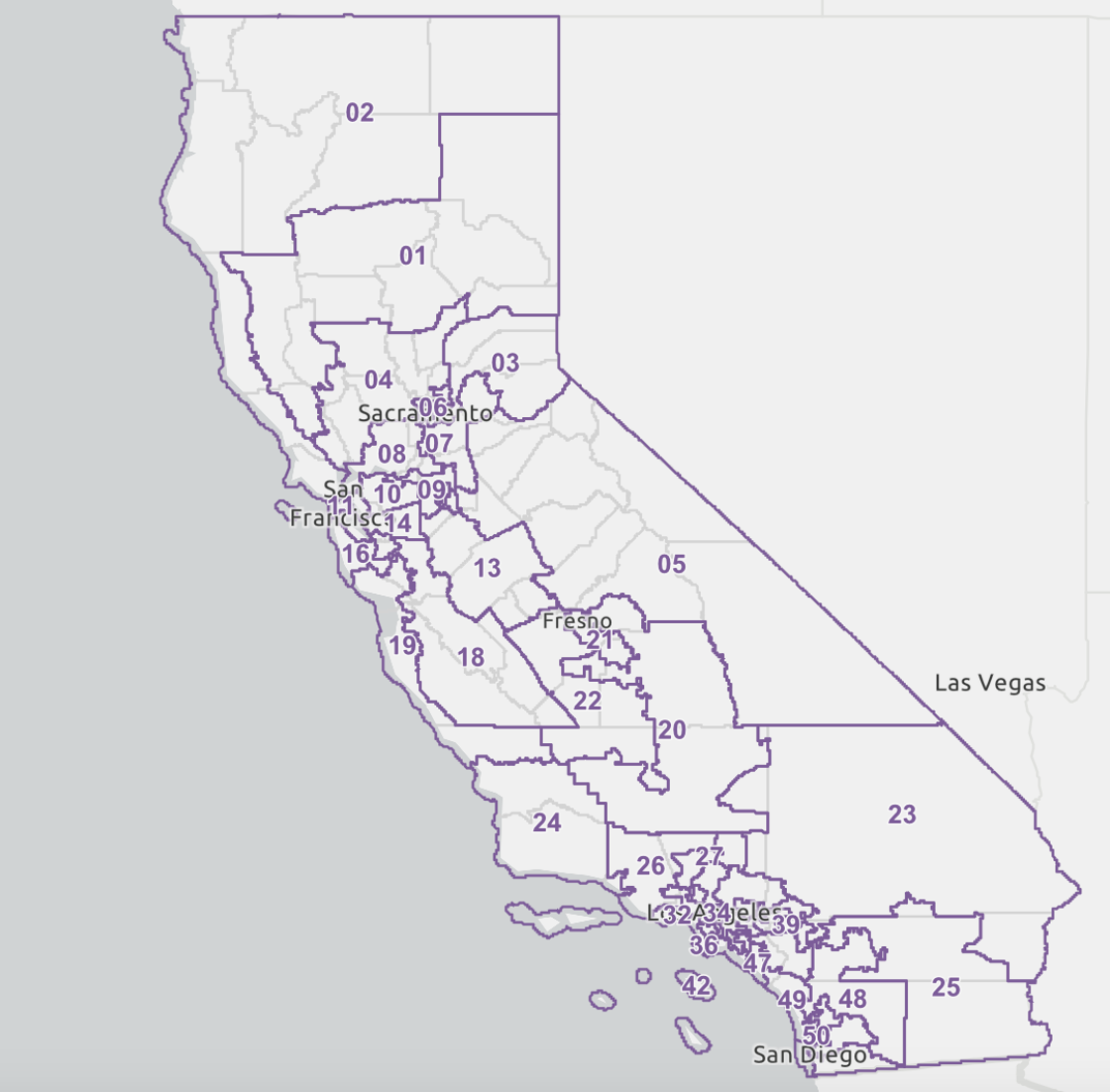
If California’s congressional districts are redrawn, District 1 residents could see lively debate about climate change and how farmers can adopt environmentally friendly practices.

Audrey Denney, chair of the Democratic Action Club of Chico, has announced she will run in the District 1 election if the proposed map is approved. Denney views agriculture as “a tremendous asset in the fight against climate change,” and would push for more incentives for farmers to adopt regenerative practices.
District 1 Congressman Doug LaMalfa, by contrast, rejects climate-focused regulations as burdensome for small farmers and the food industry. LaMalfa, a rice farmer from Richvale who was first elected to the House 13 years ago, was one of four congress members to introduce legislation to provide disaster relief for farmers in the form of a permanent program.
In the proposed California congressional map, District 1 takes on a more horizontal shape, stretching from Santa Rosa through Chico and Paradise to the Nevada border, while excluding some northeastern counties bordering Oregon. The shift could create a more liberal voter majority and put LaMalfa’s seat, which he has held since 2013, at risk.
In addition to Denney, there is speculation that Mike McGuire of Sonoma County will also run for the seat, said David Welch, secretary of the Butte County Democratic Central Committee. McGuire, a Democrat, currently serves as the 52nd president pro tempore of the California State Senate.
Welch said that in next June’s primary, two final candidates will emerge—most likely one Republican and one Democrat—though who they will be still depends on who decides to run for the seat from each party.
ChicoSol reached out to LaMalfa’s office for comment on redistricting and whether he plans to seek re-election if the new map takes effect, but received no response by publication.
California’s redistricting discussion follows the effort in Texas to create five House seats that could likely be won by Republicans by redrawing the state’s congressional map. The Texas Tribune describes here how the map — which is facing a court challenge — was gerrymandered to help Republicans.
In response, Gov. Gavin Newsom signed a package of bills known as Proposition 50, and the trio of bills will be on the ballot for a Nov. 4 special election. If redistricting under Proposition 50 wins voter approval in November, the state legislature would be allowed to bypass California’s independent Citizens Redistricting Commission to redraw congressional district lines for the 2026–2030 election cycle.
Divergent attitudes toward California redistricting
Welch told ChicoSol that the essence of the redistricting battle is about “who controls the House of Representatives after the next elections.”
“What Proposition 50 and our redistricting is really about is making at least the possibility of electing a Democratically-controlled House that could act as a stopper, as a brake on what the Trump Administration is doing now,” Welch said, adding that he also hopes it will bring a Democratic representative “who has a real loyalty to the district, not just for following the line of a national party.”
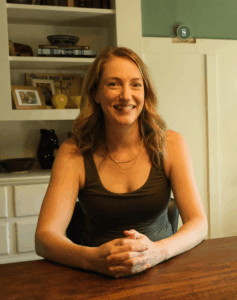
Denney believes District 1 was stretched southwest to capture more left-leaning Democratic voters, but she also stressed that she can see the threads of “land management, forest health, fire prevention” that draw District 1 together in the new map.
“They actually did a really good job drawing it with the two big population centers being Santa Rosa, which is about 170,000 and Chico, which is just over 100,000,” Denney explained. “Those two towns are both university towns, both obviously have a history with wildfire and that’s a big concern. Both have a lot of agriculture in the surrounding areas.
“And then the rest of the district is this really remote, rural area,” Denney said, adding that the rural communities will share similar needs and interests, like rural broadband and rural health care.
LaMalfa criticized the proposed map in an August statement.
“No one can look at these maps—one with a district spreading from Modoc to Marin, another shaped like a giant elephant with a trunk to bring in downtown Sacramento with Tahoe, or sticking Lassen and Plumas counties way over on the Nevada border with Santa Rosa in a coastal county—and say they appear credible,” LaMalfa says.
LaMalfa also commented on redistricting during the Aug. 11 town hall in Chico.
“Texas shouldn’t be doing that. From the information I have, if it’s purely for politics, no way. California shouldn’t be doing this,” LaMalfa said. “This is going to start a grass fire all across the country.”
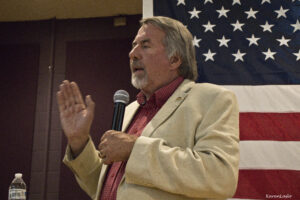
Charles Turner, a political science professor at Chico State, believes the proposed map is more narrowly political than the current one that he said was drawn “without worrying too much about partisanship and more about connecting communities.”
Turner, however, thinks that Newsom’s move is a fair response to what was a an unfair act in Texas.
“I would rather have neither Texas nor California redraw their districts,” Turner said. “But if Texas is going to redraw theirs, then it seems just as fair for California to redraw its districts. It’s sort of like Texas has thrown the first punch.”
Turner said that the problem with gerrymandering is always that “it’s valuing something other than fair representation.”
Texas Rep. Gene Wu, at an Aug. 22 American Community Media panel, pointed out the harm that gerrymandering can cause.
“If this is allowed to happen across the board, if every state, whether they’re red or blue, does this every single time after every election to make sure that they never lose, then politicians and leaders would no longer listen to the people,” Wu said. “Because why do you need to listen when you’re guaranteed to win every time? There will be no democracy left.”
“For minority and small communities, this is even more important. They’re taking minority communities that have built power over time and hacking them apart,” he added, referencing the redrawn Texas map.
Is redistricting a losing battle for Democrats?
Would California’s redistricting response prompt more red states to redistrict and lead to a losing battle for Democrats? Denney said she believes that California’s redistricting effort has a purpose.
“We’re doing our part, and our part is combating what Texas did,” Denney said. “And what comes next? What happens after this? Then other blue states are going to have to step up and be bold and do their part too.”
The California Republican Party has criticized Newsom’s move in a statement that says “hundreds of millions of taxpayer dollars” will be spent on the special election.
Denney admits that redistricting will be “an expensive fight.”
“I could have a lot of feelings on whether or not that’s a good use of funds and how much better we could make the world if we used all of this money to do good things for people, but that’s not the world we live in,” Denney said. “The world we live in — politics — is an expensive game, and both Republicans and Democrats see a lot of perceived value in the outcome of this.”
Welch believes that the biggest challenge facing Democrats is that “an enormous amount of money is being spent and will be spent to oppose Proposition 50.”
“Obviously, some very wealthy people want to maintain the power of the Republican party in Congress,” Welch added. “We’re probably not going to be able to match the amount of money” that Prop 50 opponents will spend.
“We really have to try and oppose that with volunteer energy.”
Contrasting views on rural health care and climate change
Both Denney and LaMalfa have agricultural backgrounds, but Denney said that the biggest difference between them is their approach to human-caused climate change.
“We can actually use agriculture as a way of turning back the dial on climate change,” Denney said. “The same thing with healthy forestry practices. When we practice regenerative agriculture practices, we can actually capture carbon from the air and store it in the soil.”
Denney said, if elected, she would make sure that “we’re incentivizing farmers and ranchers to use these types of agricultural practices by having a really robust natural resource conservation service, which is one of the arms under the USDA.”
“Instead of all the cuts that they’re seeing, I’d like to see increasing the funding to programs like EQIP [Environmental Quality Incentives Program] and other programs that incentivize farmers to do these practices like cover cropping and increasing habitat and all of the ecosystem services that farmers provide,” she added.
LaMalfa supports livestock grazing to reduce wildfire risks and advocates for forest thinning as a management practice to protect rural communities. He holds a different view of climate change.
For example, in 2022, he opposed the Securities and Exchange Commission’s proposed rule to require publicly-traded companies to disclose extensive climate-related data and argued that would place heavy burdens on small family farms.
“For far too long, [environmental standards] have placed heavy and unnecessary burdens on our nation’s energy and food production industries, making it harder to produce these essentials domestically, while incentivizing imports of these goods,” he said in a statement then.
“Small family farms are struggling financially to keep their operations up and running, they don’t have the funds to hire a full-scale environmental compliance department to meet the SEC’s ridiculous demands. Farmers are producing more food and fiber with less inputs like water, land, and labor than ever before.”
“The SEC needs to think about the unintended catastrophic consequences this new rule will have on our nation’s farmers, and in turn our food supply,” he continued.
Welch believes that although the local effects of redistricting are less significant than the national effects, a representative can still have an impact on local people’s lives.
Denney and Welch both mentioned the impact of MediCal cuts on rural hospitals, including the upcoming closure of the Glenn County hospital.
“Rural hospitals, in general, are financially precarious,” Welch said. “Oftentimes people are traveling long distances for services. If we add the stress of less Medicaid funding to that, many of those hospitals are not going to survive.”
At the August town hall, LaMalfa responded to a question about the impact of the One Big Beautiful Bill on rural hospitals.
“We’ve been working very hard to help our rural hospitals,” LaMalfa said, mentioning that there’s an element in the reconciliation bill that has $50 billion directed to these medical centers.
“It’s difficult in rural America because the cost of doing business is still high for them,” LaMalfa said.
LaMalfa said that it’s the Biden administration’s new mileage calculation process that makes Glenn Medical Center not eligible as a critical access hospital anymore.
Welch, who is retired from nursing, didn’t buy LaMalfa’s argument.
“While they try to assign that to the Biden administration, they’re obviously the ones in power now, and have been for nine months now and they have the ability to control what’s going on with Glenn Medical Center,” Welch said.
Yucheng Tang is a California Local News fellow reporting for ChicoSol.
2 Comments
Excellent and very informative article.
For those who didn’t see it, this letter by me was published recently in the Chico ER.
Letter: Redistricting plan will be good for Chico
PUBLISHED: September 10, 2025
Regarding Bob Gustafson’s September 7th letter, “New districts mean some new competition.”
Actually this is a good thing according to the title. Here’s why. As someone who voted for the reapportionment commission when it was on the ballot in 2010 (if I recall the year correctly) actually I believe that the lines drawn under the legislature’s map as they pertain to Doug LaMalfa’s district is a fair map. More of the people around Chico vote Democratic. Like the majority of the people in Sonoma and Mendocino counties to the west, most of the people around Chico vote Democratic and are more progressive.
Among the various issues, the people around Chico and the areas to the west care strongly about the environment. The people don’t want cuts to Medicaid and the Affordable Health Care Act. I don’t know about tofu but Audrey Denney who by the way listened to farmers concerns when she previously ran for Congress and who may be the Democratic nominee, will represent this entire area very well in Congress.
This is absolutely not true of Doug LaMalfa. He and other Republican congressmen before him have not represented the majority of people around Chico very well. Even though the Chico area won’t be in Republican Congressman Keven Kiley’s district, he will continue to represent the arch conservatives in the northern interior of the state including around Chico.
Walter Ballin, Columbia, MD
https://www.chicoer.com/2025/09/10/letter-redistricting-plan-will-be-good-for-chico/?fbclid=IwY2xjawMuUpNleHRuA2FlbQIxMQBicmlkETFEYkxHMFA5MzBHSTlzRkxaAR5DxXIqIju2R7QVNs6FfJ1eMOzpSPtYvNBQJL3vozbhU_ybXekIN5gn7Tn9Pw_aem_u_h0ylLB_p6mLe_JWNtpvg
Regarding my letter to the ER where I wrote “even though the Chico area won’t be in Republican Congressman Keven Kiley’s district, he will continue to represent the arch conservatives in the northern interior of the state including around Chico,” I wrote that letter before I was aware that Republican Kiley’s hold on that seat with areas around Sacramento being added to his district will also fortunately be jeopardized. People who among other things don’t believe that people shouldn’t be entitled the necessities of life like health care, food and housing, and believe in racism etc., aren’t entitled to representation. Besides there are many people in these rural parts that will be badly hurt by Trump and the Republicans “big beautiful bill.” Unfortunately many of them ignorantly have been voting Republican. And there are also a heck of a lot of people who don’t regularly vote. We have a job to do which is to get those people to vote.