
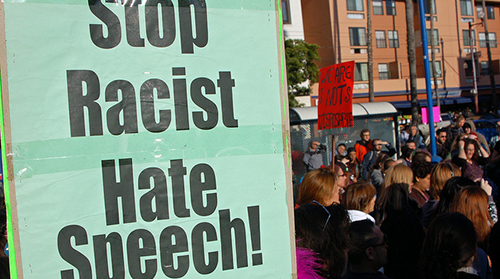
White nationalist rhetoric has become common in U.S. mainstream politics – and some educators point out that it also has a long history of prevalence in the North State.

Chico State University professor Shawn Schwaller said such language is now common in this “extreme political climate,” and its use has been increasing since 2016. Extremist language often affects, in particular, marginalized communities.
“When you hear Trump and his cronies talk about immigration, they sound a lot like the nativist supporters of the State of Jefferson movement in the North State, who have sought for years to break a portion of Northern California off from the rest of the state to create a white ethno state,” Schwaller said.
“Undocumented people are obviously even more vulnerable now due to the Trump administration’s racist and extremist immigration crackdowns,” Schwaller said.
He notes that Latino students make up 36% of Chico State’s student population, up from only 12% in 2010, and noted that people in this area have been “victims of racist anti-Mexican hate crimes.”
“I think we are seeing a mainstreaming of right wing extremism that is deeply rooted in the North State and in other white rural and small town conservative areas across the U.S.,” Schwaller said.
Extremist ideology gains traction across country
Researchers largely agreed in a Nov. 14 American Community Media news briefing (ACoM).
Sanford Schram, adjunct lecturer in political science at Stony Brook University, said that white nationalism has been gaining prominence within the Republican party for decades. A large number of people within the party loudly support racially-tinged ideas that “white identity is threatened” and that the government ought to punish marginalized groups through immigration enforcement crackdowns, he said.
Journalist Heath Druzin noted that there are “an alarming number” of people who are comfortable expressing their approval of Adolf Hitler’s beliefs. Druzin hosts the “Extremely American” podcast, covering the mainstreaming of extremist and militia movements.
Druzin said Trump attracted many people who have become hard right voices spewing messaging containing racism and nationalism. The Internet has rapidly emboldened people to say what they might not in person, and has desensitized them to what once was thought of as socially unacceptable or morally wrong, he added.
Some churches have played an outsized role in promoting white nationalist language, said Matthew Taylor, a senior Christian scholar at the Institute for Islamic, Christian and Jewish Studies.
The term “Christian nationalist” has been coined to specify nondenominational evangelical Christians who use charismatic spiritual leaders to spread this rhetoric among their congregations. Taylor pointed to a narrative that has built a mythology around Trump as a “quasi-messiah” who white nationalists hope will “restore order” for the “Christian essential identity.”
“Trump has uniquely enlisted that coalition into these broader far right circles,” Taylor said. He added that some white Christians have a long history of weaponizing religion against people of color in order to declare themselves intrinsically more “American” than others. Taylor said this is what leads to seeing “Christian flags alongside American flags on January 6.”
Devin Burghart, an author and human rights researcher, has documented the networks of far right activists and how they have infiltrated and wielded influence over Republican lawmakers, helping to influence hundreds of bills in many states.
“I tracked around 2.5 million activists engaging in conspiratorial and often racist messaging which created a momentum toward shaping politics, mainstreaming such beliefs over time,” said Burghart, executive director of the Institute for Research & Education on Human Rights.
White nationalism in the North State
Extreme language has roots in rural areas of the country like Butte County, where groups like the Ku Klux Klan made a home in decades past. But elected officials are often quiet on the subject of immigration crackdowns and other themes.
Chico State English instructor Anna Moore told ChicoSol that Butte County’s elected officials haven’t clearly discussed risks to the immigrant or greater communities or taken a clear stance against the spread of white nationalist speech.
“If local leaders spoke out, that would make people feel better,” Moore said.
Moore said her classrooms have been quieter with students seemingly less willing to engage in “hot button issues.”
As an educator, Moore said she tries to create “safe” classroom environments and avoids facilitating activities where a student could be “outed” or put at risk for any reason.
But Moore said her classrooms have been quieter with students seemingly less willing to engage in “hot button issues” than in the past. She thinks they may feel intimidated by the mainstream acceptance of overt nationalism or racist language.
“I’ve noticed ever since 2016 that people are more comfortable with their racism, claiming that it’s free speech to say racist things,” Moore said. “The classroom feels like less of a safe place to me, for people who might be undocumented or have family members who are undocumented, for people in the queer community.”
Schwaller also noted an incident last May when several swastikas were found spray painted on the bike trail that runs along the west side of Chico State’s campus along the railroad tracks.
“The president’s office worked swiftly to cover them up with black paint, but they still served as a testament to the danger faced by our students in the greater Chico State campus area,” he said.
Schwaller, like Moore, said he has seen the impacts on Latino students in the classroom. He teaches Mexican American history and said he has heard many stories over the years from these students about “racist epithets” directed at them on campus and in other parts of Chico.
People who are undocumented or from mixed-status families may fear speaking out. They fear “being rounded up and deported by ICE if they put too much attention on themselves,” Schwaller said.
“They’re severely in fear of their safety and thankfully, local advocates are working to help them.
“The most dangerous part about the extremist rhetoric is that it leads to violence, the destruction of lives, and the tearing apart of families,” he said. “Trump is tapping into and mainstreaming that kind of mindset, one that is ultimately based in white fears and anxieties about the increasingly diverse multiracial and multiethnic society we live in.”
Natalie Hanson is a contributing writer and editor at ChicoSol.
4 Comments
White nationalism, racism, some of the new political language can result in hatred. Hatred that is easily redirected to whoever is the convenient “other.” Poor people (e.g. unsheltered people) for example are an easy target. Explain to me why some in our community have it as OK to shoot at the Alt-Site, (Chico’s camp for poor people)? People drive by and shoot pellet guns; they shoot golf balls at the Alt-Site residents. A golf ball smashed the windshield of a car of a friend of mine. Why do so few Chico churches step up to work with Safe Space or North State Shelter Team in spite of the data that shows their programs are not a risk?
As someone who has supported agricultural programs at both Butte College and CSU, Chico for decades — as an undergraduate, alumnus, and community advocate — I can’t ignore what these recent administrative decisions look like in the larger civil-rights context that ChicoSol has been reporting on.
CSU, Chico publicly celebrates diversity, equity, and inclusion. Yet two of the most significant leadership removals on campus in the last couple of years — the demotion of the Dean of Agriculture and the ousting of the University Farm Director — both targeted Hispanic leaders in high-visibility roles. These actions were taken with almost no transparency and with no public explanation that would reassure the community that racial bias played no part.
At the same time, many of us have watched the outsized influence of the local Farm Bureau’s “good-ol-boy” network inside the University — a network that historically resists inclusive leadership, resists modernization, and undermines research-based agricultural education. When private power brokers operate in the shadows while public institutions quietly remove Hispanic leadership, it is not unreasonable for the community to see a civil-rights problem developing in real time.
These dynamics are not abstract. They directly impact the futures of our students, faculty, and regional workforce. Agriculture programs at CSU, Chico and Butte College should be thriving — they have national recognition, faculty expertise, land resources, and strong student demand. Instead, they are being held back by decisions that bear the hallmarks of political pressure and cultural gatekeeping.
And here’s the tragedy: these programs are poised to become national models for regenerative agriculture, climate-smart farming, and community-rooted innovation. They could be engines of opportunity for first-generation students, rural families, and young people from historically marginalized communities. The potential is extraordinary — but potential cannot grow under administrative silence and back-room influence.
If CSU, Chico wants to stand on the right side of history — especially at a moment when white-nationalist rhetoric is emboldened on and near campus — it must choose transparency over secrecy, inclusion over gatekeeping, and accountability over convenience. Our region deserves institutions that model the civil-rights values they claim to uphold.
From what I have read, seen and experienced these racists have wrapped themselves in the flag of religion thinking it is their god given right.
A well researched and well written collection of the increase in racism articulated unashamedly in every day life. I hope the writer — or someone else — takes it a step further into some of the analysis of why now. Unless we some idea/s of why we remain fairly powerless to combat it and combat it we should.