Disagreements occasionally flared, primarily over the underrepresentation of domestic well owners and small farmers within Tuscan Water District, during a groundwater forum on a recent Saturday afternoon.
Concerns about legal implications of groundwater recharge for water ownership also surfaced during the meeting hosted by the League of Women Voters of Butte County.
The panel, consisting of county officials, Tuscan Water District (TWD) leadership, a geology professor, and an environmentalist, discussed potential solutions to improve groundwater sustainability and the challenges of maintaining a balanced aquifer. Around 150 people, including city councilmembers Katie Hawley and Addison Winslow, attended the two and a half hour session.
Christina Buck, assistant director of the Butte County Department of Water and Resource Conservation, said groundwater levels have remained relatively stable over the past 10 years due to several wet years, but over the longer term—since 2000—the trend still shows a decline.
The underrepresented: small farmers and domestic well owners
One of the controversies around the TWD, some critics reiterated during the meeting, is that it doesn’t adequately represent small farmers and domestic well owners because of its weighted voting system based on land acreage.
“What about the domestic water users, and how much say do they have in voting and deciding on projects that the Tuscan Water District will implement?” one attendee asked Tovey Giezentanner, TWD general manager.
“Domestic well-users use about a tenth of a percent of the water, so the answer really is not much,” Giezentanner said, “but they’re going to pay very little compared to the landowners who own the acreage, who are going to pay for the projects.”
An argument between a few domestic well owners and Giezentanner broke out later.
Anne Dawson, a domestic well owner who lives in an area governed by the Vina Groundwater Sustainability Agency (Vina GSA) and the Tuscan Water District, said most domestic well users are effectively excluded from voting rights within TWD.
“You have all this lip service to beneficial users and usage. And yet, on your board, you have a domestic well user, supposedly, but he’s actually a farmer,” Dawson said. “And then you have this voting structure that is [one vote] per acre.”
Giezentanner responded.
“That’s how that works — they have less skin in the game, which means they pay less when projects come down,” he said. “Now you could say, that’s not true, because if my domestic well goes bad because you’re doing all that, well, there’s going to be a domestic well mitigation plan.”
“…the small farmers get left behind” — Cheetah Tchudi
“That’s not true,” a woman wearing a black mask yelled in the audience. “How long is it going to take for somebody to get the mitigation while they have no water? Look at what happened in Orland.”
“That’s Glenn County. That’s not here. And we move pretty quickly,” Giezentanner said.
“Domestic well owners are vulnerable,” the woman continued.
Cheetah Tchudi, groundwater engagement organizer of Community Alliance with Family Farmers, expressed his concern for underserved small family farmers in an interview with ChicoSol after the meeting.
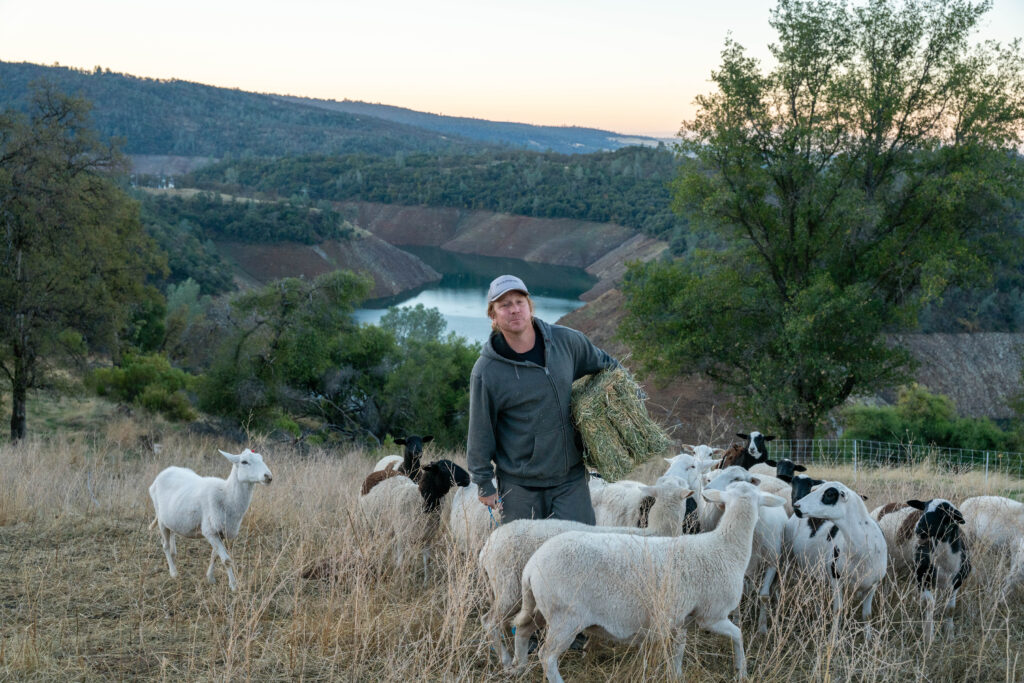
“Small farmers’ wells are usually old and not very deep,” Tchudi explained. “They were drilled in the 1960s when the water table was very high. When large farmers can drill bigger, deeper wells, and when they draw down the water supply, the small farmers get left behind, and they’ve got dry wells, and they cannot afford to repair it or drill a new and deeper well.”
Now, all the small family farmers within TWD have to pay the fee to support the district’s operation, yet the benefit for them remains unseen, he said, adding that the small farmers he talked to have no interest in being part of TWD, but have no choice “unless they pay about $1,000 to apply to opt out.”
“Small farmers are working so hard just to stay afloat just to provide food for our community that they don’t have the time to break away and waste three hours in a water policy meeting,” Tchudi said. “But their voices need to be heard.”
Recharge: “Privatization is not inevitable”
During the panelists’ presentations, recharge — a practice of directing surface water, such as river flows or stormwater into the ground so it can refill underground aquifers — was discussed as a solution to tackle groundwater sustainability.
However, Jim Brobeck, a water policy analyst of AquAlliance, an organization dedicated to protecting North State ground water, cited a 1975 court case and raised concerns about what recharge implies for water ownership legally.
“It [the court case] dissolved the right of overlying landowners to pump groundwater and gives that privilege to the agency that recharged the groundwater,” he added.
“In 2020, the attorney for the Vina Groundwater Sustainability Agency issued a comprehensive white paper outlining the legal consequences of engaging in experimental recharge programs. The water in the aquifer would no longer be owned by the public, while the recharger may exercise full control over that water.”
During the Q&A session, some audience members also brought up the matter of water ownership.
Buck acknowledged those concerns but said aquifer privatization is not inevitable.
“There can be ownership of water if you have surface water,” Buck said. “And you do the work to put that surface water into the ground, and that is still your surface water stored underground.
“[But] in the Vina Subbasin, these projects are being pursued for the benefit of sustainability of the subbasin. It’s a conjunctive use approach. The Vina GSA can provide landowners with surface water that offsets their groundwater pumping. It can be set up so the landowner does not receive the right associated with that [conjunctive use]. … it changes the operations at the landowner level, and recharge occurs.
“So privatization, in my understanding, and talking to legal counsel and thinking about these projects, is not inevitable,” Buck said. “That’s an important one that is still kind of in the works.”
Buck later told ChicoSol in an email that the Vina GSA is exploring “the acquisition of surface water supplies to promote conjunctive use and/or recharge of the local aquifer.”
Brobeck, however, also noted that some recharge projects require lowering groundwater levels first to create storage space in the aquifer—a process that might further harm ecosystems and the environment, causing subsidence, streams going dry, shallow aquifers disappearing.
Future water exports?
Giezentanner also addressed the audience about the regulatory guardrails facing TWD, including a condition set by the Local Agency Formation Commission (LAFCO) that prohibits the district from exporting groundwater outside the Vina or Butte subbasins.
Michael Nalin, an audience member, asked for more detail.
Nalin said LAFCO had advised changing the language to ban the export of any water from Butte County — not just groundwater — a recommendation that was ultimately rejected.
“I think that’s what makes people worried about the possibility of permits in the future that allow us to export surface water,” Nalin said.
“So what is the reason that that language was not included?” Nalin asked.
“That’s a good question. I don’t know,” Giezentanner said. “Several years ago, our attorney said, ‘Look, do it this way.’ So that’s the way we did it.”
“Against LAFCO’s advice?” Nalin pushed.
“It’s a political process where you go through, and you have staff involved, you have interests involved. Just because the staff says something doesn’t mean you do it, right?” Giezentanner answered.
“There’s always negotiation on these things, but that was the recommendation from our attorney,” Giezentanner added. “It’s still a pretty sweeping provision.”
Yucheng Tang is a California Local News Fellow reporting for ChicoSol.
5 Comments
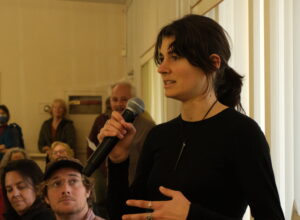
Yucheng’s photos illustrate the story so well because he actually captured action at a public meeting. He caught as much perhaps as some photographers do at some sports events! I’m impressed. I particularly like the second picture in which I can almost hear Anne Dawson talking. Certainly the people around her are listening intently because I see their heads tilted toward her. In another photo, I see action in Katie Hawley’s expression and hand gestures with audience members obviously paying attention to her words. Even the picture of people seated around a table (at the top of the story) shows engagement with one man studying some papers, another talking and two women listening. It get the feeling that something important is being discussed in these three photos. They represent the work of a good photojournalist – who, by the way, is the same journalist who had to pay close attention to the issues so he could write a story. While focusing his camera on what was happening, he was also listening to everything said. Yucheng also told the story with words and pictures. Good job!
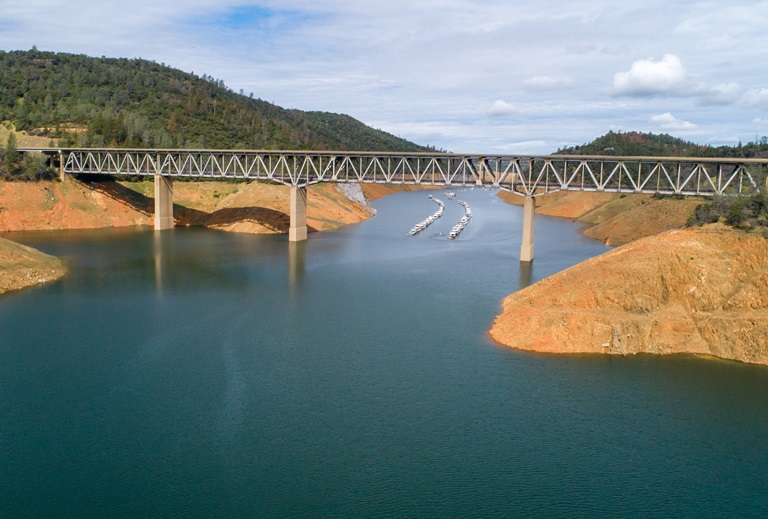
PS: The fourth photo illustrating this story – courtesy of Cheetah Tchudi – also provides a beautiful landscape with man, animals, land and water. It too adds to the report. I hope ChicoSol readers take the time to find out what was going on in the Tuscan Water District. Read the story (and enjoy the photos).
The Public Policy Institute of California predicts that Butte County’s ordinance that slows down groundwater transfers should be erased by State legislators since the aquifer is now “protected” by SGMA (Sustainable Groundwater Management Act). But the Union of Concerned Scientists observed “Unfortunately, many Groundwater Sustainability Agencies have been dominated by the historic powers in the region, and the implementation of many plans as currently developed would favor those with the strongest voices, the most money, and the most political power.”
The PPIC complains about delays in water transfers:
“In the absence of state regulation of groundwater, county ordinances have protected local parties against injury from groundwater-related exports. In Butte County, for instance, it would take 18 months to go through all the steps to obtain a permit for a same-year groundwater substitution transfer. Once GSAs establish sustainability plans that address undesirable impacts of pumping, it should be possible to ease the coarser restrictions on this practice found in most county ordinances—which effectively preclude trades if they entail water leaving the county. If counties with restrictive groundwater export ordinances fail to amend their laws to conform to SGMA, the legislature should consider preempting local laws that discriminate against out-of-county uses or place undue burdens on groundwater and groundwater-substitution transfers that would not jeopardize sustainable groundwater management of the source aquifer.” https://www.ppic.org/publication/improving-californias-water-market/ County export ordinances prevent beneficial trades.
Many thanks for this detailed article about our local groundwater issues.
Sadly, it is clear that the concerns driving the strong opposition to formation of the TWD are still in place. With the undemocratic voting system of one vote per acre of land, small land owners with shallow wells did not stand a chance against the votes of “Big Ag”. The crucial point is that large land owners who water hundreds of acres (or thousands) and draw from deep wells can easily and legally draw down the groundwater level below the reach of shallower wells – so the shallow wells run dry BECAUSE of the impossible competition with large farms for groundwater. The 30′ well that my farm depends on for water to provide food for the local community could be pumping air while the neighboring large farm has no problem watering their 600 acres of almonds to ship overseas.
Sadly too, the Butte County Supervisors and Butte County Water and Resource Conservation are committed to Big Ag and will not budge. I hope that somehow, this fight is not over!
(my 12-acre farm)
This is one of the most thorough and effective news articles I have ever seen written on this topic. Very grateful and impressed by Yucheng Tang’s skill in picking up the complicated threads of this story and giving due weight to the perspectives of those most vulnerable to well failure in the coming years.