
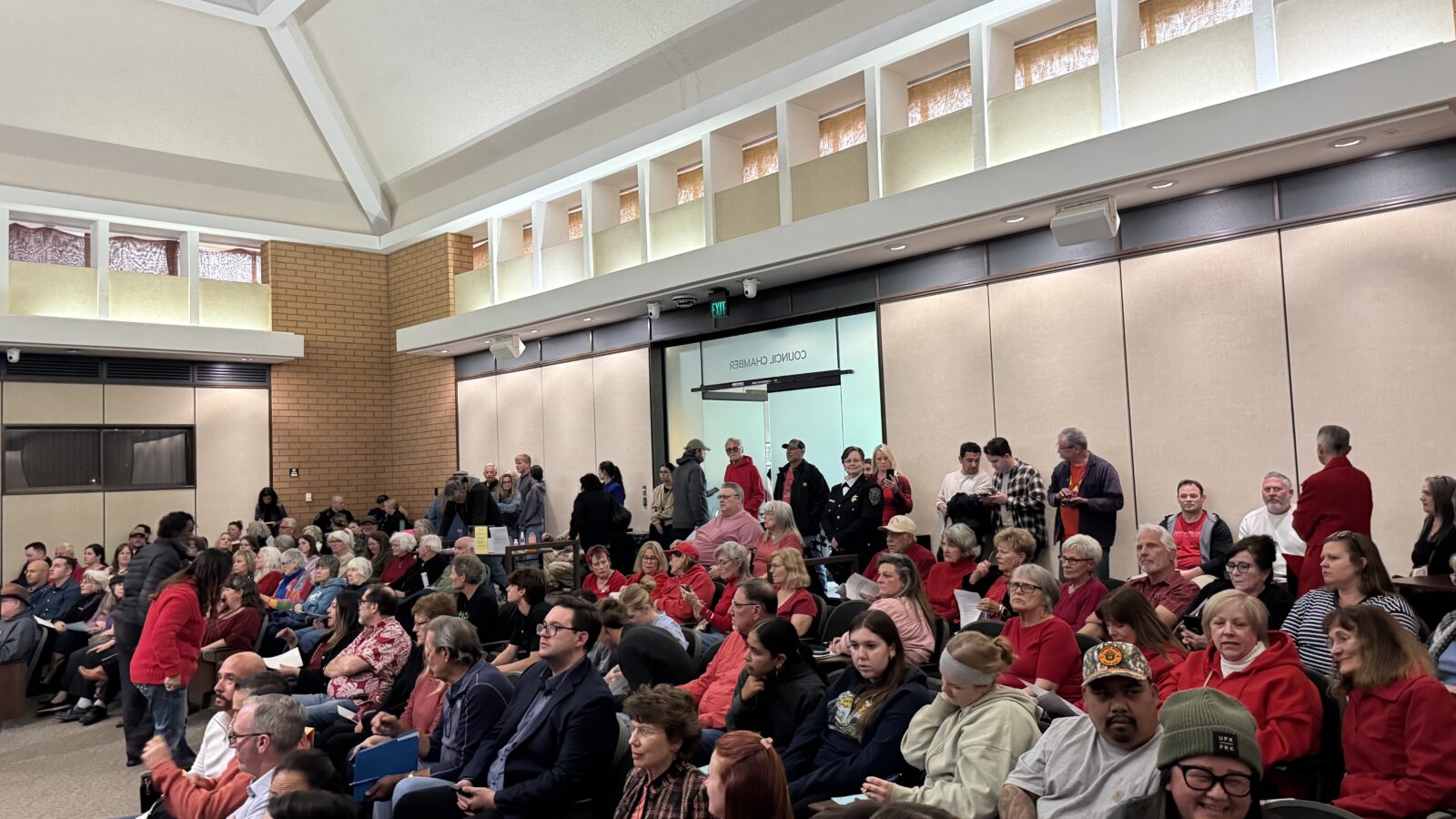
The recommended downtown redesign plan, Alternative 1, again failed — after a four-hour session — to win approval from Chico City Council, leading to another stalemate over revitalization.
The Council produced a tie 3-3 vote on Alternative 1, even after 70 members of the public spoke at the podium, with about two-thirds in favor of the plan. Alternative 1 would create protected, one-way bike lanes by removing one of three lanes on Broadway and Main streets.
Public comment saw the second-highest turnout of any City Council session. There were 77 sign-ups, but seven potential speakers left the packed chamber during the public hearing. Some members of the public were asked to listen from the “overflow” room.
Many speakers compared downtown’s Main Street to a highway and said its design leads to dangerous situations, and even accidents, that could be mitigated by removing a lane. This sentiment was shared even among some of the speakers who opposed Alternative 1. Some called for shrinking the lane sizes to reduce speeds.
“Downtown Chico is like a highway thoroughfare,” said speaker Julie Keener. “I would like downtown to be a destination, not a thoroughfare. Let’s plan for the future. What an amazing opportunity we have.”
Without approval, the City will miss out on the Active Transportation Grant that requires an application by June 22. The grant would help fund a majority of the project outlined in Alternative 1, excluding landscaping. The City would also need to find a way to match the grant by 12 to 20%.
Public Works Director Brendan Ottoboni said Alternative 1, of three plans that were prepared, would likely be the most competitive for the grant program.
Mayor Kasey Reynolds, Vice Mayor Dale Bennett and Councilmember Michael O’Brien — who each voted no in the April 7 meeting — said new information came to light in the April 21 meeting, such as Enloe Medical Center’s opposition. They again opposed Alternative 1.
Similar to the previous meeting, councilmembers Addison Winslow, Bryce Goldstein and Katie Hawley voted for Alternative 1. Councilmember Tom van Overbeek recused himself because he owns downtown property.
Suzie Lawry-Hall, director of marketing and community outreach at Enloe, said Main and Broadway streets provide the quickest access from south and west of downtown and to Durham, something that would be affected if a lane was removed.
“Our concern is that our perspective has not been adequately considered,” she said. “Nor have we been asked for additional input as a stakeholder.”
But Noel Carvalho, project manager for Public Works, told ChicoSol several special meetings for stakeholders were held. Throughout the process, Enloe hadn’t been present, and this meeting was the first he had heard from the city’s only hospital.
ChicoSol reached out to Enloe for comment and Enloe issued a statement this afternoon. The statement notes that Enloe Health “is not opposed to the revitalization” effort in principle.
Some speakers argued that elimination of a lane could affect response times for first responders, while others said the plan would make downtown safer by slowing down traffic.
Several speakers were parents who wanted a more bike-friendly downtown for their children. High school teacher Jon Tyler said he has a daughter learning to ride a bike.
“My daughter and I love riding bikes, we do, and we want to get around town wherever we can on our bikes,” he said. “She’s a new bike rider, though. There’s no way we can bring her downtown for the next year, at least.”
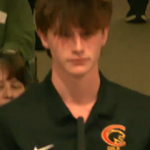
Anton Carrio was one of many Chico High School students who spoke in favor of Alternative 1.
“While I can’t speak from a business owner’s perspective, I can speak for Chico’s youth,” Carrio said. “To us, downtown is more than just a place; it’s the heart of our community.”
Some community members voiced frustration with what they saw as a lack of information and haste in the project’s consideration.
However, the City has held several outreach events since spring 2025 with both stakeholders and the public, sent informational emails and posted fliers around downtown asking for feedback.
The project’s consultant, Aaron Silva, said there had been a total of nine outreach events. During his presentation, he noted that once the City was awarded the grant, there would be more opportunities to restructure the plan and hold community meetings.
Alan Tochterman, who owns several buildings downtown, told ChicoSol he wanted more time before the Council took a vote.
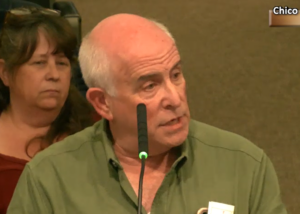
“Tonight was the very first time I heard what this was potentially going to cost,” he said during public comment. “Forty to fifty million, that’s a wide range, and the City might have to come up with 20% of that figure.”
If Alternative 1 was approved, a grant award could come at the end of this year. Work would begin several years later.
Councilmember Hawley made one final plea to her colleagues before the vote, calling on them to look at community feedback.
“If we go forward for our future, continue using our downtown as a thoroughfare, I want to be really cognizant of what that message means to people who want to stay in Chico, like me,” she said. “Because if we don’t make community-oriented decisions, I don’t want to live here the rest of my life.”
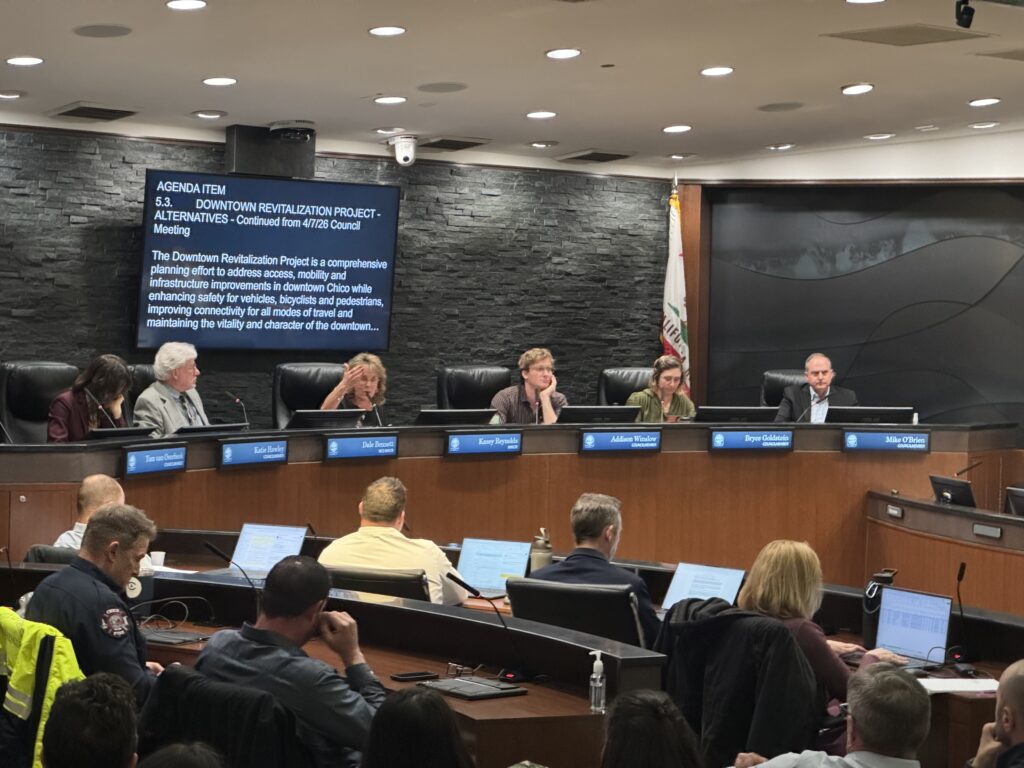
When it was Reynolds’ turn to vote, there was a long pause. Finally, Reynolds said, “I’m a no, but I want to move forward somehow on this.”
She said she was leaning toward Alternative 3 instead of Alternative 1.
Alternative 3 would remove about 49 on-street parking spaces, remove a lane, and increase sidewalk space. But there would be no protected bike lanes on Broadway and Main streets; instead this option would create buffer bike lanes on Salem and Wall streets.
Even without bike lanes, it would still cost around $40-50 million, Ottoboni said.
“I wish we would have had this in front of us two months ago so we would have had more time to continue this conversation,” Reynolds said. “But we’re here now and we have to be done in two weeks.”
Goldstein raised an objection to Alternative 3. “It would not be a good use of taxpayer dollars to put $50 million into bike lanes on streets that are already safe to bike on and not change Broadway or Main at all.”
“I feel like if we let this project die, we’re avoiding the voice of our community,” Goldstein said.
The Council didn’t bring Alternative 3 to a vote. As some members of the audience showed their frustration, Chico’s Bill Monroe told Reynolds she should have recused herself as the owner of the downtown Shubert’s Ice Cream.
Chris Hutton is a Chico State journalism major who will graduate in May.
3 Comments
I’m all for making improvements but I’m not at all sure downtown is having problems because it doesn’t have these features, or that adding them will make downtown any more viable for business, especially for nightlife. We can’t change the lifestyles of Butte County’s people by changing the street furniture. I’ve been alarmed at what was done to Telegraph Avenue in Oakland, every parking space having its own special sign and designation and hours and privileges. Placing a bike lane between sidewalk and parked cars creates new safety hazards and unexpected run-ins between bikers and pedestrians getting out of parked cars, in the bike lanes themselves. The elimination of all wiggle room from the street space takes with it the serendipity, the ease of use, for everyone, including (in my experience) cyclists. The atmosphere it creates, for me, is one of implacable control, not civility or welcome. Ms. Goldstein is quoted above saying that bikes are already plenty safe on Salem and Wall Streets. If so, why do we need bike lanes right on Main and Broadway? Will they be used for business, or just for pleasure? Because one supports the storefronts and the other doesn’t. Few people shop on bicycles; even fewer go out to eat or stay out late on bikes. With the security creepiness of indigent folks ever present, a lot of people don’t even want to walk a block or two to the garage or the lots. The kiosks added another unwelcome layer of complication that people don’t have to deal with at the mall-like retail strips. There’s a lot to be said for having it be possible to nip in and out of downtown in a car hassle-free, especially after dark. It is already pretty easy to do so on a bike, as long as you’re willing to walk the bike the last block. When I arrived here 13 years ago that was the delight of downtown – its ease and simplicity and openness. Soon after, the city began eliminating parking spaces at every major intersection, in this same misguided spirit of “if you build it they will come.” But they didn’t come, because they couldn’t park – and half those spaces taken out have no restaurants using them. Places like Santa Cruz and Berkeley, which mostly do have sufficient bike and pedestrian bourgeoisie on the ground to support businesses, have with the best of intentions nonetheless made their streets fussy and cramped and hard to navigate and lacking in any room for error, whether on bike or behind the wheel. I find it rather alienating to be in those places and would frankly rather downtown Chico stay proletarian and simple and unencumbered in its features. We have to be progressive within the bounds of the possible, and not end up alienating our own Butte County people from downtown even more than they already have been. Downtowns aren’t parks or museums; either they have bustling, organic civic life and and money changing hands, or they just snooze and disappoint and decay. That could easily be the outcome of Proposition 1, even after spending $50 million ripping up pavement. Imagine what that much money could do as seed money or loans for cool new businesses and residential buildings downtown instead.
It is remarkable that the conversation to revitalize downtown does not include more effectively addressing our deadly, yet preventable, Shelter Crisis. For a fraction of the money we’re spending on sweeps we could have a tiny home for every unsheltered person in town; put a tiny home village on the vacant land north and south of town would help clean up downtown. Contact the City Council, P.O. Box PO Box 3420 Chico, CA 95927, to direct staff to use State Statute 8698 and get going with the NSST Proposal for Safe Spot Communities like other towns have done. The NSST tiny homes are waiting empty, with unsheltered women dying outside. That’s a shame.
Watching the Chico City Council struggle is difficult. One member often appears confused. Some members who support the police seem unaware of their white privilege, and the youth movement faces resistance when they bring up new ideas. City Manager Sorenson remains silent as usual. The Public Works manager looked visibly upset. The new city attorney did not contribute. Overall, it was a disappointing example of poor leadership.