
Elizabeth Isaacs, a long-time resident of the Alternative Camping Site, has been worried about her future since the city announced its plan to shut down the site in January 2027.
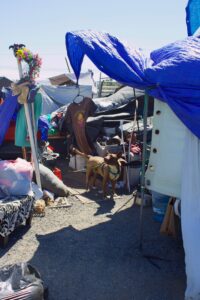
“I try not to think about it,” Isaacs told ChicoSol on a sunny Friday morning while standing beside her tent. “I try to just live daily. I don’t have a plan yet.”
The harsh sun forces Isaacs to squint constantly. She said that the heat and lack of shade often drive residents at the site into their tents, making them less likely to come out and spend time with others and leading to more isolation.
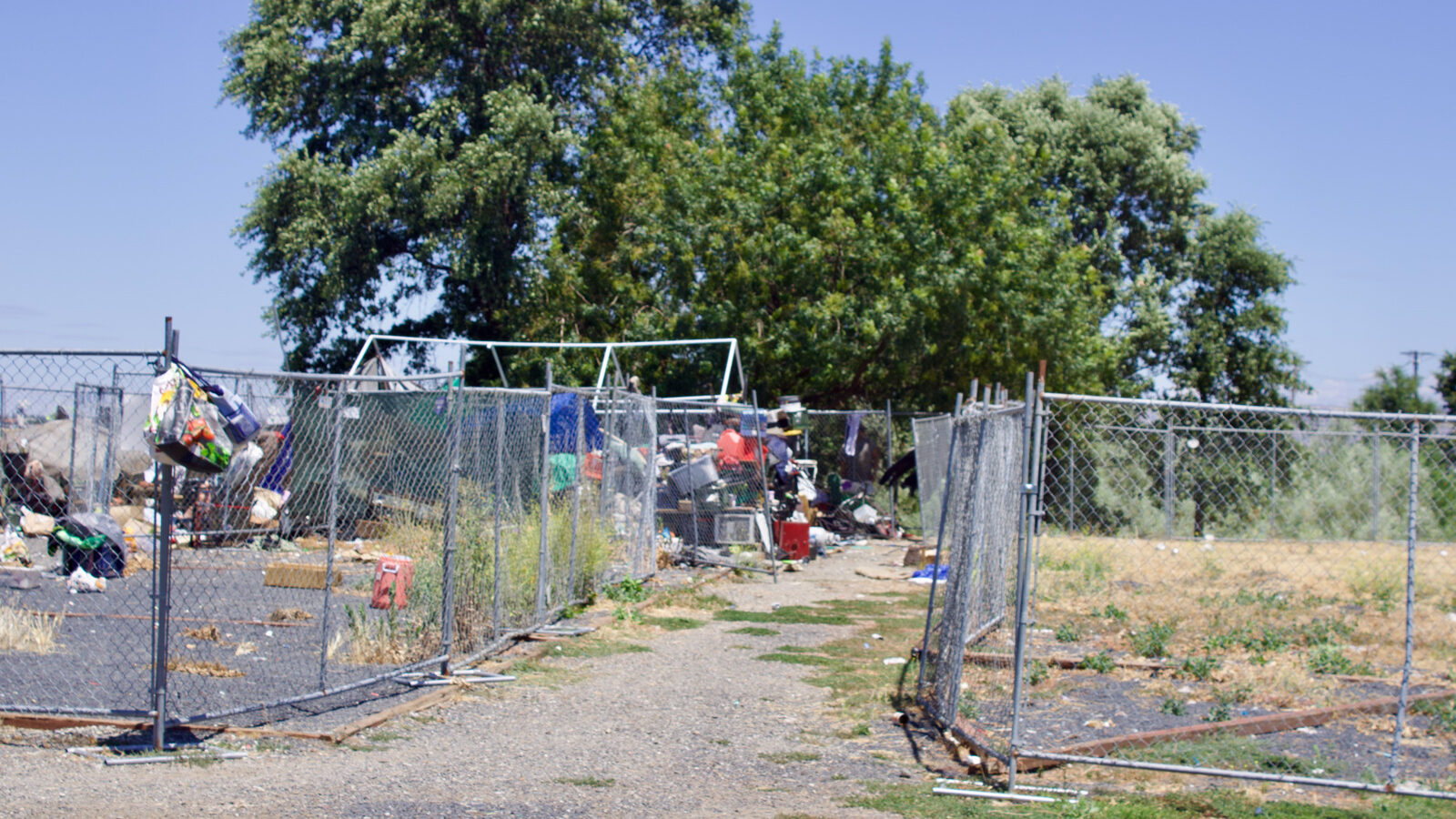
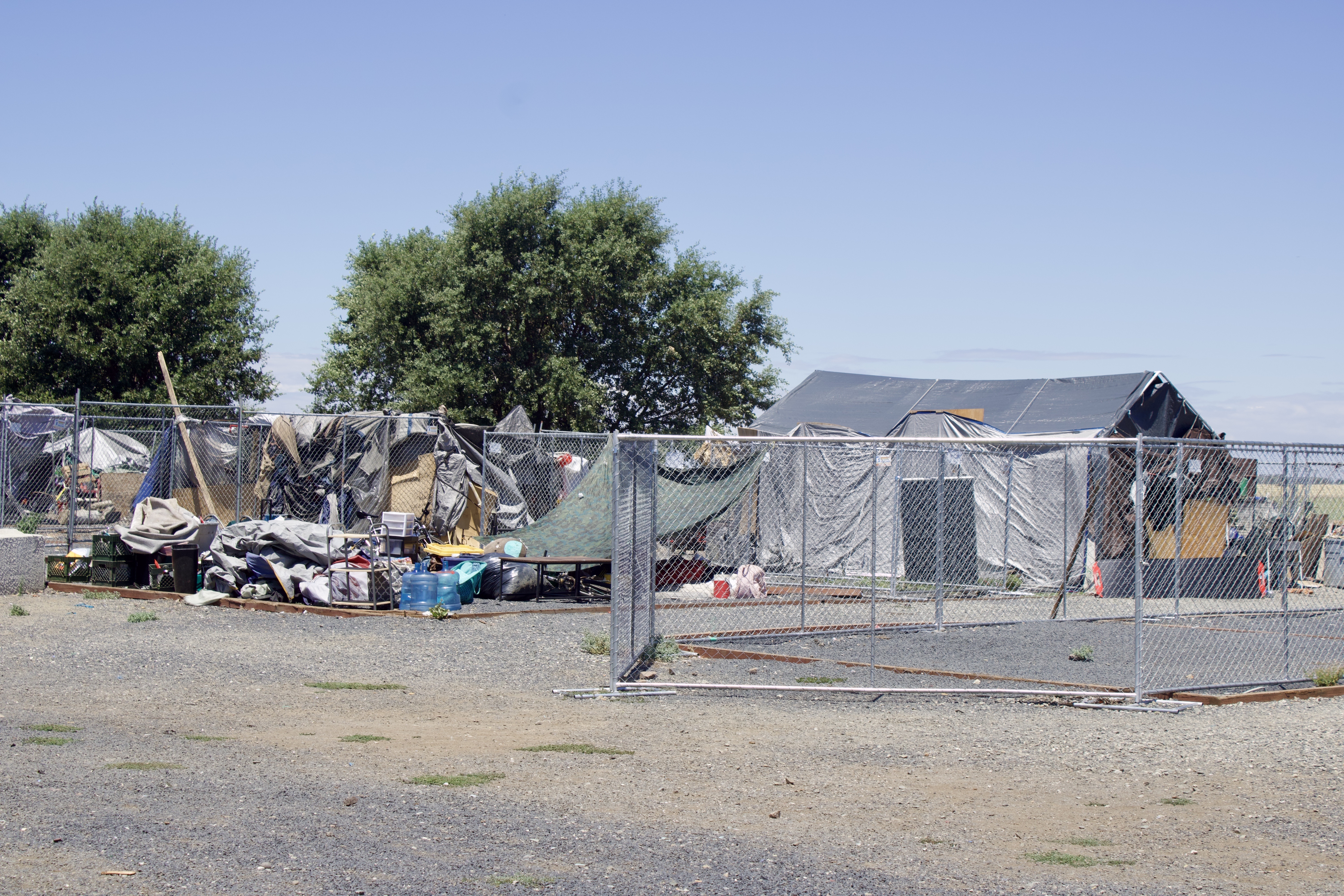
The Alternative Site, a corner lot at Eaton and Cohasset roads, is enclosed by a chainlink fence, and the ground is covered in gravel. Designated residents live in tents within designated 20-by-20-foot spaces. The site offers only the most basic amenities: a few portable toilets, a water hose, two barbecue grills and a dumpster.
The city established the Alternative Site under the Warren v. Chico Settlement Agreement, which required that it provide a location for people who don’t qualify for the Torres Community Shelter or the Genesis pallet shelter. The site’s closure comes as the settlement agreement is set to expire in January 2027.
In practice, the site also accepted people who refused to stay in either shelter. Charles Withuhn, who runs the North State Shelter Team that provides weekly shower service for residents at the site, recalls that at one point more than 50 people were staying there.
Several of the seven remaining residents, including Isaacs, told ChicoSol they fear they will be pushed back to the streets once the site closes. Most have lived unhoused for more than five years, and adapting to a managed shelter environment with limited space and more rules can be challenging.
The 2025 Point-in-Time survey found that 25 percent of participants reported not using shelters because they “feel overwhelmed being around so many people,” while 18 percent said they “feel unsafe.”
As a result, the residents say they would rather camp in places such as a church parking lot, along the creek in Lower Bidwell Park, or elsewhere than stay in a shelter.
Some housing advocates predict that the site’s closure will leave at least some of its former residents back on Chico’s streets and in other public spaces once again.
Withuhn said he understands some of the reluctance to enter shelters and voiced concern about what he calls “ineffective” way to tackle homelessness.
“If the Alternate Site camp is closed down, and then if we don’t provide a new place for the campers to live in, such as a tiny home or some sort of managed campground situation, we are going to be spending a lot more taxpayer dollars on more sweeps or jail,” Withuhn said.
The site has long been the subject of controversy since opening in February 2023. Nearby neighbors have repeatedly voiced concerns about safety at City Council meetings.
“There’s going to have to be some accountability” — Erik Gustafson
Hostility toward homelessness in the city has also extended to the site itself. In 2023, when a ChicoSol reporter visited the site, someone in a passing car fired a BB gun at a group of people at the site.
As a result, even residents at the site who may be viewed as troublemakers worry about their own personal safety and the security of their belongings. They said many problems were caused by unauthorized campers and complained that the site’s living conditions had remained inadequate and largely unchanged for a long time.
Now that the city will be free to forge a new direction with the expiration of the Settlement Agreement, it will shut down the Alternative Site, and instead, stress the importance of accountability on the part of unhoused people and enforce the ordinances banning public camping.
At a May City Council meeting, Assistant City Manager Erik Gustafson said that a “high utilizer service resistant team” would be formed to work with the people who remain on the streets after the closure of the Alternative Site. The responsibilities of this team would include enforcing anti-camping ordinances and “clean Chico’s public spaces.”
“We’ve deployed a whole lot of compassion, and I think there really has to be a time for accountability,” Gustafson said. “It’s those folks [who] continue to behave badly, break the rules, and don’t want to get into the program. There’s going to have to be some accountability associated with it, too. ”
“It shouldn’t be a crime to be homeless”
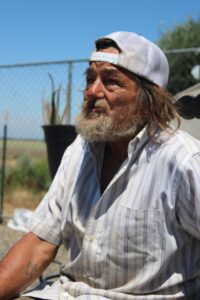
Timothy Shelley, a resident of the site, worries that once it closes, he could be arrested for sleeping on the streets during law enforcement sweeps.
He was cited “three or four times” for setting up a tent in a public space before moving to the Alternative Camping Site three years ago, he said.
“It shouldn’t be a crime to be homeless,” Shelley said, adding that the government should not criminalize people just because they are “down on their luck, or they don’t have enough money to pay rent, or they just can’t get a house.”
Shelley once stayed at Genesis for a few hours but found he did not like it there. He compared staying there to being in an “internment camp.”
He returned to the streets before police officers persuaded him to come to the Alternative Camping Site, where he has remained.
Although the Alternative Camping Site is “not much better” than the pallet shelter, Shelley said it gives him space to move around and a greater sense of freedom. When this reporter met him at the site, a few friends were visiting.
He came to Chico to participate in the Salvation Army’s Adult Rehabilitation Program, which helps participants combat their addictions, build the work and social skills needed to re-enter the workforce. After graduating from the program, he found a job as an equipment operator, met his girlfriend and was ready to start a new life.
Later, however, he was forced to leave the house he had been renting and planned to buy. Around the same time, he injured his back at work and could no longer continue working.
He has been homeless since — for eight years.
Shelley’s biggest complaint about the site, he said, is the lack of shade. Two years ago, when the temperature reached 115 degrees, he sat in his wheelchair in the hot sun all day just to prove that nothing could beat him and that he was strong enough to live outside.
Shelley also struggles with some of the site’s rules. He understands that rules are necessary, but still finds them difficult to accept and follow. One challenge, he said, is keeping all of his belongings within the 20-by-20-foot space.
Withuhn said that instead of the city unilaterally introducing and enforcing rules, it would be better if campers could work with the city and nonprofit organizations to discuss and decide on the rules together.
“I’m meant to be out here”
Isaacs, 45, said she has been unhoused for almost 16 years, ever since her parents kicked her out because of her drug use. She described her past behavior as a “stupid thing.”
She said she has become accustomed to living outdoors after so many years of living unhoused.
“I feel like maybe I’m meant to be out here for whatever reason,” Isaacs said. “I could stretch here. Living inside walls is stifling, and especially the pallet (shelter), because it’s very small and they (the city and the shelter’s staff) want you to be in that with your partner and all your animals.”
Each cabin at Genesis measures roughly 7.5 by 8.5 feet.
“It looks like an above ground cemetery,” Isaacs said, adding that she also doesn’t like the “mothering” style of the pallet shelter.
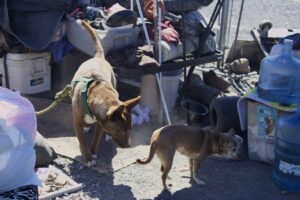
She and her boyfriend have four dogs, one of which has been with her for almost 16 years. She said she will not give up her dogs in order to enter the Torres Shelter, a congregate shelter where only one pet is allowed for each resident.
Isaacs wears wrappings on her legs because she has lymphedema, which causes swelling and discomfort. She rarely leaves the site because of the pain. In the past, when more people lived at the site, she could ask others to go to the corner store and pick up things for her. She misses that time.
Isaacs is working on her application for Social Security Disability Insurance (SSDI). She worries the benefits will not come through before the site closes.
Two new residents moved in on the day this reporter visited. Their arrival also triggered speculation, with some residents, including Isaacs, wondering whether the city still plans to close the site.
“Why would they do that if they’re just going to shut this place down?” Isaacs said, adding that it’s “all guessing and wishful thinking.”
“It’s like you don’t want your kids to know the Christmas presents,” she added.
The city’s new direction
While the residents still hold some hope, the city plans to shut down the site, implement additional rules at Genesis — such as incorporating a curfew — and create the so-called service-resistant team, Gustafson has said.
The team will “coordinate across multiple service providers to play targeted intervention strategies, improve accountability, [and] reduce repeat offenders,” Gustafson said. The team would build on Chico PD’s existing Target Team responsible for anti-camping enforcement and outreach to the unhoused.
“The overall goal is to clean and sustain Chico’s public spaces,” Gustafson said.
These proposed changes have raised concerns that stricter shelter rules could discourage some individuals from entering Genesis or remove more residents from Genesis, leaving them with no alternative places to go, particularly as the Alternative Camping Site is scheduled to close.
Councilmember Katie Hawley asked at the May meeting what the city’s plan is for residents who remain at the Alternative Camping Site if it ultimately closes. She noted that some residents have been unable to move into Genesis because they have more than two pets or because of other barriers, including criminal histories.
Amber Abney-Bass, CEO of the Jesus Center, said one resident has been offered a placement at Genesis but has not been ready to move because of mental health challenges. Two campsites are occupied by three residents whose number of pets exceeds the Genesis limit, while another resident has been difficult to place because of “some of the justice involved issues surrounding that person.”
Abney-Bass said the Jesus Center’s case management team provides services at the site two days a week.
“Our goal is to be able to have all of those people on the road to what will come next for them, as opposed to just turning up the lights and wishing them all,” Abney-Bass said.
Councilmember Addison Winslow asked what the city would do with people who are removed from Genesis for breaking the rules.
Gustafson said the service-resistant team would encounter those individuals during enforcement operations.
“I think that they’d be ideal candidates for this team to really spend some or deploy some special attention to try to find them a path forward,” Gustafson said.
Winslow continued by asking whether that meant putting them in jail.
Former City Manager Mark Sorensen responded to Winslow’s question indirectly.
“All of these folks have different stories, different reasons for being in the position they’re in,” Sorensen said. “So I don’t think we can give a blanket answer.
“That’s where the Target Team really shines, because they typically know these folks on a first name basis and have a pretty good understanding of what their issues are and can at least try to get them moving in the correct direction,” Sorensen continued.
Courage
Like Isaacs, Shelley is also completing the paperwork to apply for SSDI. He was diagnosed with mental health conditions several years ago but needs an updated diagnosis to qualify for benefits.
Now he earns a small amount of money by recycling every night, and only at night.
“Only that way people don’t fuck with me,” he said.
Two Chinese characters are tattooed on Shelley’s forearm. The word means “courage” in Mandarin (勇气). Shelley said the tattoo was done by his late girlfriend.
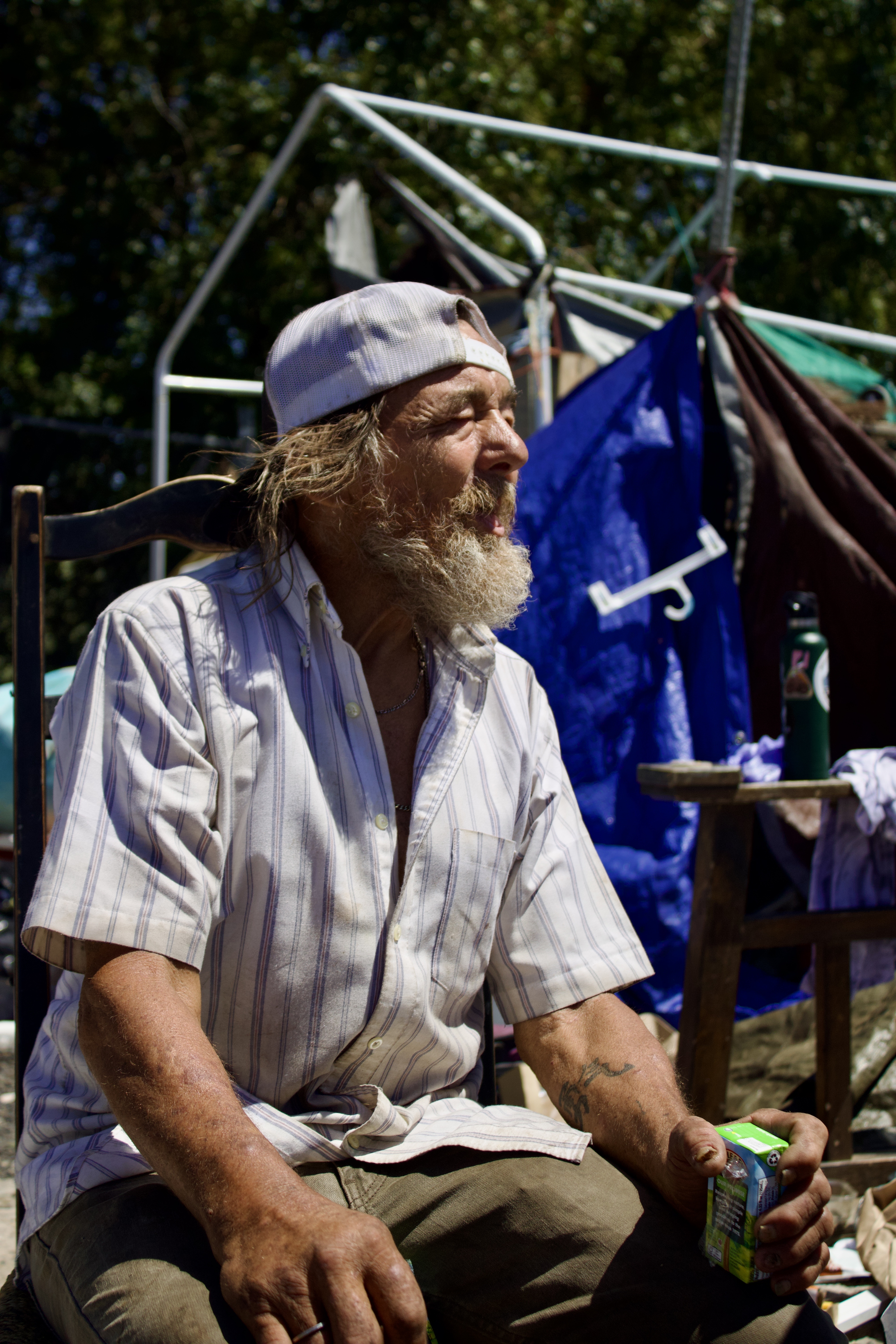
He and his girlfriend had the same two characters tattooed on each other’s arms. They did it for each other. They chose the word “courage” to remind one another to keep facing life’s challenges, but they wanted the message to remain private — something people around them would not understand — so they had it tattooed in Mandarin.
In a town without many Chinese residents, it became a secret shared only between the two of them.
Then their lives unraveled. They lost their home and their steady income, and together they drifted into homelessness.
Three years ago, his girlfriend died unexpectedly, leaving him alone with the tattoo they once shared.
Shelley doesn’t yet know where he will go after the site closes, but he knows he will carry the word “courage” with him wherever life takes him next.
Yucheng Tang is a California Local News fellow reporting for ChicoSol.
4 Comments
I would like many dogs. I cannot afford them. I would like the government to pay for my water, sanitary needs and refuse disposal. They don’t. I would like the government to pay for my medical needs. It doesn’t. I really don’t like being near other people. Yet, I must deal with them. This problem is self manufactured. Enough.
Helen, I hope you were being facetious. You know the government pays for your medical needs, even before you reached Medicare age.
The “self manufactured” problems are solvable in “housing First” programs. “Houston, Texas, reduced it’s homeless population by more than half utilizing Housing First programs.” The amount of money it costs taxpayers to leave someone on the street is about twice the cost of housing them.
Jail can be $90 a day, that taxpayers pay. Opportunity Village is about $9 a day that the participant mostly pays. North State Shelter Team has 4 tiny homes waiting empty. Chico can do better.
Excellent, first-rate journalism. I really appreciate how balanced and thoughtfully researched this article is. It doesn’t just present one viewpoint—it gives voice to the people living through the situation, provides valuable historical context, includes perspectives from city officials, law enforcement, and service providers, and follows the discussion all the way through the City Council meeting.
What I especially appreciated was that it highlighted the complexity of the issue. There are no easy, one-size-fits-all solutions, and the interviews help illustrate why. Understanding each person’s circumstances makes it clear that lasting solutions will likely require multiple approaches, not a single blanket policy.
Whether readers agree with every perspective or not, this article provides the kind of nuanced reporting that encourages informed discussion rather than simply reinforcing opinions. Thank you for the time and effort that clearly went into producing it.