
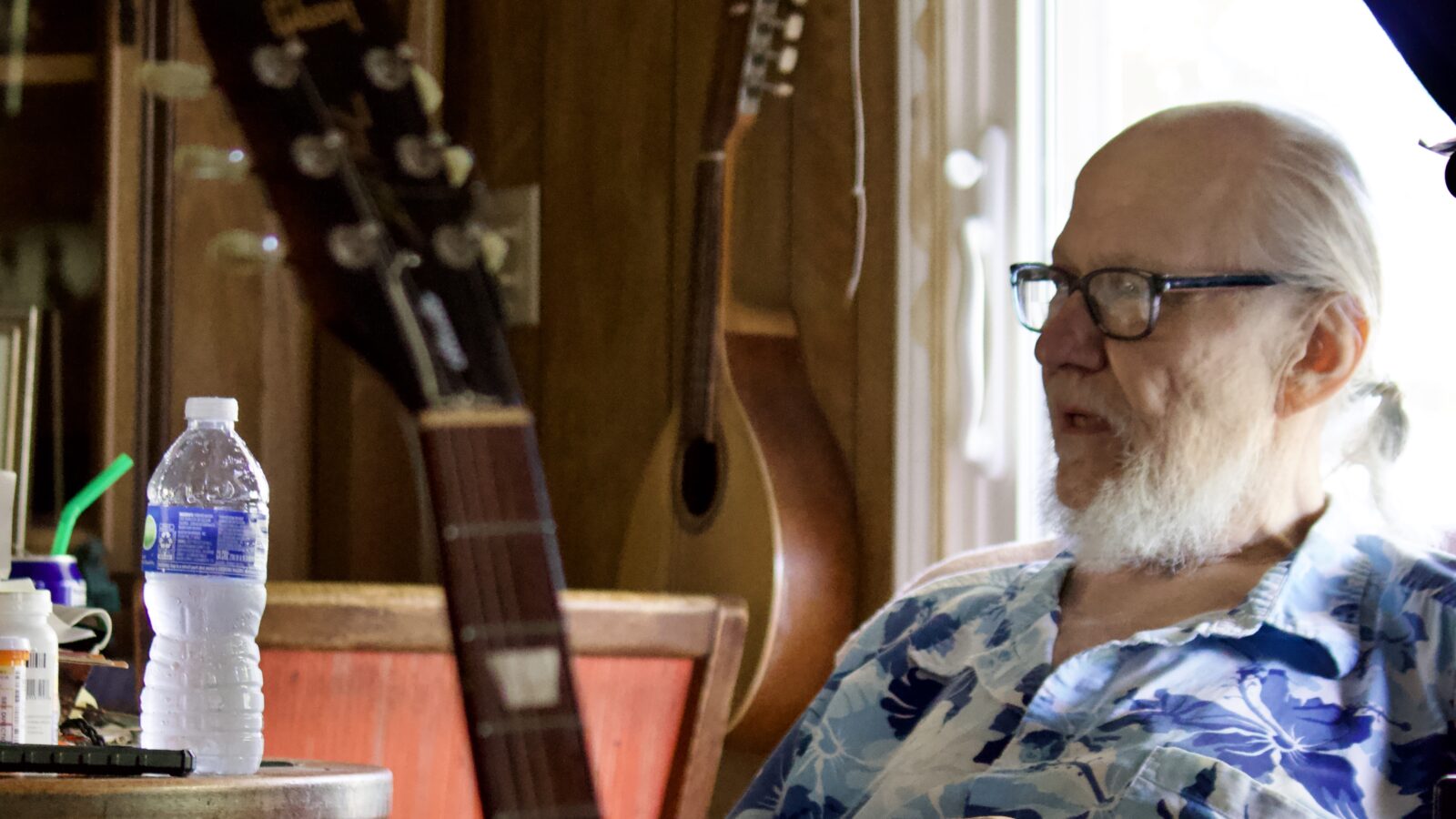
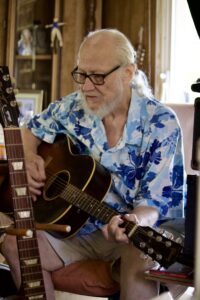
Justin Bishop’s ponytail taps the collar of his Hawaiian shirt as he strums an acoustic guitar inside a mobile home in an Oroville senior living community. The curtains are drawn. Sweat trickles down my forehead.
It’s around 3 p.m., and it’s already 90 degrees inside the 75-year-old’s home.
This is Bishop’s second day without power after Pacific Gas & Electric cut it off July 20. He assumes it was because he didn’t pay his bill of $1,259, which has been climbing for months.
Bishop said his bills have been high because he had to run three space heaters after a gas leak drained the propane tank while he was in the hospital. For Bishop, staying cool in the summer months and warm in the winter is crucial for his health. He has a medical condition in which nerves near his brain and spinal cord are damaged, resulting in pain and numbness in his hands and feet. Extreme temperatures make his condition worse.
He’s not on a payment plan for PG&E. “Not that I wouldn’t be on one, but I don’t get them on the phone,” he says.
Recently, the California Public Utilities Commission barred utility companies from shutting off customers’ power if the temperature exceeds 90 degrees for three days.
Paul Moreno, a spokesperson for PG&E, said that safety is the top priority and shutting off power is a last resort. He said typically two notices are sent; ChicoSol was able to verify Bishop received a two-day notice, but Bishop couldn’t remember if he received another one.
Moreno wrote in an email to ChicoSol: “PG&E’s focus is on implementing the new CPUC-approved temperature threshold for disconnections and helping customers stay safe and connected through payment plans, financial assistance programs and other support resources.”
He added that PG&E has given about $35 million of the committed $50 million to help customers who aren’t able to pay their bills.
Moreno said PG&E has several programs that can help low-income customers, such as its baseline plan. There are also local and county plans that can help — but Bishop said he thought it was being handled by such a program.
Temperatures exceeding 90 degrees for prolonged periods can be dangerous, particularly for older adults and people with chronic health issues. In the United States, extreme heat kills more than 700 people a year, according to the Centers for Disease Control.
It was 92 degrees on the day his power was cut off; when I visited him the temperature climbed above 100 degrees. Since May, Oroville has experienced 48 days above 90 degrees, according to the National Weather Service.
Bishop’s former at-home registered nurse called this a “life-and-death situation.” Bishop already struggles with his blood pressure and a lack of sodium, which can both be deadly, especially in the heat.
I checked the weather forecast while he told me about the long, financial support forms he has had to fill out and the long wait times on the phone with very little ever getting resolved. It wasn’t going to drop below 90 degrees for the foreseeable future.
I reached into my pocket for a piece of paper, now soaked in sweat.
Bishop said he doesn’t sleep until late at night when he can open the windows and let the cool wind bring the temperature down. A suffocating blanket of heat wakes him up around noon as the temperature builds inside the mobile home.
Bishop awoke to the power cut-off on a Monday. “I woke up, and there was no radio going on, and no lights to turn on, and I thought, ‘uh oh,’” he said.
Bishop called a friend. His friend, concerned about his health, went to check on Bishop and brought me along. I sipped ice water inside an air-conditioned car outside Bishop’s home while waiting for his friend to confirm that I could join them inside.
Soon enough I sat inside Bishop’s home, running my fingers through my damp hair.
I eyed his panting dog, Holly. She was injured recently, and had a slight limp when she walked from her bowl of water to the couch, where a single cushion had been removed to make it easier for her to get up.
Bishop coughed periodically throughout our conversation. Beside him was a table covered in bills and notices, and an oxygen concentrator to help with pulmonary issues. Without electricity, it can’t run.
Each month he receives $1,200 through Social Security, but his rent – $786 and expected to go up soon – takes up the majority of that income.
Bishop explained that he doesn’t live a glamorous lifestyle. He doesn’t eat out, sticking to frozen foods now spoiled in the fridge that was kept faintly cold by ice. By the time I left at around 4 p.m., he still hadn’t eaten that day.
His truck hasn’t worked since an engine failure. He said it was too costly to repair, so he borrows a neighbor’s car in the senior living park when he needs to go somewhere.
Last summer, in August, PG&E shut his power off because of late payments. It wasn’t turned back on for 10 days until his at-home nurse called Adult Protective Services, which paid the bill and brought Bishop water and food within two hours.
But this time, a friend who called Adult Protective Services told Bishop that the situation was an “ongoing issue,” and APS needed 10 days to investigate.
Last year, Bishop was experiencing dire health challenges; he hadn’t been able to play guitar for years.
This was not the Bishop I met earlier this week. He picked the guitar and told me about rediscovering a song he wrote, “Tomatotown,” under a pile of papers.
As Bishop reflected on his travels to more than 40 countries playing old Western music as part of a government program, I shifted uneasily in the thinly-cushioned chair, searching for a cool spot.
While telling me about his arthritis, he said: “I beat myself to death touring, carrying heavy guitars and banjos onto airplanes.”
Music is his passion. He spent much of the time talking about touring and the various instruments he has. His YouTube channel, horsesense2020, contains some of his songs and even videos of him playing the fiddle alongside people from the District One California State Fiddlers Association in Oroville.
He began to list the places he’d traveled to: “East and South Pacific; South America; Central America; Mexico; Canada; Africa; Europe; Eastern Germany.”
“It was a great career, and it was a lot,” he said. “I loved it. I hated having to give it up.”
He stopped touring and came to Sacramento for about eight years to care for his mother until her passing at the age of 95. After family infighting that he said resulted in him losing his home and money, he came to Oroville.
He almost never plays for crowds anymore. But since the multi-year period he couldn’t play, he is regaining his musical prowess. Earlier this month, he played a song at a celebration of life for his friend.
Without power, he can’t charge his phone or play his CDs. A television his friend had given him — usually tuned to MSNBC — sat powerless in the corner of the room. He told me he reads the New Yorker often; his friend later quipped that meant he had too much time on his hands.
I asked a few times what the plan was now that Adult Services hadn’t yet stepped in like last time, but each time, Bishop pivoted to another story about the adventurous life he led.
As Bishop and I spoke, his eyes brightened as he talked about the untethered life he once had, telling stories of shaking the hands of world leaders and revolutionary figures across the globe, always with a guitar close by. But when I left his home, I was reminded that Bishop is now tethered to a place baking in the Oroville summer heat without electricity.
A trail of sweat — or perhaps a tear — accumulated around my left eye while Bishop played “Across the Divide” by Kate Wolf. I’m not sure why the song hit me so profoundly; maybe it was that, despite everything, his fingers still found the chords and his voice still found the lyrics.
Chris Hutton is a recent Chico State journalism graduate and a regular contributor to ChicoSol.
ChicoSol has corrected language in the second to the last paragraph of this story to state that Bishop met “world leaders and revolutionary figures” during his travels. We apologize for an earlier misstatement about who he met.
4 Comments
Great story Chris.
I,too, found a few tears accumulating in my eyes.
What will happen to Mr. Bishop?
Ask the PUC and the Governor, who colluded with PGE to raise rates, destroy rooftop solar and ignore the needs of Californians so that PGE could rake in more dough.
I have. Thanks for the suggestion, pard’.
I’ll survive. Thanks for askin’.