
This story is a follow to ChicoSol’s Changemaker profile of Kate Transchel.
Dr. Kate Transchel recalled studying slavery in grade school, remembering that her younger self wished she had been an abolitionist in the times of the Underground Railroad.
But in a March 5 lecture at Chico State, the retired professor and human trafficking researcher said there continue to be ways to act — as did abolitionists — against forms of slavery.
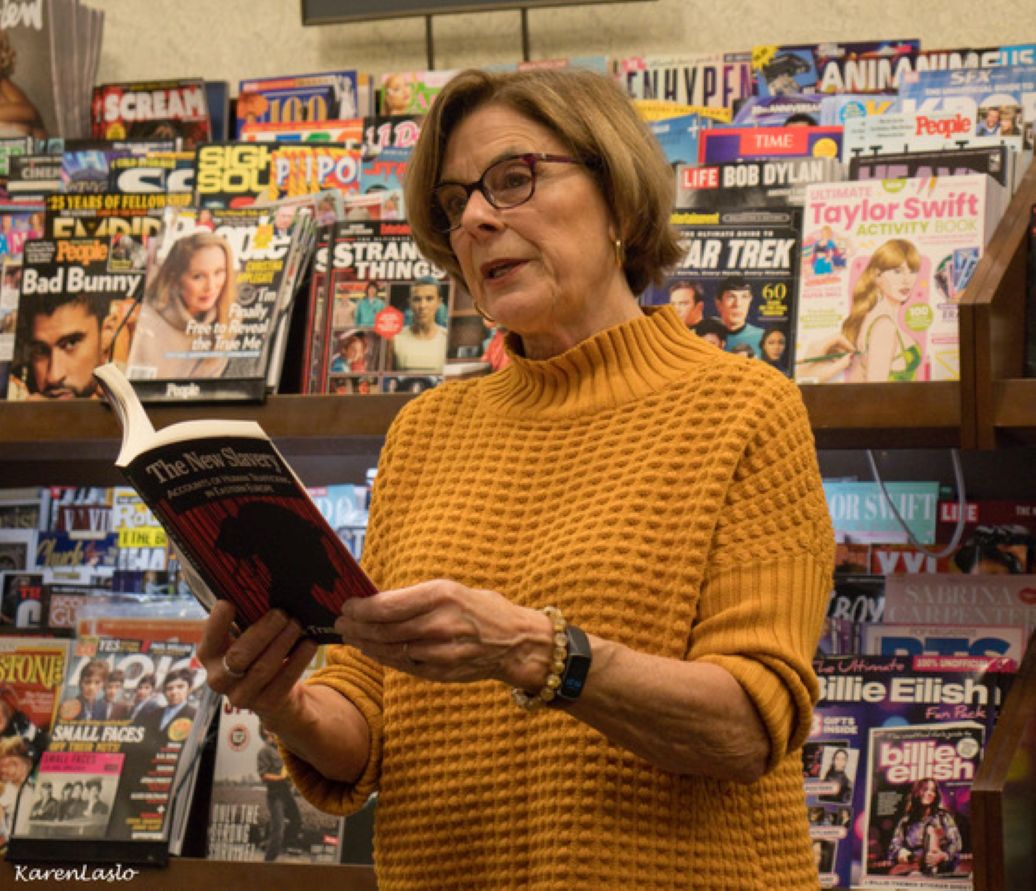
Transchel discussed modern human trafficking, the subject of her newest book, “The New Slavery: Accounts of Human Trafficking in Eastern Europe.” She described the book’s style as “documentary prose,” noting that she included transcriptions of interviews instead of inserting her own interpretations in order to tell victims’ stories as authentically as possible.
“What I’m trying to tell people through my book is that this is [a] time of slavery,” she said.
Transchel’s lecture covered a comprehensive account of modern slavery, which is more multi-faceted than most might assume: sexual slavery, labor exploitation, street begging for the profit of exploiters and even selling illegally stolen babies for adoption. She said that globally, around 50 million slaves exist on any given day, and the market nets around $150 billion annually.
Transchel noted that many people might first think of “old slavery” when asked about slavery – the enslavement of African Americans in colonial America. But “new slavery” looks much different – there is “no single face,” she said.
She said that she has faced criticism from peers for focusing on, “the enslavement of, say, a 13-year-old girl on the streets of Chico,” and how that is “not the same as the enslavement of Africans in Mississippi in the 1800s.” She confirmed that what happened then is true and horrific – but stressed that modern slavery is “different from the old slavery that we all think about.
“The result is often the same – suffering and degradation. And that’s why I call it slavery – not everyone who talks about human trafficking calls it slavery, but [victims] are socially, legally and physically degraded and unable to leave their situation. And if that’s not slavery, I don’t know what it is.”
California alone is home to three of the 10 top trafficked cities in the United States – Los Angeles, San Francisco and Sacramento. Additionally, the Central Valley is particularly notorious for farm worker labor trafficking.
Transchel commented on the Trump Administration’s dismantling of the U.S. Agency for International Development (USAID), which largely funded the National Human Trafficking Hotline. While the Trump Administration has since funded another organization to work against trafficking, Transchel said “nobody knows anything about that organization.”
Transchel advised those seeking ways to combat human trafficking to become more informed, join organizations that seek donations to fund help for victims of trafficking, purchase fair trade items and vote for officials who take a stand against human trafficking.
The Author Talk event featuring Transchel was co-sponsored by the Chico State History Club and the Department of History, and she was introduced by History Department Chair Robert Tinkler.
Students and alumni who were among about 50 people attending commented to ChicoSol on Transchel’s presentation.
History Club member Tatiana Addonizo said that though she hadn’t had Transchel as a professor, she knows her to be “super well-respected” and a “very loved professor.”
“I think highlighting human trafficking and going from a global scale to something more local is something really important for the Northern California community to focus on,” she said.
Chico State alumna Victoria Villaseñor said she had Transchel as an instructor while pursuing her degree in history. She described Transchel as a personal “inspiration” and a “good role model of the importance of studying history.”
Lexi Lynn is a journalism major at Chico State.