
This is the second story in a two-part series that analyzes three decades of county opposition to marijuana and reviews the state of legal cannabis in Chico. Read the first part here.
Even in politically liberal Chico, some people opposed a plan to authorize medical marijuana dispensaries in 2010. Only one could credibly threaten to prosecute the Chico City Council if they passed it.
“If that which is illegal is authorized as legal, you can expect to see every one of those city councilors jailed,” vowed District Attorney Mike Ramsey in an interview with Chico Enterprise-Record reporter Toni Scott.
The cannabis industry would eventually bring Chico a major new source of employment, a growing tax haul, and zero reported public safety problems. But those benefits arrived 15 years earlier in Redding, a more conservative city 80 miles to the north. That gap was largely the result of one man’s aggressive opposition — in courtrooms, in council chambers, and in law enforcement raids that destroyed businesses but produced zero criminal convictions.
On April 21, the City Council voted 5-2 in favor of Councilmember Katie Hawley’s motion to have city staff explore licensing commercial cannabis cultivation in Chico. Councilmembers Mike O’Brien and Tom van Overbeek opposed the move. If the City follows through, it would mark the furthest step yet from the era when Ramsey’s opposition kept Chico from even allowing a storefront dispensary.
Ramsey’s grip on marijuana policy
For decades, whenever the City Council considered approving marijuana dispensaries, Ramsey was there to argue in opposition. At the time of his threat in 2010, six of seven Council seats were held by progressives.
A year later, Ramsey was jeered at a meeting where the Council considered an ordinance regulating dispensaries. Councilmember Andy Holcomb, an attorney, said the DA lacked the qualifications to claim certain patients don’t have a medical need. If this were a court of law, Holcomb told Ramsey, he would object. Audience members erupted with applause, the Enterprise-Record reported.
In another 2011 episode related to a Chico cannabis ordinance, Ramsey got into a heated argument with pro-marijuana lawyer Max Del Real in the foyer of the City Council Chambers. Del Real claimed the two were touching chest to chest.
Reporter Scott explained the power Ramsey exerted over marijuana matters: “… Even if the (Chico City Council designates) particular areas within the city for dispensaries, the question of whether they are permissible comes down to one individual: Mike Ramsey. As the chief law enforcement official in the county, he interprets the state’s laws and court decisions. Ramsey’s opinion on what is and isn’t permissible by law drives the type of cases that are prosecuted in the county. And, in his opinion, any cash exchange for marijuana is tantamount to criminal conduct.”
Scott wrote those words 16 years ago. Two years earlier, in 2008, the first medical marijuana dispensary had opened in Redding, a North State city of similar size to Chico. Marysville authorized medical marijuana dispensaries in 2017 and added recreational cannabis sales two years later.
In November 2016 — 20 years after state voters approved medical marijuana use by backing Proposition 215 — they made recreational use of cannabis lawful for people 21 and older by passing Proposition 64, the “Adult Use of Marijuana Act.” The law treated all violations of cannabis growing limits as misdemeanors, but Ramsey announced his office was “still in the game of prosecuting” marijuana offenses by stacking them with environmental violations.
In August 2020, the City Council voted 5-2, with Sean Morgan and Kasey Reynolds dissenting, to legalize cannabis sales in Chico. Chico’s three dispensaries — Sweet Flower in Meriam Park, Embarc on Cohasset Road, and Oregrown on Park Avenue — opened between December 2022 and October 2023.
Revenue and results
In fiscal year 2024-2025, the City obtained $1.05 million from its 5 percent “community benefit assessment” on retail cannabis sales. During the first eight months of the current fiscal year, which will end June 30, the City took in $814,000 from the cannabis tax. City officials are projecting that figure will climb to $1.2 million for the full 2025-2026 fiscal year, which would amount to a 14 percent revenue increase over the previous 12 months.
Cannabis sales are heavily taxed. In addition to the 5 percent city assessment, marijuana buyers in Chico pay 15 percent state excise and 9.25 percent sales taxes. Roughly 2 percent of the sales tax goes to the City.
Estimates of Chico’s annual retail cannabis market vary widely. David Petersen, a co-founder of the Chico California Cannabis Company, known as C4, has put the figure at $30 million; Sweet Flower dispensary co-founder Tim Dodd has said $15 million. At a 5 percent tax rate, $1.2 million in projected revenue implies roughly $24 million in retail sales — between the competing claims.
Ramsey did not respond to a ChicoSol request for comment on claims that cannabis has brought revenue to the City without public safety problems.
The case for expansion
Among those speaking at the April 21 City Council meeting was Petersen, whose company packages cannabis and produces edibles and concentrates sold by retailers. All C4’s products are made from marijuana grown outside Butte County.
Petersen lauded city staff for “navigating the risk, uncertainty and complexity of bringing a highly scrutinized industry” to Chico.
“Chico took a chance on cannabis and that chance has paid off,” Petersen said. “The program has generated millions in revenue and, more importantly … not resulted in increases in crime or public safety issues that many were concerned about early on. By most measures, it has been a responsible and effective rollout.”
Petersen said society’s use of legal marijuana outlets is growing and that “Chico State this year received grant funding to study cannabis.” He called on the Council to permit commercial cultivation.
“Allowing businesses to cultivate, manufacture and sell locally keeps more value here — more jobs, more investment, more taxable revenue,” Petersen said. “More participation doesn’t weaken the system, it strengthens it.”
Charlie Burton, a founder of Chico’s Best cannabis products, said he has long been involved in marijuana discussions with city staff. From the beginning, “we didn’t want to bring in Budweisers; we wanted to build Sierra Nevadas,” he said, referring to Sierra Nevada Brewing Co., the craft beer giant founded in Chico in 1980.
“Cannabis is here, and it’s going to stay. It’s not going anywhere,” Burton said. “It’s going to build, and we’re going to import it or we’re going to export it. Anyone in business knows you make much more exporting.”
Burton advocated for broad industry expansion, including a testing lab to ensure product safety and cannabis “consumption lounges” to replace bars that close downtown.
Commercial cannabis cultivation is already big business in the Shasta County cities of Redding and Shasta Lake, generating in 2023 nearly $30 million in value and surpassing such agricultural staples as hay and cattle. That year, 45 licensed cultivators harvested nearly 50 pounds of cannabis. All commercial grows in Shasta County are required to be indoors.
In a March 23 report, Hawley argued that “absolute bans on commercial cannabis cultivation at a municipal level rarely prevent the adverse impacts that unlicensed cultivation fosters, such as criminal activity, nuisances, and pollution.”

Hawley said she would prefer outdoor or “vertical indoor” cultivation practices that are energy efficient without creating residential land-use conflicts, such as complaints over smells.
The existing dispensaries urge caution
Chico’s three dispensaries favor allowing well-regulated commercial cultivation. However, the focus of their representatives’ comments to the City Council on April 21 was on dissuading the City from increasing their number. Councilmembers Hawley, Addison Winslow and Bryce Goldstein favor exploring dispensary expansion but lack the fourth vote needed to move forward.
Sweet Flower’s Dodd and Embarc’s Josh Lewis used the same admonition: “If it ain’t broke, don’t fix it.” Both spoke of instability and tax revenue losses from the closure of thousands of dispensaries statewide. They blamed an oversaturation of cannabis storefronts.
“We are, if I may say, a model of responsible retail,” Dodd said. “And I would say that Chico has a model cannabis program.”
Lewis called on the Council to “maintain the current structure and codify the limit at three retailers.”
The number of dispensaries operating in Redding peaked at six but appears to have fallen to four.
The public safety debate
Councilmember O’Brien said he opposes legalizing cultivation due to “the emerging data on the impacts of marijuana on the developing brain.” Some studies have found a connection between regular use of high-potency cannabis and increased risk of developing schizophrenia, especially for younger males.
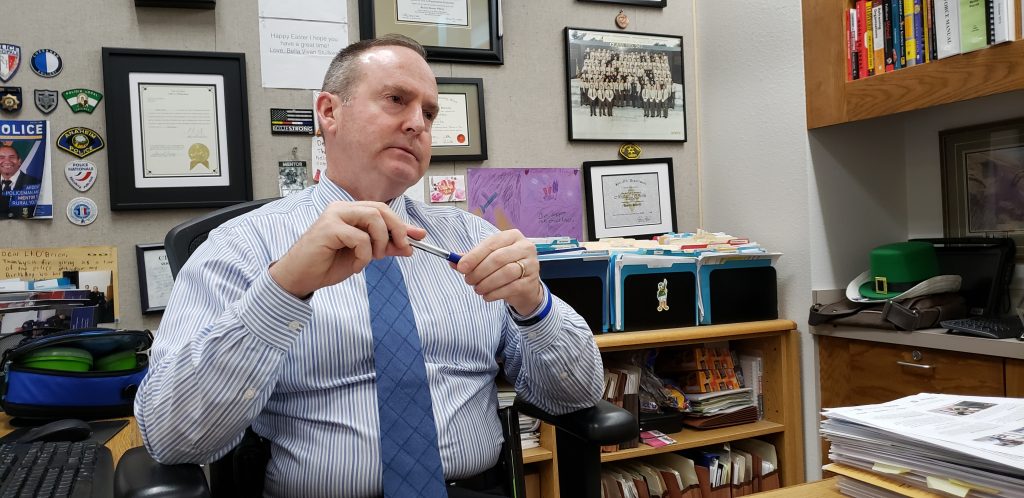
O’Brien, who directs the Butte Interagency Narcotics Task Force, opposed legal marijuana operations during his five years as Chico police chief. In 2010, both Chico PD and the task force O’Brien now leads were involved in a massive law enforcement raid on eight Chico-area marijuana dispensaries that resulted in zero criminal convictions. In August 2020, a couple months after O’Brien’s retirement as chief, the Council voted to legalize cannabis sales.
O’Brien argued at the April 21 Council meeting that legalization increases the black market in marijuana, while Hawley, Goldstein and Winslow said the opposite was true. Sweet Flower’s Dodd has said that Butte County does not have a problem with the black market because illegal operators tend to be plant proponents and sometimes multi-generational family growers and not organized crime like in Southern California.
Councilmember van Overbeek said he is “not a fan” of marijuana but noted that some of his friends use cannabis gummies as a sleep aid.
“My observation is that society does not have a shortage of unmotivated young people, and selling them dope makes them even less motivated,” van Overbeek said. “I’m against increasing the production of dope and having more dope dealers.”
Goldstein said that by not allowing cultivation and by limiting storefronts to a “small number,” the City is missing out on revenue with tight budgets on the horizon.
In arguing for allowing more cannabis operations, Winslow said, “the only thing we see are positive effects” and more competition could reduce consumer costs. He said it was never the City’s intention to avoid oversaturation.
“The fact that some cities allowed more businesses than were able to succeed does not mean we need to limit it and be the government picking winners in an industry,” he said.
Winslow riffed on Burton’s reference to Sierra Nevada Brewing Co.
“What if we put a cap on craft breweries, and Ken Grossman didn’t get a permit?” he said. “Where would we be as Chico?”
Dave Waddell is a freelance journalist and contributor to ChicoSol.
1 Comment
I spoke on this at the council meeting, and I think starting with a pilot program makes the most sense. Not because Chico shouldn’t explore cannabis cultivation, but because we should be realistic about the impacts before going all-in. And to be clear, I’m more worried about the cultivators than the city.
People already raise concerns about farming impacts, water use, odors, traffic, and energy demands. Cannabis can be a high water and high electricity crop, especially in Chico’s summer heat where indoor climate control is often needed. I 100% recommend own well, and solar, or total off grid if at all possible.
A pilot program would let the city and the farmers study real-world impacts, costs, enforcement, water and power demands, and city/county compatibility before expanding anything long term.