
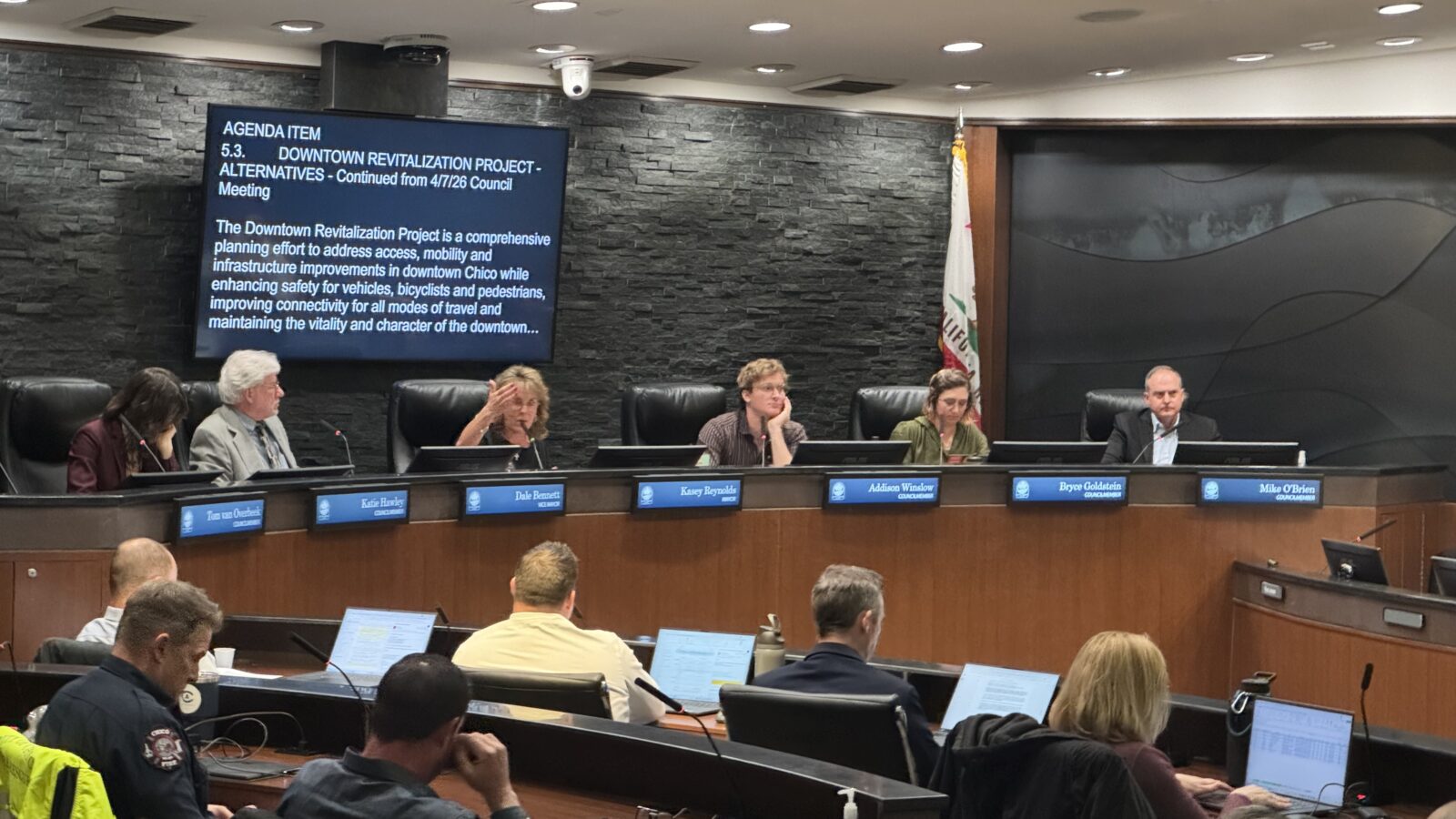
Chico’s Downtown Revitalization Project has led to another Fair Political Practices Commission (FPPC) investigation — this time involving Councilmember Tom van Overbeek.
The state commission opened a conflict of interest investigation into van Overbeek on July 7, spurred by an August 2025 anonymous complaint.
The complaint alleged that despite van Overbeek recusing himself on votes affecting downtown because he owns property in the city’s center, he was still influencing and participating in conversations about downtown issues.
The complaint cites the Downtown Streetscape Redesign Project, which later became the revitalization project. The project was a multi-year endeavor that would have removed a lane from Main and Broadway streets in order to extend the sidewalk and add protected bike lanes.
The project failed in City Council after two stalemate votes; van Overbeek recused himself, but Mayor Kasey Reynolds, a downtown business owner, did not.
This project led to an FPPC investigation into Reynolds, as well as complaints that were filed against councilmembers Addison Winslow and Bryce Goldstein. All three council members became the subject of complaints that were filed almost a year after the complaint against van Overbeek.
Shortly after the August 2025 complaint was filed, van Overbeek retained attorneys from Sacramento-based Bell, McAndrews & Hiltachk LLP.
“I’ve never been fined or disciplined by the FPPC for anything, so I thought why not bring an attorney to respond the right way,” van Overbeek said. “It’s just a prudent thing to do.”
Within responsive documents to an Aug. 16 California public records request filed by ChicoSol, van Overbeek’s attorneys argued he had not violated any FPPC rulings, stating that he had recused himself on downtown-related items and engaged with the revitalization project as a downtown building owner only.
A 2024 FPPC advice letter determined van Overbeek likely would violate the Political Reform Act if he participated in matters concerning the downtown revitalization.
The FPPC regularly provides advice letters when requested. While those letters are not an official ruling, they hold weight. Since then, van Overbeek has recused himself on votes pertaining to downtown, he noted in comments to ChicoSol.
Van Overbeek is running for City Council’s District 6, where he has been the representative since he was elected in 2022.
The debate
The complainant against van Overbeek specifically pointed to a Aug. 6 stakeholder meeting led by city staff that invited downtown business and building owners, according to FPPC documents.
“Councilmember Van Overbeek continues to provide staff with input regarding the consultant working on the redesign as well as the actual project,” the complaint alleges.
Van Overbeek’s lawyers argued that the FPPC exception for public officials acting as a member of the public applies. The exemption states there is no conflict if the appearance is related solely to personal interest.
“I was invited as a property owner, as a member of the public,” van Overbeek told ChicoSol. “I had every right to speak out.”
The complainant also mentioned City Council items pertaining to downtown that were introduced by van Overbeek, including pedestrian and historic building signs. Van Overbeek’s attorneys argue that because a vote was not taken, there is not “a realistic possibility or anything more than hypothetical or theoretical and therefore cannot be a conflict …”
The FPPC judges if a conflict would be a realistic possibility through looking at a variety of circumstances related to both the topic and individual involved.
Van Overbeek noted that he appreciates the FPPC’s mission and “there is transparency and no self-dealing of putting money in our pocket as a public official.” But he said the items mentioned in the complaint do not fall under the FPPC mission.
“How do wayfinding signs make me wealthier?” van Overbeek said, later calling the complaint a “misuse of these regulations for political purposes.”
The complaint also alleges van Overbeek influenced staff “with input regarding the consultant working on the redesign as well as the actual [downtown streetscapes] project.”
His attorney referenced an FPPC code that states complainants must provide specific examples of times where van Overbeek influenced staff, which was not present within the provided complaint, and van Overbeek denied the allegation.
The investigation opened nearly a year after the complaint was filed and van Overbeek’s attorneys had filed a response.
The FPPC’s dance with the revitalization project
The downtown revitalization project has led to separate complaints against four council members: Mayor Kasey Reynolds and councilmembers Bryce Goldstein, Addison Winslow and van Overbeek.
After voting against the project, Reynolds received more than 80 complaints. Many of these came after a website called Save Downtown Chico launched that helped citizens file a complaint against the mayor for not recusing herself.
The commission opened a conflict of interest investigation into Reynolds on April 29, and has yet to make a determination. The alleged conflict concerns her co-ownership of Shubert’s Ice Cream & Candy, which is within the revitalization plan area. Reynolds has often stated she meets several of the FPPC’s conflict-of-interest exemptions.
Reynolds was also sued regarding the downtown revitalization vote by former Mayor Ann Schwab. A Butte County Superior Court judge rejected the preliminary injunction seeking to overturn Reynolds’ votes, and recently the lawsuit was dropped.
Winslow and Goldstein were both the subject of complaints filed by conservative activist and former attorney Rob Berry for voting on downtown revitalization. Berry alleged the council members had a conflict of interest because they lease office space within the project area.
It is unclear if the FPPC has determined whether it will investigate Winslow and Goldstein because the complaints do not appear on the FPPC website. Typically, even if the commission opts to reject a complaint it remains on the case portal.
ChicoSol did not get an answer from the FPPC by the time of publication.
FPPC investigations can take anywhere from months to years, mainly due to a backlog of cases, according to CalMatters. If the FPPC determines there was a violation of the Political Reform Act it can fine up to $5,000 for each violation.
All four elected officials have characterized the complaints as the FPPC being weaponized to harass or burden public officials.
Chris Hutton covers city government for ChicoSol.