
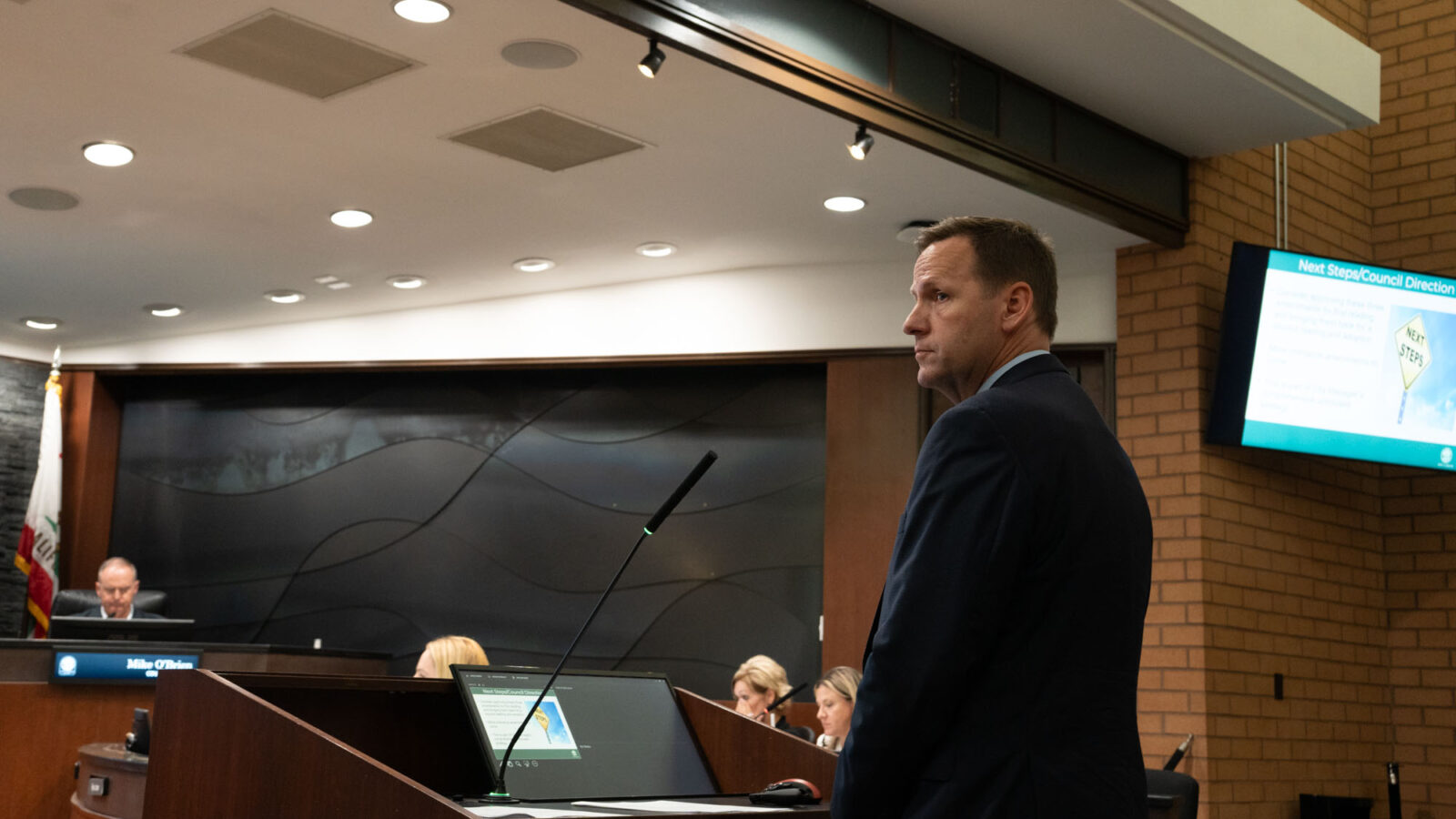
In a rare moment for Chico City Council, audience members and councilmembers alike stood opposed to a loitering ordinance that they called redundant and vague and that they feared would open the door to more litigation against the city.
City Attorney Ryan Jones, acting on a consultation with the Chico Police Departmemt, proposed a loitering ordinance that would allow police to fine people idling on public premises without a “legitimate purpose.”
The city does not have a loitering ordinance, except for minors unaccompanied by a guardian, Jones said.
The Council has been reevaluating its municipal code, mainly anti-camping ordinances, as it prepares to exit the 5-year Warren Settlement in January. The settlement has restricted much of the City’s ability to enforce its anti-camping ordinances.
The anti-loitering ordinance was added not at the direction of Council, but instead because of a recommendation from Chico PD, Jones said.
There have been calls from council members and in the community for stronger anti-camping ordinances and more expansive ways to compel people into shelters and out of public spaces — but this loitering ordinance approach seemed to go too far for the public and the Council.
The Council unanimously voted down the ordinance, and while councilmembers Katie Hawley and Bryce Goldstein suggested they would never vote in favor of enacting a loitering ordinance without good cause, the Council directed Jones to come back to a later meeting with a revised version.
Councilmember Addison Winslow took issue with the ordinance’s “vagueness,” saying, “In my reading of this, you can be doing anything and it could be illegal.”
Councilmember Mike O’Brien, who was a former police chief, called it “redundant and vague.” He said that while he trusts the police department to not over enforce, it provided too much discretion for misuse.
O’Brien proposed a scenario: “If any of us are lying in a lounge chair at One Mile and someone comes up and sits next to us, and talks about a subject they find offensive, are they going to call the police and complain?”
There was concern about a section of the ordinance that would prohibit people from creating or causing “any disturbance or annoyance to the comfort” of a person or business.
“If being annoying is illegal, lock me up,” Hawley said. She said this was one of the most “aggressive loitering ordinances in the state.”
She said that broad loitering ordinances makes it too easy for discriminatory enforcement. “Oftentimes that falls on unhoused individuals and our community members of color,” she said.
Ordinances pertaining to the unhoused were top of mind for the Council; before the loitering discussion the Council had voted, 4-3, to move forward on stronger anti-camping ordinances designed to deal with the homeless.
Councilmember Tom van Overbeek made the initial motion to have Jones come back with revisions. Van Overbeek sided with the other council members and called the ordinance “vague” and not a priority.
Mayor Kasey Reynolds said she believes there must have been a “legitimate reason” for this ordinance to come to Council, but that “something got missed in the wires.”
The nine public commenters also unanimously opposed the ordinance, for much of the same reasons the Council opposed it.
Rob Berry, a lawyer and vocal critic of the progressives said, “It took four years but I did finally find one sentence that I agree with Addison Winslow on, which is enforce current laws.”
Berry said that loitering laws were “highly litigious” and often attacked for vagueness and ambiguity. He shared his concern that this would lead to another lawsuit.
Other members of the public said they were concerned with giving broad authority for others to judge if someone had a right to be in a public space, and that this ordinance was likely to unfairly target anyone from protestors to the unhoused.
Jasmine Guzeldere, who spoke during public comment, had concerns about granting the government more expansive power when there is already an overhaul to the municipal code underway.
“Wen an ordinance allows an officer to intervene based on concepts like whether someone’s presence is legitimate or whether it creates annoyance or disturbance, I do kinda worry that we are moving away from regulating conduct and toward regulating presence — that should concern every person in this room,” she said.
Chris Hutton covers city government for ChicoSol