by Dennis Ramirez, guest commentary | Posted September 25, 2025
Dennis Ramirez, Chairman of Mechoopda Indian Tribe of Chico
For the Mechoopda Indian Tribe of Chico, California Native American Day on September 26th is more than a date on the calendar. It is a celebration of who we are, where we have come from, and where we are going. It is a reminder that the Mechoopda people have always been here, stewarding the land and passing on our traditions for countless generations. Our Tribe’s ancestral homelands stretch across the Sacramento Valley, with deep roots along Little Butte Creek and what is now known as Chico.
Our history is one of resilience. Despite hardships, displacement, and generations of challenges, the Mechoopda people remain. We remain committed to our culture, our language, our ceremonies, and our way of life. California Native American Day is an opportunity not only to honor that resilience but also to educate others, to ensure that California’s history is told honestly and includes the voices of its first people.read more
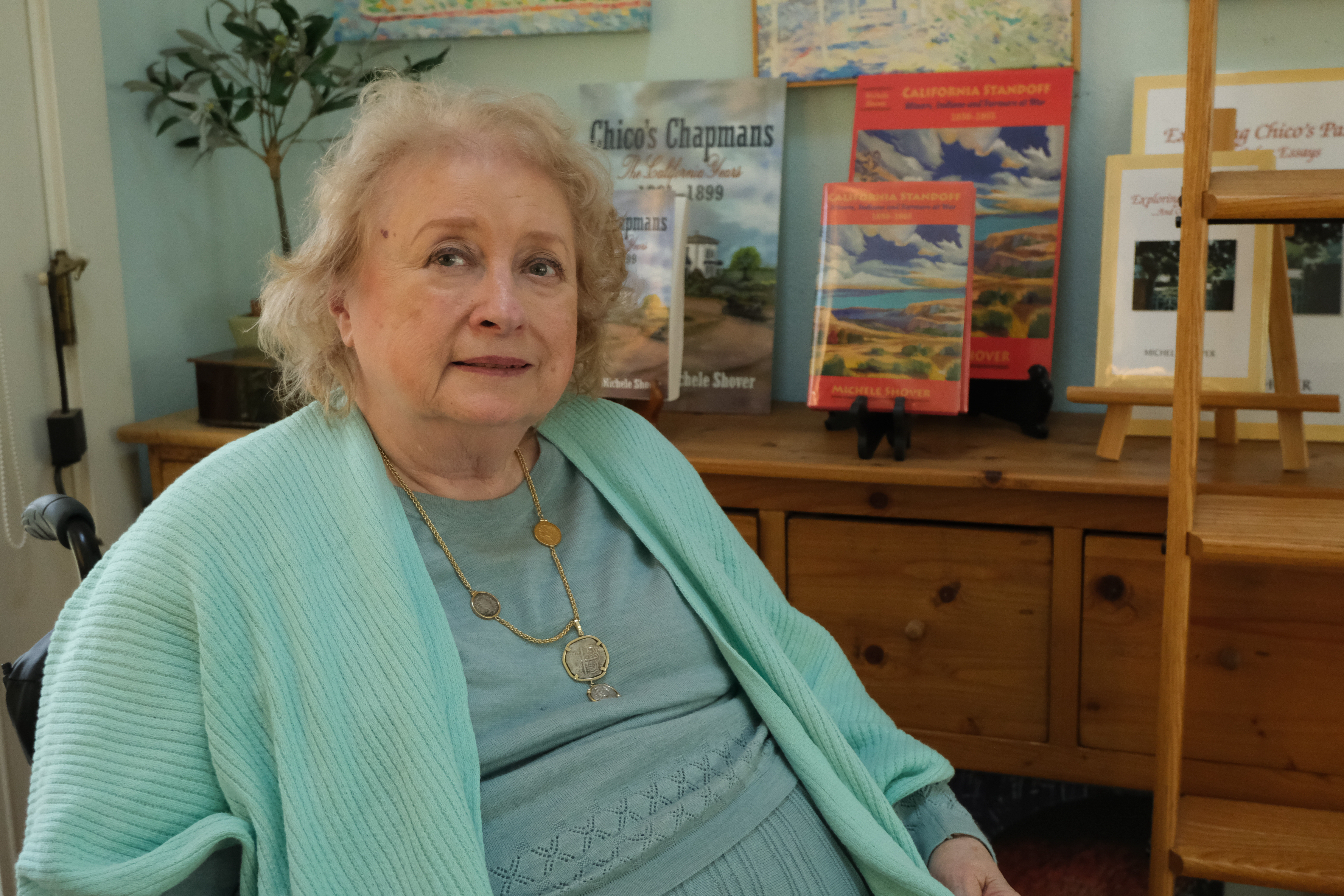
Historian Michele Shover’s effort to tell a more nuanced story of John Bidwell, considered the founder of Chico, began in 1989 when a footnote in a book caught her by surprise.
“I found it diametrically opposed to what people thought about Bidwell,” Shover said of the passage containing the footnote.
Shover, now 83, is retired from Chico State where she served as chair of the Department of Political Science. Her research on John Bidwell and Northern California Indian-settler conflicts of the 1850s has often been cited; she published articles based on primary research on Butte County history during more than four decades.
Over 20 years, Shover gathered all the historical data that she could find about Native Americans from this area from various sources, “whether it was newspapers, academic studies, correspondence, diaries,” she said.
At the beginning, she found it difficult to understand the reports written by local Indians, even though these had been recorded in English, “because they had a different sense of narrative. They have a different sense of time.”
She described her research as comparable to putting together a puzzle and refrained from reliance on work by present-day writers. Shover to this day is proud of this approach: “In my experience, some of the modern writers had tapped into a few of these sources, but no one I found had done as broad and deep a search as mine.”
After years of research, Shover published a book, “California Standoff: Miners, Indians and Farmers at War,” in 2017.
One of the nuanced stories Shover tells is about the treaty that was known as the U.S. Treaty of 1851. People often think that Bidwell, who helped organize a treaty meeting in 1851, played an important role in advancing the contract that reserved a 227-square-mile tract for the tribes.
But Shover found a different story through her research. She said Bidwell wrote a letter to California Congressman Joseph McCorkle and U.S. Sen. William Gwin after the meeting, recommending they not ratify the treaty. “He wrote it from a perspective as if he was protecting the Indians, but he was really protecting his control (of his Indian labor force),” Shover said.
“Should the Mechoopdas move to a reservation, he would lose a great asset — his substantial, cheap, available and usually stable Indian workforce,” Shover wrote in her 2017 book.
The Mechoopda Indian Tribe website explains that the U.S. Senate secretly rejected treaties signed during the 1851-52 period.
In a 2011 speech at Chico State, Shover shared a heart-wrenching detail about the labor exploitation on Bidwell’s ranch.
During the wheat harvest on the ranch, the wheat was spread in a huge circle and was separated from the chaff by having massive herds of horses racing around on top of the wheat. “The way they stopped the horses was, they sent the Indians out in front of them,” Shover said, pausing for a few seconds with a solemn expression after sharing detail of this dangerous work.
“He did things that I really regret,” Shover told ChicoSol on an early spring afternoon in the study of her Chapmantown home where, when this reporter arrived, she had been watching television news. However, Shover also thinks it’s important to recognize the good things Bidwell did and said she considers his “larger impact more positive than negative.”
Shover agrees with many community residents who note that the Mechoopda people were not well represented in the previous Bidwell Mansion State Historic Park, and would also like to see two new memorial structures on the park property. (Read our story on the Bidwell Mansion rebuild here.)
According to her, Bidwell moved the indigenous valley village “sort of more behind” the headquarters of the ranch to protect its residents from attack by the mountain Maidu, another subgroup of local Native Americans; on one occasion he brought a doctor from Sacramento to save the life of a Mechoopda tribal member, who had been shot by mountain Maidu.
“He taught them skills. He never demanded that they stay. They could have left. But most of them stayed,” Shover noted. “When I started this (research), I was pretty skeptical about John Bidwell. The more I did it, the more I saw the complexity of the situation.”
When Shover was growing up, there was a common belief in white culture that Indians were bad and settlers were good, and when the counterculture emerged decades later, the settlers became evil and the Indians became “good,” she said.
But Shover tried to sidestep such simplifications in her work, and in her book, shows the complexity of the interplay between groups.
Her efforts were rewarded when she says she was thanked on two occasions by local Native people. In one case, a young man came up to her when she was shopping in a store downtown. The man said he was a member of the mountain Maidu group, and told Shover, “I want to thank you. You were so fair in writing this book.”
This is the third story in a three-part series on the fire that destroyed Bidwell Mansion and the role the Mansion played in our community. Read the first story here and the second here.
Yucheng Tang is a California Local News Fellow reporting for ChicoSol.
Long neglected Mechoopda history could play a bigger part in next project
by Yucheng Tang | Posted April 13, 2025
photo by Yucheng Tang
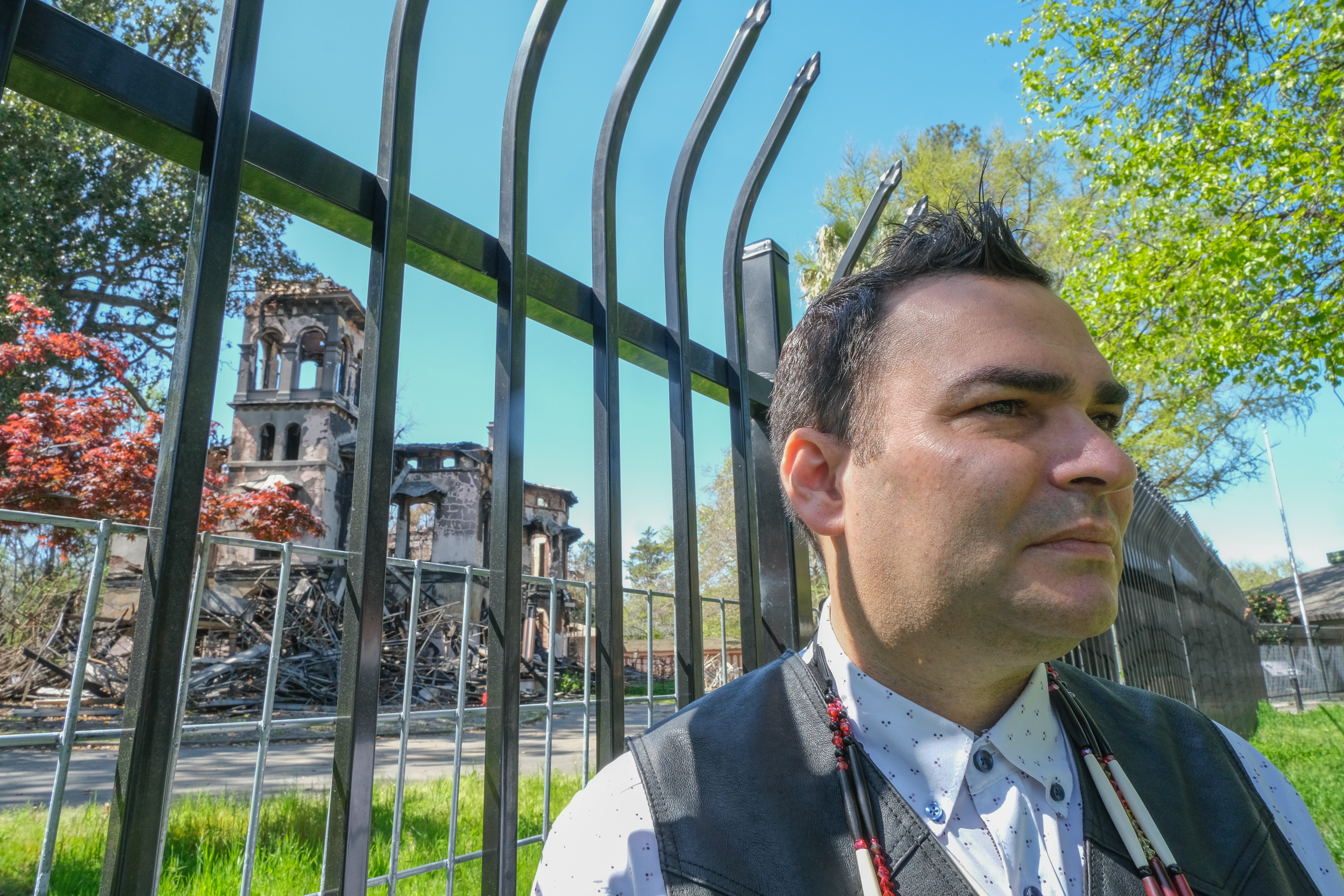
Browning Neddeau in front of the ruins of Bidwell Mansion
(The is the first story in a three-part series on the destruction of Bidwell Mansion and the role the Mansion played in our community.)
Chico State Associate Professor Browning Neddeau made his first and only visit to Bidwell Mansion, a local landmark from the 1800s associated with the founding of Chico, in 2019.
During the tour, Neddeau and his father, who belong to the Citizen Potawatomi Nation, asked their tour guide some hard questions about the Native American experience during the era of John Bidwell — who is known as the founder of the city – but they felt that their questions were ignored.
Neddeau was frustrated with the “settler-centered mindset” reflected in the stories told during a tour of the Mansion, where Bidwell lived with his wife, Annie. He remembers that the only items related to the Mechoopda Tribe, an indigenous people of California who lived in this area long before John Bidwell’s arrival – was a collection of baskets made by tribal members.
When he got out of the Mansion, he told himself he’d never go back.
Last year, on the morning of Dec. 11, a fire engulfed and destroyed the Mansion, leaving it in ruins and putting the fate of more than 3,000 objects, including the Mechoopda made baskets, in question. The arsonist, Kevin Carlson, was sentenced to 11 years in state prison and ordered to pay $37.4 million in restitution. (See part 2 in our series here.)
About 20 baskets were the only ethnographic objects related to the Mechoopda in the building, and they are very unlikely to have survived the fire, according to a State Parks official.
After the fire damaged Bidwell Mansion, discussions around the controversial relationship between Bidwell and the Native Americans who lived in the area resurfaced, drawing both local and international attention.
Opinions on John Bidwell, who acquired the Mexican land grants where the City of Chico would be established, remained divided. Some see him as a progressive settler and pioneer, while others regard him as an exploitative colonizer. The essence of the argument is about whether a controversial figure like Bidwell deserves to have his former residence memorialized in this way — and whether his story should be told with more nuance.
Some community members have called for a replica of the Mansion to be built, and many want the Mansion rebuilt in some fashion; several funds have been opened for donations to that end. But some Native people believe the Mansion should be leveled and the land returned to the local tribe.
In any case, State Parks officials, local historians and some members of Bidwell Mansion Association agree that the local Mechoopda Indian Tribe should be better represented in whatever takes the place of the original Mansion.
Incorporating Native indigenous knowledge
“With Bidwell Mansion, whatever we do, we’re going to be incorporating the Native indigenous knowledge,” said Matt Teague, district superintendent for the Northern Buttes District of California State Parks, during a March phone interview.
According to him, the “recovery” will also align with the State Parks’ “Reexamining Our Past Initiative.” That initiative seeks to identify and remove “inadequate interpretive programs or exhibits that fall short in fully contextualizing California’s history in parks,” the State Parks’ website says.
In the Bidwell Mansion story that has been told, there could be components “that aren’t necessarily accurate,” Teague explained. “I think it gives us a chance to choose those out and also give the tribe an opportunity to provide that input and incorporate indigenous knowledge into the project that they didn’t have the opportunity to before.”
Teague added that State Parks has drafted a memorandum of agreement with the tribe, and the Mechoopda haven’t requested the return of the land.
“It’s still in draft mode,” Teague said of the agreement. “We haven’t executed yet, but it’s a memorandum of agreement that says that we will work with the tribes specifically on the Mansion fire incident and recovery.”
“… the building is like a reminder of the trauma” — American Indian scholar Browning Neddeau
State Parks has received the hazardous materials report from the consultant and is reviewing and finalizing that document before proceeding with cleanup and structural assessments, according to Teague.
“We will also probably have a third party facilitator to help navigate through the community engagement as part of the planning process to gather inputs and try to determine what the plans are for the park,” Teague said.
State Parks conducted “a quick, rough estimate” to rebuild a replica of the building, estimating that cost at $37.4 million.
“We have submitted a request for funding, but right now we do not have secured funding for this recovery. So that’s also a big question,” Teague told ChicoSol.
Local historian: There could be two memorial structures
Michele Shover, a retired political science professor at Chico State, has researched John Bidwell and Northern California Indian-settler conflicts of the 1850s for more than 20 years. (See part 3 on Shover’s research here.)
She said John Bidwell’s success would not have been possible without the Mechoopda people, who provided the only accessible and stable labor force in the early years after he established his ranch in the area. Shover says the Mechoopda people were not well represented in the previous Bidwell Mansion State Historic Park.
Shover doesn’t object to rebuilding the Mansion, but she would also like to see two memorial structures on the park property — one honoring the Mechoopda and the other recognizing the Chinese immigrants who also worked for Bidwell.
For Shover, Bidwell Mansion State Historic Park, a place that holds collective memories of local communities, could showcase the history of Chico more comprehensively and honor those who made a huge labor contribution to the building of Chico but were not recognized sufficiently.
Some Bidwell fans want more of the Mechoopda story
Some in the community, including those who see Bidwell as progressive in that era, believe the Mansion should be rebuilt, but a more comprehensive living history center should be planned.
Nick Anderson, a board member of Bidwell Mansion Association, has played John Bidwell at living history events since 2013. Based on his own research, he believes Bidwell, who “showed care to the land and people,” was different from other settlers, but critics tend to “lump all the settlers together just because they were here at the same time.”
Anderson has been to Bidwell Mansion about a hundred times and hopes the Mansion can be rebuilt on the base of the existing structure.
“I would like to see a whole living history center there, because when the Mechoopda were here, they had their own way of doing things. They had their own culture. I would like people to see that as well,” Anderson said.
He thinks the fire that destroyed the Mansion provides an opportunity to show a more complete version of history and re-imagine “how we’re going to tell this story and from whose perspective.”
“What was it like pre John Bidwell? What’s the kind of farming the Mechoopda would have done? And what kind of houses did they build … That’s a 5-acre place where you can put a lot of other things there,” Anderson said.
“I want that history to be told from every perspective, because you can’t really understand anything if you don’t see it from all points of view.”
Local historian Dave Nopel said the Mechoopda story faded from the view of mainstream culture not only during the Bidwell era when indigenous people were losing their land to settlers, but also along with the loss of standing in the 1950s when the federal government “stripped it away.”
In the 1950s, the federal government implemented the termination policy, which sought to end federal recognition and services to tribes; the Mechoopda Tribe was subject to this policy and terminated in 1967, losing its 26-acre Chico Rancheria. The tribe wasn’t federally recognized until 1992.
“It never was a major part of that Bidwell Mansion State Historic Park,” Nopel said. “They never got a real chance to have a full exhibit … about what their life had been like, what their culture had been like, where they live, how they live.
“I could certainly be supportive of a bigger place, a bigger chance to have their story as part of what is going to happen there.”
Nopel is among those who say that it’s unfair to label John Bidwell solely as an exploiter or colonizer.
“It’s not right to look back and make these judgments about the past, thinking that the past is just a backward extension of the present,” Nopel said. “The past was different. People didn’t have the same information and the understanding that we have today about human behavior.”
“A reminder of the trauma”
Neddeau, a multicultural and gender studies professor, recalled the narrative Bidwell Mansion provided. “There was a lot of mention about how wonderful the Bidwells were to Native people, almost like something that they should be grateful for,” Neddeau recalled.
“That’s not accurate because Native people were thriving before Bidwell arrived in this area. So there was no need for them to be here to help Native people thrive. In fact, they created hardship for Native people.”
Neddeau believes that multiple narratives about John Bidwell should be told, including one that is more Native-centered.
“In present-day U.S. education, we have a focus on victory,” he said. “And victory is emphasized over oppression, so coloniality is celebrated. We need to think about how we can lessen the severity of settler colonialism on communities and think about (how) we’re not always victorious.
“We need to think about the multiple narratives about the Bidwells, and how we can learn from these multiple narratives that are going on instead of leaning on one narrative, which is the settlers’ narrative.”
Neddeau doesn’t support the rebuilding of the Mansion, but noted that he doesn’t speak for the Mechoopda people of this area and commented only as an American Indian scholar.
“I don’t think that rebuilding the Mansion will do anything except to replace a thing that people are attached to,” he said. “The families that are impacted by settler colonialism are still here. So having a Mansion where their ancestors were not treated with care and their relationship with land was disrupted is still part of inter-generational trauma.
“Even though the ancestors walked on, their relatives are still here. So the building is just like a reminder of the trauma and a reminder of settler colonial history.”
ChicoSol reached out to the Mechoopda Indian Tribe through email and phone, but didn’t get a response by deadline.
Ursula Filice, State Parks curator, told ChicoSol in a recent phone interview that around 10 percent of the 3,000 items in the building were original, and many of them didn’t have copies, such as Bidwell’s office ledger, four Asian vases, a unique toilet in the shape of an elephant, and more.
When the fire took place, Filice said, the first things on her mind were the Mechoopda made baskets.
“They probably were my favorites. Because of their importance to the Mechoopda people, it makes me very sad.”
Yucheng Tang is a California Local News Fellow reporting for ChicoSol.
Butte County contingent prepares for global action on climate change
by Leslie Layton | Posted August 28, 2018
photo by Karen Laslo
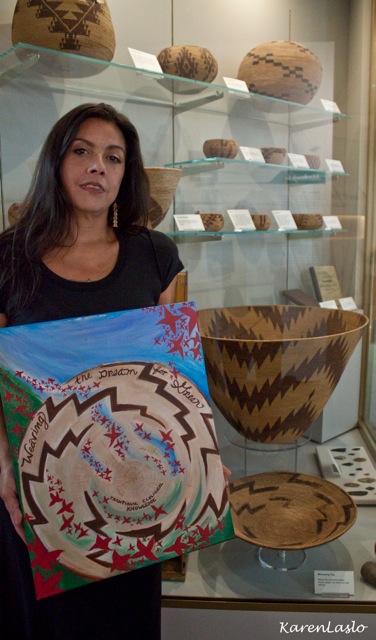
Ali Meders-Knight shows her painting next to the Mechoopda basket (lower right) that provided inspiration.
When Ali Meders-Knight was asked to provide mural art for the local contingent at the upcoming San Francisco march for climate action, she thought of the basket designs used by her Mechoopda ancestors.
She thought about historical descriptions of the Northern Sacramento Valley, when birds and butterflies were so numerous they sometimes blocked any view of the sky.
And before that day was out, she had a painting that will be used as a template for a mural panel at San Francisco Civic Center.
Some 60 Chico-area residents are expected at the Sept. 8 RISE for Climate, Jobs & Justice march in San Francisco that has been promoted as a major action to demand an end to fossil-fuel reliance and more governmental and private-sector support for renewable energy development.
The march will be led by indigenous groups, beginning at the Embarcadero Plaza in San Francisco, and will end up at the Civic Center where some 55 communities from around the state will each produce a panel for a single street mural.
The story of how a Mechoopda design was chosen to represent the Chico community is only in part about Meders-Knight, an artist and basket-weaver who has worked in a childrens’ outdoor and other environmental programs. It’s also about the evolution of the climate justice movement itself.
“Having me do this design brings us to a window, opens the door to dialogue,” Meders-Knight said.
“Let’s look at how this land was when John Bidwell got here. We’ve ruined all the riparian zones. We have non-native plants and trees in areas where they don’t thrive. My goal is that we have open public dialogue that re-purposes us to become stewards of the ecosystem and collaborate with indigenous people.
“We can work with the Mechoopda to restore wetlands, have prescribed burns, create jobs in land management,” she added.
The Mechoopda tribe, based in the Chico area, was decimated in the 1800s by violent citizen militias and government policies that called for the removal of Indians from land coveted by gold-seekers and white settlers. But many of the Mechoopda survived, and in 1992 the tribe won federal recognition and began rebuilding an economic base.
Nationally, the 2016 Dakota Access Pipeline protest led by Standing Rock Sioux tribal members became a watershed event in environmentalism, noted Ann Ponzio, a member of the environmental group Chico350.
“Standing Rock really changed the environmental movement,” said Ponzio, who has been involved for many years in environmental advocacy. “It became a model on how to elevate our voices and the attitude that is brought to those voices.”
But it was more than just a model for activism. Ponzio said many supporters of the anti-pipeline movement (#NODAPL) also realized how much they could learn from other cultures, including from indigenous communities that have successful models for environmental stewardship.
Chico350 thus reached out to Meders-Knight to provide a design that will be placed on a 40-foot concrete slab and become part of a mural that RISE predicts will set a new Guinness world record for the largest street mural.
“Standing Rock was an opportunity to take off the mask,” Meders-Knight said, alluding to mythology sometimes attached to Native cultures. “We understand migration patterns, where willow grows and how to make it into medicine. This is not spooky stuff.”
Meders-Knight’s design is based on one of her tribe’s baskets on display at Bidwell Mansion. Museum visitors can see the intricate and beautiful designs decorating water-tight cooking baskets that required such precision and planning that Meders-Knight says weavers must have understood “MIT-level calculus.”
The Mechoopda, she noted, are one of four California Indian tribes famed for their art, probably because they had the time and resources to explore their culture in the rich and fertile Northern Sacramento Valley.
The panel design by Meders-Knight recently evolved into a chalk sidewalk mural in front of the Chico Peace & Justice Center – a draft for what will be done on Sept. 8 when Meders-Knight leads an artistic team at the Civic Center in painting with tempera.
Wendy LeMaster, a Paradise resident who will help paint, said the design represents the inter-connectedness of people, and the mural, when completed, will “send a powerful message.”
The march, one of thousands of actions planned globally, is timed to coincide with a gathering of world and private-sector leaders at the Global Action Climate Summit in San Francisco from Sept. 12-14. Participants like LeMaster want to pressure leaders to take more aggressive action to mitigate the effects of climate change.
LeMaster noted that North State forestland is mismanaged, but some of the conditions leading to this summer’s giant wildfires are the “direct result of climate change.”
“I want my children to know that I took a position on this, that there are a lot of other people who have taken a position, too, that this is just the beginning, and they get to continue to lead the fight,” she said.
Ponzio said she plans to devote her energy after the march to local electoral work.
Meders-Knight said she hopes people return to Chico inspired to take on environmental tasks. There’s a lot that can be done, she explained, to care for the environment locally, from improving forest management to better conserving Bidwell Park.
“We want to get into a large land management project here,” she said, comparing a community to a family where everyone has a part in maintenance and beautification. “In indigenous communities, everybody had a role.”
Meders-Knight said she struggled for years in this area as the “token Indian” in outdoor education work. “People wanted me to be spiritual, to show them something magical about the environment.”
What she had to offer, she says, was “applied science.”
As she’s learned about pre-colonial history in this area, Meders-Knight says she’s tapped into something that is “rich, juicy, gorgeous,” and best of all, “empowering.”
Chico350 is providing a 54-seat bus to San Francisco that is filling fast. To find out about transportation options, send an email to annpnz@gmail.com.