
This story by contributor Lexi Lynn is part of ChicoSol’s Changemaker series.
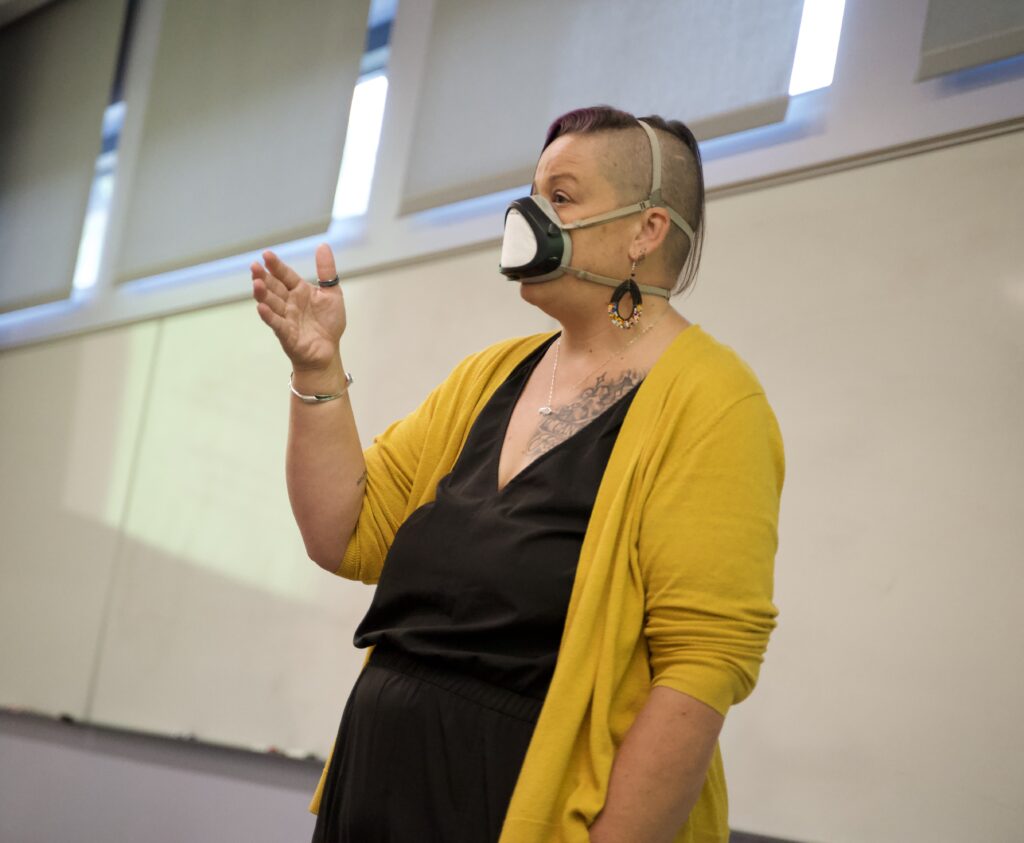
As Chico State students slowly trickle into Lindsay Briggs’ classroom, a Whitney Houston song plays on the overhead speaker, filling the room with the bubbly lyrics of an ’80s hit. A few students first make their way to the front of the classroom to snag a colorful mask from the front table, free to whomever feels inclined to take one.
A colorful slideshow is pulled up on dual projector screens, the initial slide filled with attention-grabbing graphics and memes. Students pull out their computers as Briggs fades out the ’80s music ambiance and begins the day’s lecture on mental health disorders.
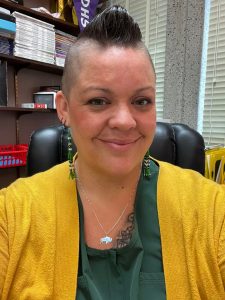
Beyond the walls of the Behavioral and Social Sciences building, Briggs approaches her role as a tenured public health professor with passion. Contrary to her controversial reputation that Briggs has received since being added to Turning Point USA’s Professor Watchlist, Briggs is well-liked and trusted among many students.
Briggs was born in Indiana, moved to Santa Cruz as an infant, and moved back to Indiana at the age of 8. Experiencing both the “Midwestern values of Indiana” and the “radical, leftist ideals of California,” Briggs said that her life has been a “juxtaposition of those extremes,” ultimately making her more comfortable in her identity and belief systems.
Though Briggs spent most of her higher education studying in Indiana, she studied abroad in China for a period of her undergraduate degree in politics. She said that China’s one-child policy was what initially sparked her interest in public health — specifically in reproductive rights.
Upon continuing her education, she steered away from politics and decided to attain her master’s in public health at Indiana University.
It was during her doctoral program at Indiana University Bloomington that she fell in love with teaching. As a PhD student, Briggs was required to teach as an instructor, and shortly after finishing the program, she decided to apply for positions teaching public health.
She applied to 54 universities after graduating — and Chico State was her first choice, combining the small-town feeling that she grew up in with California ideals. When she was offered a position at Chico State, she immediately accepted. Briggs said that she has no plans of ever leaving.
“That is why I’m such a fierce critic — not because I hate Chico, but because I love it so much,” Briggs said.
While Briggs has been criticized for her sometimes harsh commentary on Chico State, she said that she speaks up because she “knows [we] can do better.” Most recently, Briggs posted screenshots of an email sent from Professional and Continuing Education encouraging Chico State professors to teach use of AI, responding to the message in her caption by writing, “Do better CSU.”
Briggs shared her disdain for AI and called out faculty members who might accept compensation for integrating the technology into their curriculum.
In a classroom, Briggs emphasized that she encourages students to think for themselves
Briggs is on Turning Point USA’s Professor Watchlist — a compilation of college professors who“discriminate against conservative students and advance leftist propaganda in the classroom,” according to its website. TPUSA was founded by the late Charlie Kirk in 2012, and the Professor Watchlist was subsequently created by the organization in 2016.
Her profile on the website has sparked community controversy and has invited many to send Briggs hate speech online, which Briggs openly shares and responds to on her social media pages. She regards the website as “dangerous” and “one of the worst ways we’ve seen higher education attacked.”
On the contrary, Briggs commented that those who only know her as a social activist have no idea what she’s like as a professor — and don’t know that both parts of her identity are vastly different.
Though she may be opinionated in the digital space, in a classroom, Briggs emphasized that she encourages students to think for themselves.
“If students engage in critical thinking, evidence and support of their ideas, and end up polar opposite from me, that is fine. I want students to feel solid and grounded in their beliefs — and that is what I teach in my classes,” Briggs said.
Briggs said that her goal in online advocacy is to step in front of vulnerable audiences to divert negative attention away from them — in doing this, she said that she’s faced public scrutiny, but said that she doesn’t mind it.
“I’m very happy to be somebody’s target if that means they’re leaving somebody else alone,” Briggs said. “Don’t hurt the people who are already scared and suffering,” she said, referencing at-risk groups like the trans and Latinx communities. “I’m here — I’m asking for it. Leave them alone.”
“If you stopped your hate speech, then I would stop being so brutal to conservatives” — Briggs
In the midst of an ever-changing political landscape, Briggs insisted on the importance of free speech, but added that she isn’t an “unencumbered free-speech advocate.” Instead, she said that she would be more likely to support a “more gentle and kind” version of free speech, meaning an elimination of hate speech.
Nonetheless, when Briggs receives hate online, she responds with equal venom. Rather than feeling complacent or quieted, she said that she makes an effort to match her aggravators in intensity and rage.
“If you stopped your hate speech, then I would stop being so brutal to conservatives,” she said. “If you’re going to be a bigot, then I’m going to be an asshole.”
Her ferocity behind the lines of crafted social media posts ultimately stems from her desire to stand up for what she believes in, regardless of risk, she said.
“It’s safer not to care, it’s safer to not speak up,” she said, but concluded that she feels a responsibility to protect threatened groups in whatever capacity she is able to.
As the education system seems to be moving in the direction of classrooms that are less social and participatory, it is interesting to see that students in Briggs’ classroom don’t shy away from raising their hands to ask questions about course content and upcoming assignments. Compared to typical college classes where students hide behind their computers without conversing, the engagement in Briggs’ class is impressive.
Three public health students in Briggs’ emotional health class lingered behind on a recent Tuesday to share thoughts on their professor.
Erica Lucero, a fourth-year student, described Briggs as, “way down to earth and real,” and shared that Briggs has been one of the best teachers she’s had at Chico State.
Soraya Carrillo shared similar sentiments. Having two classes this semester with Briggs, Carrillo said that her lectures feel “more like conversations,” making it easier to ask questions and connect with the content.
Jordan Tremble added that she admires the way that Briggs “fights for her students.”
“I like the way she teaches because it’s so much more than student-teacher relationships,” Tremble said, explaining that Briggs is one of the only teachers with whom she feels comfortable sharing personal information.
The student consensus appeared to be that Briggs’ classes are more than just a place to learn — students voiced that they feel safe and listened to in her classroom, qualities that Briggs emphasized are of importance to her both as a professor and as an individual.
“My sense of self comes from my own internal evaluation of whether or not I am doing things that make the world a more just, more equitable and safer place for everyone,” Briggs said. “If I feel good about my actions, I don’t care what other people think of me.”
This story was corrected to state that Briggs moved back to Indiana as an 8-year-old.
Lexi Lynn is features editor at The Orion and a fourth-year journalism major at Chico State.
2 Comments
I love the way Lexi starts this profile and I love the way the professor starts her class. That’s what I’d like to do if I taught in person instead of remotely.
It was a pleasure to read this well written piece about someone doing their job with creativity and courage. That Briggs is pushing against received wisdom in how she teaches and that her students seem to like her all the better for it is heart warming.
The fact that she is on a Turning Point USA watchlist is chilling and one can’t help worrying about
where that will lead.