
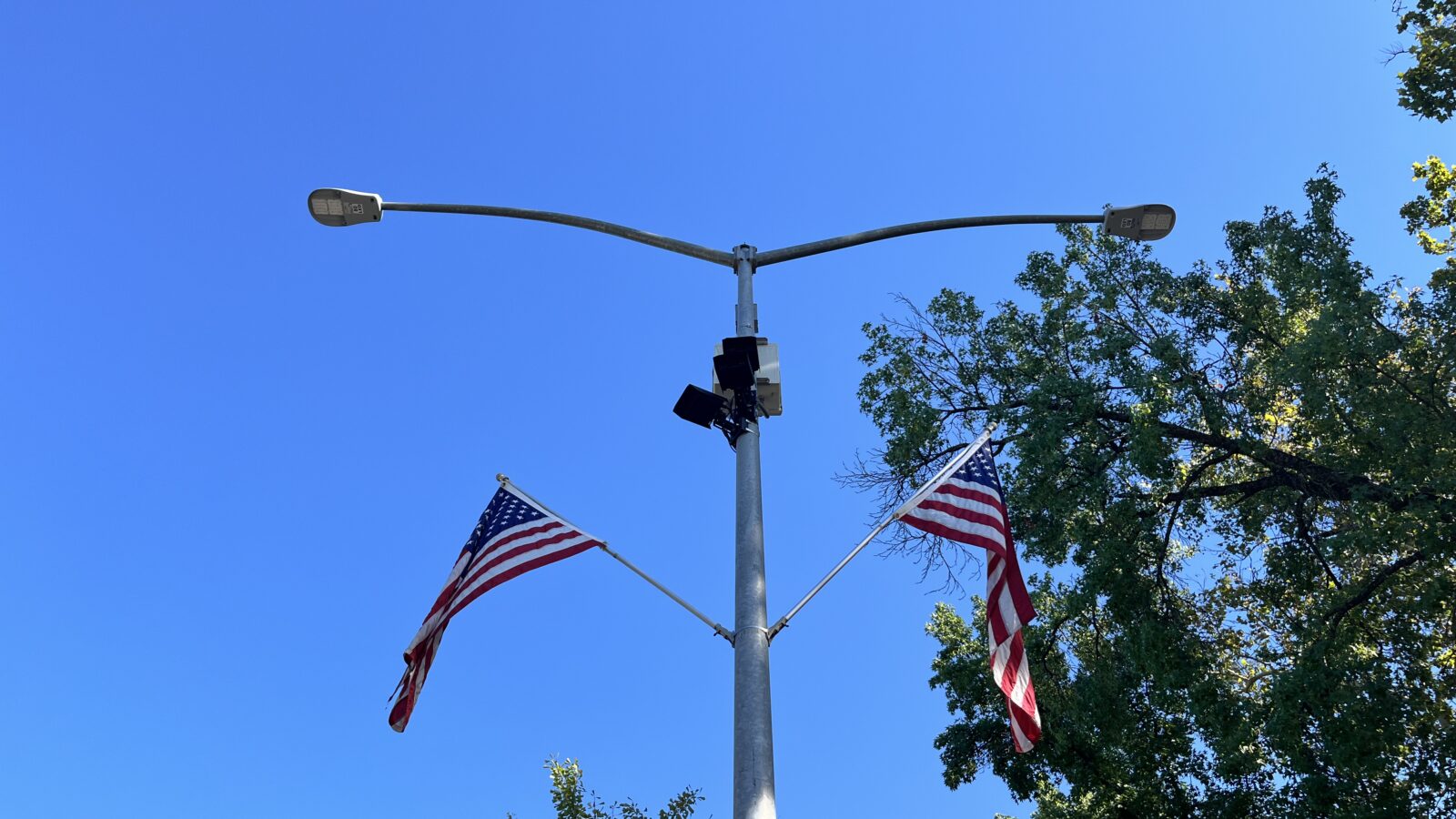
The Chico Police Department says it has shut off license plate reader data sharing that, until July 8, appears to have been in violation of California state law.
Two weeks after ChicoSol requested public records related to the department’s Automated License Plate Reader (ALPR) data sharing program, Chico PD said it stopped sharing data with federal and out-of-state agencies.
Two California laws restrict or prohibit the sharing of ALPR data beyond this state. SB 34 says local law enforcement can only share collected data with California agencies. SB 54, the Values Act, bars local law enforcement from assisting in federal immigration actions.
In a recent interview, Chief of Police Billy Aldridge indicated, at one point, that he had been unaware federal and out-of-state agencies had access to the city’s ALPR system.
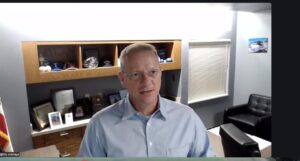
“As we started producing the information for the PRA, we found out, holy cow, we’re sharing with these people and actually when it was set up we shouldn’t have been sharing outside of California or with the federal agencies,” Aldridge said in a Zoom interview on July 22.
“We immediately shut it off.”
The data sharing may have violated the 10-year-old SB 34 as well as 8-year-old SB 54, civil rights attorneys said.
“[The] law is crystal clear that a law enforcement agency in the State of California is not allowed to share ALPR information with any law enforcement agency outside of the state, and that includes the federal agencies,” said Nick Hidalgo, a senior staff attorney at the ACLU of Northern California.
Hidalgo called ALPRs a “dangerous and invasive” surveillance technology.
Chico PD said it could not yet provide documentation showing the sharing shutoff. It also said it has begun a full audit of the data-sharing.
In response to a June 22 Public Records Act request, Chico PD provided records that show data sharing with many federal and out-of-state law enforcement agencies. Records as recent as July 7 from the Motorola ALPR dashboard show there were 20 federal agencies and more than 80 out-of-state law enforcement agencies with access to Chico’s data.
Agencies that were able to access Chico’s surveillance data include ICE Enforcement and Removal Operations, ICE Homeland Security Investigations, the U.S. Border Patrol and a military police department at a Southern California U.S. Marine base.
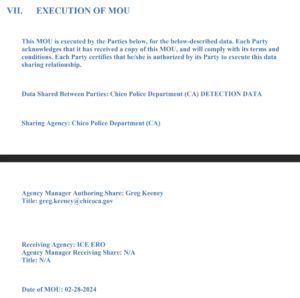
Chico PD has given ICE access to its ALPR data since Feb. 28, 2024, according to MOUs (memorandums of understanding) obtained by ChicoSol through public records requests.
Aldridge told ChicoSol the system is nearly two years old and was set up solely for the purpose of criminal investigations and to help in locating missing persons and stolen property.
“It was never intended for any kind of immigration purposes,” Aldridge said. “We don’t abide by any kind of immigration enforcement because we have SB 54, the Values Act.”
The sharing with out-of-state and federal agencies was in line with Chico PD policy – even though the California laws that impose restrictions, such as SB 54, — were in effect.
“When we initiated the ALPR system and started allowing access to it, it was through an MOU process, it was an agreement that they would only use it for criminal investigations, there would be no immigration enforcement at all,” Aldridge said.
The chief said an internal audit is underway that shows federal agencies accessed ALPR records, but the audit doesn’t yet show data was retrieved by those agencies.
The audit has found that “we’ve had access by federal agencies on multiple occasions, but so far no sharing of data that has happened,” Aldridge said. “The plates they were looking for did not pop up in our system.”
However, the chief noted there are several million records in the system, and many are still unaudited.
Aldridge indicated he is concerned about the full audit.
“It’s definitely something that concerns me,” Aldridge said. “Did we do something that we need to take ownership of? If there’s legal issues from that I’ll refer to the city attorney.”
ALPR cameras: What are they capturing?
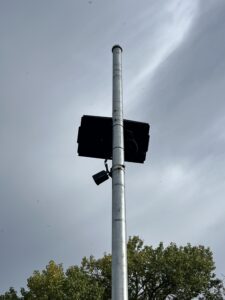
The Chico Police Department has 27 locations where it has stationed active Motorola-brand ALPR cameras. The cameras are capable of collecting identifiable data from passing vehicles and capture more than just license plate numbers.
Many of these cameras are positioned near major roadways entering and leaving Chico. The department has plans to install two additional cameras in the near future, Aldridge said.
ALPR cameras are capable of identifying the make and model of a vehicle, as well as bumper stickers and images of a vehicle’s passengers, said Jennifer Pinsof, a staff attorney at the Electronic Frontier Foundation, a digital civil rights organization.
“It’s a scary mass surveillance machine,” she said, noting that the state Attorney General’s office has commented on similar practices in other cities. “So it’s pretty clear that Chico’s in violation of the law.”
The data is aggregated into large, searchable databases where law enforcement can trace a vehicle’s movements months after the data has been captured.
“This data can be compiled with other data to reveal more and more about people,” Pinsof said. “Where they go, where you sleep at night, how they commute to work.”
In Chico Police Department’s policy manual §449.5.B.1, the department allows data sharing with Oregon, Nevada, Arizona and federal agencies once an MOU is reached between Chico and the receiving department. Out-of-state and federal agencies have entered successful data-sharing MOUs with Chico PD.
“It was within our policy that we would share with an agency that would request an MOU,” the chief said. “That policy has since been pulled.
“New policy is being released here shortly and pretty much removes the piece about sharing,” Aldridge said. “Only inside California agencies will now have access.”
Aldridge was unsure where Chico PD’s data sharing policy originated.
“I’m not exactly sure how that language was created,” he said. “If it was Lexipol language or if it was our language – we’re still working through that to figure out how that happened.”
(Lexipol is a distributor of law enforcement policy manuals contracted by the city of Chico.)
At the time of publication, section 449.5.B.1 of the department’s policy manual, permitting ALPR sharing with out-of-state and federal agencies, remained live on the city’s website.
In Chico and nationwide, concerns about privacy
Nationwide, cities are reconsidering their use of ALPR technologies because of data privacy concerns. On July 15, the city of Los Angeles discontinued its three-year contract with ALPR provider Flock Safety.
Chico criminal defense attorney Elizabeth Latimer said the technology recently helped Chico police recover her stolen vehicle quickly.
Officers were able to track the car to Williams about five and a half hours after she reported it stolen. Although she was happy she could quickly recover her car, she admits she was “frightened” by the precision and reach of the tracking technology and its implications for privacy.
Sept. 1: Chico PD says it is correcting an earlier statement made to this publication in response to our public records requests. The story has thus been corrected to state that ALPR cameras are stationed at 27 locations in the city — after originally reporting that there are 27 cameras. In fact, according to the correction we received, there are 46 cameras in total.
Editor Leslie Layton contributed reporting to this story. The article was fact-checked by reporter Chris Hutton and reviewed by several editors including contributor Dave Waddell.
Elias Myers is a freelance journalist and a recent graduate of UC Berkeley. To support early-career journalists with a donation of any size, please visit our membership page.
17 Comments
Leslie, thank you and your ChicoSol team for revealing this troubling story. Chief Billy has a lot of explaining to do. This scandal was brought to the public by ChicoSol, NOT the Chico ER, Action News Now, KCRA, Paradise Post, Chico City Council members at public meetings, Police Community Advisory Board members, and others. O’Brien has said he opposes civilian oversight of Chico PD, but the council has failed in that duty. Once again, O’Brien is blindly supporting his protege and other “good ole boys. Sharing data is not only against the law but an invasion of privacy, unethical, appalling, and heads should roll!
There are no excuses Aldridge can use to escape the blame.
Councilmembers O’Brien and Bennett wanted Aldridge for City Manager while Aldridge’s staff was actively violating state law and the civil rights of Chicoans!
Chico PD during the regime of Madden, Aldridge, and O’Brien had Sergeant Michael Williams actively engaging in sexual predation. Williams used police computer data to help him stalk his victims. Officer Michael Vincent was receiving fellatio on duty. Aldridge keeps discipline non-transparent. Chico just paid a $350,000 settlement to a teenager who was roughed up by CPD Lieutenant Mark Bass. Aldridge was either Chief or a high-ranking officer during these scandals, and he knows he has done other things that crossed the line.
The Chico City Council has to do the right thing and FIRE Aldridge immediately.
Absolutely! Billie, the buck stops with you. If you don’t resign, you should be fired. Feigned ignorance of the laws you violated is no defense.
Members of the community have a legal obligation to know the law and are thus prosecuted based on a their following of said laws. I guess that doesn’t apply to the people who do the prosecuting.
This is unforgivable – our own PD breaking the state law – and we only know because ChicoSol – this tiny intrepid investigative journal – keeps up the tradition of what real journalism used to be and barely exists anymore. Thank you. I agree with Scott Rushing, Aldridge needs to be fired, but doubtful our current city council will act on that. Vote out the overly police rubber stampers, Kasey Reynolds and Tom van Overbeek. We can and must do better. Can you see more lawsuits over this?
Thank you ChicoSol for your continued fight for justice. This is another work of journalism that makes a tangible difference in the lives of Chico’s community. Nobody is doing it like y’all.
As other commenters have said, let’s (at the very least) vote out the city council members who have enabled this negligent “boys club” for far too long.
This is reprehensible! It perfectly represents WHY some of us don’t want this! No matter what “positive” spin is put on it, invasion of privacy, monitoring, selling out citizens is what happens. Either by this ridiculous, illegal, ignorant action by Chico PD, or by data breach. When are we going to learn?
So what, internal investigation, blah blah, very concerned, blah blah. Baloney
Many cities have cancelled their contracts with FLOCK ALPRs such as LA, Mtn View, Santa Cruz, Oxnard, Oakland, Flagstaff, Let’s push for the cancellation of Chico’s contracts with Motorola immediately. !! Not two more as Aldridge is planning for. It’s the least Chico PD can do for the violations of state law.
Congratulations Chicosol, editor Leslie Layton, and reporter Elias Myers for breaking this story and the wonderful graphics it includes which show us just how large that network of data gathering and sharing was.
It is not only a feather in the cap of this publication but a reminder that as we feel our politial agency being intentionally diminished that local news coverage helps us exercise the ability to act.
Congrats Chicosol for reporting this! You are reporting important news that the Chico ER and local tv networks are not covering. I hope the voters in Chico change the makeup of the city council this November. I can’t vote on this, as I live in Columbia Maryland now. It’s a lot more progressive here.
Hypocrisy is VERY unbecoming!
Do as I say : Not as I do!? I believe documentation demonstrating why this is such a fundamentally reprehensible, not to mention
Unlawful behavior goes back to the BIBLE no less!?
Old Billie was
‘NOT AWARE’ !!??
See how far that defense will get you in a Butte County Courtroom
DA Ramsey loves to brag that no one is ablove the law nor beneath its protection…well is Aldridge above the law? Ignorance is no excuse for civilians. Does Aldridge get a get out of jail free card for his ignorance? He knows he has crossed ethical lines in the past and suffered no consequences but his “I was unaware” claim is pathetic and indefensible. FIRE HIM NOW! He is an embarrassment to the profession, Chico, and the taxpayers.
Excellent reporting. In this age of hedge funded and destroyed local news, Chico Sol continues the fight. Be sure you forward this story to friends and neighbors. Goal: educated and well informed voters.
That looks terrible! Will there be fo-
Thank you Chico Sol for your excellent investigative reporting. If we are to live in a free democratic society we must have freedom of the press! This is only possible by everyone’s support and contributions to make Chico Sol possible. Please give generously and often to maintain our democracy and freedom!
I agree with all the comments made so far. This is inexcusable. I hope the present city council is willing to rise to the occasion and fire Aldridge, and not wait to be replaced by people who surely would.
I fear for the damage that has already happened – how many of us are being watched by the feds for one twisted reason or another?.I have a lot of bumper stickers- some political, on my car. I wonder if the federal agents have my name now and what might they do with that information? I think it’s freedom of speech but we know that the first amendment is no longer a protection.
CC4J and others have been calling for a formal citizens oversight committee for many years. and it has never been taken seriously. Now is the time. The police exist to protect the citizens of the community not the other way around.
Great work, ChicoSol!
The long arm of the law too often wields the iron fist of fascism? Not jest asking.
Thank You ChicoSol! We still miss DNA’s The Ball’s Edge, Tim Bousquet and The Chico Examiner, The Synthesis, C,N,&R in it’s former state, Death to the World:The MetaPunk Manifesto, Magical Blend, Redding’s The Flying Penguin, et al. Relatively speaking, ChicoSol is a class act, even though, possibly,sadly, like H.R. Puff-n-Stuff, we can do a little, but we can’t do much. Oops! Don’t forget, out of Sacramento, BecausePeopleMatter and Barbara. Just maybe…