
The Chico City Council has moved forward with staff recommended ordinance revisions to strengthen public nuisance law enforcement, primarily targeting issues related to homelessness.
At its Aug. 18 meeting, the Council on a 4-3 vote directed city staff to review codes and bring possible revisions back for further discussion, along with community input.
Mayor Kasey Reynolds, Vice Mayor Dale Bennett, and councilmembers Tom van Overbeek and Mike O’Brien voted in favor of ordinance revisions. Councilmembers Addison Winslow, Katie Hawley and Bryce Goldstein voted against the revisions.
In supporting tougher ordinances, O’Brien said that “compassion” should be for the entire community rather than only for a certain group.
“This is the difference between being ticketed and potentially being arrested or put in county jail” — Katie Hawley
“I think these are common sense adjustments to our existing municipal code,” O’Brien said. “I just want to state that compassion is not just for a few. Compassion is for the entire community. That includes those that are unhoused, but also includes the rest of the community that are impacted by some of these issues.”
The Council debate centered around whether to exclude some proposed revisions. One of the most controversial changes would make it possible for police to charge misdemeanors instead of infractions in cases of violations to the Chico Municipal Code. Another would change the Recreational Vehicle code to shorten the allowed period of camping on public roads from seven days to one.

Hawley warned before the vote that she would oppose a motion if these two items were included for revisions.
“This is a pretty overarching and broad agenda item, but I do want to be clear that I will not entertain for a second the possibility of converting all of our current interactions in [the municipal code] to misdemeanors,” Hawley said. “This is the difference between being ticketed and potentially being arrested or put in county jail.
“I think that’s very dangerous, and I think that would be the city going way too hard on our power,” Hawley said.
Winslow said he doesn’t think there is a need to make already illegal things more illegal.
“That’s not really an approach for us,” Winslow said. “I think as policymakers, to just make everything an arrestable offense — I don’t think that makes the city better.”
Goldstein stressed that more foundational solutions for homelessness should be looked at by the Council.
“If there are other tools that our staff can use to proactively address homelessness, then I’m going to entertain those,” Goldstein said. “I really want to see us take a much bigger picture look at this and continue conversations on planning for when the [Warren Settlement] expires.
“I always want to reiterate: people need shelter. People need tiny houses, a safe place to park their cars,” Goldstein continued.
Before making the motion, Reynolds confirmed with city attorney Ryan Jones that the proposed changes were intended to address potential liability for the City if its code was not properly written, as well as to reflect “best practices” used elsewhere.
Reynolds also said the city should immediately enforce codes that don’t violate the Warren v. Chico Settlement Agreement.
Public nuisance is different than anti-camping
Earlier in the meeting, Jones made a distinction between public nuisance abatement and anti-camping enforcement. Jones said that although the City cannot enforce anti-camping ordinances under the Warren Settlement, it can continue enforcing some public nuisance provisions, such as health and sanitation regulations, as well as smoking regulations.
Jones noted that the misdemeanor option would only give officers more flexibility to determine whether an offense should be treated as an infraction or misdemeanor based on the severity of the situation and their assessment on scene.
Hawley made a substitute motion to exclude the misdemeanor code updates and accepted an amendment by Winslow to also exclude the change to the RV ordinance. That motion failed.
Eleven residents spoke during the public comment session.
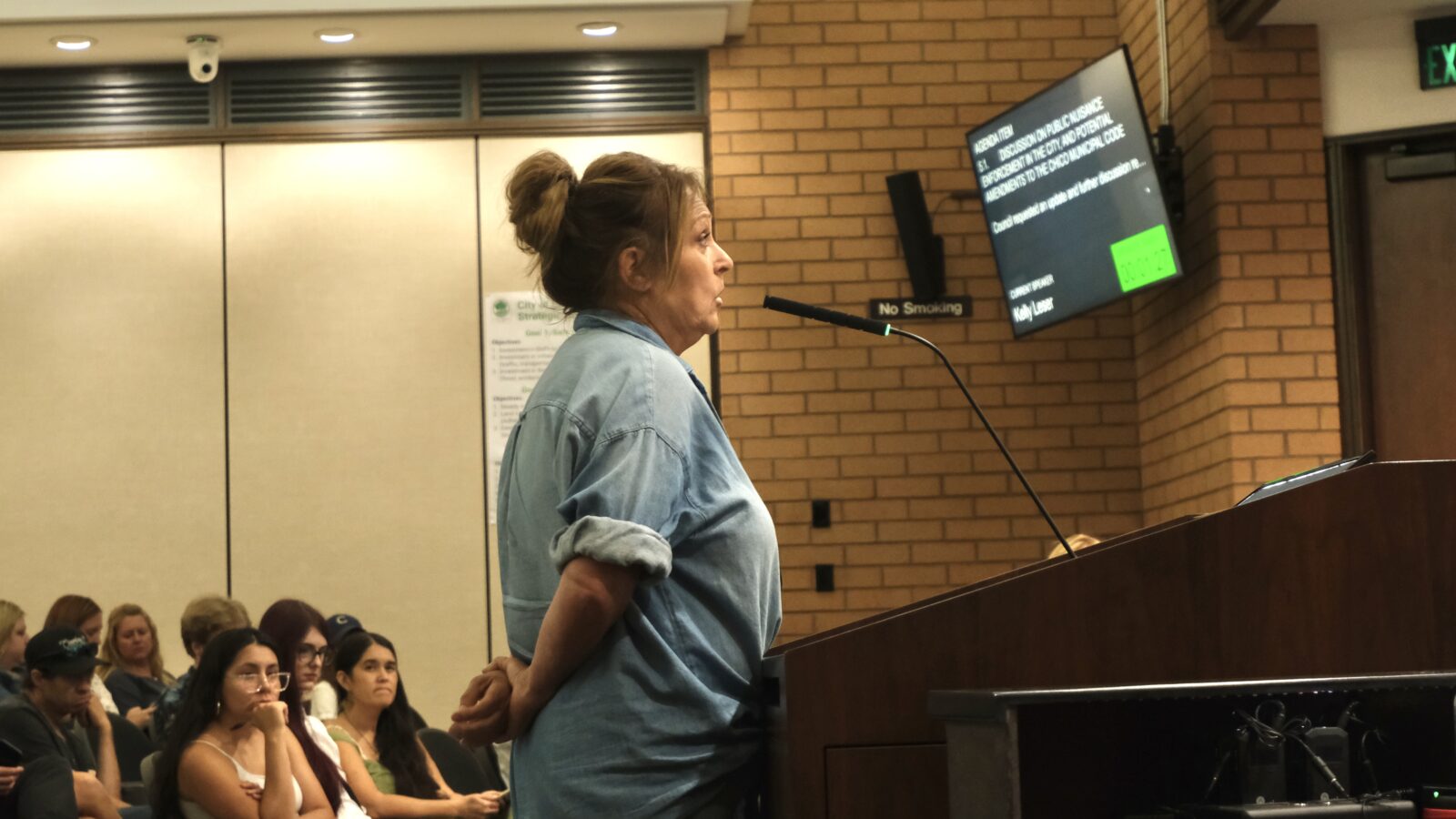
Kelly Leser, a downtown business owner, shared conflicted feelings.
“I do want to thank you for starting to do something regarding this situation instead of waiting until January 14th [when the Settlement Agreement expires],” Leser told the Council. “There are so many of us that are working so hard to keep our doors open, and this is part of the problem with what’s going on downtown for us.”
But Leser also expressed empathy toward unhoused people.
She stressed that “not everybody can be locked into one category” and “it’s heartbreaking to drive in every day and see people living in this manner.”
Charles Withuhn, president at North State Shelter Team, urged building more tiny homes in comments to the Council. Later, he told ChicoSol that the city is dealing with symptoms rather than addressing root causes of homelessness.
Yucheng Tang has been covering city government for ChicoSol during the term of a California Local News fellowship. This was the last Council meeting he will cover in Chico.
4 Comments
Thanks for the coverage. I think attempts to further criminalize being impoverished/unhoused is abhorrent. I’m glad those in favor are showing their true inhumane colors for all to see. When people show you who they are, BELIEVE THEM!
Tiny homes are cheaper than sweeps. North State Shelter Team has a plan that got 4 Counilor’s votes to go forward and then City Staff stopped it. Let’s ask the City Council to direct staff to use State Statute 8698, pick a location (like the old abandon CHP parkinglot) and get the North State Shelter Team’s Safe Spot Community tiny home proposal going.
“We are supposed to be here in service to one another with kindness and generosity” Carlos Santana
“Kid, I’m down to my last peso” Humphrey Bogart, Down and Out.