
ChicoSol runs guest commentary and analysis on Mondays.
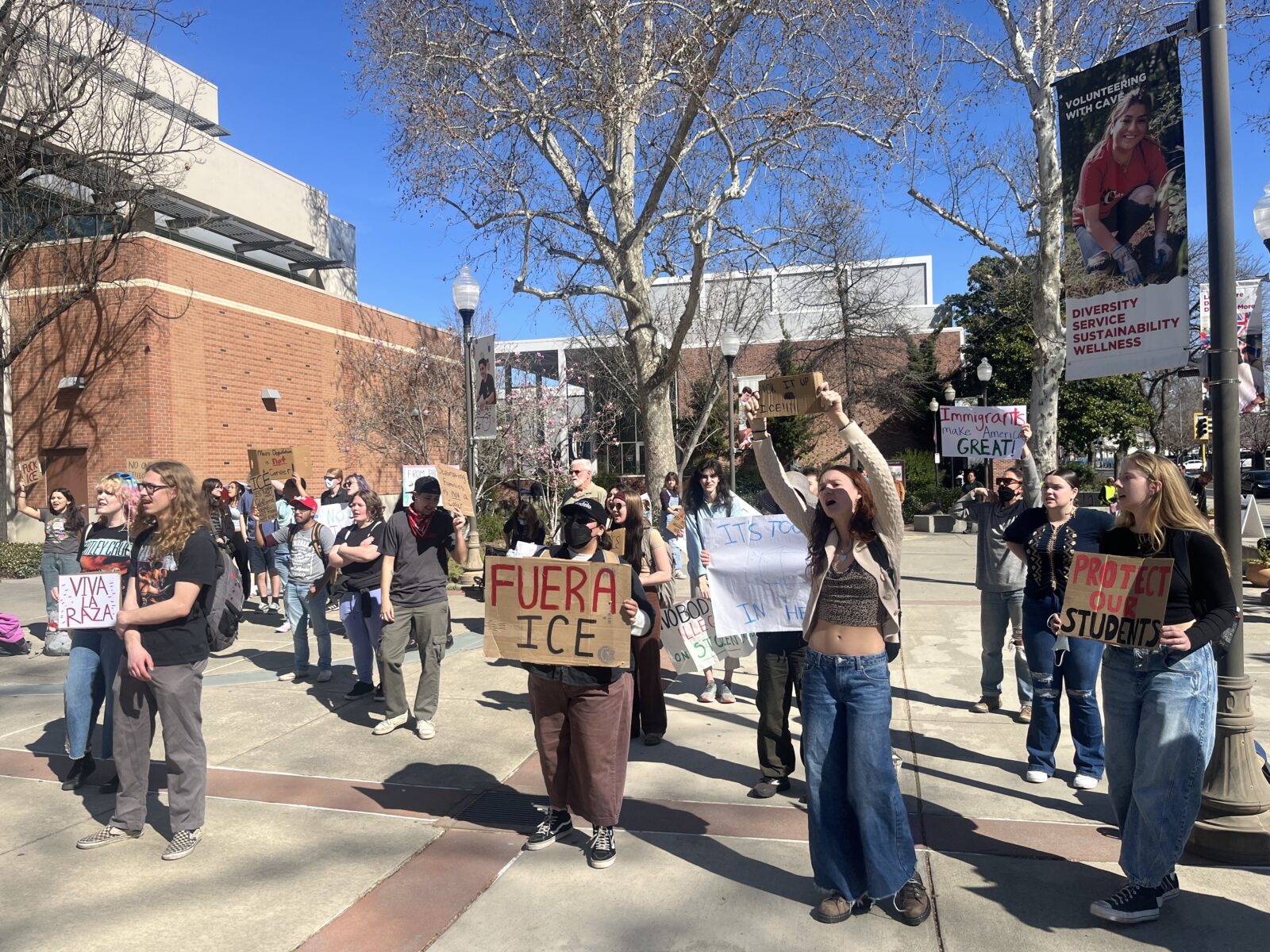
In early 2025, a social media post advertised a sit-in protest at an upcoming job fair on the Chico State campus. Immigration and Customs Enforcement (ICE) would be present at the fair to recruit students.
The social media post triggered an email to students that warned that protesters could be subject to a range of possible repercussions, including criminal penalties, in accordance with a new system-wide policy on protests in the California State University (CSU) system.
The preemptive warnings caused students to change the plan to sit around ICE recruiting tables inside the Bell Memorial Union auditorium, and instead protest from the outside plaza. Protesters and job fair attendees alike were forced to use the narrow accessibility ramp – the other entrances had been barricaded – with police officers stationed at doors normally accessible during operating hours.
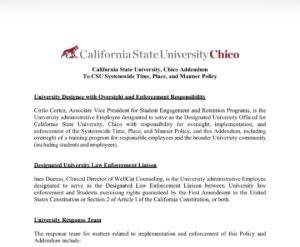
In 2024, Chico State’s approach to policing free speech and expression was changed. Prior to August of that year, each of the 23 campuses in the CSU system had its own individual policy on free expression generally called the “Time, Place, and Manner” (TPM) policy. By fall, each of these policies was overridden by a new Interim Systemwide TPM policy.
Until the CSU’s Systemwide TPM Policy was implemented, our Chico State TPM policy was created and maintained in the form of an Executive Memorandum, and so was subject to a vote by our Academic Senate. It was, by this token, amenable to change.
The Academic Senate of the California State University stated that the policy’s increased policing and surveillance was already “disproportionately imposed upon Black and brown members of our community”
The Systemwide TPM Policy is not amenable to any comparable sort of change, and was not subject to the kind of shared governance characteristic of the Academic Senate. The Board of Trustees, vested with governing authority over the CSU by California law, did not vote on the policy. According to the CSU Northridge Faculty Senate, it was “implemented unilaterally, thereby sending a chilling effect about the ripping of democratic rights and freedoms enshrined in the US Constitution.”
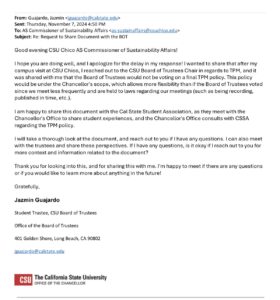
In an email, Jazmin Guajardo, who was then the student trustee on the CSU Board of Trustees, shared with me that the Board had chosen not to vote on the policy. That would allow “more flexibility than if the Board of Trustees voted since we meet less frequently and are held to laws regarding our meetings (such as being record[ed], published in time, etc.)”
At least 12 Academic Senates across the CSU scrutinized the policy formally, and at least half a dozen outright renounced it shortly after its implementation. Although these bodies suggested many reparative measures, they were ignored by the CSU.
The Academic Senate of the California State University (ASCSU), the official voice of CSU faculty in systemwide governance, lambasted the CSU’s actions in their ASCSU Resolution on the Interim TPM policy, citing “unconstitutional restrictions of protected freedoms of assembly and speech for faculty, students, staff, and community members.”
(ChicoSol reported in November 2024 that Chico State’s Academic Senate had called on the Chancellor’s office to suspend the TPM policy.)
They also stated that the policy’s increased policing and surveillance was already “disproportionately imposed upon Black and brown members of our community,” and they called on the Chancellor’s office to carry out a series of reparative measures, none of which were carried out.
At the Chico State job fair, protestors watched students proceed up the ramp to the BMU, where they would presumably have the opportunity to be recruited into a well-paying ICE career, unimpeded by disruptive students. I had a conversation with a member of the University TPM Response Team (URT) about the protest. It turned out that, even in its diminished form, the students’ activity was still out of line with the Interim TPM policy. However, the URT had elected not to enforce the policy in this instance.
Curiously, the constitutional validity of TPM policies hinges on content-neutral and uniform enforcement. Concerns continue to mount over a perceived uneven enforcement pattern, of which Chico State’s 2025 ICE protest is but one example. Whether the policy is enforced more in a way that suppresses certain political viewpoints or predominantly impacts students of particular ethnic or racial categories of identity remains an open but contentious question.
There is, at present, no adequately comprehensive public data on such questions, although AB 2551 may remedy this to some extent, should it pass.
At the ICE protest, several students shared with me that they had chosen not to participate in the protest, out of fear for their and their family’s safety. They worried they might lose financial aid, be subject to increased academic and behavioral scrutiny, or face a litany of other serious penalties like those incurred by Angelmarie Taylor at CSU Channel Islands.
The CSU attached misdemeanor penalties to violation of the Systemwide TPM Policy by grounding its authority in California Education Code §89031. A student may be found guilty of violating the code so long as their activity meets the definition of “disruption.” Even in the case where misdemeanor penalties are not invoked for disruptive activity, students may be subject to a range of penalties for participating in free expression (including disenrollment).
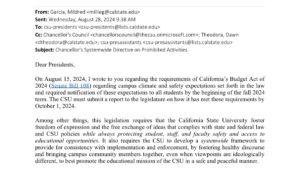
In an Aug. 28, 2024 Systemwide Directive, the CSU Chancellor characterized TPM as “not new” and merely restating and clarifying “what [had] always been well-established values, rules and expectations throughout the CSU for decades.”
But the Interim Systemwide TPM policy (still considered “interim” after two years and slated for finalization without vote at some unspecified date), whatever its intent, has drastically changed the way its rules and expectations are governed, and in doing so, has set a precedent for future decision-making in matters of protected rights.
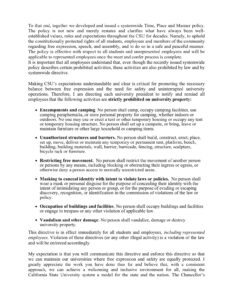
The Board of Trustees has increasingly delegated authority to the Chancellor’s Office, thereby bypassing “laws regarding their meetings” in extraordinarily controversial circumstances like those relating to artificial intelligence and free speech.
Since the formal channels through which the grievances could be addressed have proved ineffectual, and since “disorderly” dissent has been rendered a potentially criminal act by the Interim Systemwide TPM policy, I would argue that any effective means of opposition has been effectively precluded.
These massive systemic changes are increasingly made behind closed doors, and they seem to serve the CSU system at the expense of the individual human beings who must live inside of it and who play a seriously diminishing role in decision-making.
Transparency, good-faith consultation, shared governance – safeguards against tyranny – are routed around, apparently because of the friction they produce, and in the interest of systemic efficiency.
In an internal communication to campus presidents on Aug. 15, 2024, the same day the Systemwide Policy was issued, the CSU Chancellor directed presidents to send out “a campus climate notification email …”
At Chico State, that climate notification was titled “Exercising Your Rights to Freedom of Expression.” Under this progressively mechanized CSU system – the largest public university system in the United States – our “campus climate” has become frigid, ideal for a complex mechanical system, but increasingly inhospitable to human beings, especially those among us most vulnerable to the cold.
Worse, the thermostat’s dial has become the exclusive purview of a small group of executives who appear quite unconcerned.

Adin White is a Master of Public Administration student at Chico State and the recipient of the Mike Thompson Political Science Scholarship for demonstrated dedication to public service. White is the founder and president of VIRES, a student advocacy organization currently focused on freedom of expression on campus.
2 Comments
“To do injustice, as a select few are above the law and no down trodden souls will be spared from its cruel, crass, corrupt persecution” ???? ??????
In Solidarity with Thelma and Louise.