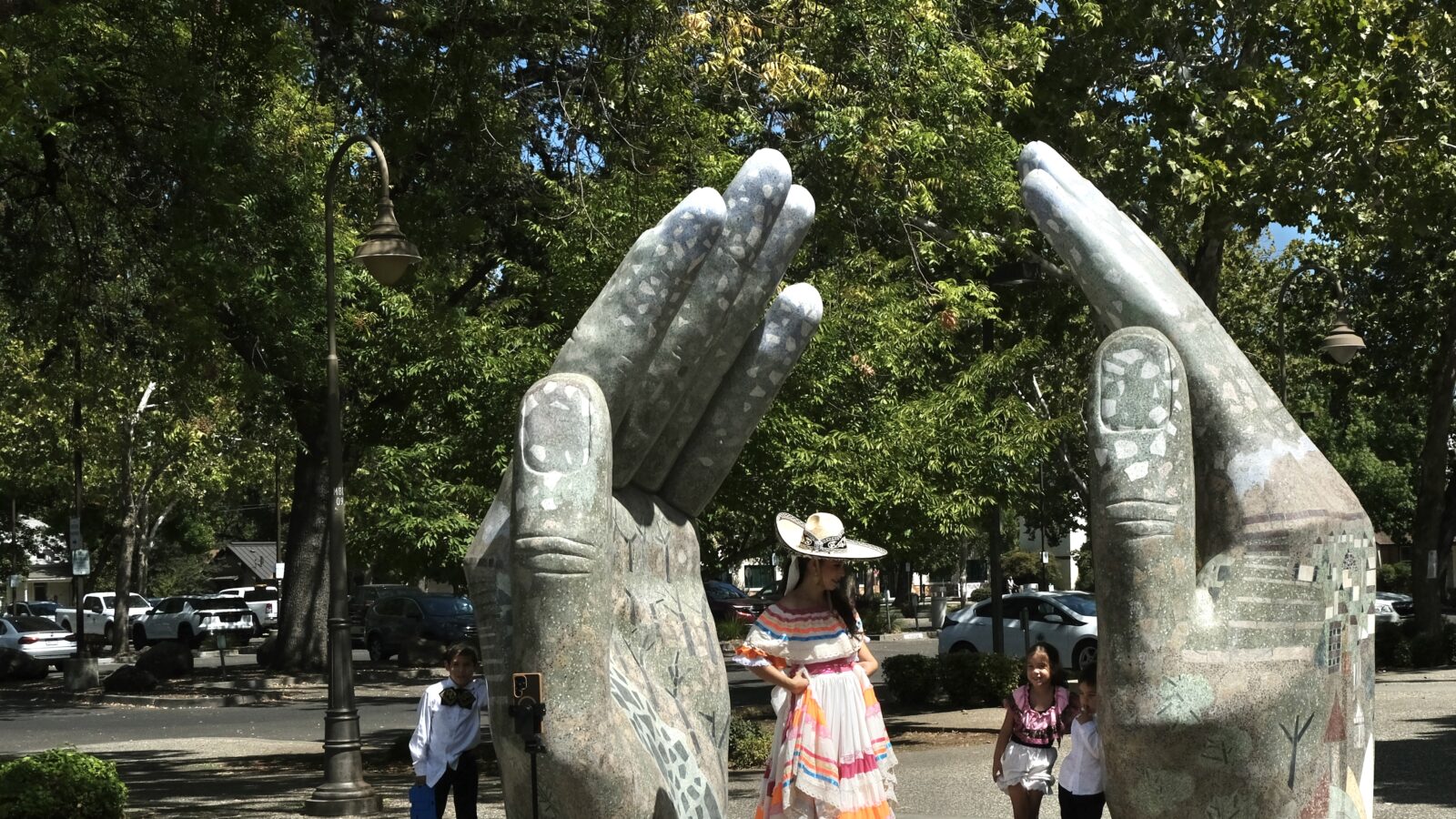
My most unforgettable memory of the Our Hands sculpture — the two huge hands next to city hall — was on a windy winter night in 2024.
I was covering a memorial for unhoused people who had died outside that year. A group of people gathered next to the sculpture in a circle, holding tiny digital candles. Some speakers, right in front of the sculpture, talked about the housing crisis facing the community and how we should come together and help one other. Then, people read aloud the names of those who had died, one by one, in unison.
The two 12-foot-tall hands just stood there, silently, while the names were read. I was touched by the empathy people showed toward those they did not necessarily know personally. At the time, I didn’t know what the sculpture represented or the story behind it.
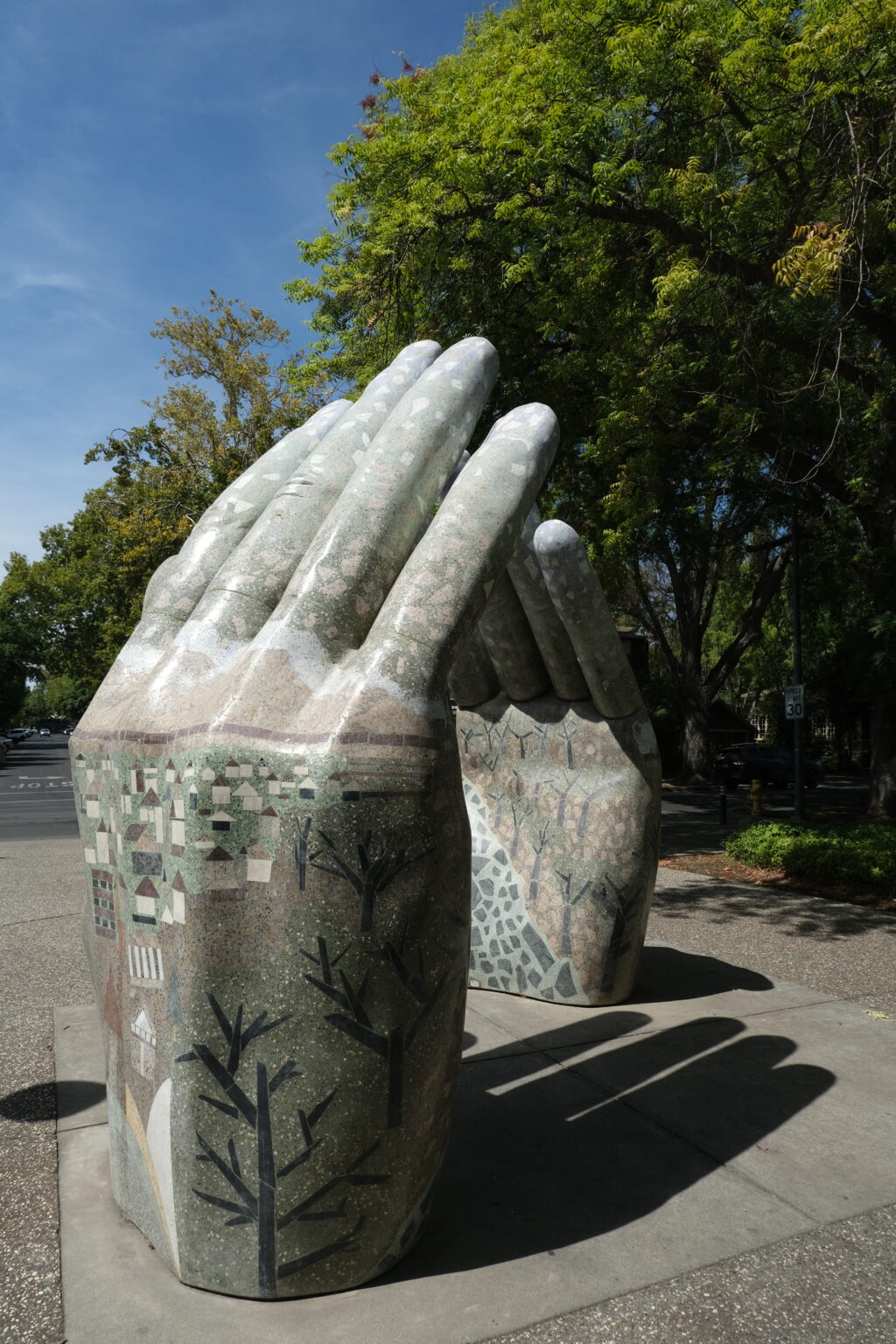
One year later, I went to another memorial held for the same purpose. That day, the sky was brighter. I took a closer look at the two hands. They are two beautiful, gray-green hands covered with terrazzo, with images of trees, rivers, farms, and houses scattered across them. The nails and creases on the fingers are carved in vivid detail.
A golden-hued plaque on the ground says the sculpture was made by Davis artist Donna Billick in 2000.
I hadn’t thought much more about the sculpture until recently, when my editor asked me to write a farewell story for ChicoSol. I had never really stopped to think about their story, although I saw them all the time when I was downtown.
Whenever I went to the City Council Chambers to cover meetings, I passed by the sculpture and often saw the NorCal Resist team there, distributing food and clothes to unhoused people. It was also there that I talked to Michael Morgan, a well-dressed unhoused gentleman, who asked the public to move beyond stereotypes about homeless people. He hoped unhoused people could represent themselves during those Council meetings.
I saw hope and dignity in his eyes, and I wanted to convey his message.
My interactions with Our Hands happened in these small moments. I guessed the hands might represent mutual aid.
Controversy and connections
Then, I dug into the history of Our Hands by reading old newspapers.
My guess was validated by a Chico Enterprise-Record article about the meeting at which the Council approved the purchase of the sculpture in January 1999. The article mentioned the artist’s intention. Billick said the open hands represent “a universal gesture of caring, of touching, of greeting, of warmth.”
She also told the Council she hoped the piece would help bring the people of Chico and city officials closer together.
But in addition to that, I found another interesting layer to this story. It is about controversy.
At the City Council meeting, the panel discussed whether to approve the purchase of the sculpture that would cost $65,000. Many residents voiced strong opposition during a public hearing that lasted more than an hour.
Some people spoke against the purchase of the sculpture, and one person called it a “laughing stock” and said the city would be known in the future as “the city with the big hands.” Some argued that the piece was too expensive and the money could be spent elsewhere, such as on infrastructure improvement. Others worried about safety issues, such as the piece falling down or people climbing on it.
The purchase was approved in a split 4-3 vote. A conservative councilmember, Bill Johnston, didn’t vote along partisan lines that day. According to the same article, Johnston believed that the sculpture would distinguish Chico from other small cities.
“I am elected to vote what I think,” he said. “I think this will help make Chico a good place to live. I think it’s integral to that — to have this sort of component in town. I love it.
“This is the last place we should look for economies,” Johnston said.
One year later, on March 9, 2000, the pair of hands was installed outside city hall. In an ER article, Mary Gardner, then city art projects coordinator, said that the piece could herald a new era of positive reception of public arts projects.
“I’ve heard only positive comments — no one’s going to burst my bubble,” Gardner said then.
Twenty-six years later, Bryce Ingersoll, who came to Chico for school and stayed after graduation, had no idea the sculpture had been controversial. To him, it has become an iconic Chico landmark. He views the hands as helping hands and appreciates the value they convey.
“I’ve been to many events that say ‘meet at the hands,’ and everyone seems to know what that means,” Ingersoll said.
Art inspires conversation
Bonnie Pipkin, now chair of the Art Commission, told me that art inspires both coming together and controversy.
“I love the way that people can interact with the Our Hands sculpture,” Pipkin said. “I like to see people take photos with it. It’s a piece of art that is sort of like a welcoming representation of what we want Chico to feel like.”
Pipkin admitted that people always get upset about artistic content, but she said there is something healthy about the controversy.
“I think art does inspire conversation, and conversation is important,” Pipkin said. “Conversation is actually the only way to address the division. I think art has the power to bring people together in that way.
“And as time passes, it seems like that kind of controversy just goes away, or we move on to something else,” she said.
Controversy — that’s the word I think of when I think of Chico.
Chico is a city full of controversies — no matter the topic — whether it’s homelessness, groundwater or the debate over whether the City should turn three vehicle lanes into two to revitalize downtown. Debates and disagreements were everywhere, and sometimes, as a reporter, I felt overwhelmed.
But the story of Our Hands helps me think differently about controversy.
Perhaps, as Pipkin said, public art can not only cause controversy, but also stimulate conversation, and conversation can address division.
At the last City Council meeting I covered on Aug. 18, councilmembers debated public nuisance enforcement. Some residents said the potential revisions were inhumane approaches to targeting homelessness. Meanwhile, next to the Our Hands sculpture, a dozen unhoused people were receiving help from local volunteers and waiting in a line for a free meal.
During the Council meeting, a speaker from the audience who agreed with stronger public nuisance enforcement also showed empathy, noting that there are multiple causes for homelessness.
Perhaps a nuanced understanding of a stigmatized group is helped along by the community members who are constantly showing the care, empathy, warmth and willingness that the sculpture conveys.
Perhaps opening our hands to help and our minds to communication is the way for us to move forward while living with controversy.
Yucheng Tang is completing a two-year fellowship with ChicoSol funded by the California Local News program.
5 Comments
Chico is my hometown and I love The Hands! I see them as welcoming and caring. Thanks, Yucheng, for the excellent article – and for all of the outstanding work you have down for ChicoSol during your two-year fellowship.
Yucheng made sure to show me the hands on a tour of downtown chico in late 2024, not long after he had moved there. They left a big impression, it’s still one of the first things I think of when I think of the city.
Mr Yang, you have done a remarkable job with Chico Sol and I can imagine your future in telling important stories, well written, with a strong eye for detail. Thank you for this story, as all your others, and know how much you gave contributed to our community.
Brilliant and thought provoking writing. Thank you Yucheng for your contributions to our progress on importnat issues.
The long arm of the law too often wields the iron fist of fascism?