
A 1,200-acre solar farm may soon develop off Skyway as Cenergy Power prepares to file its application to the California Energy Commission.
The project has flown under the radar because the developers are submitting to a state commission rather than seeking county permits.
Cenergy President William Pham said going through the state allows for a quicker timetable for the development, which helps with banking requirements.
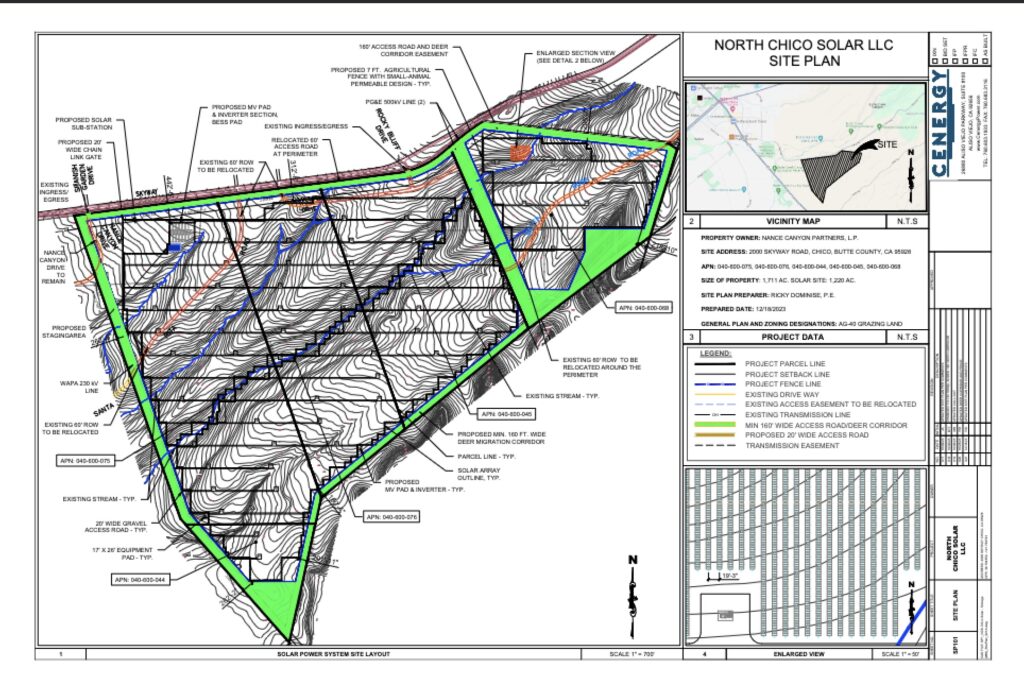
North Chico Solar LLC, formed by Orange-county based company Cenergy Power, has been trying to build a solar farm in the county for several years. The company acquired 1,700 acres of land that is sometimes used for cattle grazing, county documents show.
The developer plans a solar farm on the southeastern side of Skyway that is sized to have a maximum generating capacity of 300 megawatts of alternating current. That could power approximately 30,000 to 90,000 homes.
Cenergy has been active in the community, speaking with nonprofit groups and public officials, including Butte County supervisors.
“Our primary mission is to build clean energy projects but also provide community benefits,” Pham said.
During those discussions with stakeholders, they discussed donating money to disaster relief and mitigation, along with fuel reduction projects to reduce wildfire risk. But as an energy company, he said its goal is to keep most of the power the farm generates in Butte County.
Pham said Cenergy has been speaking with Pioneer Community Energy, which is expected to begin serving the county at the end of 2027. Pioneer is a not-for-profit public agency that purchases power on the open market to compete with PG&E rates.
He said they’re hoping Cenergy can help Pioneer bring further cost savings to Chico and Butte County residents.
In December 2023, Cenergy filed an application to the county for the solar farm. But Cenergy recently opted to file directly to the state’s California Energy Commission.
Assembly Bill 205, passed in 2022, allows developers to file clean-energy developments directly to the CEC rather than going through city or county permitting processes. The CEC is required to hold a public comment period before the application is submitted to the state.
Pham said Cenergy intends to hold public meetings as well, with one anticipated later this month in Chico. He said the plan is to submit the application this month, but can be flexible depending on community feedback.
Doug Teeter, supervisor for District 5 that includes the land where the farm would be located, said he supports landowners doing what they want with their property. He noted it might not be the best use of the land, but pointed out the need for clean energy. He also said the project would generate hundreds of thousands of dollars in tax revenue for the county.
Public officials and community raise concerns
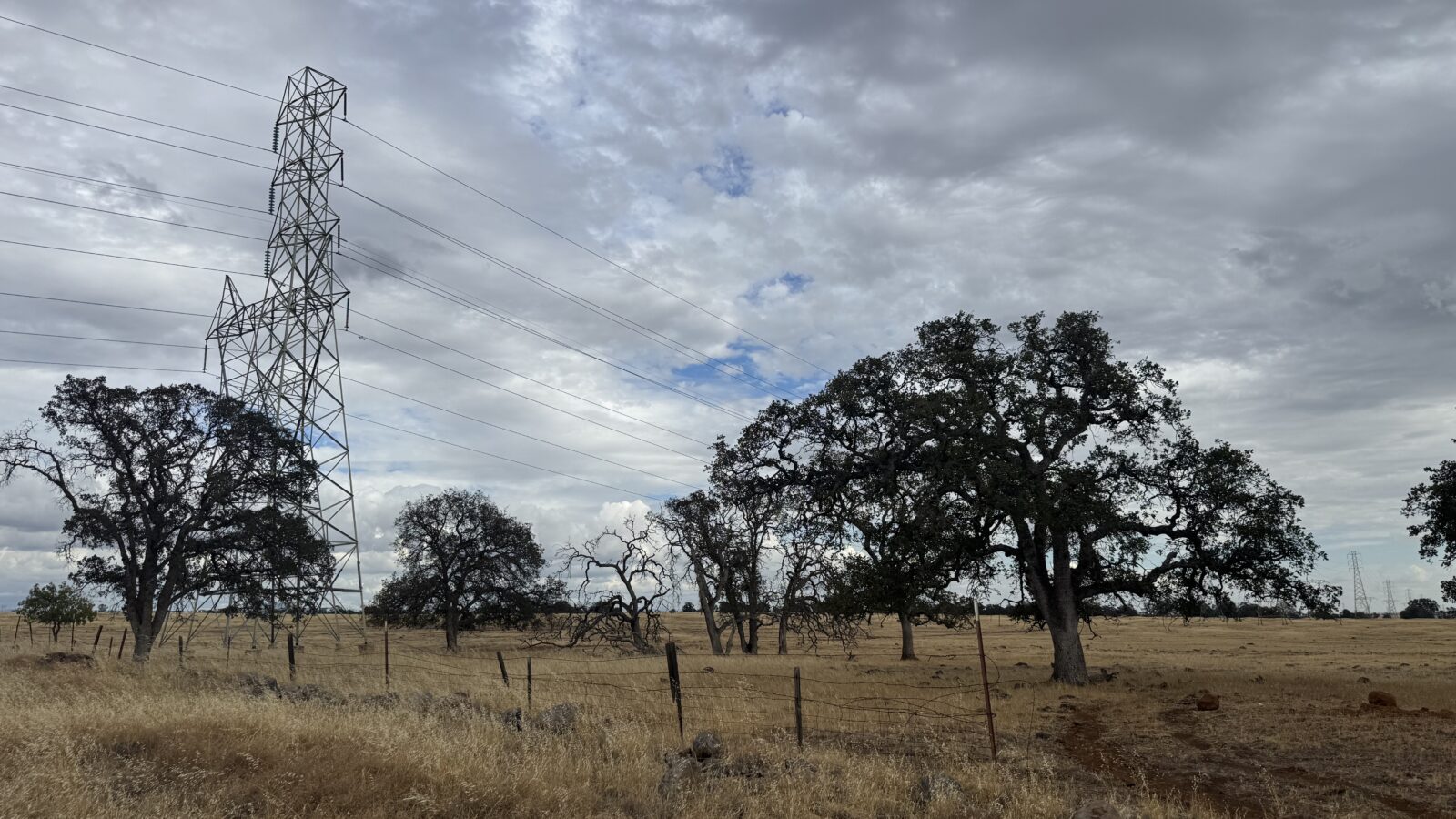
The county performed a study in 2017 to determine where solar projects would be most suitable. That study listed the site where the project would be located as a “low suitability” area. However, the land traverses the Western Area Power Administration line, a series of high voltage lines that run along towers like those you might see in Chico’s Upper Park. WAPA’s use is a requirement for the amount of electricity the farm would generate.
Butte County is unable to block the development if it is approved by the CEC. This is something two Butte County supervisors have shared concerns about.
“It’s going to be less about what we want to see and what state goals are with large scale power,” Teeter said.
Tami Ritter, supervisor for District 3, said the state might not thoroughly consider fire risk and the county’s natural landscapes. A small portion of the proposed project area is in the Camp Fire burn scar.
Pham acknowledged the fire danger but said they’ve begun discussing mitigation plans with CAL FIRE and the Butte County Fire Safe Council.
Modern-day batteries, Pham said, are certified and monitored to minimize fire risk. He said the industry has moved away from lithium-ion batteries to more fire-resistant batteries.
Mark Stemen, a geography professor at California State University, Chico, said he met with Cenergy Power to share concerns about the project, and said the company seemed responsive to his ideas.
He asked them for one thing: make a portion of the generated power available independently of the grid.
He explained the grid is “brittle” and if it went down, the solar farm could help alleviate some of the burden.
“They’re willing to do that, and all of a sudden it’s a community benefit,” Stemen said. “When they finally come up with the project we have to see if it’s worth it or not.”
Ritter also acknowledged the need for solar power, and argued that solar is a crucial way to address reliance on fossil fuels. But, she said where these types of farms are developed needs more consideration.
Ritter and Stemen are both concerned about environmental harm because of the large number of blue oak trees that would be cut down.
The initial project plan had the majority of the equipment in the upper portion of the property, where the densest areas of blue oak trees are found. There are approximately 7,200 trees on the property. The trees are slow growing, with some a century old.
Pham said many of the trees are dying or dead, and they’ve shifted the location of the panels to reduce the number of healthy clusters of blue oaks that would be removed.
California has been pushing for more solar power for years. Cenergy’s farm would be the first of its kind in Butte County, but it’s not the first time a project like this has been attempted.
Butte County residents have repeatedly opposed development projects southeast of Chico. Most notably, the Valley’s Edge project — near and on the opposite side of Skyway — was struck down with a referendum following Chico City Council’s approval.
The Tuscan Ridge Project will place 165 homes on land that nearly butts up against the farm’s boundary.
Cenergy Power was founded in 2006, and since then has been building numerous, small scale solar projects. Pham said 30 acres is the average size for most of its projects.
North Chico Solar would be its largest project by about 40 times its average project, and if approved is expected to begin construction in 2028.
Stemen fondly recalled planting 1000 trees along Butte Creek to replace 100 that had been cut down He said he is conflicted about the project.
“This project is really hard for me,” Stemen said. “We need solar power. We need blue oak trees. We really need solar power. How can we make the project better and the [negative] impacts less?”
Correction: fixed the location where Mark Stemen planted the trees
Chris Hutton is a freelance journalist who contributes frequently to ChicoSol.
6 Comments
I hadn’t heard anything about the solar farm before I read this story.
Thanks for the great reporting.
Thanks to great journalism, we now are aware of this project. But also sounds like a done deal. Amazes me how projects like these are done with no in put from people who actually live here.
Great reporting. ChicoSol keeps us critically informed. Thanks
i have been saying for years that solar projects should be located on the parking lots of large commercial parking lots and buildings
It’s a scenic highway and determined to be low suitability by the County. Why did they buys this property instead of some valley grazing land with no trees. Right next to the PG&E substation on Cottonwood Road would be good. Seems they cut a deal with the property owners.
Glad to see that even the Sierra Club’s Mother Lode Chapter has expressed concern and pointed out that Aqualliance is on board. Sean Wirth, conservation Director of the MLC, wants to know if our local club is getting on board to help save all those trees. Please let me know if you want to help get our Blue Oak Group involved! Thank you. g-marvin@comcast.net