
“We eventually drove deep into the forest, until my mom sensed a strong presence from two old, wise cedar trees. She believed we’d be safe between them, at least for a while, so we set up camp. But when it comes down to it, even the strongest psychic trees can’t protect you from the police” – Excerpted from Weaver’s chapter, “Born with a Bandanna on a Stick.”
Lily Marie Weaver has written journals her whole life, and until recently, she didn’t hold on to them. Some of the journals burned in the Camp Fire. Some of them, Weaver buried.
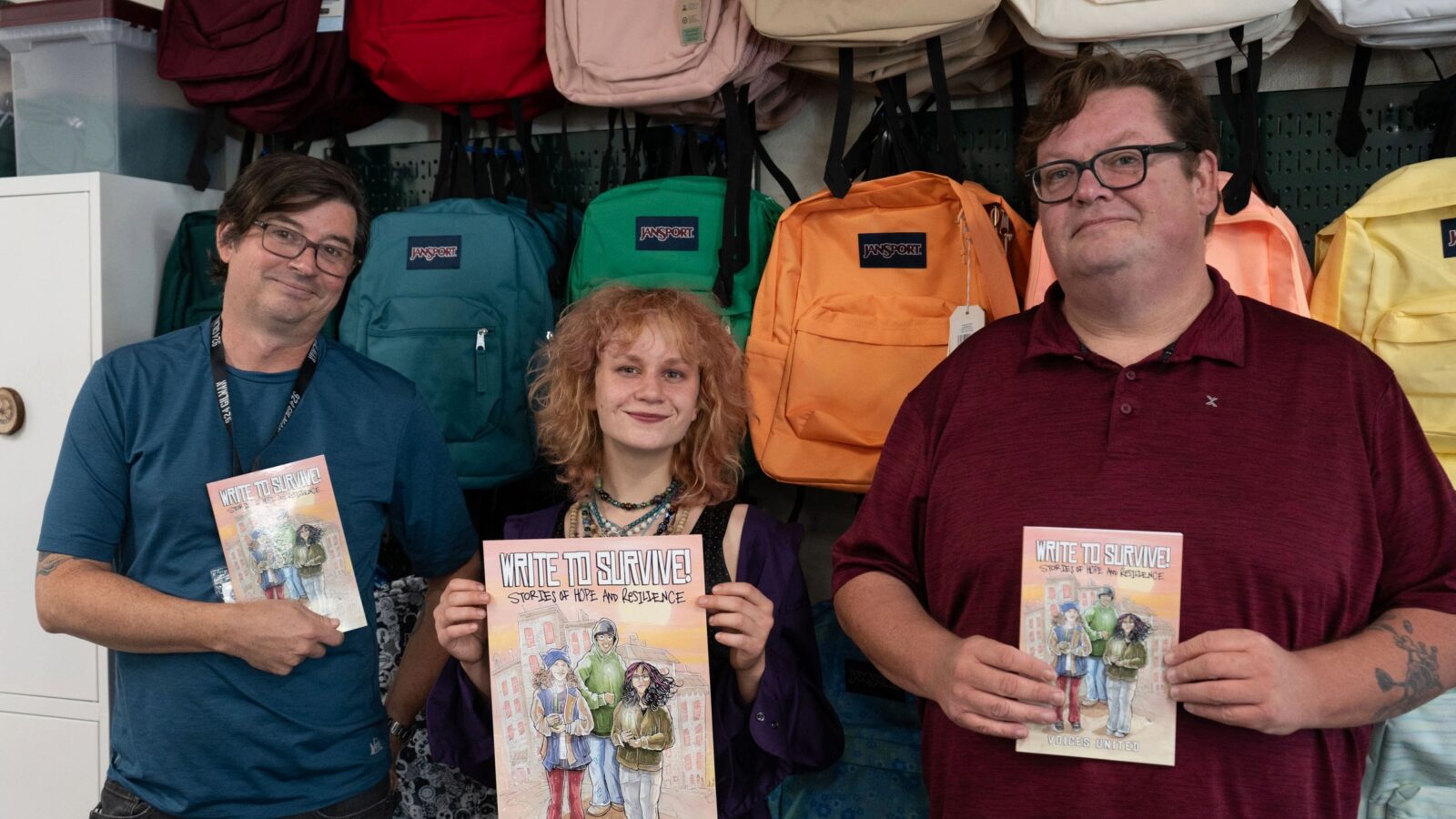
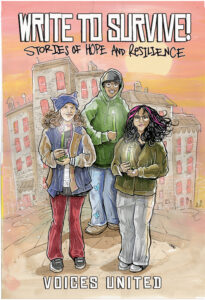
But in a new book titled, “Write to Survive! Stories of Hope and Resilience,” edited by local writers Ken Smith and Josh Indar, Weaver preserves her story as one of several young people sharing their experience with homelessness in Butte County and beyond.
The book began as a project to create a survival guide of tips and advice for young people facing adversity, including housing insecurity. But as it developed, Smith and Indar realized that the project would focus on the emotional level, sharing narratives and giving the young people a medium to tell their stories.
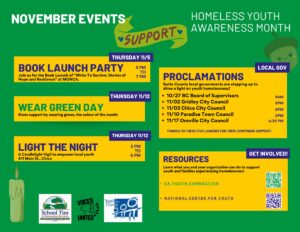
The book release party for “Write to Survive!” is from 5 p.m.–7 p.m. Nov. 5 at the Museum of Northern California Art, 900 Esplanade, Chico. There will be refreshments, readings and a discussion. The event is one of several taking place in November in observance of National Homeless Youth Awareness Month.
“Write to Survive!” was produced by a group called Voices United, a Butte County youth advisory board (youth is defined as people aged 18 to 25) of people who have experienced homelessness or foster care placement, in partnership with the Butte County Office of Education (BCOE) and the nonprofit Youth for Change. It was funded by a grant approved by the Legislature to support the mental health of California youth.
“Write to Survive!” regularly references the 6th Street Center for Youth, which closed in August 2026, but was cited by several of the writers as a supportive place where they found community and support.
Weaver, who is 23, grew up in Paradise before a series of adverse events left her unhoused. In Weaver’s chapter, she wrote with care and honesty, moving between moments of seriousness and trauma: people trying to take advantage of her, mistreatment and losing multiple homes. But she also wrote with playfulness, recalling her time camping in a wooded area of Washington with whimsical descriptions and a nostalgic tone.
In person, Weaver’s optimism and resilience was palpable during a recent interview.
Smith and Indar framed the book through Maslow’s hierarchy of needs, incremental tiers that break down how people move from basic safety to the final tier, self-actualization. For Weaver, writing helped with her self-actualization. The process of translating her story to the page with Smith wasn’t easy, but she said it empowered her.
Weaver, who is two years sober, recalled her experience in what was referred to as the trap house, an encampment in Chico with a reputation for drug use.
“I went to the trap house ’cause that was the only place offering, and I was like I’m not gonna trap, I’m just going to go to the trap house and be good,” Weaver said. “But it’s hard to get away from it when it’s right there in your face and you’re living with all these characters that you cannot stand to be sober around.”
When Weaver found the 6th Street Center for Youth, things turned around. After eight months of therapy, and attending case management meetings, the center gave Weaver the keys to her own place through their housing program. Weaver struggled with the guilt of having a home when she had friends and peers who were struggling and unhoused. Sometimes, she would let people stay in her room, secretly.
“I broke the rules quite a few times with having other homeless kids live with me,” Weaver said.
When Weaver had the chance to collaborate with Smith and Indar to share her story, she didn’t hesitate. “I jumped on it in a heartbeat,” Weaver said. Her initial chapter draft was around 40 pages.
“I’ve lost all of my belongings, maybe like, three or four times, so it’s nice to be able to write something and then have such an amazing editor,” Weaver said.
Smith, a seasoned editor, worked with Weaver to streamline her experiences into a chronology. “My proudest moment for myself in the book was Lily’s piece,” Smith said. The two found a symbiosis as a team.
“I’m good at getting it on the page,” Weaver said, and “really bad at organization, and I just want to write more.” The process was a labor of love, and sometimes the catharsis was difficult. But Smith and Weaver reflected warmly on their process and collaboration.
The project was initiated and overseen by Josh Indar, assistant director at BCOE School Ties & Prevention Department. Journalist Ken Smith edited and compiled the book and interviewed and wrote stories with other previously homeless youth, service providers and advocates.
“Write to Survive!” follows a book Indar published called “Writing for Donuts,” which came from a program at the 6th Street Center, “basically just bringing donuts, encouraging people to write, and then compiling that into like a weekly or monthly little zine,” Indar said. The final product garnered attention from people, including social work students at Chico State.
Now, “Write to Survive!” serves as a potential resource for students, social workers and community members seeking to understand homelessness, as well as for youths looking for representation and community. Although each story is different, there are recurring themes that affected youths’ mental health and physical safety, including the Camp Fire and COVID.
The book is also about creating visibility. “It behooves unhoused youth to be invisible to some degree,” Smith said, “but it also keeps them from getting services and help.”
“Once we got really into it, it really seemed like the physical survival is obviously hard, but not quite as hard as the mental health piece,” Indar added.
Smith and Indar hope that readers see the literary and creative potential in the young writers featured, and in their peers. “There is so much talent and potential in these young people that should not be wasted,” Indar said. “If someone reads this and they’re in that situation, they can have some hope.”
“It changes you, for sure,” Weaver said. “Writing this book definitely helped my mental health a lot.”
After the release event, the book will be available at The Bookstore in downtown Chico. Donations will be accepted, and 100 percent of all proceeds benefit Youth for Change.
Disclaimer: Ken Smith is a freelance editor for ChicoSol.
Katherine Kihiczak is a California Local News fellow reporting for ChicoSol.