
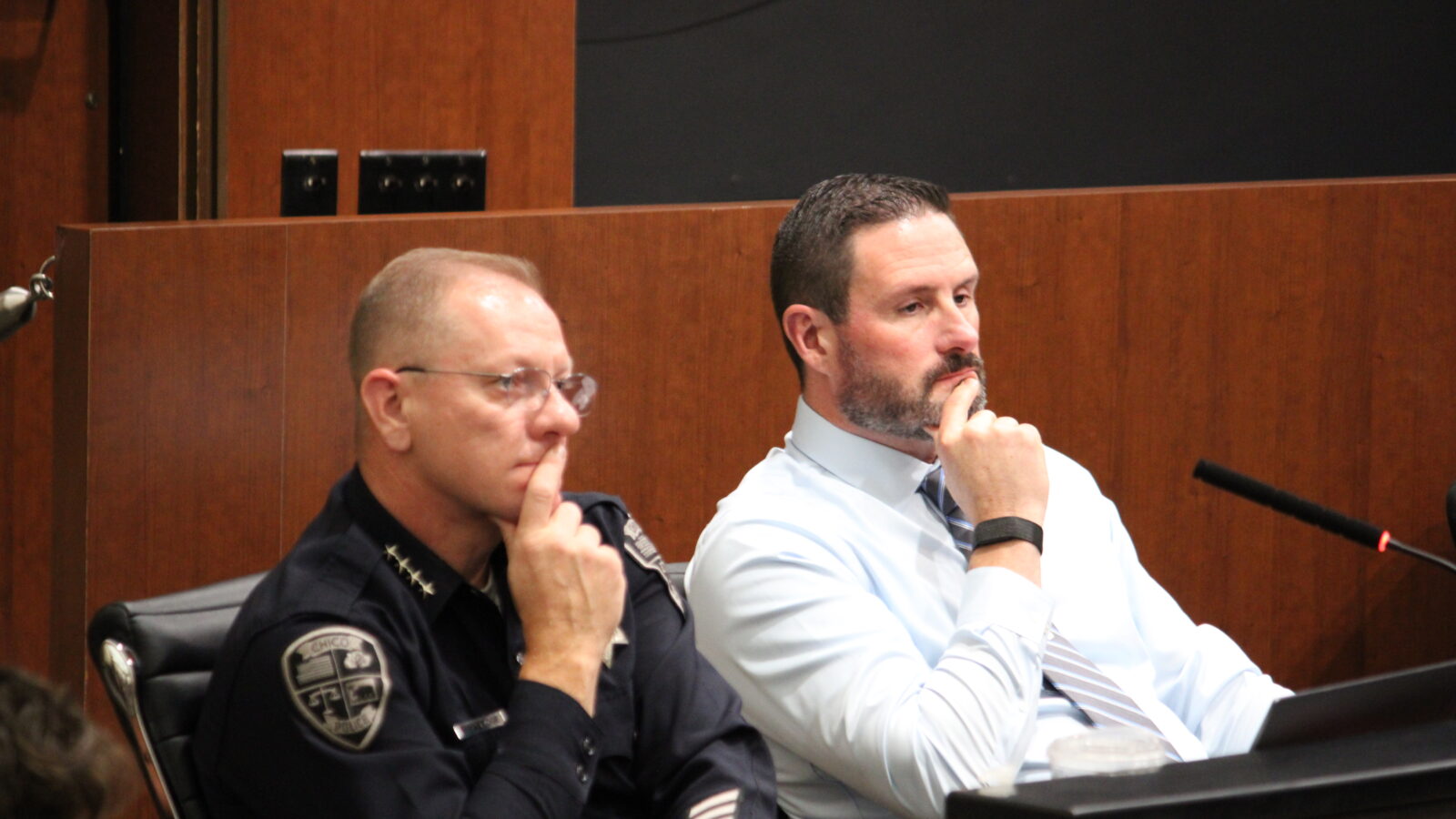
In a 4-3 split vote, the Chico City Council has directed the police department to purchase a $6,000 Motorola software subscription that might enable an audit of license plate reader data sharing.
At a special Sept. 21 session, the City Council also voted down progressive-led efforts to pause use of the city’s automated license plate reader (ALPR) network and establish a citizen-led police oversight committee.
City Council discussed Chico PD’s sharing of ALPR data in a tumultuous meeting. The special session included public comment and a 10-minute recess after an outburst by an audience member. During public comment, 24 people spoke in opposition to the ALPR program.
The subject has roiled Chicoans since a ChicoSol investigation uncovered data sharing with out-of-state and federal agencies in what could be violations of state law.
Chico PD has confirmed that ALPR data was shared with Immigration and Customs Enforcement (ICE), Border Patrol and 20 federal and 88 out-of-state agencies. On July 8, the department stopped sharing with those agencies, but in the process lost access to critical system usage records.
Councilmember Mike O’Brien made a motion to purchase the $6,000 subscription to a Motorola data retrieval tool for one year. It might expand the department’s ability to audit past ALPR sharing records. That motion was approved by Mayor Kasey Reynolds, Vice Mayor Dale Bennett and Councilmember Tom van Overbeek.

Chico PD, in its ALPR Program Review document, mentioned the data tool but seemed unsure of its capabilities. “Without further research into the exact capabilities offered by the API [Motorola’s tool], a recommendation is not made,” Chico PD states.
O’Brien included in his motion what will be a legal review of Chico PD’s memorandum of understanding (MOU) for ALPR sharing, which continues with more than 160 California agencies. The legal review would be conducted by the city attorney and ALPR policy could be edited by the Council.
Council also directed staff to plan a community forum on ALPRs, an item brought forward by Reynolds.
“These conversations are challenging, but necessary and important,” O’Brien told ChicoSol.
Immigration vs. customs enforcement
On Sept. 18, Chico PD revealed that ICE used its ALPR data to track six vehicles between May 29 and July 8.
Van Overbeek maintained that even though ICE accessed the data, it wasn’t used for immigration enforcement. It was unclear where the council member obtained this information.
“The ‘C’ in ICE stands for customs,” he said. “So there were some questions from ICE for criminal cases, but not for immigration enforcement.”
Chico PD’s abbreviated audit did not show why ICE tracked those cars, and there has been no suggestion that Motorola’s tool would answer that question.
Because Chico PD lost access to records when it stopped sharing, Capt. Jeramie Struthers said it took 30 minutes for him to generate a one-day report of all instances where ICE made a search. The sample size he gathered for the audit was 40 days.
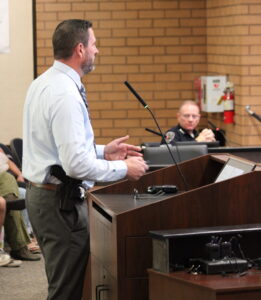
O’Brien said the tool should give Council a clearer picture of sharing.
The Council’s progressive bloc contested O’Brien’s thinking, stating it was a waste of staff time and city dollars to purchase the subscription.
“It gives us nothing that we need,” said Councilmember Addison Winslow. “It solves no problems that anybody had, and all it does is throw some money at a company, which now I’m more convinced than ever is primarily designed to suck money out of cities like this.
“This is like throwing a $6,000 bone to an invisible dog. No,” he said, as he cast his vote. Councilmembers Katie Hawley and Bryce Goldstein also dissented on the final vote.
Hawley said Struthers had already “spent an absurd amount of time” producing an audit.
To members of the public who have privacy concerns, O’Brien said there is already ongoing surveillance through smartphones.
Capt. Struthers noted 69 cases where the cameras aided in criminal investigations, including the Bidwell Mansion arson.
Law enforcement officials say the ALPR system has been an invaluable tool for public safety.
In Struthers’ presentation on the ALPR system, he noted 69 cases where the cameras aided in criminal investigations, including finding stolen vehicles. The program was most notably used to assist in detaining the Bidwell Mansion arsonist.
Trust broken, say community members
Most public speakers indicated they had lost faith in Chico PD and Council’s oversight of the department.
“I think a lot of people in this room respect what you do,” said audience member Alysia Krafel, addressing the police department. “We are afraid of what you could do. We are terrified of what you could do … we are being surveilled up the wazoo.”
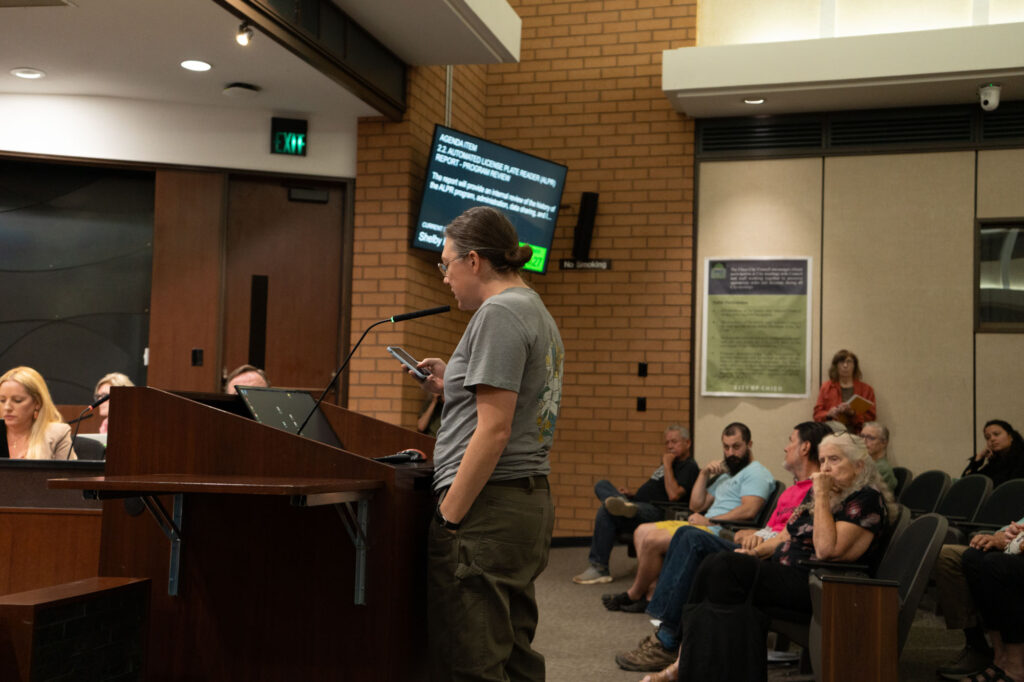
Sam Barber, a harsh critic of the police who said he had witnessed immigration agents detain a neighbor, stormed out, saying “Fuck you, Tom,” after van Overbeek said the Council should be careful not to be “stampeded by a bunch of emotional talk.”
Reynolds slammed her gavel and called for a brief recess.
When the Council returned, progressive members continued to push for a reduction in the ALPR program and for the formation of a citizen-led police oversight committee, but fell short without a majority.
Diane Suzuki, who attended the meeting with Concerned Community for Justice, spoke in favor of oversight. “This has been our ultimate goal for police accountability,” Suzuki said, adding: “Now we’re going to pay this Motorola to do what? To audit themselves?”
Julian Zener, another public commenter, described the situation as “incompetence with a touch of 1984.”
“Take this moment to form an independent review commission of our police department,” Zener said, noting that it would “rebuild trust” in the Council and police department.
Van Overbeek, who has opposed such committees, said the Council is elected and tasked with providing oversight. He noted that any citizens on the committee would be appointed by the Council.
“So how an appointed board is somehow going to magically perform all these miracles and look at police operations escapes me,” he said.
Winslow said that as the Council functions now, it isn’t effective at providing oversight.
“While I appreciate the sentiment of us being the oversight committee, I feel very ineffective as an oversight committee,” Winslow said, noting that oversight would require access to MOUs, access logs and perhaps more.
Chris Hutton and Elias S. Myers are contributors to ChicoSol and part of the New Generation Project. Katherine Kihiczak reports for ChicoSol as a California Local News fellow.
3 Comments
“Keep a Lid on Things” Crash Test Dummies, Canadian.
“Blow the Lid Off!” Peter Maurin,Co-founder, Catholic Workers Movement
“You don’t wanna cry, you wanna laugh, it’s like a little Game of Chance, we all anticipate The Elements of Nature”
Baby Animals, “Painless”.