
A few months before stepping down from the California State Assembly, Republican James Gallagher introduced a bill that could overturn a 2024 citizen-led referendum in Chico. Voters blocked the controversial Valley’s Edge development in that referendum.
The bill, Assembly Bill 2676, now in the state Senate, has bipartisan support, largely because California has a serious shortage of affordable housing, and developments have been tied up with lawsuits throughout the state.
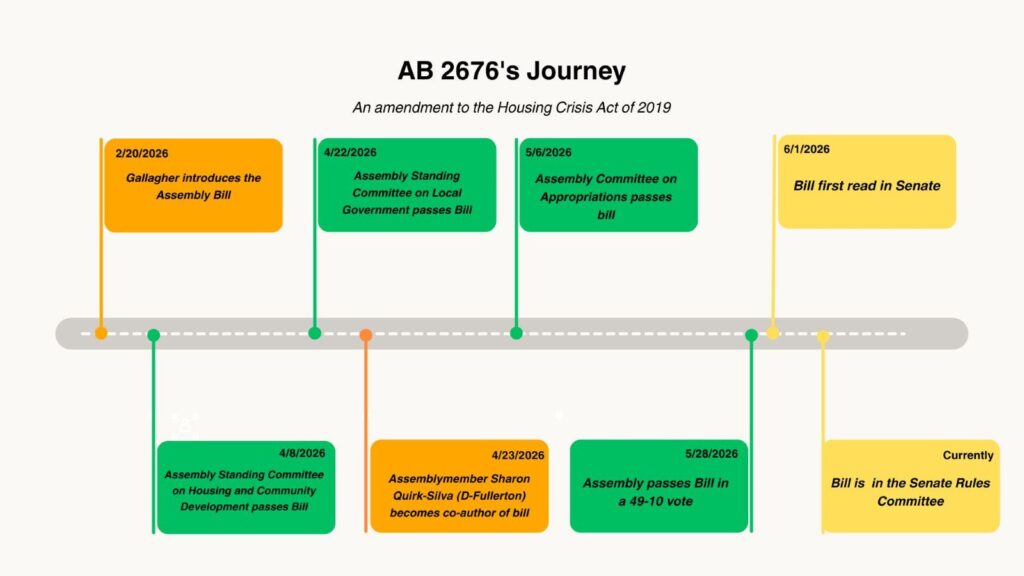
In an April committee hearing, Gallagher said AB 2676, introduced Feb. 20, was designed to resolve ambiguity in the Housing Crisis Act of 2019 — especially in regard to referendums blocking developments.

Gallagher said a direct vote, known as a referendum, that blocks housing development, such as the pair of ballot measures that Chico voters approved by about 62 percent in March 2024 that stopped the Valley’s Edge project, were intended to be a violation of the Housing Crisis Act.
The act prohibits cities and counties from imposing a “policy, standard, or condition that would have any of the following effects … changing the general plan use designation … Imposing a moratorium or similar restriction or limitation on housing development.”
The act arose from the urgency of California’s dire housing crisis. It set forth a framework to make it easier to develop and harder to block projects. While the act mentions referendums, the impact of the 2019 legislation on referendums is subject to interpretation.
Gallagher stepped down from the State Assembly after winning the District 1 congressional special election on June 2. In November, he will face Sen. Mike McGuire (D-Healdsburg) again, as he fights to keep the seat in Congress under newly-drawn District 1 lines.
Gallagher targets ambiguities
AB 2676 specifies that referendums can’t stop housing developments protected by the Housing Crisis Act without state authorization. If the bill is passed, a referendum would have to be approved by the Department of Housing and Community Development.
Gallagher argues that since the Legislature intended for a “policy, standard or condition” to include referendums, he added language in AB 2676 that would allow for it to be used “retroactively to any pending action or proceeding.”
“ChicoSol was unable to identify any other project that would be affected by the retroactive component of AB 2676 during a thorough Internet search”
He said there is already court precedent indicating that developments protected by the act can’t be blocked by referendums. In 2020, Oceanside voters overruled a City Council-approved, 214.5-acre development within its general plan. After a legal battle between the City and developers, a San Diego County Superior Court judge ruled that referendums fall under “policy, standard or condition.”
Litigation to move the project forward
The 1,448-acre Valley’s Edge project is being litigated. The developers — who later formed Believe in Chico LLC — sued the City in 2025, alleging it violated the Housing Crisis Act. But the lawsuit is in an appeals court after a Butte County Superior Court judge said the developers filed after what the judge ruled is a 90-day statute of limitations.
ChicoSol was unable to identify any other project that would be affected by the retroactive component of AB 2676 during a thorough Internet search. ChicoSol requested comment from Gallagher and his staff by both email and phone, but neither responded by the time of publication.
Jackson McNeill, a lawyer retained by Believe in Chico LLC, said the Housing Crisis Act wasn’t clear on referendums. But “clearly the legislature intended for certain referendums to be prohibited,” he said.
McNeill said even if the bill doesn’t pass, his client believes the statute of limitations applied should be three years.
Gallagher’s AB 2676 also clarifies the statute of limitations for suing under the act, stating explicitly that it’s three years. “If passed, AB 2676 would plainly allow the lawsuit to move forward,” McNeill said.
Chico City Council tied in a 3-3 vote over filing a response brief to the court, according to a March 16 document. Because the vote was in closed session, it’s unclear why Council couldn’t reach a decision on its response. Councilmember Tom van Overbeek recused himself because he owns property near the project area.
The City’s legal counsel for the Valley’s Edge case, Ginetta Giovinco, declined to comment on AB 2676 or the lawsuit.
Valley’s Edge approved, then opposed
The undeveloped area was designated in Chico’s 2030 General Plan, which was adopted in 2011 and amended in 2017, for development.
“I would rather see the community have a discussion about where and how it wants growth to occur, and how it meets state requirements on housing demand, and move on from there” — former City Manager Tom Lando
The project would have annexed land that’s used seasonally for cattle grazing, and would provide mixed forms of housing. The majority of the housing would be low to very low density (1,739 units), compared to medium to medium-high density (1,038 units).
It would also have had two designated preserves and a 371-acre regional park. The developers had planned a commercial area, a village core, school and a senior living area.
Despite concerns from many in the community, the Chico City Council approved the project in January 2023. Immediately, opponents mobilized.
Eric Nilsson was a prominent critic of the Valley’s Edge project. He said Chico needed housing, but the project didn’t do enough to address environmental concerns or provide affordable units, which he believes was the intent of the Housing Crisis Act.
“Even more than two years after the defeat, Believe in Chico LLC and Gallagher continue to ignore the will of the voters,” he told ChicoSol in a recent phone interview.
Volunteers working with the organization Smart Growth Advocates worked to gather the signatures that were needed to get Valley’s Edge on the ballot.
Legislature debates the bill
In a committee hearing, Assemblymember Sharon Quirk-Silva (D-Fullerton), who later joined the bill as a co-author, applauded Gallagher for introducing the legislation.
“Why this is significant and really important is because we’ve seen this playbook over and over, where a project makes it through planning, makes it to the council, council chambers is packed, and many times a project then is overturned at the council level,” Quirk-Silva said.
She later added: “This is a way to stall and delay housing.”
On May 28, the bill reached the Assembly floor, where it passed 49-10.
But there was some concern that it would take away from voters’ voices. Among those concerned was Assemblymember Gregg Hart (D-Santa Barbara).
He said the need for housing shouldn’t strip voter rights.
“It [AB 2676] says that even when local residents organize, gather signatures and seek a public vote on a controversial project, the state legislature should intervene and stop that vote from happening — that is a profound, undemocratic shift,” Hart argued.
Many opponents to the project interviewed by ChicoSol hadn’t learned about the bill until recently, with some even asserting that it was being kept from the community.
While ChicoSol was unable to find a mention of AB 2676 on Gallagher’s social media, it was mentioned on his Assembly website.

Marty Dunlap, an opponent of the project who helped gather signatures, said lobbying efforts to change some of the language targeting Valley’s Edge would soon be underway. Nilsson and Dunlap both said they reached out to Sen. McGuire this past week.
Nilsson said they shared information with McGuire’s staff relating to fire risk, and recommended changes to the bill’s content.
McGuire’s office told ChicoSol that the bill will “be referred to the appropriate Senate Committee in the near future.”
“Our office has heard from a number of community members concerning the bill and we will be following closely as it moves through the Senate committee process,” a spokesperson said.
Opponents raise concerns about Valley’s Edge
Project critics point to the large amount of high-income housing planned for Valley’s Edge and what they say is a failure to provide a significant number of affordable units. This was a concern for Chico’s Julian Zener, who wrote a recent letter to the editor of the Chico Enterprise-Record about AB 2676.
“The spirit of the Housing Crisis Act is to maximize housing, partially high-density housing and low-income housing,” he told ChicoSol. “It’s sort of ironic that Valley’s Edge, which is just the opposite, could be viewed as benefiting from the bill.”
But others, such as Tom Lando, the city manager from 1992-2005, who urged citizens to vote for the project, said the matter has become more complex with time.
“The fact is that the General Plan called for development in that area, and this project was doing what the General Plan called for,” he said. “Obviously, I don’t want to downplay the fact that citizens decided that it wasn’t a project they wanted.
“This [AB 2676] is an end run on it,” Lando said. “It’s just really tough. I would rather see the community have a discussion about where and how it wants growth to occur, and how it meets state requirements on housing demand, and move on from there.”
Environmental groups sue
Environmental groups have argued that the project would lead to more greenhouse gas emissions, endanger wildlife and habitat, strain the already stressed aquifer and increase wildfire risk.
The EIR addressed many of these concerns, but project opponents weren’t satisfied.
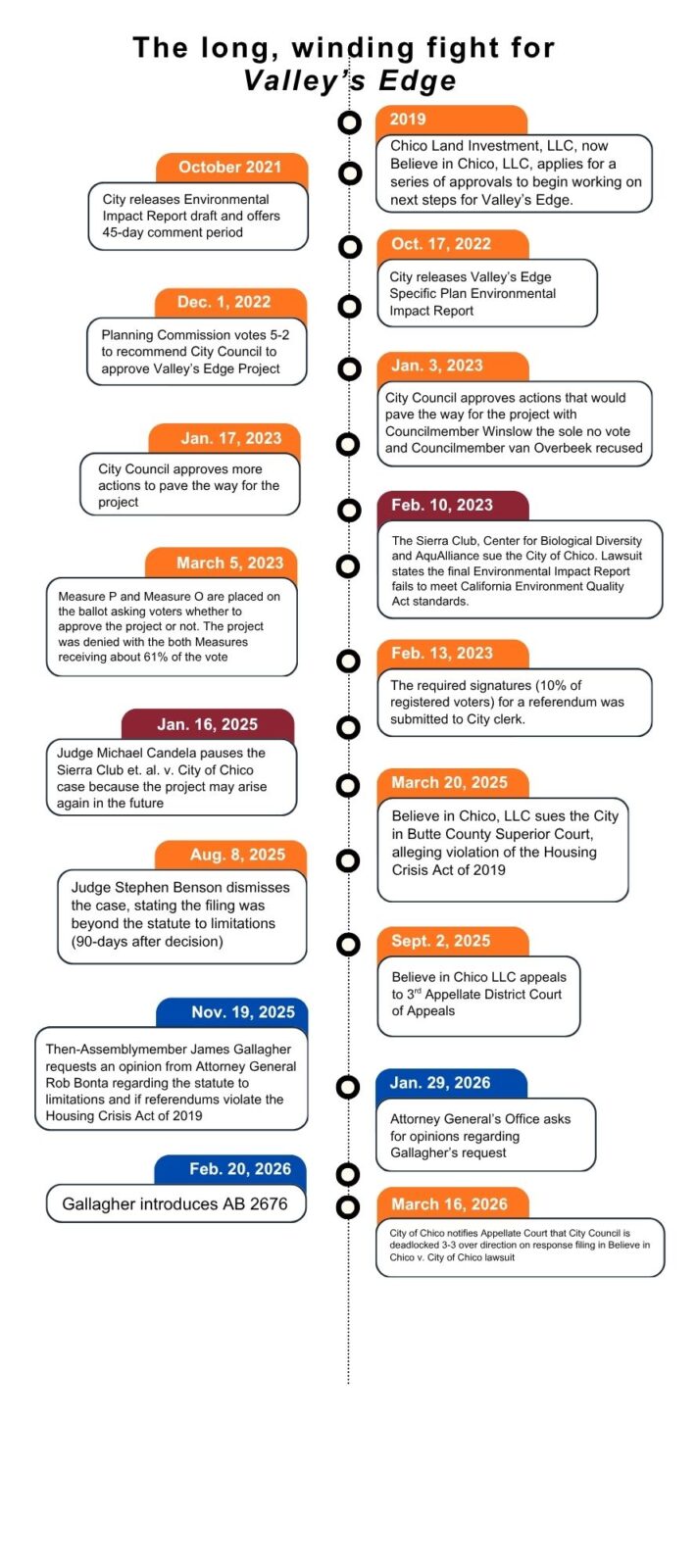
The Sierra Club, AquAlliance and the Center for Biological Diversity sued the City in 2023, alleging the EIR didn’t meet California Environmental Quality Act standards.
After both parties asked for a dismissal following the March 2024 vote, Judge Michael Candela noted a project in the proposed area might take its place. Instead of dismissing the case, he issued a pause order in case the project returned.
Zener said that he believes the opponents’ strongest argument was wildfire risk. Initially, CAL FIRE designated the area moderate risk for wildfires — now, large portions of the project are in a high-risk area.
Valley’s Edge is now tied up fighting a battle in an appeals court over what the proper statute of limitations should be. But, if the bill passes, the court will likely accept the new wording, and the developers’ lawsuit will move forward.
AB 2676 has been moving through the Legislature with little pushback, and if it passes, Chico’s two referendums in March 2025 might be considered in violation of the Housing Crisis Act.
However, the fight over Valley’s Edge won’t necessarily end with the bill. It’s likely the Sierra Club et al. lawsuit will come back into play, keeping the project on pause until a ruling is made.
Chris Hutton is a contributor to ChicoSol and a recent Chico State journalism graduate.
3 Comments
It appears Gallagher gets heavy support from real estate agents and developers. $96,050 for “developers and brokers” strictly, or $175,450 for “real-estate interests” broadly from 2016 to date. This is just a preliminary search.
Excellent article that covers the history and the legal and environment concerns. Could this be an opportunity for compromise? Fire danger and water issues are huge and could provide a point of agreement. Define the need for affordable housing. Do we want a(another) dream development or one that supports Chico and the people who live and work here?
Do we want development which gives priority to current residents (and taxpayers) of Chico for occupancy, so that the potential market will reflect the housing needs of people who are already committed to living here, rather than people who will move here from areas where they’ve sold more valuable properties to purchase “dream homes” with big dream yards, thereby doing little to relieve the shortage of affordable housing, and increasing traffic congestion and draw on fragile water resources?