
This article was originally published by The Rimfire Report, and is fifth in a nine-part series examining Gov. Gavin Newsom’s record.
SACRAMENTO — This installment breaks the pattern of the ones before it, because on mental health Gavin Newsom did something the rest of his record mostly lacks. He didn’t just spend the money. He tried to rebuild the machine.
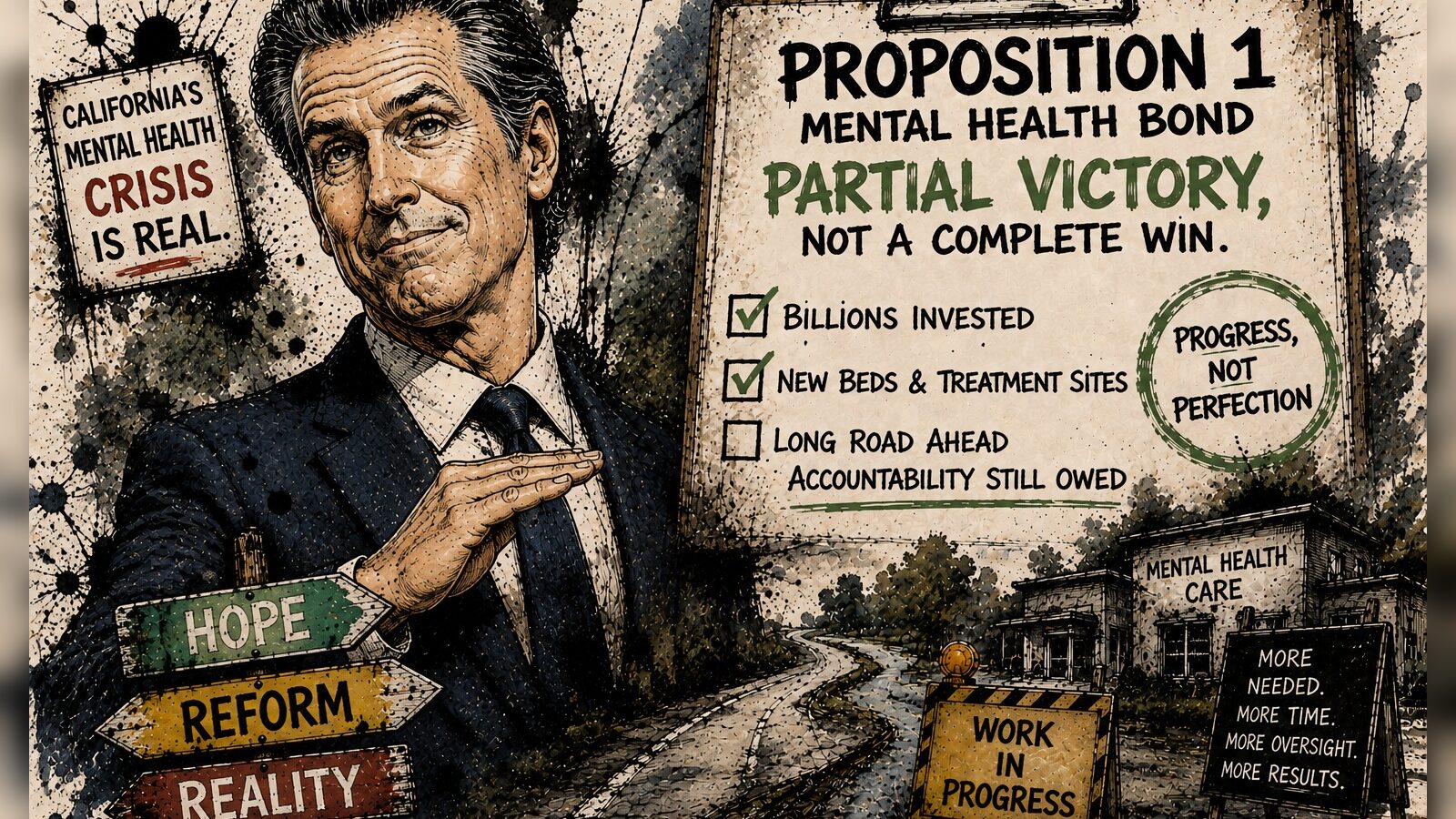
Proposition 1, the $6.4 billion behavioral health measure California voters narrowly approved in March 2024, is the closest thing to genuine structural reform in Newsom’s tenure, and it is two things at once. Half of it is a bond to build treatment beds and supportive housing for the seriously mentally ill and the addicted, many of them living on the street.
The other half rewrites the 2004 Mental Health Services Act — the voter-approved 1% tax on income over $1 million — steering that money toward the most severely ill and bolting on the accountability, data and transparency rules the old system never had. Running alongside it is CARE Court, the initiative Newsom signed into law in 2022 to move people in the grip of psychosis into treatment through the courts.
Give the man his due. This is hard, unglamorous, politically fraught work: restructuring a two-decade-old funding stream, picking a fight with counties over how they spend it and pointing the whole apparatus at the population every prior governor found too hard to help. Where the bullet train and the housing pledge were promises a governor could never personally keep, this is a reform a governor genuinely can drive. Newsom drove it.
The trouble is what he is saying about it before the results are in.
The bond: funded is not built
In March, Newsom announced the final round of bond awards and declared the thing a success.
By his telling, Prop 1 is ahead of schedule and beating its targets: 177 projects funded, a combined 6,919 residential treatment beds and 27,561 outpatient slots across 333 facilities, the goals cleared in just two years.
Those figures count beds and slots the state has funded. They are not, for the most part, beds anyone can yet sleep in. Newsom did point to real openings — 36 facilities operational by March, he said, projected to serve nearly 1 million people a year — but that is 36 against 333 planned facilities, and it steps around the gap that matters most.
When CalMatters tracked the specific projects the state had scheduled to finish in 2025, it found that not one had opened. Of the first 10 due by year’s end, nine were delayed, some by as much as two years, and one was canceled outright. The beds are funded. Most are years from being built. It is the same distinction that shadowed this administration on housing, where units planned ran far ahead of units occupied: a governor counting the money out the door and calling it the outcome.
To be fair, building is slow everywhere and slower in California. The cautionary precedent is instructive: five years after voters approved the 2018 “No Place Like Home” bond, just 1,797 of a promised 20,000 units for the mentally ill had been built. Measured against that, Prop 1’s first two years are not a scandal. Some projects are slated to open in 2026, and the bond is at least aimed better than what came before, steering treatment money into rural and underserved regions that earlier state grants had largely passed over.
CARE Court: where the teeth came out
CARE Court is further along, and the picture there is harder on Newsom, because the gap between what he sold and what exists is wider.
When he unveiled it, Newsom promised a court with real power — to compel counties to provide treatment on pain of fines, and to compel patients to accept it on pain of conservatorship. His administration estimated 7,000 to 12,000 Californians a year would qualify. By the summer of 2025, nearly two years in, roughly 528 people had enrolled in treatment plans or agreements, almost all of them voluntary. A few hundred, against a promise of thousands — barely more than the modest referral law Newsom had dismissed as a failure when he pitched CARE Court as its replacement.
What happened is that the teeth came out in the Legislature. The mandate Newsom described softened into something closer to an offer: counties cannot medicate participants against their will, court-ordered plans are rare, and the state has not levied a single fine against a county for failing to deliver services. An early legislative analysis put the cost at about $713,000 per participant in the program’s first year, when it served roughly 100 people — a figure critics brandish and defenders answer by noting that even petitions that never become formal agreements connect people to county services they would otherwise never have reached.
There are signs of life. Los Angeles County petitions jumped about 85% between late 2025 and early 2026, a first cohort has begun graduating, and most participants who reach the end choose to keep their services rather than leave. The counties argue, plausibly, that raw petition counts understate the human impact. Newsom, for his part, named 10 underperforming counties in March and told them to do better — a real accountability gesture, even if the counties fairly note that they do not control who files petitions.
Two problems that aren’t growing pains
Two things, though, are not teething trouble, and they are why honest observers withhold a verdict rather than hand one down.
The first is money — not the bond, but the cost of running the buildings once they open. The plan always assumed counties would cover much of those operating costs with Medi-Cal dollars. Then the federal government cut Medicaid. The head of the county behavioral health directors’ association warned of hard times ahead, saying some programs will need to be cut back or cut entirely. A system of gleaming new facilities the counties cannot afford to staff is a genuine failure mode, and it is now on the table.
The second is that the reform has serious critics on its own left. Disability-rights and peer-support advocates opposed Prop 1, warning that its tilt toward involuntary treatment and its rewrite of the funding formula could pull services away from people with milder conditions and from the communities the old system was built to serve. They may turn out to be wrong. They are not cranks, and their objection is a reminder that “transformation” cuts in more than one direction.
The honest score
So what is the fair verdict. Not failure. The thing is too young, too genuinely ambitious and too plainly aimed at a real and long-neglected problem to be written off, and a governor who takes on the hardest population in the state deserves credit for trying where others flinched. But not the triumph Newsom is narrating, either. The beds are funded and mostly not open. The court reaches hundreds where it promised thousands. The operating money wobbles. The verdict is pending, and pending is the honest word for it.
What can be said with confidence is narrower, and it is this series in miniature: Newsom is grading himself on the inputs — dollars awarded, laws signed, goals “exceeded” — while the outputs that matter to a person sleeping outside in psychosis remain years, and several hard problems, away. For a governor who may run in 2028 on having fixed what others could not, mental health is the file where he has the strongest claim to have done the serious work, and the least evidence, so far, that it worked. This is the one to judge by what opens, not by what was announced.
This is the fifth installment of a nine-part Rimfire series assessing Gov. Gavin Newsom’s record and showing what to expect of a prospective Newsom run for the presidency in 2028.