

Three of the seven Chico City Council seats will be on the November ballot in a race that could shape the city’s direction on homeless policy, development, budget allocation and affordability.
The City Council is the city’s legislative body. The seven members vote on ordinances, budget, and policies, while also directing city staff. Voting for City Council members can make a notable difference in direction, from ordinances to how its nearly $200-million budget is allocated.
The City Council is nonpartisan. However, Council members are often divided along ideological lines on homelessness, development, transportation and enforcement.
Two years ago, two seats flipped in progressives’ favor – those now occupied by Katie Hawley and Bryce Goldstein. Hawley and Goldstein joined fellow progressive Addison Winslow, but the four conservatives still hold a majority when the panel divides along ideological lines.
City Council elections in Chico can be surprisingly close with the outcome decided by a slim margin. In that 2024 election, Vice Mayor Dale Bennett won by fewer than 100 votes in District 3.
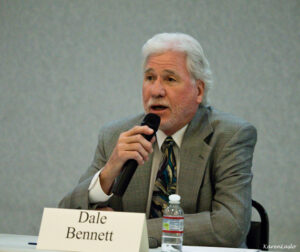
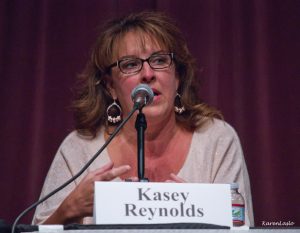
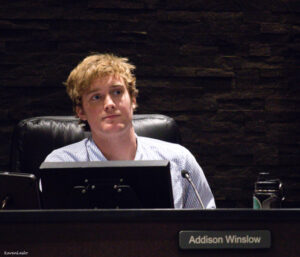
Council members are elected to four-year terms, with elections for alternating districts held every two years. The seats up now for election are held by Mayor Kasey Reynolds in District 2, Addison Winslow in District 4, and Tom van Overbeek in District 6.
Council members receive roughly $22,800 a year in pay for their position, according to a public records request of employee salaries from 2025. The mayor is paid 20% more.
The Council selects the mayor from amongst themselves after each election cycle. The Council selected Reynolds for mayor in 2024.
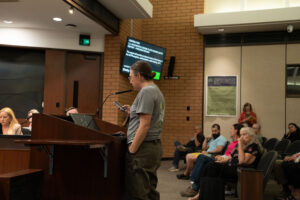
The Council meets on the first and third Tuesday of each month in the Chamber at 421 Main St., where city staff present recommendations and the public can comment on items on or off the agenda. Frequent agenda items include homelessness, housing and development, bringing many in the community out to advocate for policy.
Often people will come to advocate for improvements to their neighborhood or bring attention to events.
A city divided on homelessness
The Warren Settlement, an agreement the city made with the court after it was sued by homeless plaintiffs, is set to expire Jan. 14, 2027. The November election could determine how the city handles homelessness, shelters and enforcement after that expiration. Council discussions have already begun about how it will enter a post-Warren age.
The Council at present is focused on issues related to public safety and a tougher approach to anti-camping enforcement, while progressive Council members have been more reluctant to be tougher on the unhoused population without providing more services.
The City Council has asked city attorney Ryan Jones to look for ways to further strengthen or adapt municipal codes that can be enforced now and not violate the terms of the settlement. In August, the Council declared a local emergency because of fires in and around Lindo Channel. This declaration led to the removal of 48 encampments.
A Jan. 28, 2025, Point-in-time survey identified 1,065 people in Chico who were homeless. Chico’s homeless population has been rising faster than state and federal rates. Wildfires and a lack of affordable housing are two of the primary problems, according to the survey.
Two shelters in Chico are generally not at full capacity. There’s disagreement on the why, with some arguing the rules and criteria need to be loosened. But with loosening rules and assessment criteria, worries abound that the shelters will become less safe.
For those who don’t qualify for congregate and other sheltering, the city was required to have an alternate camping site — located off Eaton and Cohassett roads — but it’s so far unclear if it will remain once the settlement expires.
Chico has a substantial portion of cost-burdened renters, and the price for a single-family home compared to income is among the worst in the United States, according to Harvard’s State of the Nation’s Housing 2025 report.
It also has a shortage of housing — especially affordable housing. Housing and development have been subject to ongoing debate in Chico, with disagreement over where and how needed development should take place.
Will downtown be ok?
Chico’s struggling downtown is another ongoing issue, with competing perspectives on how best to support local business and revitalize a beloved area. Recently, the Council approved entertainment zones, where people can walk around downtown with alcohol from participating businesses.
The progressive and conservative split on Council was most notable in recent deliberations over the Downtown Revitalization Project, a multi-year endeavor to remove one of the three lanes from Broadway and Main streets and replace it with extended curbs and a protected bike lane.
Progressive Council members pushed hard for the project, but after contentious meetings and lengthy public comment sessions, the conservative block voted against the plan, with van Overbeek abstaining because of a conflict of interest. The Council stalemated and the project was never approved.
Crumbling roads
The need for street repairs and improvements has been a bi-partisan issue, but how to distribute Measure H, a 1% tax for public safety, roads and infrastructure, has split the Council.
Winslow has advocated increased use of Measure H funding for streets and roads, arguing that those dollars have shifted to the police department. This is something Shelby Hebert — candidate for District 2 — has also made part of her platform.
In District 2, Mayor Reynolds, who has been on the Council since 2018, faces a progressive challenger, Shelby Hebert.
Hebert, a fire resiliency project coordinator, is running on more affordable housing, mixed-use development and more options for the unhoused population, according to her campaign website.
Reynolds, co-owner of Shubert’s Ice Cream, is running on public safety, advocating for enforcement of no-camping ordinances and infrastructure projects.
Both have the topic of the unhoused population high in their priorities, but Reynolds emphasises accountability and enforcement paired with services and shelter operations. Hebert advocates for targeted enforcement, focusing on bike paths and greenways while bolstering outreach and support services, according to her campaign website.
Tracy Vincent, a Navy veteran, is challenging District 4’s Winslow.

Winslow is focused on building a more walkable city, advocating for smaller and more affordable homes, and protections for renters, according to his campaign website.
Vincent has spoken out against what she calls “infighting” between the progressives and conservatives on Council. She regularly posts on social media, breaking down her stances on City Council agenda items, then taking her comments to Council directly during public comment.
In Chico’s District 6, Meghan Thomas Petty is vying for the seat van Overbeek has held since 2022. Petty, an attorney, is focused on healthcare, wildfire resilience and recreation, according to her campaign website.
Van Overbeek, who said he initially ran for Council because of the Warren Settlement, is running on anti-camping enforcement and an approach that he says could compel people to accept more services. He’s also focused on infrastructure projects, such as removing debris from the Lindo Channel and repaving streets and roadways.
Throughout the next few months, candidates are participating in debates and canvassing to share their visions for Chico.
Smart Growth Advocates is partnering with local groups to hold a candidate forum at the Chico Women’s Club on Oct. 1 from 6-8 p.m. The League of Women Voters of Butte County has posted links to televised debates, voter guides in five languages including English and Spanish, and guidance on how to return ballots.
Chico residents can only vote on the district race their registered address is within. The City of Chico’s website maintains a map of the districts.
Eligible voters can register on the California Secretary of State website.
Chris Hutton covers city government for ChicoSol.