
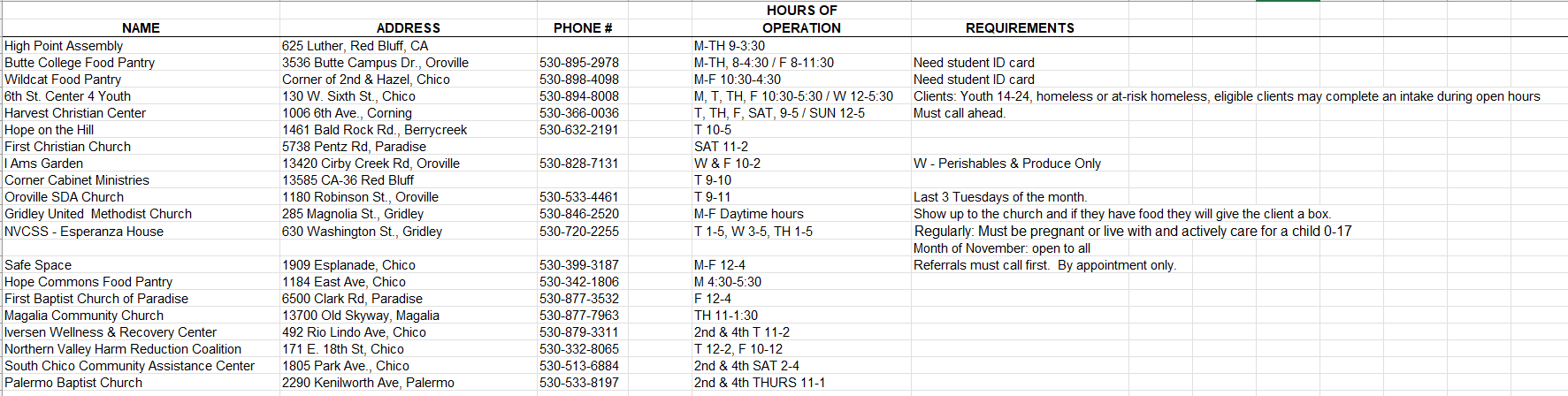
In need of food in Chico? Here is a list of food pantries and distribution sites. Safe Space opens to unhoused people from noon to 4 p.m. every weekday, providing food, clothing and a place to charge phones. A calendar for upcoming food distributions by North State Food Bank and its partners can be found on its website.
An elderly woman using two prosthetic legs entered a room at Chico’s Faith Tabernacle Church with the help of two walking sticks and a volunteer. She filled out a form, indicating her family size, and then received an allotment of packaged and canned food.

On the morning of Nov. 12 — even though many Californians had already received their allotment of what was formerly known as food stamps — demand for food assistance at Faith Tabernacle still surged by roughly 50% above normal.
Benefits from the Supplemental Nutrition Assistance Program (SNAP), issued under the name “CalFresh” in California, were paused during part of what was the longest government shutdown in U.S. history. The shutdown officially ended the day of ChicoSol’s visit to Faith Tabernacle, which is one of a host of organizations that provide food assistance.
The woman was one of about 150 who came to the church for food that day, many of them disabled, homeless, unemployed, or low-income. The majority of them rely on CalFresh, said Nick Henderson, who leads the church’s monthly Emergency Food Assistance Program distribution.
Over 42,000 people in Butte County rely on CalFresh. They faced confusion and uncertainty in early November when the federal shutdown delayed payments. California began releasing CalFresh benefits after a federal court on Nov. 6 ordered the Trump Administration to fully fund California’s SNAP payments.

Butte County’s District 3 Supervisor Tami Ritter said that as the government reopened, she presumed all SNAP and WIC (Special Supplemental Nutrition Program for Women, Infants, and Children) benefits would be restored across the nation gradually.
But community members say the damage was done, and the earlier delay strained households, leaving more families in need this month.
“What I’ve seen is when you go a long time without food, and then all of a sudden you get the means to receive food, you end up using it up faster, simply because you’ve gone without it so much that you need to fill your belly up,” Henderson said. “This [food distribution] is a great help for them. That’s why they came – even though they received some of their benefits.”
Local non-profit organizations, food banks, food pantries, and individuals, including Ritter, have been stepping up to build a safe network for people whose lives were affected by the delay of the disbursement of CalFresh benefits.
Henderson said usually around 100 families come to seek help, but this mid-November day, the church had emptied out its surplus because “we know that people are having a hard time right now financially in this holiday time.”
Volunteers from Youth With A Mission helped with the distribution, carrying out food for the disabled.

The church partners with the North State Food Bank, which provides food to food pantries across five counties in Northern California.
Timothy Hawkins, CEO of Community Action Agency of Butte County that runs North State Food Bank, told ChicoSol that the food bank was doubling distribution for all the “public facing” food pantries it partners with this month.
“Our biggest challenge is getting food to everyone that needs it,” he said.
And having enough volunteers to run the programs is another challenge. Hawkins said there are only four people running the North State Food Bank, which serves 15,000 people in any given month. With the added demand it was “going to take quite a few volunteers,” he added.
Hawkins mentioned that because of the CalFresh delay, the governor has fast-tracked $80 million in CalFood funds to food banks across the state.
“We’ve requested that money in advance so that we can have the liquidity and finances to be able to buy that much food,” Hawkins said.
Hawkins was at a food pantry at the end of October when a single mother of five told him she was worried about the delay in CalFresh benefits. He said she was a working mom, but feared her income wouldn’t be enough to feed her children without CalFresh.
“Hunger doesn’t know political stripes” — Timothy Hawkins
Hawkins mentioned the 530 Food Rescue Coalition, an app-based food rescue program in Butte County that connects volunteers with surplus food from retailers and delivers it to local nonprofits. He recommended downloading the app to volunteer, donate or receive food.
“I hope during this time people can set their political ideologies aside and focus on helping their neighbors, because hunger doesn’t know political stripes,” Hawkins said.
Evan Peterson, an unemployed parent of three, usually receives their CalFresh benefits on the 7th every month, but due to the recent delay of benefit disbursement, Peterson received their full benefit Nov. 9.
Peterson said that food stamps provide their family’s primary source of food.
Luckily, they had “slowly” built up extra non-perishables and pickled vegetables for “situations like this” since last November, so they were not too anxious when their EBT (Electronic Benefit Transfer) card didn’t receive the money on time. But Peterson was worried about those who were not well prepared.
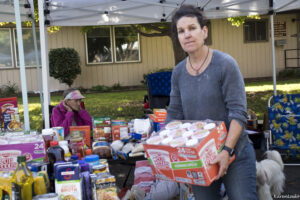
Ritter said the impact of the CalFresh delay affected not only the people who rely on the benefits, but also local grocery stores, store workers, delivery drivers, and ultimately the entire community.
“That’s $8 million that’s not going back into our community. And so we anticipated that that’s going to mean that the cost of groceries is going to go up,” Ritter explained.
To help get food into the hands of people who need it, Ritter organized a food drive on Nov. 9 in Chico to collect donations. She said the food drive received a full pickup load, an SUV load, and two carloads of food.
Ritter noted that there will be another Drive-thru Food Drive on Dec. 14 from 10 a.m. to 2 p.m. at 196 Memorial Drive in Chico. She hopes community members can attend and contribute.
Santiago Mendez, data manager at Safe Space, said that the number of unhoused people who sought help at Safe Space’s Day Center doubled in early November. Mendez said Safe Space’s food also mainly comes from North State Food Bank.
“At the end of October, we were helping roughly 30 people a day,” Mendez said. “I want to say yesterday, I think our total was around 60,” he said in a Nov. 5 interview.
Mendez emphasized the importance of CalFresh for those who are unhoused.
“A lot of unhoused folks really rely on benefits until they can get stable work or housing,” Mendez said. “ [Due to] the lack of SNAP benefits, they don’t have anywhere else to get food. They don’t have homes, so they can’t store food.
“So they kind of rely on ready-to-go food, and that’s what they utilize their EBT on. They go to the grocery stores and buy things that are sandwiches or salads or things that they can take and eat immediately that don’t require storage.”
Noah Ross, who lives in the Torres Shelter and was present at the Day Center on Nov. 5, said he was not worried about his CalFresh benefit that usually comes on the 10th of every month. He supported the reduction in government spending by the current administration because “Trump wants to combat inflation.”
“To reduce the amount of funding, although it might get some initial belly aching, it’s going to combat that inflation that we are suffering now,” Ross commented.
A 40-year-old unsheltered man, who asked to remain anonymous because “people always mess around with the homeless,” told ChicoSol that he had not received the nearly $300 in benefits he was supposed to get the day before. With his own savings nearly gone, he bought a sandwich at Wendy’s for lunch.
Even with CalFresh, he said, he struggled to make it through the month. His benefits usually run out by the 20th. Now, without them, he worried that his food situation would only get worse.
“They haven’t been poor. They haven’t struggled,” he added, referring to policymakers.
Yucheng Tang is a California Local News fellow reporting for ChicoSol.
Yes, when the SNAP benefits were threatened, our beloved community really stepped up. We also started FB public group, Feed Butte County to list all the free food resources in one place, and people joined who wanted to help others as well. In addition, our Re-Sisters public group also on FB collects about 250 pounds of non perishable food every Saturday at Vallombrosa and Mangrove from 9-10 am. Thank you Chico!
A steel common building with solar/battery power at Chico’s Alt-Site could house a 12 VT refrigerator and freezer that would be an inexpensive way to make food storage available to the unsheltered people living there. Having food storage would go a long way to addressing a host of issues at the Alt-Site. The Alt;Site is not Chico’s proudest project. Write our Mayor Kasey Reynolds P.O. Box 3420 Chico 95927. Council could use State Statute 8698 and get more non-congregate shelter programs, like the NSST Safe Spot Community, operational before winter.