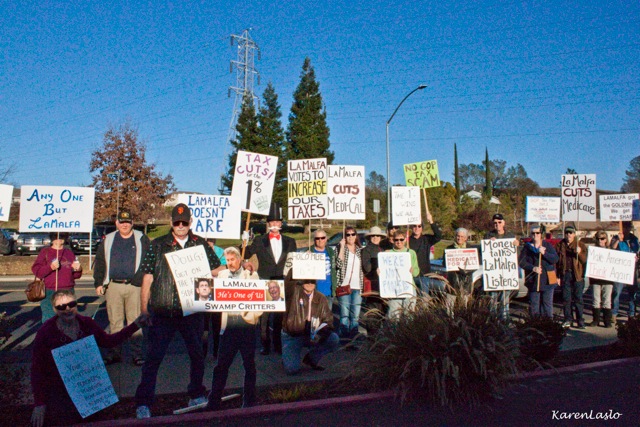
Demonstrators on the 20th Street bridge. Photo by Karen Laslo.
Dozens of Chico-area people joined the Labor Day weekend Bridge Banners Action today, protesting Trump Administration conduct and policy from overpasses on Eaton Road, Cohasset, 20th Street and Skyway.
According to the Defenders of Democracy coalition, the theme was “We Are OVER It,” and local protesters acted in concert with West Coast residents in the “Mexico to Canada Bridge Banner Challenge.”
The demonstrators received supportive honks from passing vehicles, and said they would be protesting as well the mornings of Aug. 31 and Sept. 1. The coalition is “devoted to nonviolent activism towards changing the current racist and authoritarian political culture,” a press statement said.read more
LGBTQ resource center plans rally to support trans community
by Natalie Hanson | Posted March 28, 2025
Chico’s Stonewall Alliance is pushing back against nationwide anti-trans rhetoric by bringing together allies and LGBTQ people to stand by their trans neighbors, culminating with a rally Sunday.
The nonprofit organization, which provides resources to LGBTQ people and their families, organized special programming throughout the last week of March, such as workshops and training sessions.
Executive Director Justina Sotelo led one of these sessions March 24, one of several workshops designed to train people on being bystanders prepared to handle escalating incidents where an LGBTQ person is targeted with threats or worse.
“This information will be helpful for all actions, rallies, protests, and daily situations we may find ourselves in as active allies to trans people and other marginalized communities,” Sotelo told a group of nine attendees in a video workshop.
Sotelo, presenting several videos on responding to public incidents with a perpetrator and victim — or “target” of threats — emphasized the importance of managing one’s emotions and practicing self-awareness to de-escalate conflicts. She asked if anyone had witnessed a situation where a queer person was unsafe and felt unsure how to help, and several attendees said they had.
Sotelo presented a wide range of examples of disrespect toward queer people from name calling and “jokes,” to verbal harassment and doxxing. Speaking up can look different in various situations, from ignoring the perpetrator and speaking only to the victim, to directly confronting a perpetrator. The approach varies based on many factors, including the power dynamics and whether there’s a clear physical threat, she said.
“Follow the lead of the target,” Sotelo said. “Don’t make things worse.”
Several attendees said they’ve used the strategy of distracting a perpetrator, not always with success. Participant Florence Ives said they’re working on not being reactive and avoiding argument with perpetrators in order to help protect a victim or “target.”
“If you can’t get involved until the person leaves, then you wait, and then get involved with the target where they are at,” Ives said.
Sotelo said that sometimes intervention cannot take place immediately to protect a victim of harassment or threats. A bystander must carefully consider a victim’s safety, she said.
“This idea of keeping their safety in mind is best because we may not be the best to intervene,” Sotelo said. She added that when it comes to perpetrators who are willing to publicly attack an LGBTQ person, allies must remember that arguing is not helpful. “There’s a reality where we’re not going to change their minds.”
Stonewall Alliance has two events planned for the weekend, including a poster making event on Saturday. Attendees are encouraged to make signs to use for the following day’s rally supporting the trans community.
The rally, the Trans Day of Visibility Action, starts at 11 a.m. Sunday at City Plaza in downtown Chico. It’s slated to end at 2 p.m. and will include booths aimed at raising awareness about anti-trans boycotts, inclusive school-based and business policies, and letter-writing campaigns aimed at elected officials.
“The intention of this rally is to do more than just gather,” Stonewall Alliance said in a press release. “We’re also here to take real action on things that affect the lives of trans people and our whole community.”
Natalie Hanson is a contributing editor to ChicoSol.
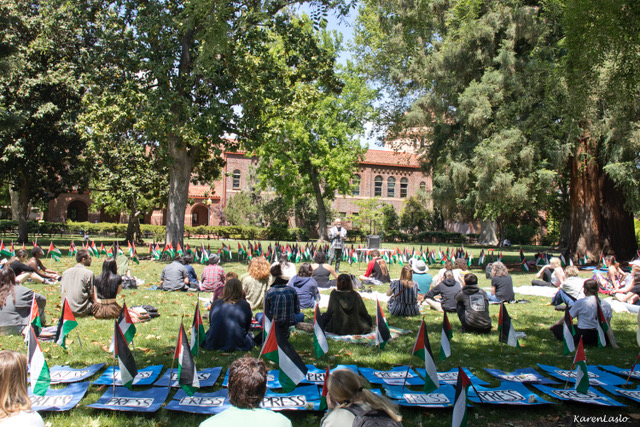
About 70 people, including students from Chico State and Butte College and a few faculty members and Chico residents, gathered in front of Kendall Hall today to call for a ceasefire and to remember journalists and other civilians killed in Israel’s bombing of Gaza. Chico State’s Academic Senate will hold a special meeting May 7 to vote on whether to agendize discussion on a ceasefire resolution, and ChicoSol will post a story after. (Photo by Karen Laslo.)
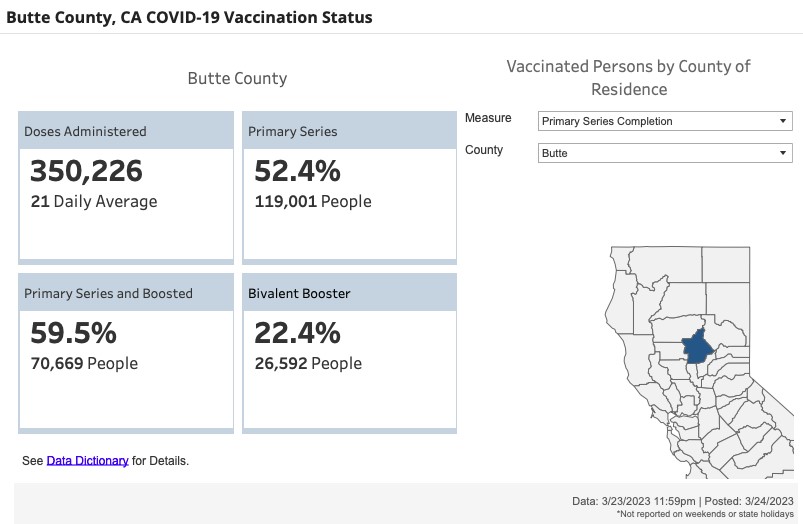
courtesy of California Department of Public Health
A new study on COVID-19 says that parents under stress or following pandemic misinformation were more cautious about Covid treatments and vaccines for their children -– and may have ignored or directly violated COVID prevention policies, including at schools.
But it is unclear how much those behaviors may have impacted counties with lower vaccination rates and amid significant infection rates, like Butte County.
California data shows that Butte County ranks among those counties most likely to have lower numbers of vaccination against COVID -– including among school age children -– with only 52% of people eligible getting the primary vaccine series compared to the statewide average of 72%. Butte’s COVID dashboard no longer shows how many people under 18 were vaccinated locally, compared to the state’s estimate of 67% of 12-17 year olds and only 37% of 5-11 year olds. Last summer, only 17.7% of children ages 5-11 and 39% ages 12-17 were fully vaccinated, compared to the statewide averages of 36% and 67%.
Butte also exhibited signs of fierce parental opposition to county recommendations and school boards following that guidance, based on thousands of comments on the county’s public health department social media and pushback at local school board meetings, criticizing local COVID prevention policies. The county’s largest city, Chico, saw four of five school board members facing a recall attempt blaming them for overseeing school campus closures –- which failed. However, misinformation around school campus closures and criticizing of county and state public health measures, encouraging parents to push back, came from many local elected officials including Republican Rep. Doug LaMalfa.
The role that misinformation and distrust of public health policies may have played among U.S. parents in particular is slowly becoming more evident. A March study from researchers based at the University of Utah found that stress pushed parents to become hesitant, nontransparent and even unwilling to follow recommended Covid-19 protocols and requirements at schools.
Researchers found that during the pandemic, parents experienced greater increases in stress compared with nonparents due to additional child-related anxieties including school campus closures. They recruited a national, nonprobability sample of 1,733 adults for an online survey from Dec. 8–Dec. 23 in 2021. The survey asked whether parents had ever engaged in misrepresentation and nonadherence behaviors regarding COVID-19 policies for their children, and reasons for these behaviors.
About 580 parents (33.5%) had children younger than 18 living with them during the pandemic, and the mean parent age was 36 years with 70.2% identifying as women. About 150, nearly 26%, reported that they committed misrepresentation or nonadherence with COVID rules, including not telling someone with their child that they thought or knew their child had COVID-19 and allowing their child to break quarantine rules. The most common reason was wanting to exercise freedom as a parent and wanting their child’s life to feel normal, or otherwise not being able to miss work or responsibilities to stay home.
The researchers said their findings suggested that some policies implemented to limit the spread of COVID-19 may have been compromised due to parents’ misrepresentation and nonadherence -– contributing to COVID-19–related morbidity and mortality.
“Our findings suggest a serious public health challenge in the immediate context of the COVID-19 pandemic, including future waves affecting weary parents, as well as future infectious disease outbreaks,” the researchers said.
However, it is more difficult to track the likelihood of parental avoidance of COVID policies in counties that are not required to collect the data.
Asked about how much this behavior and COVID misinformation may have affected Butte County schools’ ability to prevent and control the spread of COVID-19, Chico Unified School District’s communications director Erica Smith said, “Changing rules, regulations and restrictions throughout the pandemic were often confusing or challenging to identify.”
Speaking for Superintendent Kelly Staley, Smith said that while she had not read the study, the district has relied on licensed vocational nurses and health aides to maintain campus health.
“As a public school, we rely on open communication and partnerships with our families and the educational community,” Smith said. “Every decision impacts our students on campus, so we focus on keeping students at the center of discussions.”
Butte County Public Health spokesperson Lisa Almaguer said the department could not answer on behalf of how misinformation impacted schools or school boards.
“We heard arguments from both sides -– some parents wanted BCPH to implement more restrictive local measures for schools and others protested and commented at school board meetings in opposition of mitigation protocols,” Almaguer said.
“We do know that some residents throughout Butte County (we don’t know how many or what percent of the population) were opposed to COVID-19 prevention measures, such as face coverings, social distancing and quarantine/isolation for exposed or symptomatic persons. These oppositions were not exclusive to school settings. Our understanding is that the schools worked tirelessly to implement and adhere to a school site-specific COVID-19 prevention and mitigation plan, as required by the state.”
Almaguer said because the national survey does not specifically state that any of the responses were from parents living in Butte County, “it will be very difficult to definitively determine anything.” She said they could not “speculate” about how the findings may have impacted local parents’ actions.
“We have heard from parents via phone call complaints to our COVID call center (which has been closed for some time now), emails and comments/messages on social media,” she said. “No hard data has been collected on this, nor have we been required to collect this data.”
Almaguer added: “Anytime we are in a situation where the public’s health is at risk and the public is asked, and required in some situations, to take action to prevent the spread of illness it is concerning when these actions are purposely not followed. Clear defiance of public health prevention and mitigation places the entire community at increased risk for increased rates of illness, which may lead to increased hospitalizations and death.”
Current Chico Unified school board members did not respond to requests for comment. But educator and former longtime elected school board member Kathleen Kaiser, who beat the recall, said she has heard anecdotal reports about parental pushback to COVID policies -– but noted the possibility of economic reasons for that pushback.
“What reactions should be assumed that would make a difference if there is no available child care or financial necessity for work -– do we think school districts will/should be able to afford either solution?” Kaiser said. “We know a number of child care facilities closed during that time.”
Smith said that impacts resulting from the COVID-19 pandemic will be long-lasting “and far exceed the immediate future.”
“Our students are resilient, but we want to take it one step further and make sure they have the opportunity to thrive,” she said.
Natalie Hanson is a contributing writer to ChicoSol who has covered COVID misinformation, among other topics. This story was previously published by Ethnic Media Services.
Shooting sergeant member of Ramsey investigative team
by Dave Waddell | Posted November 12, 2020
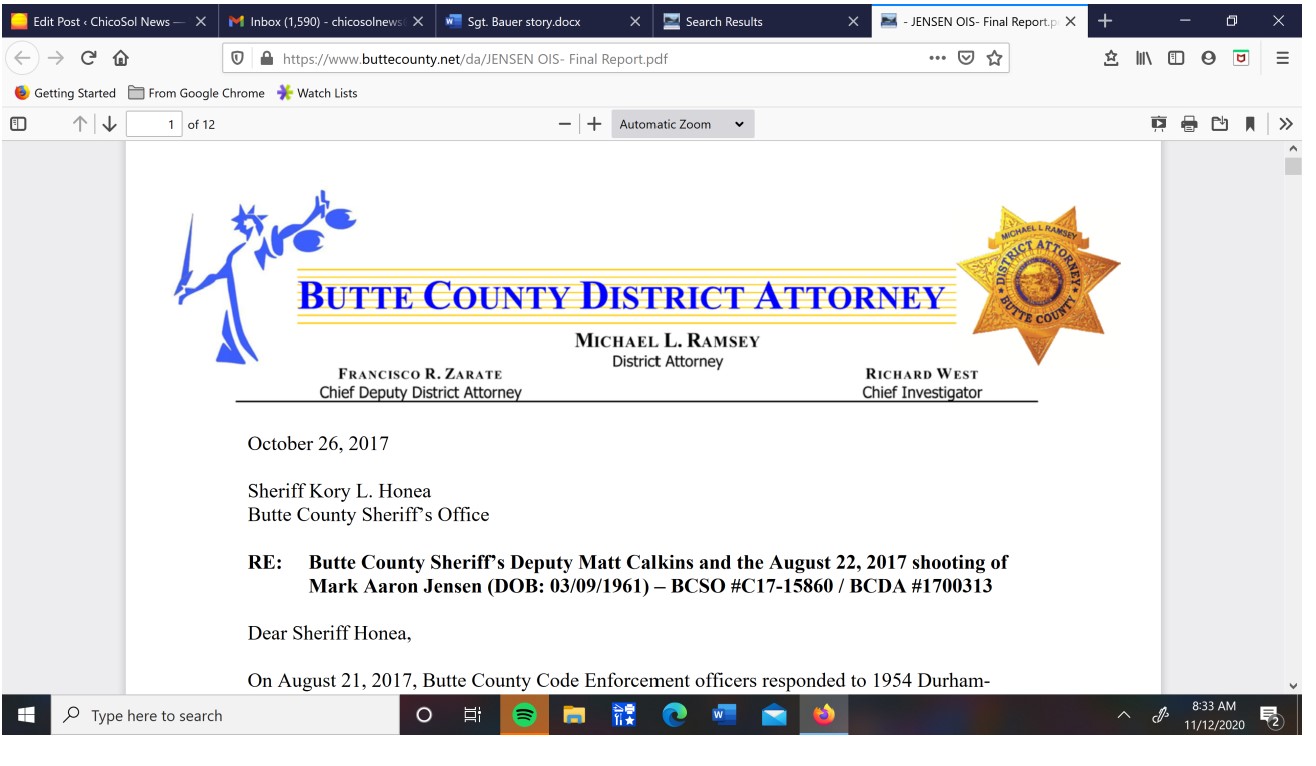
from Butte County District Attorney website
Chico police Sgt. Nick Bauer, a member of the DA’s OIS investigation team, worked on the report about the killing of Mark Jensen.
The Chico Police Department sergeant who shot Stephen Vest last month is a member of a designated team of officers that investigates officer-involved shootings in Butte County.
Sgt. Nick Bauer has been part of District Attorney Mike Ramsey’s Officer Involved Shooting/Critical Incident Protocol Team, which Ramsey has described as made up of “seasoned” law enforcement officers from agencies throughout the county.
In killing Vest on Oct. 14, Bauer fired his revolver twice, while officer Tyler Johnson shot eight or nine times in two seconds, Ramsey said. Vest was armed with a folding knife with a roughly 4-inch blade. Other than Vest, no one was hurt in the incident.
Even before learning of Bauer’s involvement with the protocol team, Chico’s Concerned Citizens for Justice (CC4J), a police reform group, was questioning the independence of the team’s investigation into Vest’s death. CC4J wants the state attorney general’s office, not Ramsey, to investigate Vest’s killing. Ramsey has said no conflict of interest exists because, by design, there are no Chico PD personnel on the Vest shooting protocol team.
Emily Alma, CC4J’s coordinator, said if officers that Bauer has worked with in the past on shooting investigations are now investigating Bauer’s shooting, a conflict of interest seems unavoidable.
“We can’t accuse (Bauer’s investigators) of being biased, but, on the other hand, how can they not be biased?” Alma wondered.
Ramsey did not respond to a phone message and emailed questions about how long Bauer has belonged to the protocol team, how many OIS’s he’s investigated, and whether he’s previously worked with any team members currently investigating his own shooting case.
Seth Stoughton, a former officer and investigator and one of the nation’s leading experts on use-of-force issues, told ChicoSol that Bauer’s connection to the team could jeopardize the accuracy or legitimacy of the investigation. Stoughton, an associate professor of law at the University of South Carolina, co-authored the book “Evaluating Police Uses of Force.”
“If the point of the Officer Involved Shooting/Critical Incident Protocol Team is to make sure that officers aren’t being investigated by people that they know and work with, that interest obviously isn’t being advanced when the team investigates a shooting involving one of its own members,” wrote Stoughton in an email reply to questions from ChicoSol.
“Even if the investigation has the best possible methodology and comes to the most accurate answer, it won’t mean much if the investigation isn’t also legitimate,” Stoughton said. “‘Legitimate’ means generally accepted and trusted by the relevant communities. Even if the investigation is accurate, if no one trusts that is the case, there’s going to be a problem.”
Stoughton said an “external investigation” can help ensure both accuracy and legitimacy.
“Investigators are human, which means they are affected by a range of unconscious bias that can affect the accuracy of the investigation,” Stoughton wrote. “Confirmation bias, for example, may lead them to view the available information in a way that favors a friend or coworker, and interviewer bias may lead the investigator to ask certain questions or to ask questions in certain ways that can skew the results of the investigation. Getting someone who doesn’t work with the shooting officer can help with that. It can also help with legitimacy; the public may perceive that an external investigation does not have the same potentially self-serving incentives that an internal investigation might have.”
For the outcome of an investigation to be accurate, Stoughton said, it is essential that investigators ask the right questions.
“An officer’s use of force can be ‘lawful but awful,’ as police experts call it, where the officer didn’t commit a crime but the shooting could have and should have been avoided,” Stoughton said.
Public records obtained previously by ChicoSol show Bauer has worked at least two protocol team investigations, both involving fatal shootings by Butte County sheriff’s deputies.
Following the 2017 sniper killing of Mark Jensen by deputy Matt Calkins near Durham, Bauer wrote a report after interviewing sheriff’s personnel. Protocol team members in the Jensen shooting included seven investigators from the DA’s office, four from the county Probation Department, three including Bauer from Chico PD, two from Paradise PD, and one each from the California Highway Patrol and Gridley-Biggs PD.
The drunken, gun-wielding Jensen was killed with a single shot to the chest from Calkins’ rifle from about 130 yards away after Calkins said Jensen pointed a pistol at him.
After the 2018 shooting in the back of Myra Micalizio by deputy Charles Lair near Palermo, Bauer canvassed residents of the neighborhoods where Micalizio lived and was killed, writing up his findings. Micalizo, shot as she was backing her vehicle toward Lair, was in mental crisis when killed.
Team members in the Micalizio shooting included three investigators from Probation, two including Bauer from Chico PD, and one each from the DA’s office, Oroville PD, Gridley-Biggs PD, and the state Department of Parks and Recreation. The other team member from Chico PD in the Micalizio case was Mark Bass, who has been involved in two fatal shootings.
Community members gathered Sunday to mark the second anniversary of the killing of 25-year-old Desmond Phillips, shot multiple times by Chico police officers in his father’s living room. Other parents frustrated with Butte County’s criminal justice system again joined the Phillips family for a march, potluck dinner and a program that included speakers and performances.
Scott Rushing, father of Tyler Rushing who was killed in a shooting that involved Chico police and an armed security guard in July 2017, traveled from Ventura to attend the Sunday gathering.
Rain Scher from the Justice for Desmond Phillips team said in an email, “We believe that the community at large should be reminded of who Desmond is and what happened to him and all the things that we fight for in his name: accountability for the officers who killed him and the chief of police, better mental health care access in Butte County, better training for police officers including anti-bias training.”
Also present Sunday were the parents of Marc Thompson, a 25-year-old Chico State student who was brutally killed in 2014 in a case that has yet to be solved by the Butte County Sheriff’s Department. Marc Thompson’s body was found in his burned-out car in a remote area about 28 miles northeast of Oroville. Marc Thompson and Desmond Phillips were cousins.
Lawrence Thompson says the Butte County Sheriff’s Department “bungled” the investigation into his son’s death. Butte County Sheriff Kory Honea told ChicoSol in 2017 that sheriff’s detectives, in hopes of generating new leads in the case, were employing new technology to mine data from Marc Thompson’s cell phone records.