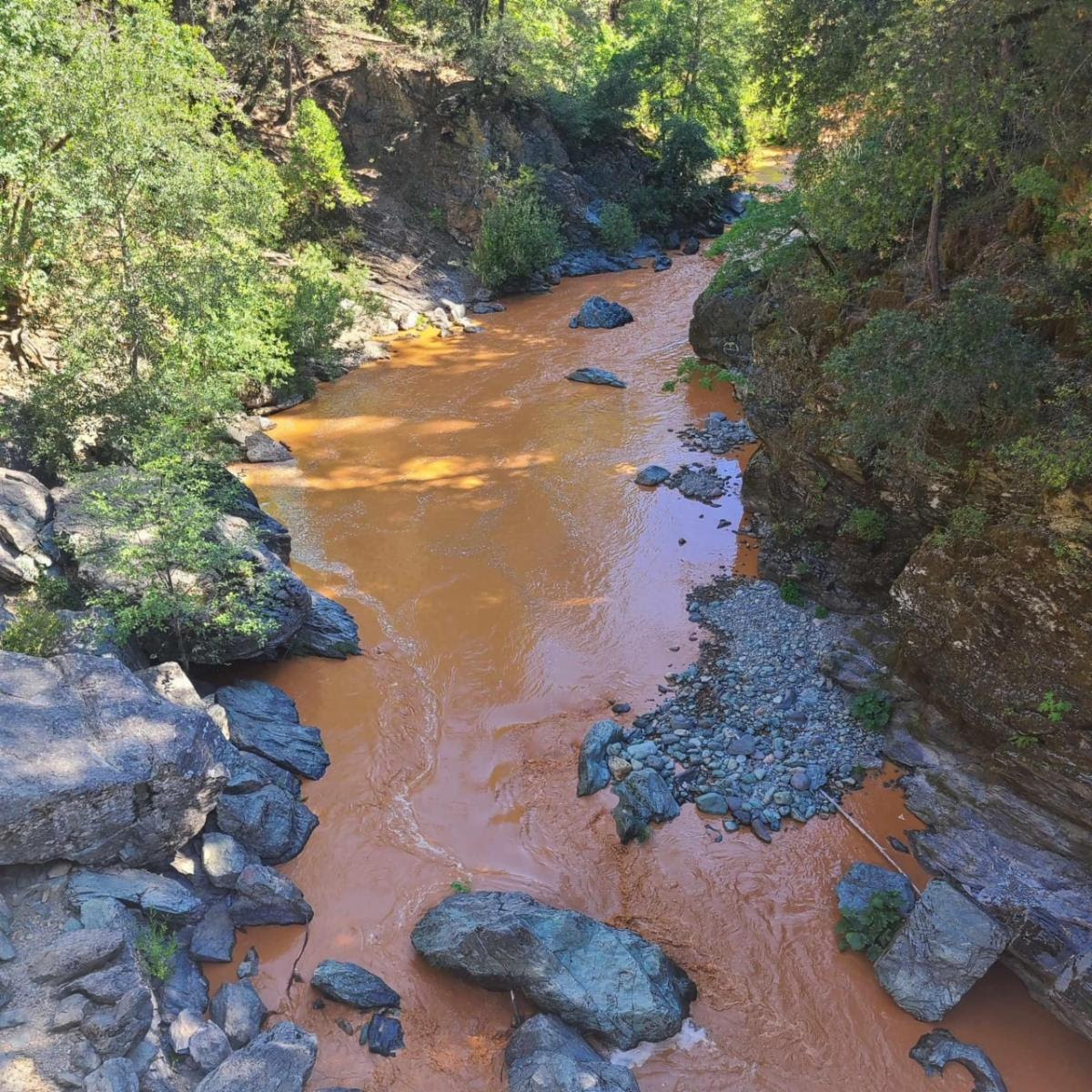

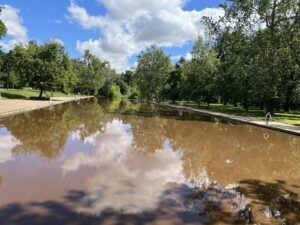

Sycamore Pool in the One Mile Recreation Area, which was built around Big Chico Creek, turned brown early this week.
Big Chico Creek turned chocolate brown earlier this week after a light May 12 rain washed vegetation and eroding bank sediment from the Park Fire burn scar into the water. Today the water look somewhat clearer.
Environmental studies professor Mark Stemen said the wash-off has environmental benefits, but also poses potential danger.
“We should be seeing this happen for a while,” Stemen said. The dry weather that followed rain “freed up much more sedimentation.”
Some of the sedimentation “will end up in the creek and provide good sediment for spawning.” But if there’s too much, he warned, “it could suffocate [salmon] eggs. One of the things that’s really striking is how much of our watershed has burned and destabilized the sediment.”read more
Large landowners who favored fee had more voting clout
by Leslie Layton | Posted February 13, 2025
photo courtesy of Tuscan Water District
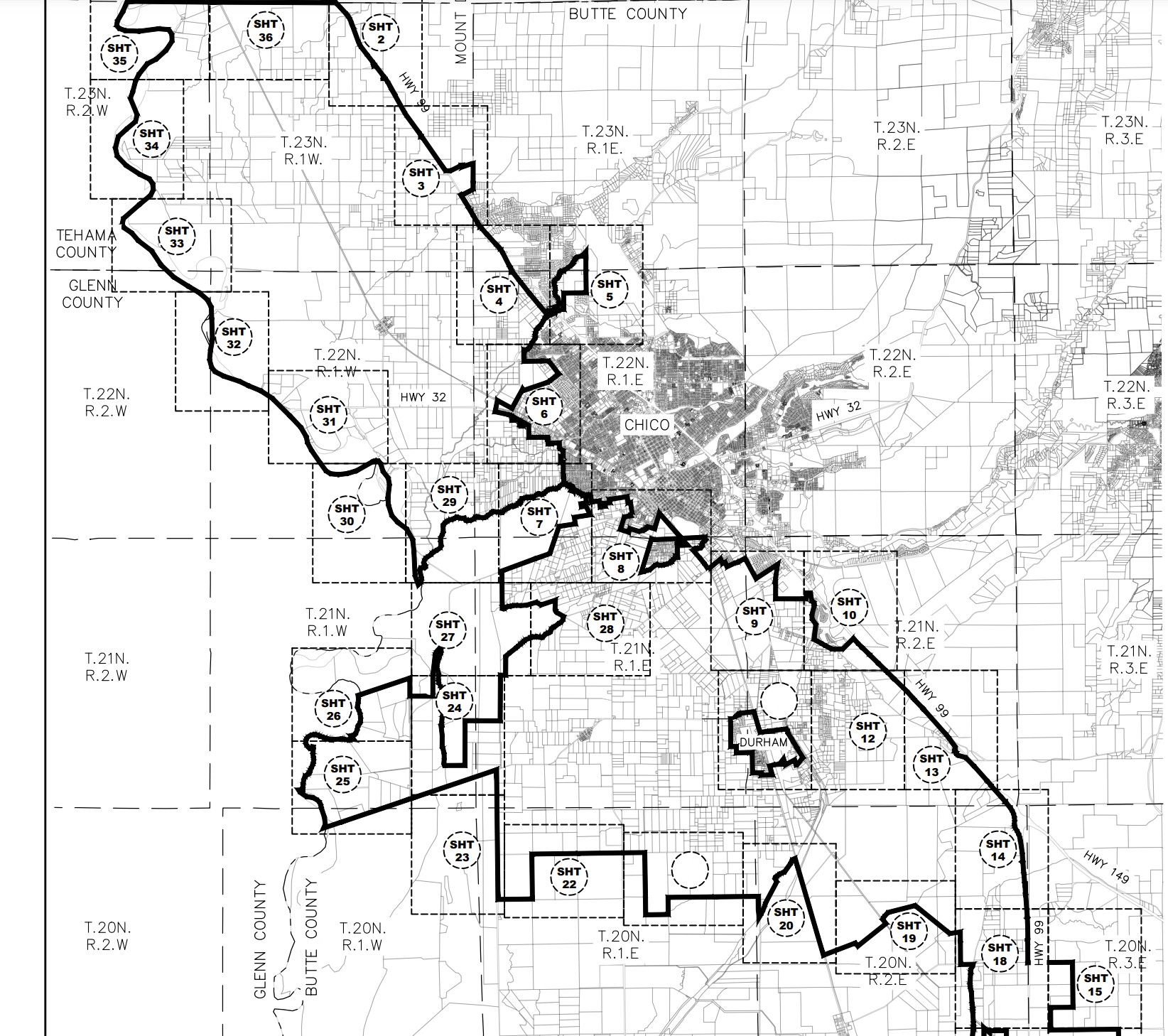
Approved TWD map
The recently-formed Tuscan Water District (TWD) is now in the budget planning stage after winning the right to levy a special assessment fee on landowners within district boundaries.
In an election held last month, TWD won the support it sought for a fee of up to $6.46/acre to be paid by landowners whose votes were weighted based on the number of acres owned. That was in accordance with California law that allows weighted voting in special districts, said TWD General Manager Tovey Giezentanner.
Giezentanner said the fee could raise up to about $620,000 a year that would pay for “general expenses, not around a specific project, but to fulfill the mission of the district.”
Giezentanner said TWD will “pursue service supply” and undertake both recharge and conservation projects to reduce groundwater overdraft. TWD must win approval for any new fees that would fund special projects.
Whether the election was the overwhelming win claimed by TWD is a matter of perspective. TWD critics say the voting mechanism – even though it’s allowed under state law – is undemocratic.
Groundwater for Butte, a local activist organization, points out that had it been one vote per ballot, the fee would not have won approval. Outgoing coordinator at Groundwater, Emily Alma, said the vote was 422 opposed to 404 in favor.
But each ballot was weighted by the number of acres owned by that voter and multiplied by what is the possible assessment fee. When votes were weighted by the number of acres owned, the fee passed with almost 88 percent approval.
If only the weighted vote is considered, “it looks like we, the opposition, were slaughtered,” Alma wrote in an email. Alma said “it took more than two weeks for us to get access to the ballots” to count them on a one person-one vote basis.
TWD held a Jan. 15 pulic hearing where landowners had a last chance to vote. The meeting, according to a report by North State Public Radio, was contentious, with some objecting to the weighted voting and others complaining that public notice was inadequate.
TWD debates
Durham attorney Jim McCabe, a TWD critic, told ChicoSol this week that he believes the election wasn’t conducted properly. McCabe was one of several people who worked successfully to stop a TWD formation vote in September 2022 because it didn’t meet state requirements for noticing and other issues.
“This is an effort to give large farmers — the largest farmers, really — a leg up in deciding how that water is exploited,” he said at the time.
McCabe argues that the fee is really a special tax that requires, under California’s Proposition 13, a two-thirds vote for approval.
Giezentanner responded to the special tax argument.
“There’s an argument out there for that,” Giezentanner said. “I don’t think it’s legally sound. You’ve got hundreds of special districts that are funded [this] way.”
Giezentanner described to ChicoSol the process TWD followed to hold the most recent election, noting that the district “hired a third party election consultant to handle the mechanics” who has conducted such elections in other special districts.
The weighted voting is a piece of the framework set up by the Legislature for special districts, he said, which can address irrigation, mosquito control, or in this case groundwater management. Landowners can say, ‘There’s an issue we want to deal with here,’” Giezentanner said. “In our case we want to bring more surface water into the area and reduce our use of groundwater.”
The certified election results show that 831 ballots out of the 2,057 that were sent out were returned. (Some 63 were returned as undeliverable.) That means so-called “turnout” was only slightly above 40% in a count of individual ballots returned. But Giezentanner says ballots returned represented about 60% of the district’s acreage.
The weighted voting matter has proved controversial and been used by TWD critics as an example of the problem inherent in forming the special district: It gives too much control over the aquifer, they say, to a small group of large landowners, not all of whom are locally-based.
TWD prepares to move forward
Giezentanner said TWD was thrilled with the special assessment election results, even though there were a few more ballots cast in opposition than in favor. From the start, he said, TWD expected that the “bigger parcels would get us over the goal line.”
The number of ballots returned -– and returned in favor of the fee — was a “big deal in an acreage-based landowner election,” he said. “We were thrilled with that. That’s a huge turnout to self-assess in a bad economy.”
The district was formed in 2024 in response to long-term worry over groundwater overdraft and a changing climate that increasingly delivers unusually wet and dry seasons in an alternating cycle.
In addition and more recently, Giezentanner said, walnut and almond prices have been down due to “oversupply, issues with transportation, all these other macro issues. We’re hoping we come out of it. It’s cyclical.”
The district is comprised of between 96,000 and 97,000 acres, stretching from Butte’s northern border with Tehama County, west to the Sacramento River, east to Highway 99 and south to the Durham area. It bypasses most of the City of Chico.
TWD says it will work to reduce reliance on groundwater through conservation, by delivering more surface water and through recharge projects. Recharge involves the placement of water on the ground’s surface; the water is allowed to seep downward to replenish the aquifer.
In a natural process, water flows from the mountains to the valley, Giezentanner noted. “We want to slow it down to enhance the natural recharge process,” he said.
That worries environmentalists who say that recharge has troubling legal implications for water ownership. Environmentalists say that the replenishment that takes place in artificial recharge projects may not offset the groundwater pumping that was required, and the projects are often more detrimental than beneficial.
Canyon residents want long-term plan for salmon survival
by Leslie Layton | Posted August 30, 2023
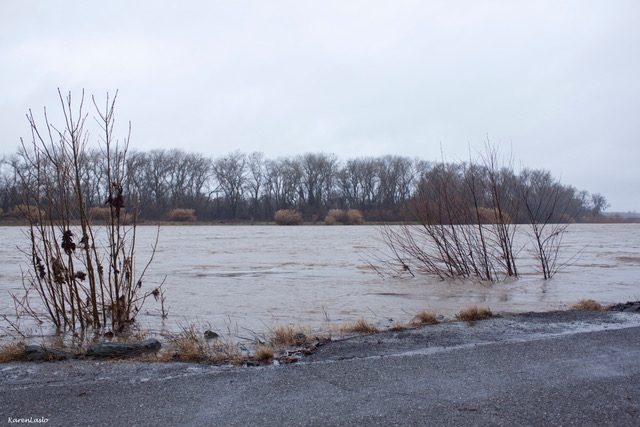
photo by Karen Laslo
Mechoopda Indian Tribe Environmental Director He-Lo Ramirez said a “primary goal” is the restoration of wild salmon on Butte Creek.
How to hold Pacific Gas & Electric Corp. accountable was a top concern at an Aug. 24 community meeting in Butte Creek Canyon following the canal failure that created a landslide earlier this month.
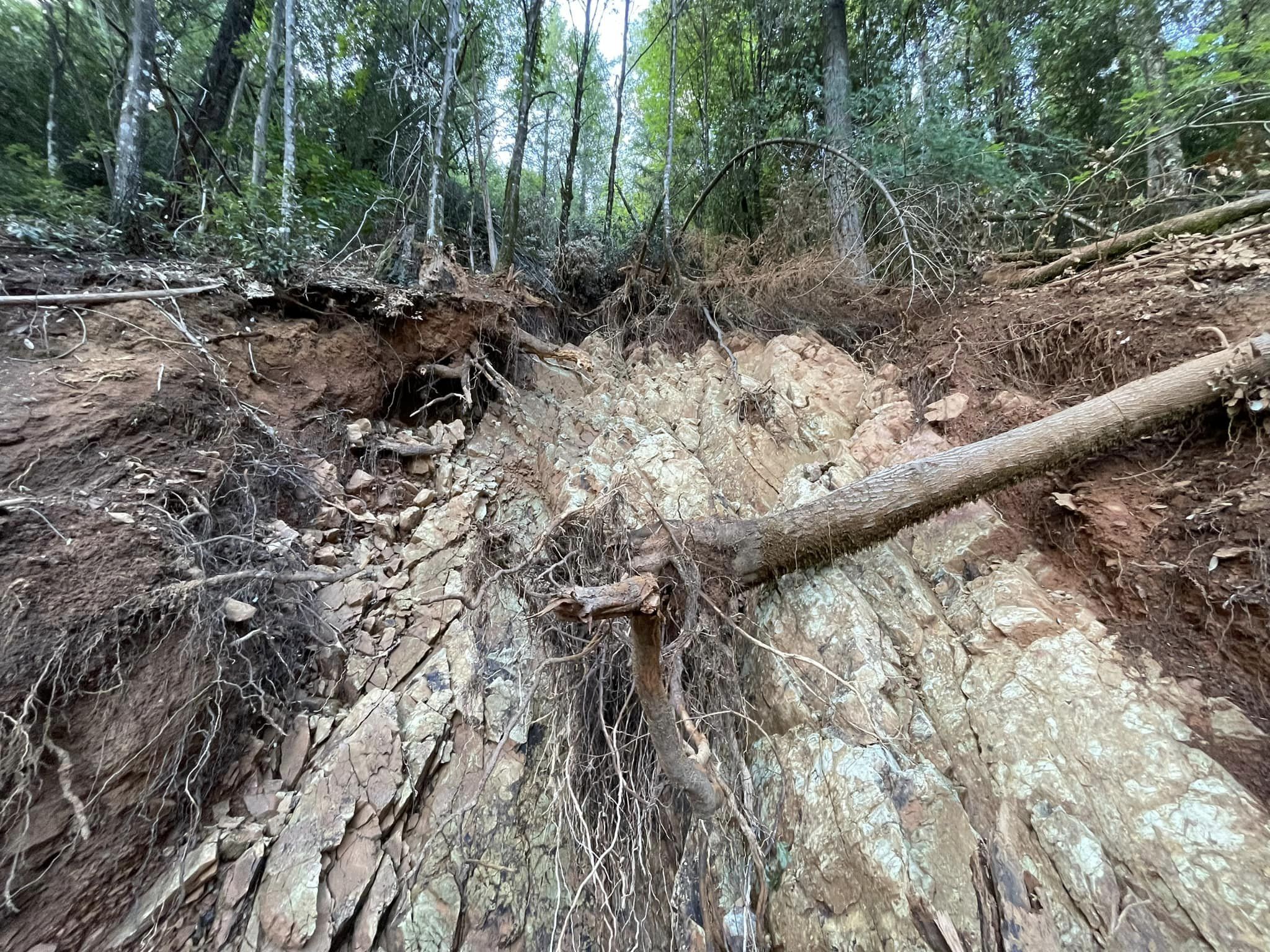
Butte Creek Canyon residents, still worried about the welfare of this year’s relatively small spring run of wild Chinook salmon, also want to know how future accidents can be prevented and whether steps to conserve the fragile ecosystem will be taken. The canal failure washed out a hillside, for a short time damming the creek and for a couple of days turning it sludgy orange.
“This is a sacred, sacred part of California and deserves more loving care because we have the last salmon run,” said Phaedra LaRocca Morrill, one of the organizers of a meeting attended by some 100 people that crowded into the historic Centerville School House on a warm summer evening.
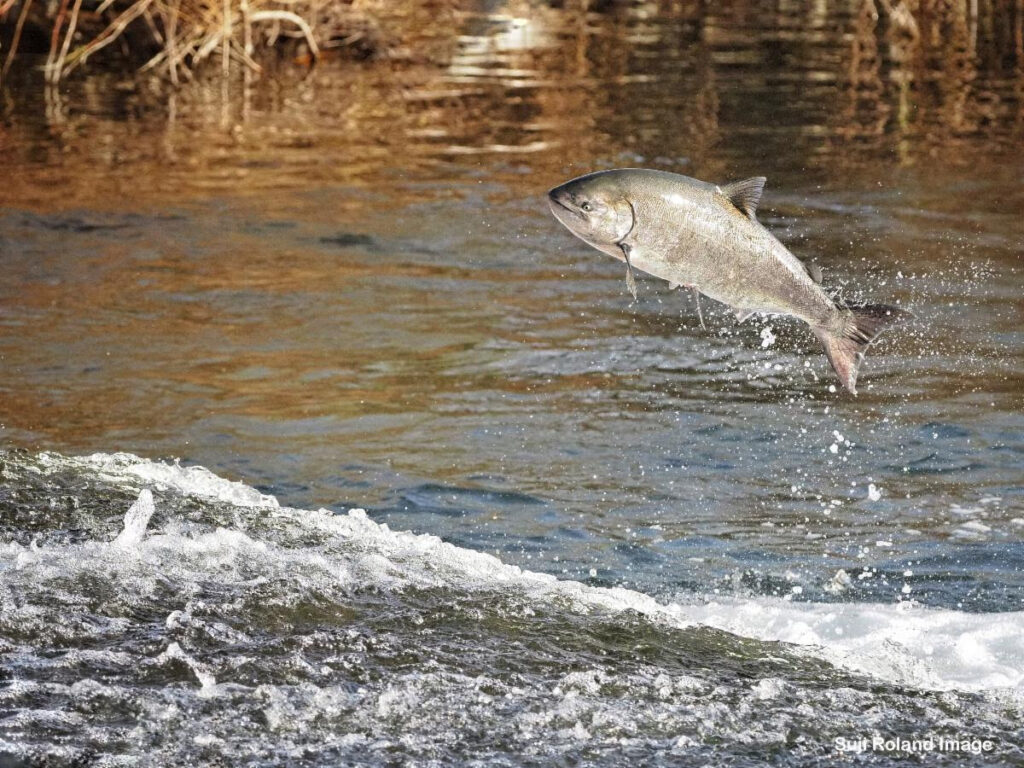
Butte Creek hosts one of the few wild salmon runs left in interior California and the most substantial spring run in the state. It’s still unclear how many of the roughly 500 salmon that returned in the spring have survived the turbidity and whether they can successfully spawn.
The Chinook have been struggling as well in recent years –- and in some cases dying — with warmer waters brought about by hotter temperatures from climate change, according to the conservation organization, Friends of Butte Creek.
A breach in Butte Canal was discovered by PG&E early the morning of Aug. 10, as water gushed down the side of a canyon, taking out trees and filling the creek with mud about 1.5 miles upstream from the Butte Creek Forks Recreation Area.
“This enormous slurry of clay and mud made its way down,” reported Zeke Lunder, a hydrology and wildfire expert who showed a video explaining the incident at the community meeting. “It created this new, kind of giant gulley,” he says in the video narration.
The creek turned a startling orange within hours, and while much of the sediment has since washed downstream, some has settled on the creek bed and along the edges.
“If there are survivors –- and we have heard that there are some live fish up there -– they can lay their eggs and a week later a storm comes in and covers them up,” said Allen Harthorn, executive director of Friends of Butte Creek. “Every single rainstorm will bring down more and more sediment.”
Harthorn believes that about 5 million pounds of debris gushed down in the landslide, and dump trucks or daily helicopter runs would be needed to access the site and remove that much debris. “It’s going to be a problem for quite some time,” he told the meeting participants.
Several community members noted, or asked why, there had been no announcement to explain the accident immediately after the discovery of the breach and whether the water was safe for swimming. Others wanted to know how to prevent another such accident in canals that were constructed in the 1800s for gold mining and converted later to hydropower flumes.
“They have a dilapidating infrastructure that needs care,” said LaRocca Morrill. “When you don’t put your record-breaking profits into repairs, catastrophic things like this happen.”
Biologist Sam Garcia, incident commander for the PG&E emergency management team that was set up to respond to the accident, told canyon residents at the meeting that the breach and the company’s response is under investigation. As a wetlands ecologist, he was alarmed by a “debris pile into the creek” and launched a rapid response.
Barry Ceccon, a lieutenant for Butte & Glenn counties with the Department of Fish & Wildlife, which along with the power company is also investigating the incident, said surveys have been underway by snorkelers trying to find the Chinook salmon. One live fish was recently spotted but the water was too murky to identify it, Ceccon said.
Ceccon said later that he arrived at the site of the breach with two other officers by noon on Aug. 10 after he was contacted by a member of the public. “[The water] looked like chocolate milk,” he said.
At the meeting, Jarred McCord said his family members have been residents of the canyon since his great-grandparents settled there. “What do we need on our end to make sure that we can have more transparency from you guys?” he said, directing his question to PG&E. “At the end of the day, what are we going to do to prevent this?”
LaRocca Morrill said she and McCord represent a new generation becoming involved in trying to safe keep the Butte Creek Canyon ecosystem. Speakers at the meeting were also critical of county actions, including the use of herbicides near roadways that produce toxic runoff into the creek and create what LaRocca Morrill said is a tremendous fire hazard.
Friends of Butte Creek is spearheading a letter-writing campaign to regulatory agencies asking that PG&E be held accountable. “We must not let PG&E continue to get away with destroying our watershed,” says the Friends of Butte Creek website.
District 5 Supervisor Doug Teeter, who represents the area on the Board of Supervisors, promised canyon residents a town hall meeting to discuss road maintenance and herbicide use.
Harthorn presented a long-term plan for making Butte Creek the site of fisheries restoration by removing canals and two dams, “freeing the Creek, forever.”
“Cold water from the west branch of the Feather River [would be] delivered to upper Butte Creek through a tunnel,” he says.
Butte County District Attorney Mike Ramsey said PG&E will be held accountable, at the very least, for reparations based on violations of the Fish & Wildlife code. “They cannot not be held accountable,” Ramsey said. “PG&E was obviously responsible and obviously is going to have to pay for reparations.”
The DA reminded canyon residents that his office successfully prosecuted the first manslaughter case against a major utility — PG&E — for its role in the 2018 Camp Fire that destroyed Paradise.
Pete Woiwede, an organizer for the statewide Reclaim our Power, said the work by Butte County to hold PG&E accountable for that deadly fire was important, but penalizing the power company with fines hasn’t produced the structural reform needed. The campaign was borne out of the California wildfires and power shutoffs in recent years, and works with communities on utility reform plans.
“PG&E has failed time and time again,” Woiwede said. “The dollar amounts [in penalties] become a pittance compared to the impact on our communities.”
This photo was taken by an observer of the devastation caused by the canal breach.
The failure of the PG&E-operated Butte Canal that caused a landslide into Butte Creek last week, turning the water a sludgy-orange, is under investigation by the law enforcement arm of the state’s Department of Fish & Wildlife.
“We’re very aware of the situation there,” said Peter Tira, an information officer for the department. “Butte Creek has the largest spring run of wild Chinook salmon in California, and that’s the reason we monitor it so closely.”
Tira said today that game wardens have so far found one carcass, but that doesn’t mean that more of the Chinook haven’t perished. The water began clearing after one and a half days, with the orange-ish sediment settling along the creek sides, but the creek middle is still murky, making the search for salmon challenging.
“The turbidity has improved quite a bit since last week when the situation occurred,” Tira said, “but it’s not an easy thing to look for.”
Tira said the leak occurred during the night previous to the discovery by PG&E early the morning of Aug. 10.
Meanwhile, testing is underway on the water quality by PG&E as well as at the university. But the murkiness in the water didn’t deter swimmers at Butte Creek Sunday where the Covered Bridge was once located.
PG&E said the breach occurred between the forks of Butte Creek and Butte Creek Head Dam in the gunite near the bottom of the canal early Aug. 10. “In the early afternoon, (sic) identified turbidity in the creek,” said a statement from the power company. “PG&E immediately notified state and federal resource agencies and patrolled the creek and canal by helicopter.”
Zeke Lunder, a hydrology and wildfire expert who publishes the blog, “The Lookout,” said removing debris from what is a “huge pile of rubble” created by the landslide will be difficult.
“Thousands of yards of dirt and rock dammed up Butte Creek,” Lunder said on The Lookout Facebook page, noting that video shows an “entire gravel bar” that is new. (See video at bottom of story.)
“The landslide went all the way across the creek and created a temporary dam.”
Lunder has hiked part of the landslide route and told ChicoSol that the breach itself appears to have been “surprisingly small.” But as the canal water gushed downward it created a “big mess” that got larger, washing away soil and taking out large trees.
What Lunder called a “big dam of dirt” blocked the creek flow for a period of time. “Then the creek flooded over the dam,” he said, and people downstream “began to see really heavy mud.”
Tira said officials from Fish & Wildlife were in discussions last week about whether PG&E should be allowed to move heavy equipment into the creek bed to remove the debris, or whether that would “make things worse” and cause more disruption.
Allen Harthorn, founder of Friends of Butte Creek, said removing the “mountain” of sediment will be a “multi-million dollar effort.”
“There’s so much material, they’d need dump trucks,” Harthorn said. “And there’s no way to get equipment down there.”
Harthorn suspects that the canal leak ran for “many, many hours” before state officials were notified.
Friends of Butte Creek has been working to restore habitat on the creek and says only 500 salmon returned to the fresh waters this past spring that are now in danger of perishing. Even if the water is now clearer, Harthorn said the salmon “went through two days of total inundation.”
“They’ve been struggling for oxygen for two days, and the hot weather doesn’t help,” he noted.
Another danger, Lunder said, is that those that spawn will leave eggs that get buried in the mud.
Harthorn is also concerned about the water quality. For example, asbestos is found in serpentine soils, and it’s unclear yet whether the landslide involved this type of soil.
Residents of Butte Creek Canyon, Harthorn said, are “up in arms” and aware that this will hurt the wildlife as well as their property values. “This type of event lowers the property value of every single home in the canyon,” Harthorn said. “We live in a pristine watershed. That has been destroyed.”
But the biggest worry is the spring-run salmon, which Harthorn as well as other others have spent decades trying to save. Those salmon began returning from the ocean this past March, and haven’t eaten since leaving their ocean habitat. “They come loaded with good fat to carry into the fall when they spawn,” Harthorn said, “but now they’ve been four to five months without eating, getting weaker and weaker by the day.
“To have this slam them during the month before they spawn is particularly hazardous to their survival,” he said.
Harthorn blames PG&E for poor facility maintenance of the flumes — which were originally constructed for gold mining in the 1800s — and wants to see the company held accountable. A letter-writing campaign is underway and Harthorn said members of the public should “saturate these agencies with complaints about this.”
PG&E spokesman Paul Moreno said Aug. 14 that PG&E has completed repairs on the canal and is waiting for the concrete to cure. It will then seek regulatory approval to put the canal back in operation. He declined comment on whether the canal had been neglected, saying only that the power company is “investigating the cause of the breach.”
Leslie Layton is editor of ChicoSol. (Video below was shot by a resident of Butte Creek Canyon and shows canal water gushing down the side of the canyon and leaving a mountain of orange-colored sediment. Video courtesy of The Lookout.)
This story was updated at 7:30 p.m. Aug. 12 with an additional response from Pacific Gas & Electric Corp. (PG&E).
The breach in PG&E-operated Butte Canal that has turned Butte Creek into orange sludge will turn out to be the death knell for many salmon and some members of other species, says fisheries expert Allen Harthorn.
Harthorn, founder of the advocacy organization Friends of Butte Creek, warns the environmental disaster triggered by the Aug. 10 breach is a threat to what was the state’s best chance to save spring-run Chinook salmon. Butte Creek, a 93-mile tributary of the Sacramento River, is considered critical to the spring run’s survival.
“This was the best run of spring-run salmon in the entire state,” Harthorn said today, “although it was in need of a lot of restoration. This event is essentially an underwater Camp Fire — there’s no fire, but it’s killing everything in its path.”
The breach occurred in a PG&E canal that carries water from upper Butte Creek to the De Sabla Powerhouse. In an email this evening, PG&E said the breach occurred “between the Forks of Butte Creek and Butte Creek Head Dam in the gunite near the bottom of the canal.” (Gunite is the thin coating used in canal construction.)
PG&E said it discovered the breach the morning of Aug. 10 and “immediately took action to stop water flows in the canal by opening side spill gates upstream of the breach.
“PG&E crews used sheeting and sandbags at the breach to effectively stop residual water from flowing out the breach,” says the statement from PG&E’s Karly Hernandez.
“As the turbid water flowed downstream, at the DeSabla Powerhouse, additional clear water was added to the creek and diluted the turbidity,” the statement says. “PG&E is closely monitoring the turbidity, which is continuing to decrease.”
Diversions downstream to farmlands have reportedly been shut off.
A Friends of Butte Creek statement, emailed today under the title, “Death Blow to Butte Creek,” said that “after more than 24 hours Butte Creek is still not clearing up.”
“Canyon folks have compared it to the Ganges River,” the bulletin says.
State and federal agencies have been called in to work on the problem, which Harthorn says will be tough to solve; it’s been compounded by the need to divert water from the damaged canal.
“Not only do we have the failure of the canal, but we also have all of these release valves dumping water down bare hillsides and into Butte Creek,” he said. “You can’t get any [heavy] equipment down there. It’s difficult to access.”
But PG&E’s statement this evening says: “Side gates remain open. The water is directed into spill channels so the diverted water should not be producing additional sediment.”
At his property in Helltown in Butte Creek Canyon, Harthorn watched the evening of Aug. 10 as the sediment “started to drift in.”
“By 7 o’clock there was zero visibility and the creek was orange,” Harthorn said. “When I saw the color and intensity, the speed at which it overwhelmed the [creek] pool, I could tell it was a very serious incident.
“As of today, it’s an absolute catastrophe, and may very well sterilize Butte Creek if they don’t find a way to solve this problem immediately.”
PG&E says that “emergency repairs” to the breach should be completed in several days.
Harthorn watched a deer make its way to the creek after the water had turned turbid, and then stand gazing at the creek afraid to take a drink. He said that not only are salmon in danger, but so are Pikeminnow, trout, Hardhead, Riffle sculpin and other species.
“Its animals that are affected, although secondary impacts to humans will be significant,” Harthorn predicted. “There could be arsenic in this water and there’s probably asbestos. We just don’t know until the testing is done. At the very least people should stay out of the water. Animals don’t want to drink it.”
Although diversions to ag lands have been shut off, Harthorn wonders whether the sediment will leak into the groundwater.
Spring run Chinook are a threatened species under both the state and federal endangered species acts. Butte Creek is one of only three tributaries that still support a self-sustaining population of Central Valley spring-run Chinook salmon, says CalFish, a data monitoring program.
Harthorn, who has been working on salmon habitat for 28 years, says this year’s run was the lowest run he’d seen in 26 years, and about 500 salmon are at stake. The spring run that is in the ocean right now should return to the creek next year and “help rebuild the population,” Harthorn said.
“But the bottom line is that three years from now, we may not have any fish come back again [if] there’s no adult spawning population this year that’s going to survive. Those that survive are going to be greatly weakened; their eggs may be ruined. We’ve never had to deal with anything like this before.”
At today’s Chico Certified Farmers’ Market, at the stand where he sells his ranch produce, alarmed shoppers streaming by paused to ask Harthorn about the seriousness of the problem.
Ann Polivka, a Paradise native, was one of the readers contacting ChicoSol when she saw the eerie orange as she crossed Butte Creek on Highway 99 in her car.
“I looked down and all of a sudden it was bright orange,” Polivka said of the creek. “I was really shocked. I’d never seen it that color.”
Harthorn blames PG&E for what he says is poor maintenance of its facilities. “They have failed to maintain [equipment], failed to monitor. This upper Butte Canal has fallen apart so many times I’ve lost track.”
The Friends of Butte Creek bulletin says it is “deeply saddened that PG&E has been allowed to continue operating this system that has had so many failures … Their stalling techniques on relicensing the DeSabla-Centerville project are deplorable. They are not fit to operate this anymore.”
Friends of Butte Creek said it is urging “canyon residents to put out clean water for the creatures” and will provide templates for protest letters.
State today approves groundwater sustainability plans for region
by Leslie Layton | Posted July 28, 2023
photo by Leslie Layton
Billie Roney
A groundwater management board charged with managing a large portion of Butte County’s water supply met a tide of resistance July 26 to a new fee that will be levied on Chico property owners.
The fee was approved by the Vina Groundwater Sustainability Agency (GSA) Board in a 5-0 vote and set at $1.54 per acre for the 2023-24 property tax year. It will thus be almost unnoticeable for small-parcel owners, but ranchers who spoke at the public hearing, held in the Chico City Council chamber, objected that it was inherently unfair to large landowners who aren’t extracting water.
Ranch owner Billie Roney said she and her husband were “shocked” to learn the new fee was in the pipeline. “We’re not irrigating,” she told the Vina GSA board. “The fee structure is not fair. We just keep getting pummeled.”
Board member Tod Kimmelshue said he wanted the board to explore options to set a fee in the future that would be related to water use or extraction. Board members indicated they needed to fund the agency quickly at this point rather than re-start the fee-imposition process.
More than 16 people spoke during the public hearing, all opposed to the fee and many objecting to the fact that it doesn’t reflect groundwater use and provide exceptions to owners of grazing lands who don’t extract water.
“I think what they’re doing is unconscionable, I really do,” said Roney, a mid-sized cattle rancher in a telephone interview today. “Rangelands serve to recharge the aquifer. Vernal pools flourish with cattle grazing. We feel we’re doing a service.”
Board members also certified the results of a protest election that failed to block them from setting the fee. In the protest election –- which concluded with the public hearing — only property owners who opposed the fee were expected to vote, and by law a majority of Chico landowners would have had to submit a “no” vote.
That meant that to block the board from setting the fee, 17,712 property owners needed to submit a “no” vote in an election that had caused widespread confusion.
Board Chair Evan Tuchinsky indicated there had been 546 protest ballots submitted, including 124 submissions at the public hearing. (Tuchinsky is better known in town as weekend editor at the Chico Enterprise-Record.)
Some of the speakers opposing the fee said they didn’t receive a protest ballot form or discarded the flier from Vina GSA without realizing what it was. A few seemed not to understand the unusual protest-election concept.
“It just looked like junk mail,” said Groundwater for Butte spokesperson Emily Alma at the public hearing.
The water table in the Vina Subbasin has been declining, and both state and county officials want that trend reversed. The state’s Department of Water Resources (DWR) today announced approval of the groundwater sustainability plans for Butte, Vina, and Wyandotte Creek that were all submitted last year. (DWR’s analyses are included in the Butte County Water Commission agenda packet on page 75 here.)
The groundwater sustainability plans that have been drafted throughout the state “will continue to address the impacts of ongoing weather extremes associated with climate change,” said DWR Deputy Director of Groundwater Management Paul Gosselin.
Gosselin previously worked as director of Butte County’s Department of Water & Resource Conservation while the groundwater plans were drafted.
The GSAs formed in response to the 2014 passage of the state’s Sustainable Groundwater Management Act (SGMA) that requires balanced groundwater conditions by 2042 through local management.
The fee is designed to produce revenue that will fund GSA administration, legal defense and SGMA compliance. The Board originally hoped to impose a fee of $3.09 but reduced it after hearing testimony and with the expectation that a $5.5-million grant will be coming to the area.
If local management fails and the state steps in, it imposes its own fees. Some landowners, including Roney, said they’d be better off with the state-imposed fees.
The Vina board approved a resolution that allows it to raise the fee to $3.09 in coming years, without the requirement that it provide opportunities for opposition through a protest election.
Henry Lomeli, representing Eagle Creek Ranch, said that $3 fee would cost the ranch $23,000 a year.
“SGMA was designed to deal with abuses with extraction of groundwater,” Lomeli said, “but we don’t extract water.”
He wondered out loud how land ownership became, to this extent, such a “taxable event.”
“These three GSAs are not going to protect domestic wells and groundwater-dependent ecosystems,” said AquAlliance water analyst Jim Brobeck.
Critics like Brobeck argue that the plans will lead to water table depletion to alarming levels during the aquifer recharge operations that are planned. He believes the plans were designed to “increase California’s water supply” by integrating the state’s “last robust aquifer” into a statewide market.
Christina Buck, assistant director for the county’s Water & Resource Conservation Department that has provided staff support to the GSAs, said the plan sets thresholds that can be adjusted at five-year evaluation intervals and were designed to prevent ecosystem damage.
In the meantime, the Vina GSA can work to plug a “data gap” with new, shallow monitoring wells that are needed, she added.
The most urgent objections at the public hearing came from ranchers like Megan Brown.
“Fees like this are going to put me out of business,” Brown said. “I’m hanging on a by a thread.”
Leslie Layton is editor of ChicoSol and a freelance journalist.