
A national voice in urban resilience, during a recent local presentation, warned Chicoans that cities don’t fail because of a lack of vision — they fail because they double down on fragile systems instead of fixing what’s right in front of them.
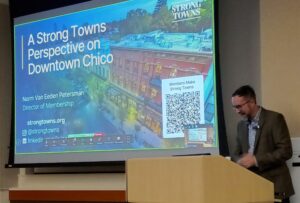
Norm Van Eeden Petersman, membership director at Strong Towns, spoke Jan. 22 at Chico State as part of the ongoing conversation about the Downtown Chico Revitalization Project as the city weighs the future of its downtown, parking, and public space.
At the heart of the talk was a critique of prevailing post-World War II development patterns — patterns that Strong Towns founder Charles L. Marohn, Jr., in his 2021 book, “Confessions of a Recovering Engineer,” and Petersman in his presentation – argue have made American cities financially weak and structurally fragile.
Petersman’s core argument, echoed throughout the presentation, is that auto-dependent design locks cities into a cycle of high costs and low returns. Streets built wide and fast to move vehicles efficiently may feel functional in the short term, but over time they create liabilities that cities struggle to maintain.
“Keeping things the way they are doesn’t preserve stability,” Petersman emphasized. “It preserves fragility.”
Since roughly 1958, American cities like Chico have focused overwhelmingly on horizontal expansion: Spreading outward with new roads, pipes, and parking lots, while under-investing in vertical growth and existing neighborhoods. The result is more infrastructure per resident, higher long-term maintenance costs, and fewer productive places that actually generate tax revenue.
“… the goal of downtown should be productive congestion …” -Petersman
Petersman pointed out that unlike businesses, cities are exempt from traditional liability rules. They manage assets owned by everyone, often without fully accounting for long-term maintenance obligations. This makes it easy to approve new construction while quietly accumulating future costs.
Petersman pointed out that cty-building is an “infinite game.” There is no reset button, no end-of-quarter reckoning. Mistakes compound. So do successes.
The solution, he argues, isn’t grand master plans or billion-dollar fixes — it’s humble, repeated action.
Citizens and officials alike were urged to:
- Observe where people are struggling
- Identify the next smallest step that could help
- Make the change
- Repeat
Small interventions — better crossings, narrower travel lanes, flexible use of curb space — can be tested, adjusted, or reversed. Big irreversible mistakes cannot.
The presentation also challenged assumptions about downtown vitality. Old buildings, Petersman noted, are often the best incubators for new ideas precisely because they are flexible and relatively inexpensive. Empty buildings and underused lots, by contrast, represent wasted productive capacity.
Counterintuitively, the speaker suggested that the goal of downtown should not be speed or convenience, but productive congestion — places where people move slowly, interact, linger, and spend money. Congestion, in this sense, is a sign of success, not failure.
“What you want is friction,” he said. “Friction creates value.”
One of the most pointed recommendations was for cities to map tax revenue against civic obligations. By using heat maps to compare property tax income with the cost of infrastructure and services required to support it, cities can see which areas are truly paying their way — and which are quietly draining public resources.
This kind of analysis reveals that dense, walkable downtown blocks vastly outperform auto-oriented development on the city’s edge.
Timely Conversation
The Strong Towns message landed at a moment when Chico is actively debating street configurations, parking, bike infrastructure, and pedestrian space as part of its downtown redesign efforts. The presence of multiple City Council members underscored the political relevance of the discussion.
While the presentation did not endorse a specific plan, it reframed the question Chico now faces: Will downtown changes make the city stronger — or simply extend patterns that have already proven unsustainable?
For attendees, the takeaway was less about ideology and more about mindset. Cities endure, Petersman argues, not by avoiding mistakes, but by learning quickly, correcting often and building on what already works.
As Chico moves forward, the ideas presented offer a lens through which residents and leaders alike can evaluate not just what downtown will look like — but whether it will remain financially and socially resilient for decades to come.
The event drew a mix of planners, advocates, business owners and curious residents into a conversation relevant to Chico’s ongoing downtown redesign process.
Chico’s Richard Roth produced this article by attending the event and receiving writing and editing assistance from ChatGPT.