
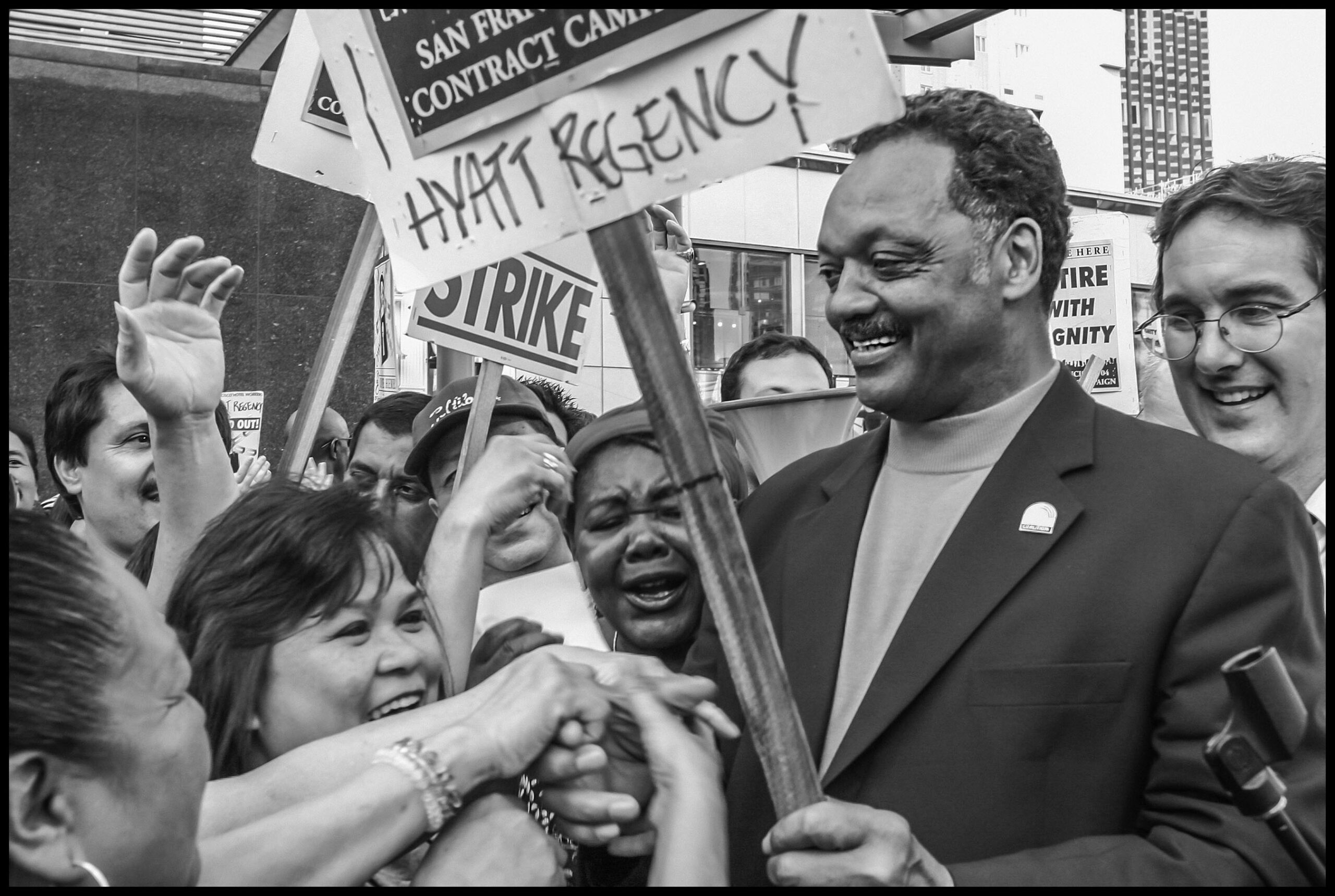
I want to start with the tears.
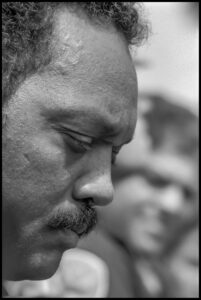
November 4, 2008. Grant Park, Chicago. Barack Obama has just been elected president, and the cameras find Jesse Jackson standing in the crowd, not on the stage, in the crowd, with his face completely undone. Tears running. Jaw tight. Eyes somewhere between here and thirty years ago. The facial posture alone carried the weight of a whole life. Impression and expression layered together the way only real grief and real joy can produce, each one refusing to yield to the other.
America saw that image and did not know what to do with it. Some people felt moved. Some grew suspicious. Some reached for the long file they keep on Jesse Jackson and filed it under “complicated” without looking too hard at what they were actually seeing.
But I could not stop looking at that face. Because I recognized the condition of it. The particular way a Black man looks when joy and grief arrive at the same moment and his body cannot tell them apart. When everything he paid and planted and refused to stop believing finally cracks the surface.
That is not performance. You cannot rehearse that. That is a man carrying the full weight of every mile he walked so someone else could run, watching them cross a finish line he never reached, and letting his face say all of it because he earned the right.
Those tears were theology. I just did not have the words for it the first time Jesse Jackson found me.
Sesame Street Gave Me a Prophet
I was a little chubby poor Black kid in Cincinnati. The television was on, the one with the antennas. And there was Jesse Jackson, not wearing a suit that fit the occasion the way certain people expected, not speaking with the diction the gatekeepers required, not holding the composure that makes Black men palatable to rooms that never built space for us. He was just there. Fully there. In his own clothes, in his own cadence, on his own terms. Leading a call-and-response with children that carried more voltage than it had any business carrying on afternoon television.
He said it. They said it back.
I am somebody.
I did not know his resume. I just knew this man was telling kids like me something that sounded like it cost something to say. Something the world would spend a long time trying to unsay.
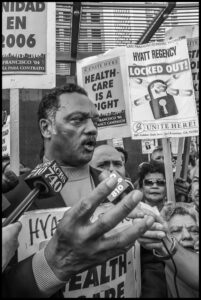
Seminary gave me the language years later. Imago Dei. The image of God. The claim that every human being carries sacred worth that no one can earn, revoke, or legislate away. Jesse was not running a self-esteem segment. He was doing public theology on public television, translating one of Scripture’s most dangerous claims into language a child could receive before the world taught him to doubt it.
What struck me even then, without knowing why, was that he did not clean himself up to say it. He said it as himself. And somehow that made it more true.
He Was Never Looking the Part. He Was Always Being It.
This is where I have to get honest about what Jesse Jackson meant to my formation as a Black man, because it was never about agreement. It was about permission.
The version of Black male identity I kept bumping into in church, in school, in the quiet architecture of what people rewarded and what they corrected, demanded a specific performance. Speak correctly. Present correctly. Sand down the edges. Translate yourself into something legible to the people holding the keys. The implicit promise was that if you mastered the performance, you would earn access. Dignity. A seat.
Jesse Jackson never took that deal.
He did not speak in the carefully modulated tones that make certain rooms comfortable. His cadence belonged to the Black church, the street corner, the rally, the call-and-response. He stumbled through moments. He said things that required correction. He was not the respectable ambassador some wanted him to be. He was a man from Greenville, South Carolina who refused to shrink himself into the frame America offered him, and who kept showing up anyway, kept building anyway, kept demanding that the country look at the people it preferred to ignore.
That gap, between how his critics saw him and what he actually was, became one of the most important things I ever learned about identity. The critics measured the performance. Jesse lived the substance. He was not looking the part. He was being it. Every single time.
The Door Respectability Politics Locked
I was hungry for something specific growing up, and I did not have words for it. I needed to see a Black man who was great and still in process. Consequential and still human. Somebody who had done significant things and still had significant distance left to travel.
Not the polished, suitable-for-all-audiences version of Blackness that empire codifies and cultural conformity baptizes. Not the kind that is easy to accept and easier to manufacture, but impossible to actually live. The real thing. The kind that costs something.
I needed this because the same Black mothers and fathers who lifted me on pedestals could not reach the part of me that already knew I was going to stumble. That part needed to know whether stumbling ended you. Whether a Black man could be imperfect in public and still be worth something.
Respectability politics locked that question behind a door it never wanted opened. It insisted the only Black men worth honoring had eliminated every rough edge, every contradiction, every moment of public humanity. Clean enough for Sunday morning. Safe enough for white comfort.
Jesse Jackson kicked that door open, not by lowering the standard but by refusing the premise. He showed me you could be formative without being flawless. Prophetic without being polished. Worth learning from and worth holding accountable, at the same time, in the same body, without apology.
That is the section of Blackness they were guarding. Jesse walked me in.
What the Tears Said
So when I saw him at Grant Park, face open, tears falling, I did not see a man who lost. I saw the whole road. Greenville to Greensboro. Selma to Memphis. San Francisco to Atlanta. Chicago, and then Grant Park. A geography of defiance that ended not with him crossing the finish line, but with him standing in a crowd watching someone else walk through a door he helped build.
Far removed from the Lorraine Motel, and Bull O’Conner, but well before that promised land that his slain brother proclaimed.
That’s what the tears said.
Grief, joy and pride and the particular ache of legacy arrived all at once, refusing separation, insisting on being felt.
That’s what the tears said.
Those tears said what his voice had been saying for decades: I am here. I am human. I am not a monument, and I never tried to be one. I tried to build something that outlasted me.
The salty natural occurrence of water flowing down his brown cheeks, a reserve for sure, of what could have flowed, but this grown man, held it together as best as he could.
A little chubby poor Black kid watching television in Cincinnati learned from that man that the tradition had room for someone still becoming. Still stumbling. Still insisting, against all available evidence, that he was somebody.
That kid is still learning it.
Still grateful the door was open when he arrived.
As I think of his life, his work and his gift to our nation, his gift to me,
I now get it Jesse.
Rest well, Jesse. Complicated, consequential, fully human. Never looking the part. Always being it. And my good sir, that was always enough.
Robert A. Morton Sr. is a pastor, writer and community organizer serving Oroville and Butte County, California, and founding executive director of The Black Resiliency Project.
16 Comments
Splendid, eloquent, penetrating Insight Here !
My thoughts I also was touched by his tears. I am only seven years younger than Jesse, so I witnessed some of the same things as him, some from a distance.
Great commentary and tribute, brother.
A beautifully written essay about Rev. Jackson. His example of “Doing The Right Thing” lives on today in leaders like Rev. Morton. Thank you, Rev. Jackson, for your inspiration. And thank you Rev. Morton for continuing to speak out. Our world needs more who see beyond a broken world to a world of possibility and justice and unity.
Absolutely beautiful and exquisitely informative. Thank you!
A moving & deeply poetic inspired story. It’s a memory to help us all to keep up the work- no matter what.
In a conversation with a friend about the profound effect this tribute had on me, I mentioned that I felt lifted up out of limiting perspectives. She added the feeling of being lifted up into new perspectives. This is what it means to be touched. I then watched the Sesame Street episode with all its historical and personal impact. Thank you to ChicoSol for bringing Reverend Morton’s words to us. And to Reverend Morton for forming these feelings into a work of historical significance and a roadmap for the future.
As a Native Chicagoan, I was there for “Run Jesse Run” as well as Barack victorious at the finish line. Same tears on my cheek…
Thank you, Rev. Morton, for your deeply honest sharing, carrying readers into the heart of a young black child growing up in this racist land. You sharing this story about Jesse’s impact on you, helping you to understand that YOU are SOMEBODY has moved me to tears.
Many thanks to ChicoSol for publishing Rev. Morton’s tribute to Jesse Jackson, through a child’s eyes and heart.
Jesse Jackson would have been an amazing President – sadly, the world was not ready for him!
Dr. Morton, I loved what you wrote about Rev. Jesse Jackson. I loved his energy and leadership through the years but somehow forgot him in recent years and when he died I couldn’t dredge up distinct memories, only the stirring of another time when our Rainbow Coalition seemed like there was hope and momentum. With all the memorials I’ve deepened into who he was and what he meant throught the focused eyes of others and I’ve appreciated that…. How could I let him go with such flatness in my feelings?! Your words were like an epiphany and both you and Jesse have emerged for me in the most tender and respectful way. I hope kids these days are finding inspiration like you did. The future needs such role models. Peace and Gratitude.
In the excitement and joy of Obama’s triumphant appearance at Grant Park on election night, I, too noticed Jesse Jackson crying. And I started crying, although I couldn’t explain why. Robert Morton now has done that for me. Speaking of crying, long ago I saw a news segment about Jackson’s PUSH organization. They showed his call and response with Black kids – “I AM somebody” “I AM somebody.” That brought tears to my eyes, too. Thank you, Robert Morton. Thank you, Jesse Jackson.
Robert Morton, thank you, very much, for writing “The Man Who Cried at Grant Park”. Jesse Jackson was amazing and remembering him is important. I am proud remembering my parents voting for him in his 1984 and 1988 presidential campaigns.
Obama’s election was worthy of Jesse Jackson’s tears. Sad that Obama did not live up to the hopes of those tears.
On February 15, 2003, just before the invasion, Jackson addressed a crowd of over one million people in London’s Hyde Park, one of the largest anti-war demonstrations in history.
Sad that there are no demonstrations and little concern, as the US readies to attack Iran, population about 93 million, Iraq in 2003 about 26 million.
Weirdly, it seems there are more MAGA types than “lefties” concerned, but NOT demonstrating either.
Thank you…moving….
Beautiful
Thank you so much Rev. Morton,for so lovingly marking the passing of a great man, who really made a difference in the world he touched…..and to chicoSol, for the inspiration to publish it
I enjoyed this so very much. I am so very proud of all you have accomplished and the great man you are becoming. MAY GOD CONTINUE TO RICHLY REWARD YOU. GIVE MY LOVE TO ALL