
Candidate speculation begins in the wake of Prop. 50

The ballot measure's passage divided Californians but passed in a landslide
by Natalie Hanson, Lindajoy Fenley and Leslie Layton | Posted November 6, 2025
District 1 Rep. Doug LaMalfa would face competition in a more liberal congressional district. Photo courtesy of Wikimedia Commons.

Californians handed a big win to Proposition 50, according to preliminary Nov. 4 election results, signaling a major change to congressional maps in historically red districts like District 1.

The majority of voters in the rural Northern Sacramento Valley opposed the proposition, which will significantly reshape its District 1 that is now represented by Republican Doug LaMalfa. The Butte County Clerk-Recorder reports today that almost 46% of the county’s voters favored Prop 50 and more than 54% opposed.

Opposition was even greater in Glenn and Tehama counties, with the “yes” vote further behind at almost 29% and 27% respectively. 

Statewide the picture was quite different. CalMatters’ reports today that nearly 64% of Californians voted for Prop. 50. read more

Redistricting will matter to District 1 residents

Climate, farming practices, rural health would be debatable
by Yucheng Tang | Posted September 16, 2025
Audrey Denney argues for passage of Prop 50 at a recent Sweet September meeting. Photo courtesy of Bruce McLean.

If California’s congressional districts are redrawn, District 1 residents could see lively debate about climate change and how farmers can adopt environmentally friendly practices.

Audrey Denney, chair of the Democratic Action Club of Chico, has announced she will run in the District 1 election if the proposed map is approved. Denney views agriculture as “a tremendous asset in the fight against climate change,” and would push for more incentives for farmers to adopt regenerative practices.

District 1 Congressman Doug LaMalfa, by contrast, rejects climate-focused regulations as burdensome for small farmers and the food industry. LaMalfa, a rice farmer from Richvale who was first elected to the House 13 years ago, was one of four congress members to introduce legislation to provide disaster relief for farmers in the form of a permanent program. read more

Redistricting issue may come back to Chico City Council

City attorney rethinks his position
by Yucheng Tang | Posted February 24, 2025

photo by Karen Laslo
Councilmember Addison Winslow

Councilmember Addison Winslow complained at the Feb. 18 City Council meeting that there were “cockamamie” procedural objections that blocked his effort earlier this year to ensure there will be future discussion on redistricting and how it’s done.

“I wanna believe that this is the last time that we have an issue like that,” Winslow said from the dais during the public comments section of the meeting. “I think the least that we can do is maintain a legitimate public decision-making process.”

Newly-elected Councilmember Bryce Goldstein, at the Jan. 28 meeting, made the motion to direct staff to return with information regarding the application of several reforms, including the possible establishment of an independent redistricting commission.

After Goldstein’s motion for electoral reform failed on a 4-3 vote at that meeting, Winslow moved to table discussion on an independent redistricting commission to September 2028. That effort was met with objections from both Mayor Kasey Reynolds and Councilmember Tom van Overbeek.

“I don’t think we can do a follow-up motion,” Reynolds said. “Can we do two motions on one item?” she asked, turning to the city clerk and city attorney.

City Attorney John Lam indicated that the motion should be disqualified. He said at the meeting that Winslow’s motion was “an attempt to try to reopen that discussion on that failed motion.”

Redistricting is the process of redrawing election district lines so that each district is “substantially equal in population.” Redistricting is undertaken every 10 years in connection with new data from the U.S. Census. The FAIR MAPS Act states that “boundaries shall not be drawn for purposes of favoring or discriminating against a political party.”

“We saw in the first and second processes in Chico, two different political majorities on the City Council, who, in some opinions, kind of drew district lines in favor of themselves,” Goldstein said at the January meeting, noting that both liberals and conservatives have been accused of manipulating district boundaries to their advantage.

Winslow said he later consulted experts in municipal law who said the disqualification was “absolutely wrong” because his and Goldstein’s motions “would have produced a totally different outcome.”

“This is ridiculous that you can’t have multiple motions on an item,” he told ChicoSol in a phone interview.

Lam acknowledged in a follow-up email to Winslow that “a motion that is substantially different from the failed motion could be made.”

Lam also responded to ChicoSol questions in a Feb. 21 email, indicating he has reconsidered and reversed his position.

“Following the January 28th, I’ve had the benefit of reviewing the council meeting video and determined my initial understanding of the motion was inaccurate,” he wrote. Lam noted that his initial understanding was that the motion made by Winslow would constitute a “Motion to Reconsider,” which in fact has quite restricted use.

Winslow said he has considered bringing the motion back at some point before the next census. “Maybe in a year, we’ll try to bring it back again,” he told ChicoSol. “Probably closer to the (2026) election is a more sensible time when people are watching Council actions more.

“We need to get a fourth vote in order to have a discussion again in order to make that motion to table it again. It puts us several steps away,” he added.

Winslow pointed out that redistricting can determine the political majority of the Council because of the ways in which voters are grouped in the City’s seven districts. Winslow said he decided to speak during the public comment time at the most recent meeting because, “to a certain extent, the public, too, should be aware of how our rules work.”

Yucheng Tang is a California Local News fellow reporting for ChicoSol.

Referendum petition fails to meet deadline

by ChicoSol staff | Posted January 14, 2022

photo by Karen Laslo
David Welch

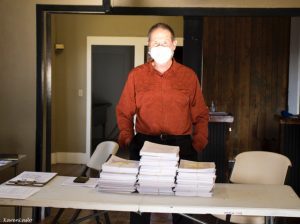
At a press conference today, David Welch, spokesperson for “No On Butte County Gerrymandering,” announced that the group fell short by just a few hundred signatures in its effort to petition for a referendum on the newly-adopted Butte County district map.

Group members, arguing that the redistricting map adopted by the conservative majority on the Board of Supervisors was heavily gerrymandered, said their work was hampered by the holidays, the Omicron variant and rainy weather. “The gerrymander of our county, against the backdrop of Republican gerrymandering across America, has aroused a level of passion I’ve rarely seen for a local issue,” said Welch, vowing that other options would be explored. — Karen Laslo
Redistricting battle heats up

Two supervisors protest the slice-up-Chico map as gerrymandering
by ChicoSol staff | Posted November 17, 2021

photo by Karen Laslo
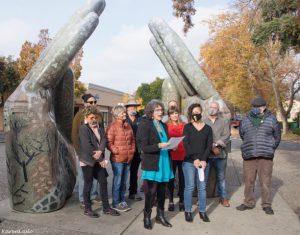
Supervisor Debra Lucero (left), and Supervisor Tami Ritter (right), at Nov. 17 press conference.

District 2 Supervisor Debra Lucero, speaking today at The Hands in a press conference, warned that the Butte County Board of Supervisors’ conservative majority may attempt to pass a gerrymandered map at a special 1 p.m. Nov. 22 meeting.

The county spent some $80,000 on consultants who drew up several redistricting maps, but instead are considering a map proposed by Paradise Supervisor Doug Teeter that slices the city of Chico into four parts and the city of Oroville into three. Lucero says Teeter’s map was designed by a Republican strategist and she and District 3 Supervisor Tami Ritter argue it would dilute Chico’s representation and give lopsided power to agricultural interests.— Leslie Layton

Sick of gerrymandering? Join California’s redistricting commission

Panel seeks to end political rigging of voting districts
by Mark Hedin | Posted July 18, 2019

Kathay Feng, Common Cause national redistricting director, has championed independent redistricting efforts across the country. Those efforts began with two initiatives California voters passed prior to the 2010 Census, leading to the formation of the state’s Citizens Redistricting Commission, which is now seeking new members.

California is looking for new commissioners to draw its redistricting maps — the maps that define who votes for California’s representatives in Congress, its state Senate, Assembly and Board of Equalization members. The deadline is coming up fast to apply for the job, which pays up to $300 per day.

The initial application form takes five minutes to fill out. It’s due by Aug. 9 for the first round of the application process. Find it here.

(The California State Auditor’s office reported today that more than 5,500 Californians have already submitted applications and only .68 percent are from Butte County.)

“This is your chance to shape California’s future by drawing fair district boundaries that serve the best interests of all of the people of California,” said Kathay Feng, national redistricting director for Common Cause, the nonprofit that led the way in creating the commission, the nation’s first, in 2009.

“It’s so important. Teachers, small business people, demographers, people who have served in a local planning commission,” Feng said, would all be good candidates for the work, most of which will be done in the first half of 2021. The $300 per diem pay is for any six or more hours spent in a 24-hour period doing the panel’s work.

Applications opened in June, but so far, the pool of applicants does not reflect California’s diversity, according to both Feng and Stan Forbes, the current commission chairman. Two-thirds of the applicants have been white and two-thirds have been male. “That is not California,” Forbes said.

“We know from last time that the reasons the commission was so good was there was good diversity in the applicant pool,” Feng said. “Our hope is that between now and Aug. 9, people will take a look at the application and put their hats in the ring.”

Serving on the commission,” Forbes noted, “is one of the most rewarding things someone could possibly do. It’s taking power away from the politicians and giving it back to the people.

“When’s the last time the public had an impact?”

The work will begin in earnest in early 2021, once the data collected in the 2020 census is in. The commission will take the total number of people in the state who were counted in the census, and try to divide them equally and fairly into the number of congressional seats California has – currently 53, but subject to change according to census data showing geographic shifts in population dispersal nationwide. The 435 seats in the House of Representatives are divided evenly among the states according to their population.

Current projections are that the state may lose one or two congressional seats once the census has retabulated the number of people in the country based on the data it will gather in 2020.

The commission will also create 40 districts for the state’s 40 state senators, 80 state Assembly districts and four Board of Equalization districts. The Board of Equalization is the state agency tasked with tax administration and fee collection and handles appeals of decisions made by the state Franchise Tax Board.

The proposed new maps will be submitted to the secretary of state for certification by the end of July 2021, a process Forbes described as a “pro-forma” review to ensure they meet legal criteria.

The reason it’s important for all California communities to be represented on the redistricting commission is to ensure that the unique concerns of every community are heard.

“We all have different issues,” Forbes said.

For instance, during one of dozens of community meetings held up and down the state in the first commission’s work in 2011, the people of Marysville, in Yuba County, told the commission that they needed better political representation. They were stuck in the same congressional district as the agriculturally focused Central Valley, and felt their very different political concerns — about fire prevention, watershed protections and recreational activities — were being ignored.

So, Forbes said, “We drew a district that represents the foothills.”

Similarly, the commission adjusted plans to create a district in Napa Valley, known worldwide for its wine industry, to include its warehouses, and, along the Interstate-710 corridor near Long Beach, created a district that linked the shared interests of a populace impacted by the diesel pollution emanating from port operations there.

Similar considerations were made to not dilute the voice of other communities of interest, Forbes said, such as Koreans in Hollywood, South Asians in Fremont, Vietnamese in Orange County and the gay community in San Jose.

Ethnicity factors into redistricting considerations in other ways, too. Per the Voting Rights Act, Forbes said, the redistricting process can’t pack all people of a group into one district, or distribute them thinly across so many districts that their voices are drowned out.

California’s Citizen Redistricting Committee is the nation’s first, but there are efforts under way in smaller California jurisdictions and in states across the country to create similar bulwarks against the abuses of gerrymandering. In California, the cities of Long Beach, Santa Barbara and San Mateo all passed laws to create a citizen commission, Feng said, and encouraged people to participate in those, too.

Another positive development in California toward getting communities fairly represented in census data and all that flows from it, Forbes said, is that prisoners will no longer be considered residents of the communities, typically rural, in which they’re incarcerated, but instead will be linked to their hometowns.

“We’re the gold standard,” Forbes said. In his travels across the country, in connection with Common Cause and the League of Women Voters, for discussions in other states of similar redistricting reform efforts, “progressives and moderates are in awe of California.”

At an event recently, he said, former California Gov. “Arnold Schwarzenegger wanted to have his picture taken with ME.”