
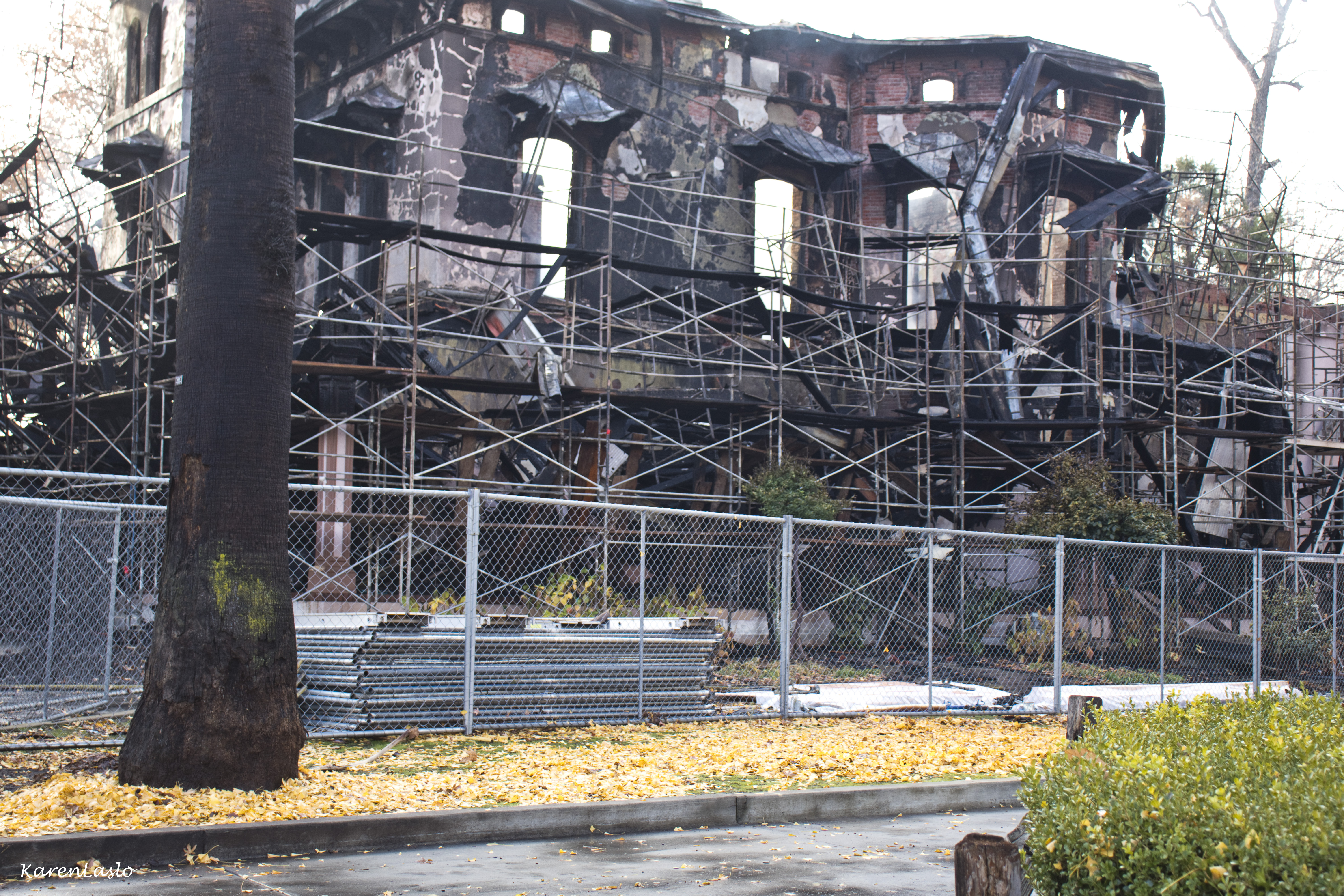
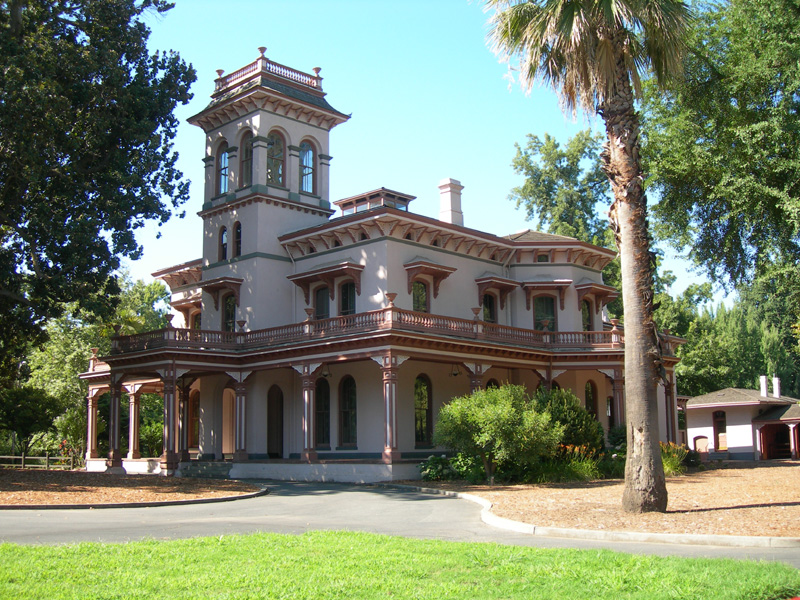
On the first anniversary of the fire that destroyed the iconic Bidwell Mansion, we’re posting a poem written and contributed by local poet Danielle Alexich.
Sleep-drunk, we hear sirens from bed and at dawn check our phones. I stride the neighborhood avenue to find Bidwell Mansion, Victorian landmark, yesterday pink, now charred and smoldering, grieving itself, collapsed into a Dalian dream. Light seeps through majestic trees.
Locals line the sidewalk. Girl Scout alumni who toured ornate, eerie rooms with a blind and brilliant docent. Old-timers holding hands. Unwitting parents whose kids cut class to smoke weed on the veranda. Amid the rubble, steps survive, once slick from generations of events, spontaneous picnics, first kisses, erased footprints of those who were conquered.read more
Would a functioning alarm system have saved the building?
by Leslie Layton | Posted April 18, 2025
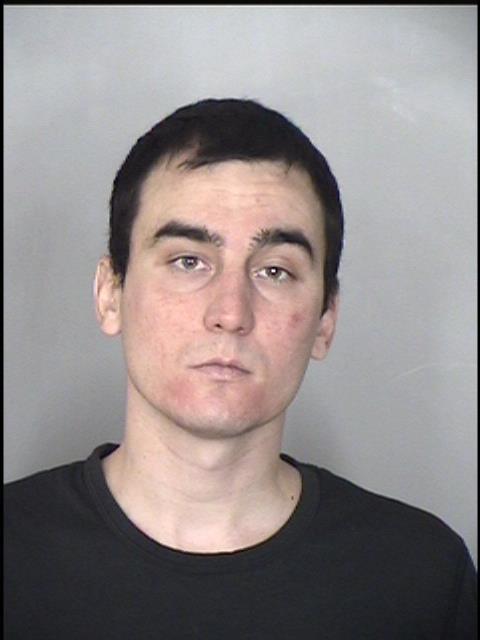
photo courtesy of district attorney
Kevin Alexander Carlson
This is the second story in a three-part series on the fire that destroyed Bidwell Mansion and the role the Mansion played in our community. Read the first story here.
The report issued by Butte County Probation in the Bidwell Mansion arson case begins to answer this troubling question: Why did a 30-year-old man with no criminal record set fire to the iconic Victorian?
But though it begins, it doesn’t entirely answer the big “why”: Why Kevin Alexander Carlson shattered a window with a hammer and doused the interior with a gallon of gasoline in a series of maneuvers that began the day before the early Dec. 11 fire. Or how the building became engulfed in flames before Chico Fire Department had a chance to respond.
Carlson is serving an 11-year prison sentence — the maximum possible for his conviction — at North Kern State Prison in connection with the fire that destroyed the 146-year-old former home of John and Annie Bidwell, the couple who are considered Chico’s founders. The medium-custody prison’s website says his earliest possible parole date — which is subject to change — is July 2030.
“The defendant deliberately set fire to a historic building of deep cultural and communal significance,” said the Butte County District Attorney’s Office in asking for the maximum sentence. “This level of premeditation distinguishes his conduct from impulsive or reckless arson …”
The Butte County Probation Department recommended a middle term, but Superior Court Judge Corie Caraway said she had received more than 100 victim impact statements from community members as well as other “aggravating factors.”
Chico Police Department said Carlson began preparations for the crime on Dec. 10, traveling to Oroville from Chico where he “purchased supplies needed to commit the arson.” He removed the license plates from his vehicle prior to setting the building on fire, Chico PD said.
Depressed and anxious
Carlson told investigators that he had awoken that December Tuesday feeling “manic” and “anxious,” and his mood had been affected by the “genocide” – a reference to the war on Gaza. He said he was “stressed about making rent.” His statement to investigators tracks his deepening alienation and despair over both his personal circumstances, as well as the contrast between the costly renovation of the Mansion and homelessness.
Chico PD reported on an interview with Carlson’s mother, who said her son was “was suspected of being autistic, is highly intelligent, and graduated at the top of his class.” Carlson graduated from Chico State in 2018 with a BA in mathematics.
She mentioned Carlson’s “alcoholism” and “intense hatred toward capitalism” as sources of tension for the Chico family.
Carlson, who would later plead no contest to a felony arson charge and accept the DA’s “special allegation,” told investigators he had only slept in “small increments” for a couple of weeks prior to the arson and “did not intend to burn the entire structure.” He wrote that he was “extremely depressed.”
“I remember feeling a deep sense of alienation as I walked by people going about their day,” he wrote about Dec. 10 in a statement submitted by the probation department. “… Looking at the disparity between those parts of my community, my grief shifted quickly to anger and in a snap judgment I decided I wanted to vandalize the mansion.”
Carlson’s statement includes a reference to John Bidwell as a man who was “known to exploit people.” But it was the disparity that seemed to disturb him, the fact that there was an effort underway to protect Bidwell’s “legacy” while “ignoring the less fortunate who live near the base of the mansion.”
His public defender, Larry Pilgrim, described Carlson as a “rebel looking for a cause,” and believes that Carlson was truthful in stating his expectation that Chico Fire Department would save the building. No psychiatric examination was ordered, in part because Pilgrim said Carlson didn’t consider himself “insane.”
Pilgrim said he doesn’t think Carlson was moved to action because of a singular and strong animosity toward John Bidwell. “I don’t think it was Bidwell per se; it was the haves versus the have-nots,” Pilgrim said. “It was a social justice thing.”
An alarm system failure
Pilgrim said he’s baffled that fire alarms and motion sensors didn’t alert Chico Fire Department much sooner and said the equipment should have been checked on a regular basis.
“It’s inexcusable that the fire department was not notified within minutes,” Pilgrim said. “The damage would have been minor, a hole in the carpet.”
Instead, Carlson has been ordered to pay $37,414,083 in restitution with 10% interest that runs from the date of the arson. Pilgrim called that restitution sum “ridiculous.”
“The whole question about the fire alarm … is still under investigation” — Matt Teague
Chico Fire arrived at the scene four minutes after Chico PD was advised that the Mansion was on fire. Pilgrim said the fire, though, had been “smoldering for over an hour.”
Fire Department Chief Steve Standridge said it’s true that there was a “delayed response because [the fire] didn’t get called in.” Standridge said the alarm system was under the responsibility of the Office of the State Fire Marshal. And in fact the Chico Fire Department’s web page notes that the “response … showcased the expertise and determination of our firefighters …”
Matt Teague, district superintendent for the Northern Buttes District of California State Parks, acknowledged that the fire alarm system didn’t operate as it should have. He noted that the system should issue an alarm if there is a fire, and the contracted monitoring company should make the appropriate calls.
“The whole question about the fire alarm and why it didn’t go off is still under investigation,” Teague said. “We may never have an answer though.”
Teague said there was also a burglar alarm system tied to motion sensors in the building that also failed.
There were no suppression sprinklers in the building, which is commonplace in historic buildings when there’s concern over possible water damage during a small fire or false alarm, Teague noted.
The alarm system failures don’t absolve his client of responsibility, Pilgrim said. Still, he argues that his client believed the Mansion would be saved by a sprinkler or other fire protection system.
“He thought he was committing an act of vandalism,” Pilgrim said. “I think he was just trying to make a little statement — stop spending this money on repairs when you could be spending it on nobler causes.”
Leslie Layton is editor of ChicoSol. Reporter Yucheng Tang contributed to this story.
Long neglected Mechoopda history could play a bigger part in next project

by Yucheng Tang | Posted April 13, 2025
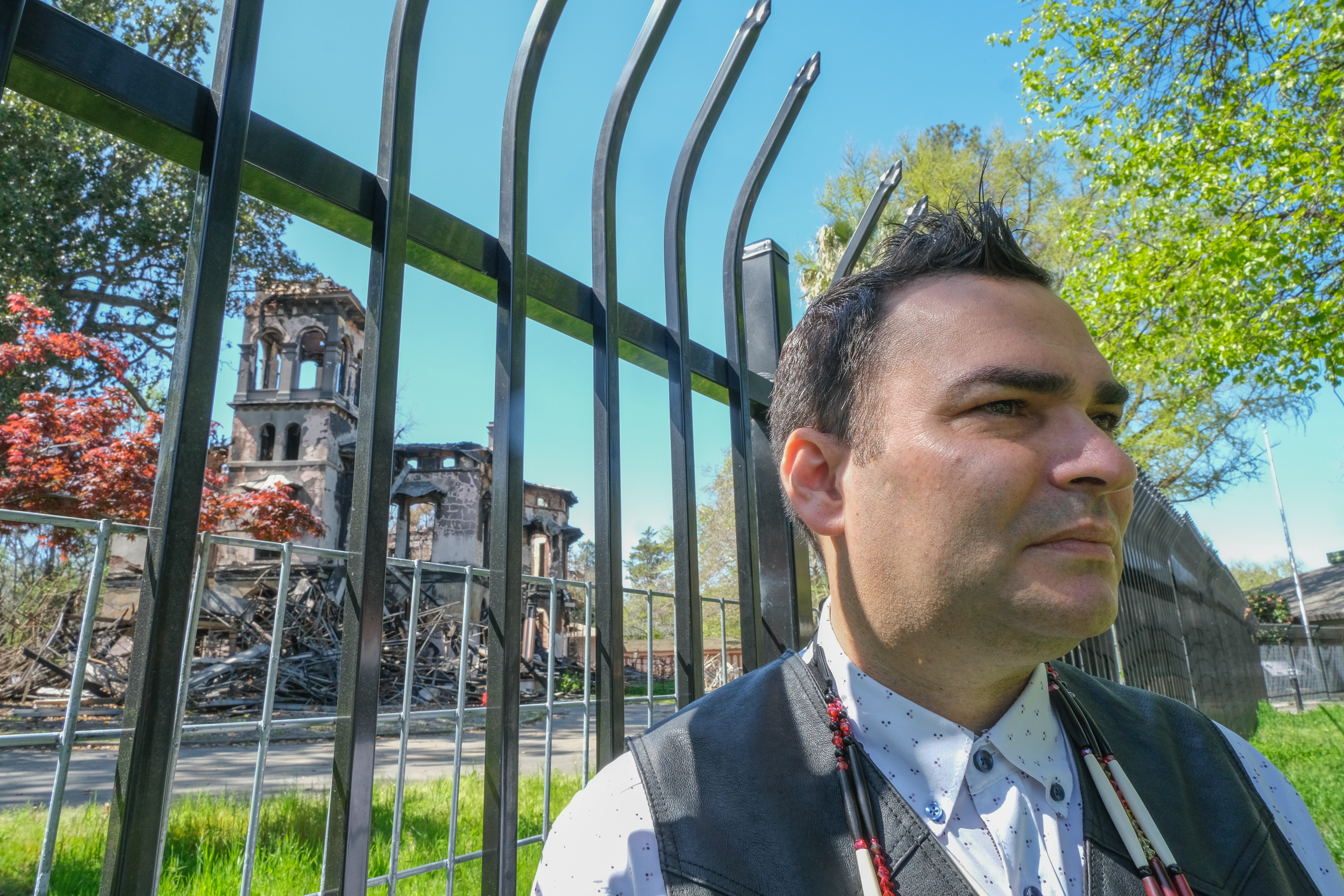
photo by Yucheng Tang
Browning Neddeau in front of the ruins of Bidwell Mansion
(The is the first story in a three-part series on the destruction of Bidwell Mansion and the role the Mansion played in our community.)
Chico State Associate Professor Browning Neddeau made his first and only visit to Bidwell Mansion, a local landmark from the 1800s associated with the founding of Chico, in 2019.
During the tour, Neddeau and his father, who belong to the Citizen Potawatomi Nation, asked their tour guide some hard questions about the Native American experience during the era of John Bidwell — who is known as the founder of the city – but they felt that their questions were ignored.
Neddeau was frustrated with the “settler-centered mindset” reflected in the stories told during a tour of the Mansion, where Bidwell lived with his wife, Annie. He remembers that the only items related to the Mechoopda Tribe, an indigenous people of California who lived in this area long before John Bidwell’s arrival – was a collection of baskets made by tribal members.
When he got out of the Mansion, he told himself he’d never go back.
Last year, on the morning of Dec. 11, a fire engulfed and destroyed the Mansion, leaving it in ruins and putting the fate of more than 3,000 objects, including the Mechoopda made baskets, in question. The arsonist, Kevin Carlson, was sentenced to 11 years in state prison and ordered to pay $37.4 million in restitution. (See part 2 in our series here.)
About 20 baskets were the only ethnographic objects related to the Mechoopda in the building, and they are very unlikely to have survived the fire, according to a State Parks official.
After the fire damaged Bidwell Mansion, discussions around the controversial relationship between Bidwell and the Native Americans who lived in the area resurfaced, drawing both local and international attention.
Opinions on John Bidwell, who acquired the Mexican land grants where the City of Chico would be established, remained divided. Some see him as a progressive settler and pioneer, while others regard him as an exploitative colonizer. The essence of the argument is about whether a controversial figure like Bidwell deserves to have his former residence memorialized in this way — and whether his story should be told with more nuance.
Some community members have called for a replica of the Mansion to be built, and many want the Mansion rebuilt in some fashion; several funds have been opened for donations to that end. But some Native people believe the Mansion should be leveled and the land returned to the local tribe.
In any case, State Parks officials, local historians and some members of Bidwell Mansion Association agree that the local Mechoopda Indian Tribe should be better represented in whatever takes the place of the original Mansion.
Incorporating Native indigenous knowledge
“With Bidwell Mansion, whatever we do, we’re going to be incorporating the Native indigenous knowledge,” said Matt Teague, district superintendent for the Northern Buttes District of California State Parks, during a March phone interview.
According to him, the “recovery” will also align with the State Parks’ “Reexamining Our Past Initiative.” That initiative seeks to identify and remove “inadequate interpretive programs or exhibits that fall short in fully contextualizing California’s history in parks,” the State Parks’ website says.
In the Bidwell Mansion story that has been told, there could be components “that aren’t necessarily accurate,” Teague explained. “I think it gives us a chance to choose those out and also give the tribe an opportunity to provide that input and incorporate indigenous knowledge into the project that they didn’t have the opportunity to before.”
Teague added that State Parks has drafted a memorandum of agreement with the tribe, and the Mechoopda haven’t requested the return of the land.
“It’s still in draft mode,” Teague said of the agreement. “We haven’t executed yet, but it’s a memorandum of agreement that says that we will work with the tribes specifically on the Mansion fire incident and recovery.”
“… the building is like a reminder of the trauma” — American Indian scholar Browning Neddeau
State Parks has received the hazardous materials report from the consultant and is reviewing and finalizing that document before proceeding with cleanup and structural assessments, according to Teague.
“We will also probably have a third party facilitator to help navigate through the community engagement as part of the planning process to gather inputs and try to determine what the plans are for the park,” Teague said.
State Parks conducted “a quick, rough estimate” to rebuild a replica of the building, estimating that cost at $37.4 million.
“We have submitted a request for funding, but right now we do not have secured funding for this recovery. So that’s also a big question,” Teague told ChicoSol.
Local historian: There could be two memorial structures
Michele Shover, a retired political science professor at Chico State, has researched John Bidwell and Northern California Indian-settler conflicts of the 1850s for more than 20 years. (See part 3 on Shover’s research here.)
She said John Bidwell’s success would not have been possible without the Mechoopda people, who provided the only accessible and stable labor force in the early years after he established his ranch in the area. Shover says the Mechoopda people were not well represented in the previous Bidwell Mansion State Historic Park.
Shover doesn’t object to rebuilding the Mansion, but she would also like to see two memorial structures on the park property — one honoring the Mechoopda and the other recognizing the Chinese immigrants who also worked for Bidwell.
For Shover, Bidwell Mansion State Historic Park, a place that holds collective memories of local communities, could showcase the history of Chico more comprehensively and honor those who made a huge labor contribution to the building of Chico but were not recognized sufficiently.
Some Bidwell fans want more of the Mechoopda story
Some in the community, including those who see Bidwell as progressive in that era, believe the Mansion should be rebuilt, but a more comprehensive living history center should be planned.
Nick Anderson, a board member of Bidwell Mansion Association, has played John Bidwell at living history events since 2013. Based on his own research, he believes Bidwell, who “showed care to the land and people,” was different from other settlers, but critics tend to “lump all the settlers together just because they were here at the same time.”
Anderson has been to Bidwell Mansion about a hundred times and hopes the Mansion can be rebuilt on the base of the existing structure.
“I would like to see a whole living history center there, because when the Mechoopda were here, they had their own way of doing things. They had their own culture. I would like people to see that as well,” Anderson said.
He thinks the fire that destroyed the Mansion provides an opportunity to show a more complete version of history and re-imagine “how we’re going to tell this story and from whose perspective.”
“What was it like pre John Bidwell? What’s the kind of farming the Mechoopda would have done? And what kind of houses did they build … That’s a 5-acre place where you can put a lot of other things there,” Anderson said.
“I want that history to be told from every perspective, because you can’t really understand anything if you don’t see it from all points of view.”
Local historian Dave Nopel said the Mechoopda story faded from the view of mainstream culture not only during the Bidwell era when indigenous people were losing their land to settlers, but also along with the loss of standing in the 1950s when the federal government “stripped it away.”
In the 1950s, the federal government implemented the termination policy, which sought to end federal recognition and services to tribes; the Mechoopda Tribe was subject to this policy and terminated in 1967, losing its 26-acre Chico Rancheria. The tribe wasn’t federally recognized until 1992.
“It never was a major part of that Bidwell Mansion State Historic Park,” Nopel said. “They never got a real chance to have a full exhibit … about what their life had been like, what their culture had been like, where they live, how they live.
“I could certainly be supportive of a bigger place, a bigger chance to have their story as part of what is going to happen there.”
Nopel is among those who say that it’s unfair to label John Bidwell solely as an exploiter or colonizer.
“It’s not right to look back and make these judgments about the past, thinking that the past is just a backward extension of the present,” Nopel said. “The past was different. People didn’t have the same information and the understanding that we have today about human behavior.”
“A reminder of the trauma”
Neddeau, a multicultural and gender studies professor, recalled the narrative Bidwell Mansion provided. “There was a lot of mention about how wonderful the Bidwells were to Native people, almost like something that they should be grateful for,” Neddeau recalled.
“That’s not accurate because Native people were thriving before Bidwell arrived in this area. So there was no need for them to be here to help Native people thrive. In fact, they created hardship for Native people.”
Neddeau believes that multiple narratives about John Bidwell should be told, including one that is more Native-centered.
“In present-day U.S. education, we have a focus on victory,” he said. “And victory is emphasized over oppression, so coloniality is celebrated. We need to think about how we can lessen the severity of settler colonialism on communities and think about (how) we’re not always victorious.
“We need to think about the multiple narratives about the Bidwells, and how we can learn from these multiple narratives that are going on instead of leaning on one narrative, which is the settlers’ narrative.”
Neddeau doesn’t support the rebuilding of the Mansion, but noted that he doesn’t speak for the Mechoopda people of this area and commented only as an American Indian scholar.
“I don’t think that rebuilding the Mansion will do anything except to replace a thing that people are attached to,” he said. “The families that are impacted by settler colonialism are still here. So having a Mansion where their ancestors were not treated with care and their relationship with land was disrupted is still part of inter-generational trauma.
“Even though the ancestors walked on, their relatives are still here. So the building is just like a reminder of the trauma and a reminder of settler colonial history.”
ChicoSol reached out to the Mechoopda Indian Tribe through email and phone, but didn’t get a response by deadline.
Ursula Filice, State Parks curator, told ChicoSol in a recent phone interview that around 10 percent of the 3,000 items in the building were original, and many of them didn’t have copies, such as Bidwell’s office ledger, four Asian vases, a unique toilet in the shape of an elephant, and more.
When the fire took place, Filice said, the first things on her mind were the Mechoopda made baskets.
“They probably were my favorites. Because of their importance to the Mechoopda people, it makes me very sad.”
Yucheng Tang is a California Local News Fellow reporting for ChicoSol.
Cal State Parks asks that people who have photos or video related to the Mansion fire scan the QR code to submit information to the CAL FIRE Evidence Submission Portal.
A Chico man, Kevin Alexander Carlson, 30, was jailed Jan. 2 in connection with the fire that virtually destroyed the city’s Bidwell Mansion. Carlson faces arraignment on what are likely to be felony arson charges at 3 p.m. Jan. 6.
A California State Parks press release issued today said Carlson was arrested Jan. 2. “CAL FIRE investigators found clear indicators pointing to an intentional act and on Dec. 17, determined the cause to be arson,” the statement says in reference to the Dec. 11 early morning fire.
No other information on Carlson was provided, but the press release notes that Bidwell Mansion State Historic Park remains closed to the public, and the 26-room Mansion, which was completed in 1868, was undergoing renovation.