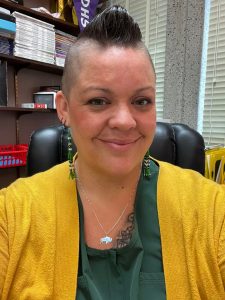
Changemaker: Briggs sees her roles online and in the classroom as different
by Lexi Lynn | Posted October 10, 2025
Professor Briggs. Photo by Leslie Layton.
This story by contributor Lexi Lynn is part of ChicoSol’s Changemaker series.
As Chico State students slowly trickle into Lindsay Briggs’ classroom, a Whitney Houston song plays on the overhead speaker, filling the room with the bubbly lyrics of an ’80s hit. A few students first make their way to the front of the classroom to snag a colorful mask from the front table, free to whomever feels inclined to take one.
A colorful slideshow is pulled up on dual projector screens, the initial slide filled with attention-grabbing graphics and memes. Students pull out their computers as Briggs fades out the ’80s music ambiance and begins the day’s lecture on mental health disorders. read more
Changemaker: Under Sue Barlow's leadership, the nonprofit grows
by Yucheng Tang | Posted April 28, 2025
photo by Yucheng Tang
Butte County Special Olympics Area Director Sue Barlow
This is ChicoSol’s fourth monthly profile in our Changemaker series.
Reneé Anchordoguy was just 10 when her older sister, Sue Barlow, took her to the state-level Special Olympics at University of California, Los Angeles.
During a race, Anchordoguy was running alongside a friend who began to slow and fall behind. Instead of pushing ahead, Anchordoguy also slowed down, reached out, took her friend’s hand — and together, they crossed the finish line.
“That’s my biggest memory of that one thing,” Barlow said, “about all the friendship they have.” Barlow remembered that after attending the Special Olympics, her introverted little sister with Down syndrome became more outgoing and confident.
That incident also changed Barlow’s life, perhaps no less than it changed Anchordoguy’s.
Barlow is now the area director of Special Olympics Butte County, a nonprofit organization working to help athletes with special needs build community, friendships and healthy lives. Under her direction, the organization has increased the number of athletes served by more than 30 percent in the past few years.
Barlow likes to give credit to her dedicated parent-volunteers and co-workers, but they say Barlow has provided the organizational attention that Special Olympics Butte County needed to survive, grow and become more inclusive.
In view of funding cuts underway to services for disabled students, the Special Olympics advocacy voice will become increasingly important, said Debbie Roth, a former area director who founded the Butte County organization’s swim team.
In the years following the UCLA games, Barlow, who was 18 years older, accompanied Anchordoguy to many Special Olympics events, even after Anchordoguy turned 20 and moved to Arizona. Barlow flew to Arizona now and then to take her sister to events. “I’ve always been very involved with whatever Reneé wanted and needed. I loved her dearly,” Barlow said of her late sister.
After retiring, Barlow moved to Arizona from the Bay Area to provide full-time care for Anchordoguy. There, Barlow and her husband started bocce ball, basketball and other sports for a local Special Olympics organization. Anchordoguy developed a strong interest in bocce ball and went all the way to the national games.
When their mother passed away 11 years ago, they moved back to California where there were more relatives who could help take care of Anchordoguy. But Barlow couldn’t find a place for Anchordoguy to play professional bocce ball — Anchordoguy’s greatest source of joy.
So Barlow founded bocce ball teams for Special Olympics Butte County, ensuring her sister could play again.
Special Olympics Butte County is part of Special Olympics Northern California, a non-profit that provides free year-round training and programs for children and adults with disabilities. Butte offers training and competitions in seven sports for athletes, including basketball, bocce ball, swimming, golf and more.
The youngest athlete in the Butte County organization is 6 years old and the oldest is 72.
On a recent Sunday morning, some 20 athletes gathered on the track and field at Chico High School, playing bocce ball and running.
Barlow, who will turn 80 next month, wearing sunglasses and a green uniform, walked around checking on every detail. She remembered every parent’s and every athlete’s name. “Have you figured out the transportation for the regional competitions?” she asked the mother of an athlete.
“If you feel uncomfortable while running, just stop and let us know,” she told a new athlete whom she thought might not be fit enough for a long run.
“They feel like they are important, people respect them, people admire them …” – Diane White
One of the parents on the field was 80-year-old Diane White. She was there for her daughter Thea Beckett, who was slow to develop when she was younger.
“Sue works very hard for everyone, for all the athletes. That’s where her heart is,” White said, adding that Barlow is the backbone of the organization.
White said the Special Olympics means everything to her daughter and other athletes. “They feel like they are important, they have a purpose, people respect them, people admire them, people look up to them,” she said. “They didn’t have that much without the Special Olympics.”
Back in high school, Thea was always picked on and made fun of, White said.
Tina Collins, a parent and volunteer coach, told ChicoSol that since Barlow became the area director, the organization has become more inclusive.
“Athletes that don’t have a disability but cannot do regular sports are also welcome here,” Collins said. “My kid can’t do regular sports because she has a heart issue and a foot issue. And she can’t run very long. So this allows her to feel normal and play normal sports.
“They used to be more for people who had obvious disabilities, but now it includes any kind of physical, mental, emotional disability.”
Collins said Barlow is “very organized and cares a lot about her Special Olympics families.”
“We are also a health organization … it’s not only about the sport” — Sue Barlow
Barlow worked as a senior director of worldwide operations for a disc drive company before retirement, and she needed to schedule the operations of five factories in different time zones. She believes that work trained her to be good at juggling, coordinating and focusing on detail, which helps her lead Special Olympics Butte County.
Barlow listed a couple of things on her plate: She needs to have a facility set up, have the insurance for the facilities, prepare the budgets, ensure that the athletes are eligible and the volunteers cleared, and order uniforms for the competitions.
Marvin Pratt, head coach of bocce ball, thinks of Barlow as a miracle.
“She dedicates so much time and hard work to this,” Pratt said. “Since she took over, she has worked really hard to rebuild the formal relationship with Northern California Special Olympics, to build the established routine for all of us to be able to volunteer, get the schedules out early, get the coaches lined up, make sure the equipment is ready to go.
“She made Butte County’s program really blossom.”
When Barlow first mentioned her idea to start bocce ball for the organization, Pratt, who was a basketball coach at the time, asked: “What’s bocce ball?”
But now, Pratt works as the head coach for the bocce teams and advocates for the sport. He discovered that bocce ball is a good sport for disabled people because the athletes don’t need to be the fastest or strongest. “It’s all about finesse. It’s all about strategy and collaboration,” Pratt noted.
Since Barlow took over the organization, the number of athletes has increased to around 150 from 110. But Barlow wants to attract more people with special needs to join the organization. She plans to set up booths at Chico High and other schools to promote the organization.
“We are also a health organization,” Barlow said. “We try to get a lot of these athletes out to exercise regularly and eat right. It’s not only about the sport, but also about exercise and health.”
Fundraising is always challenging. The most difficult part, in Barlow’s opinion, is “to find long-term donors who can donate a certain amount of money consistently.”
“There’s a lot of things that are going on in this small town,” Barlow observed. “There are a lot of organizations that do fundraising. We’re always in the bucket, always in line for the money, with all the other organizations (competing with us).”
Meanwhile, the operating costs increase. For example, renting the pool for swim training costs $1,200 this year and is set to rise to $1,500 next year. Transportation is another major expense, as they must regularly secure vehicles to take athletes to regional competitions.
They started the annual bocce ball fundraiser that provides an opportunity to sponsor teams. All registration fees go to the organization. The organization raised $11,000 in 2024, but Barlow said they need at least $18,000 for the annual budget.
Last year, Anchordoguy passed away following the collapse of her health. Barlow “struggled” after her sister’s death, feeling like she “lost the best friend” in her life.
When Anchordoguy was alive, Barlow said she felt happy every day knowing that “Reneé will take me somewhere and have some fun today.”
Anchordoguy liked to say “Hi” to everyone she met. “She couldn’t pronounce her family name, so she would just say ‘Hi I am Reneé A,’” Barlow recalled. “She had tons of friends,” Barlow added. “Everywhere we went, people would say, ‘Hey, Reneé,’ and I’d just stand there. I was only Reneé’s sister.”
Barlow remembered there was an athlete who could not bend over to lift up the bocce ball. As her partner, Anchordoguy patiently lifted the ball and handed it to her so that she could make a successfull play.
“She was just so sweet,” Barlow said. “She taught me the love of life.”
To honor her sister, Barlow sponsored a bocce team for the fundraiser, bringing together four of Anchordoguy’s friends to form a team called “Reneé Buddies.”
Barlow’s work keeps her sister’s spirit alive. When Barlow watches the athletes practice on the track and field, she thinks of Anchordoguy and says she feels her sister’s presence.
Tax deductible donations can be made to Special Olympics Butte County (77 Talon Drive, Chico, CA 95973).
ChicoSol’s Changemaker series features people whose work benefits or brings together the community. Read our March profile here. Suggestions for people who could be profiled can be submitted to chicosolnews@gmail.com
Yucheng Tang is a California Local News fellow reporting for ChicoSol.