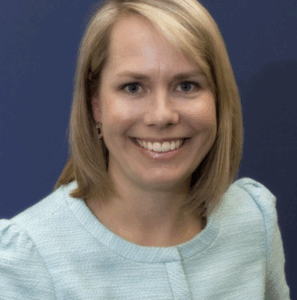
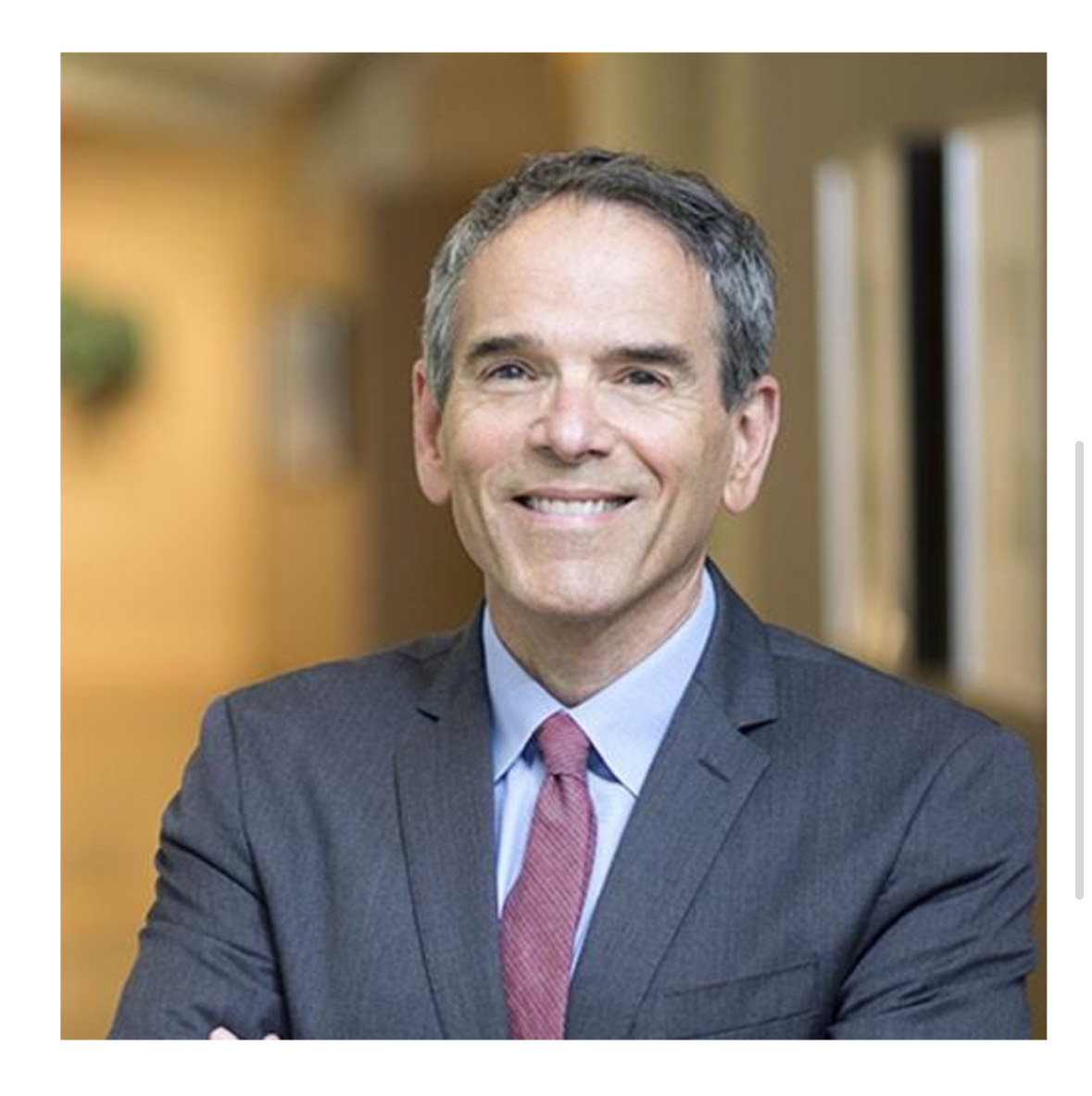
Attorney Weibel: People like Padilla may fear seeking help. Photo courtesy of ACoM.
For abuse survivors like Juana Padilla, nonprofit organizations can be a lifeline amid heightened threats of federal enforcement actions which sometimes lead to deportation.
Padilla, a woman who suffered domestic abuse in Southern California, told a recent American Community Media (ACoM) panel that the Survivor Justice Center in Los Angeles helped her get protection for herself and her Mexican-born children. The children are now here legally and getting the treatment they needed, she said.read more
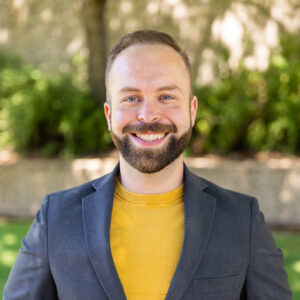
Butte College Public Relations Officer Christian Gutierrez.
California’s universities and colleges are the front lines for migrant students who seek support and a pathway to higher education.
Higher education institutions tout California’s Dream Act Application (CADAA) as a lifeline — as pressure grows to protect immigrants in California amid a sweeping and forceful immigration crackdown.
In a recent briefing hosted by American Community Media, panelists shared how students can, under the California Dream Act of 2011, apply for and receive Cal Grants and the California College Promise Grant at community colleges, as well as institutional and state aid at California colleges and universities.read more
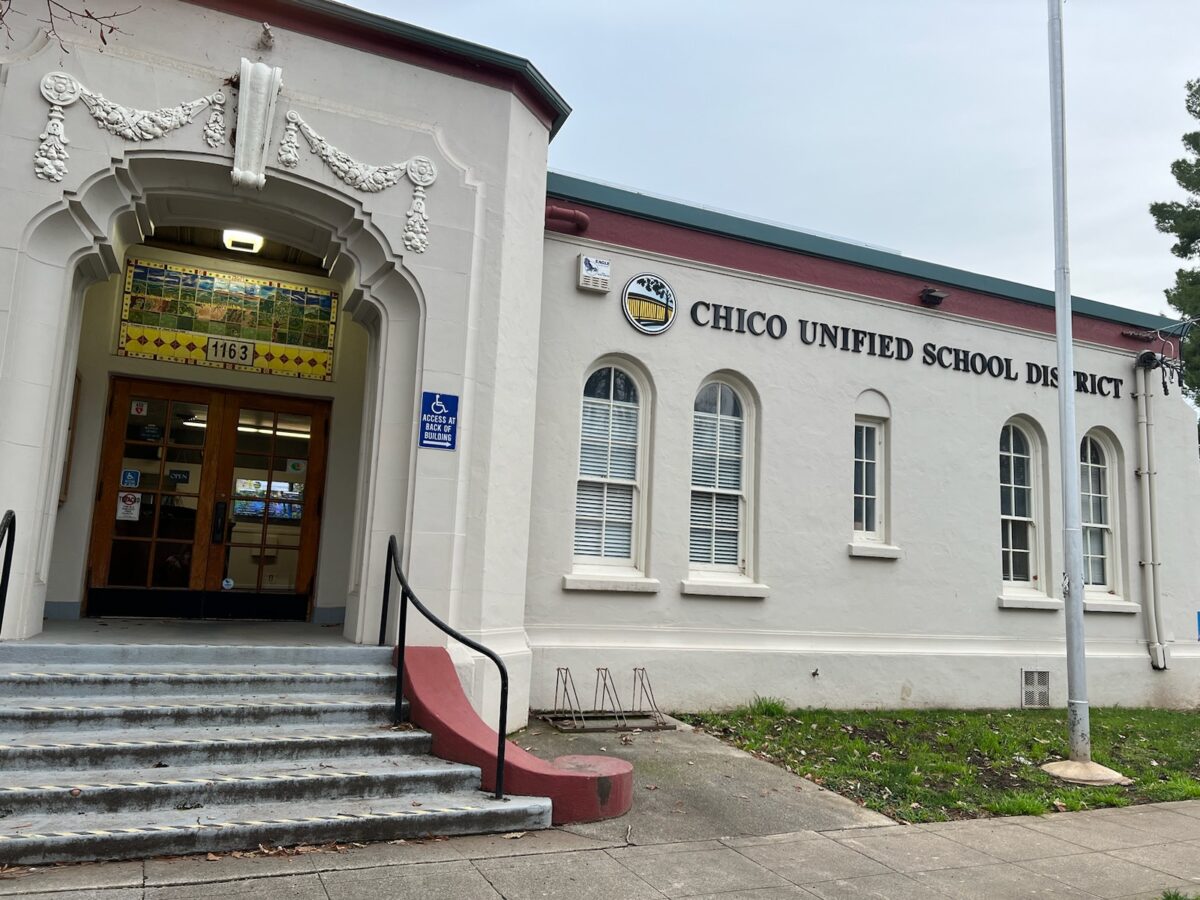
Chico Unified officials say more than $80 million in taxpayer-approved funds is getting used to address long-known problems at aging schools.
The district is updating or rebuilding most elementary schools, two middle schools and, eventually, both high schools.
Several elementary schools are getting new transitional kindergarten classrooms to prepare for the launch of a new state-mandated TK program for 4-year-olds at the start of the new school year Aug. 19. Those schools are Little Chico Creek, Marigold and Emma Wilson elementaries, and the funding comes from the Measure K bond issue.read more
The Ninth Circuit Court of Appeals has given new life to a lawsuit against Chico Unified School District that was filed in response to its policy that shaped the handling of a gender identity case.
The higher court in April said that U.S. Eastern District Court Judge John Mendez erred in dismissing a lawsuit filed by Chico parent Aurora Regino. Mendez said Regino didn’t have the legal foundation to pursue a claim opposing the district’s anti-discrimination and student privacy policy. read more
Immigrant advocacy organizations are racing to block the Trump Administration’s attempts to enforce the campaign promise of “mass deportations” that could potentially affect millions of people.
But in the North State, many people live far away from immigration attorneys who could help them with their existing cases or new threats from ICE, said Chico attorney Sergio Garcia, who practices personal injury law, and in 2014, became the nation’s first undocumented person to obtain a law license. Garcia is now an American citizen.
Garcia regularly directs immigrants needing legal help to attorneys practicing in Sacramento.
In recent weeks, the federal government has revoked green cards and student visas — sometimes because of political views — and is pressuring the IRS to provide tax information that will help detain and deport people.
Legal experts joined an American Community Media panel March 28 to explain how the administration, through these actions, has circumvented due process – particularly by deporting hundreds of people to detention centers in Panama or El Savador.
Zenobia Lai, executive director of Houston Immigration Legal Services Collaborative, said there are two approaches within the administration’s strategy. The administration has first focused on “let no one in” — making the border crossing process more difficult, for one — and then moving to “kick everyone out,” she said.
“The process begins with (accusing people) of an unlawful presence, denying birthright citizenship and then shutting the door behind people … by creating a situation where young people are also denied a future after removal of the older generations,” Lai said.
Todd Schulte, president of FWD.us, a bipartisan political organization focused on immigration and criminal justice reform using the FWD.us Education Fund, said Trump will not stop expanding the definition of who he determines cannot live in America.
Schulte said the president will seek to remove people who secured legal entry from under many violent regimes, such as Ukrainians fleeing Russia’s invasion of their country and people fleeing Afghanistan under the Taliban regime. That will exacerbate pressure at the border and in the overwhelmed court system, he said.
“We heard so much during the campaign — to go back nine and a half years — about Mexicans and Muslims. We’ve seen an effort to expand this effort of criminalizing folks,” Schulte said.
David Leopold, former president and general counsel of the American Immigration Lawyers Association, emphasized how Trump’s use of the Alien Enemies Act is the first such example since the federal government employed it during World War II to incarcerate Japanese Americans in internment camps. He said the goal is to remove Venezuelans from America, establishing a dangerous “policy by rhetoric” practice to bypass the country’s well-established courtroom processes and rules protecting due process for immigrants.
“This is about due process, and taking all of these complicated laws together is an abridgement and an encroachment,” Leopold said.
He added: “A majority of people held in ICE jails and prisons are in privately operated facilities — many of these are in the South, and Louisiana has many of them.”
Garcia, the Chico attorney, emphasized how crucial Trump’s rhetoric has been to not only make people fearful, but embolden people who are prejudiced against migrants.
“The reality is that the rhetoric is frankly what’s most harmful because it emboldens others to no longer hide their racism,” Garcia said. “The fact remains (while) Trump has deported less people than Biden and Obama, what’s truly harmful are his terror tactics that affect the most vulnerable.
“In the end, his economic policies will sink us all,” Garcia added, “but I guess the philosophy of some is, ‘That’s ok as long as he gets rid of immigrants first.’”
Garcia was approved for his green card soon after coming to the United States, but then waited in the so-called “line” for the actual card for more than 20 years.
There are a few resources available for people living in rural Northern California. Chico State’s DREAM Center offers support for undocumented students and those from mixed-status immigrant families, including consultations with its immigration legal services provider, the Coalition for Humane Immigrant Rights (CHIRLA).
NorCal Resist – an immigrant advocacy organization – posts regularly about potential ICE raids in the Sacramento Valley.
“Please remember many people are terrified right now,” NorCal Resist said in an April 6 Facebook post. “Sharing unverified rumors causes harm and distress to people who we all care about. We will immediately post information once verified. If you are a student who has had a visa revocation you are also welcome to reach out to us for assistance connecting with legal and other resources.”
Natalie Hanson is a contributing editor at ChicoSol.
Chico’s Stonewall Alliance is pushing back against nationwide anti-trans rhetoric by bringing together allies and LGBTQ people to stand by their trans neighbors, culminating with a rally Sunday.
The nonprofit organization, which provides resources to LGBTQ people and their families, organized special programming throughout the last week of March, such as workshops and training sessions.
Executive Director Justina Sotelo led one of these sessions March 24, one of several workshops designed to train people on being bystanders prepared to handle escalating incidents where an LGBTQ person is targeted with threats or worse.
“This information will be helpful for all actions, rallies, protests, and daily situations we may find ourselves in as active allies to trans people and other marginalized communities,” Sotelo told a group of nine attendees in a video workshop.
Sotelo, presenting several videos on responding to public incidents with a perpetrator and victim — or “target” of threats — emphasized the importance of managing one’s emotions and practicing self-awareness to de-escalate conflicts. She asked if anyone had witnessed a situation where a queer person was unsafe and felt unsure how to help, and several attendees said they had.
Sotelo presented a wide range of examples of disrespect toward queer people from name calling and “jokes,” to verbal harassment and doxxing. Speaking up can look different in various situations, from ignoring the perpetrator and speaking only to the victim, to directly confronting a perpetrator. The approach varies based on many factors, including the power dynamics and whether there’s a clear physical threat, she said.
“Follow the lead of the target,” Sotelo said. “Don’t make things worse.”
Several attendees said they’ve used the strategy of distracting a perpetrator, not always with success. Participant Florence Ives said they’re working on not being reactive and avoiding argument with perpetrators in order to help protect a victim or “target.”
“If you can’t get involved until the person leaves, then you wait, and then get involved with the target where they are at,” Ives said.
Sotelo said that sometimes intervention cannot take place immediately to protect a victim of harassment or threats. A bystander must carefully consider a victim’s safety, she said.
“This idea of keeping their safety in mind is best because we may not be the best to intervene,” Sotelo said. She added that when it comes to perpetrators who are willing to publicly attack an LGBTQ person, allies must remember that arguing is not helpful. “There’s a reality where we’re not going to change their minds.”
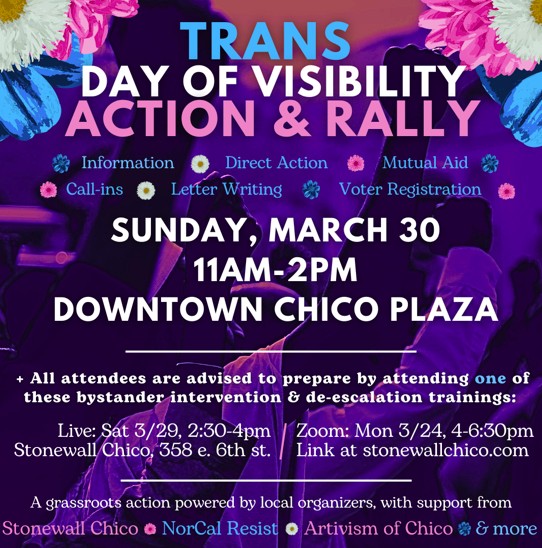
Stonewall Alliance has two events planned for the weekend, including a poster making event on Saturday. Attendees are encouraged to make signs to use for the following day’s rally supporting the trans community.
The rally, the Trans Day of Visibility Action, starts at 11 a.m. Sunday at City Plaza in downtown Chico. It’s slated to end at 2 p.m. and will include booths aimed at raising awareness about anti-trans boycotts, inclusive school-based and business policies, and letter-writing campaigns aimed at elected officials.
“The intention of this rally is to do more than just gather,” Stonewall Alliance said in a press release. “We’re also here to take real action on things that affect the lives of trans people and our whole community.”
Natalie Hanson is a contributing editor to ChicoSol.