

Domestic violence survivors face new barriers

Immigrants suffering partner abuse afraid to go to court
by Natalie Hanson | Posted September 26, 2025
Attorney Weibel: People like Padilla may fear seeking help. Photo courtesy of ACoM.

For abuse survivors like Juana Padilla, nonprofit organizations can be a lifeline amid heightened threats of federal enforcement actions which sometimes lead to deportation.

Padilla, a woman who suffered domestic abuse in Southern California, told a recent American Community Media (ACoM) panel that the Survivor Justice Center in Los Angeles helped her get protection for herself and her Mexican-born children. The children are now here legally and getting the treatment they needed, she said.

“I was afraid to even say that I was abused,” Padilla said. “Especially when your husband is ex-military and they put in your head that you have nobody. I would call the police and they would come to my house and see his uniform …. and say everything is fine, and leave.” read more

Ex-cop’s domestic violence charges dropped

Former Gridley officer convicted of animal cruelty for abusing dachshund
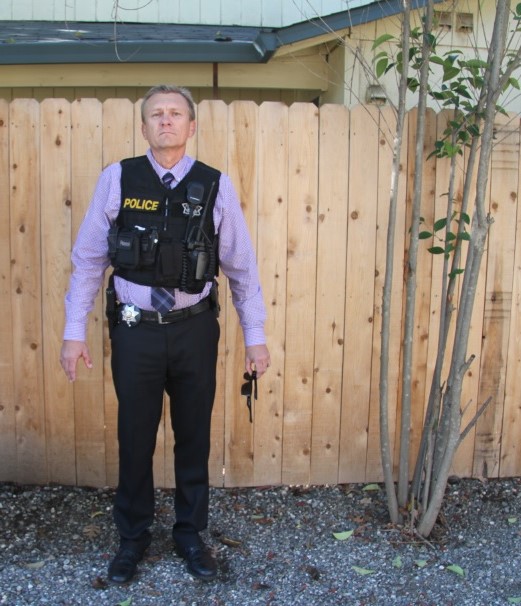
by Dave Waddell | Posted August 19, 2024

Devin Pasley

Felony domestic violence charges resulting from disturbing allegations against a former Gridley police officer were dropped because the alleged victim, herself a police officer, refused to testify.

However, the defendant, 31-year-old Devin Pasley, was convicted Aug. 7 of misdemeanor animal cruelty after a three-day trial in Butte County Superior Court. He is scheduled to be sentenced at 1:30 p.m. Aug. 29. Butte County District Attorney Mike Ramsey said the judge is expected to put Pasley on probation for three years.

At sentencing, “we will be asking that the current temporary domestic violence restraining order be extended through the three-year probationary period that we expect to be ordered,” Ramsey said. “Such a restraining order will prevent him from possessing firearms.”

Ramsey said the California Commission on Peace Officer Standards and Training, aka POST, would determine “whether such a conviction would prevent him from being a police officer” again. POST has the authority to decertify peace officers for serious misconduct.

“But frankly, since he was fired from Gridley Police Department and now has an animal abuse conviction, I don’t believe any future police agency will be hiring him,” said Ramsey.

Seth Stoughton, a law professor at the University of South Carolina and one of the nation’s foremost experts on police practices, is not so certain.

“Unless and until an officer is stripped of his certification, I think there’s a pretty good chance that he’ll be able to find another job as an officer,” Stoughton said. “Statistically, it will likely be with a smaller, less well-funded agency that does not pay as well; those agencies are too often in such desperate need of manpower that they either do not do background checks or are willing to overlook what you’d think would be disqualifying factors.”

Pasley was arrested at Gridley PD in May 2022 after his domestic partner reported 15 alleged abusive incidents over the previous 13 months. She described each incident in notes on her cell phone shortly after it occurred, according to Chico police. The woman was pregnant during much of that time with their son. She told investigators Pasley restrained her in various police holds, including the “twist-lock,” the “C-clamp,” and the “carotid control position.” She described being slammed and pinned on several occasions and in various ways, according to police reports.

Ramsey said that unlike with the domestic violence (DV) charges, the alleged victim could be made to testify against her will about Pasley’s abuse of her dog, named “Weenie Dog.”

“We proved the case through a cell phone video taken by the reluctant victim and that ‘victim’s’ testimony,” Ramsey wrote in an email response to questions about the Pasley verdict. “The DV victim, during one of the several DV incidents between her and the defendant, used her cell phone to film an incident where the defendant had picked up her Dachshund dog with one hand around its neck and the other hand on a large kitchen knife moving toward the dog’s neck. (It was not the first time he had choked or abused the dog during DV incidents.)

“Prior to trial, we had to dismiss the DV charges against the female victim, because we could not, under the law, force a DV victim testify in a DV case, and only she could give the necessary testimony/evidence against the defendant to sustain the DV charges.

“However, once the DV charges were dismissed, the judge ruled the case was no longer a DV case, and the victim was no longer a DV victim who could refuse to testify. Therefore we could force her to testify as a regular witness to dog abuse and introduce the cell phone video she had taken. She did try in her testimony to minimize and excuse the defendant’s actions shown in the cell phone video, but the jury didn’t buy it, and used the video to convict the defendant.”

Pasley’s attorney, Kevin W. Harris of Sacramento, did not respond to a request for comment on the case.

A case management conference is scheduled in Superior Court for Sept. 18 on Pasley’s petition for the return of his personal weapons, which were confiscated by Chico PD when he was arrested. The weapons include a shotgun, an assault rifle, three semi-automatic handguns, a revolver, and brass knuckles.

“City of Chico alleges that they seek to take his guns to prevent him from having guns around the alleged victim,” says that petition, filed in September 2022, four months after Pasley’s arrest. “However, there is a distinct possibility that [Pasley] and the Victim would reconcile. Since the alleged victim is a Police Officer she would have guns in their home also. The proposed order in this case is a clear attempt to sever the domestic relations between his significant other as well as his son. This is an overreach of State Power.”

Stoughton, the expert on police practices, was asked how the alleged victim’s employer, a local police agency, should view her refusal to testify about the purported crimes she had reported to law enforcement.

“Oh, that’s a hard question,” Stoughton said. “I wouldn’t expect an agency to have a lot
of patience for an officer hiding or facilitating another officer’s crime, but victims are a different story. The victim’s rights movement has for decades fought to get police agencies to be more respectful of victims’ wishes, including the desire to not cooperate with an investigation or prosecution. I think most agencies would be reluctant to push a victim, even if that was an officer, to assist in ways that they did not want to.”

Dave Waddell is a contributing writer to ChicoSol on criminal justice issues.

Sanchez’s killer accused of abusing wife

Physical, verbal assaults claimed during separation
by Dave Waddell | Posted May 11, 2022

from Chico PD video
Mark Bass

Seven years before killing Eddie Gabriel “Gabe” Sanchez, Chico cop Mark Bass was accused by his wife, Barbara Reed-Bass, of assaulting her physically and verbally during a turbulent separation prior to their divorce.

In a Butte County Superior Court declaration, Reed-Bass also reported allegations that Bass had shot his gun while drunk and in distress late on New Year’s Eve 2008, leading to an involuntary mental health hold.

The domestic violence claims made by Reed-Bass, detailed in Superior Court files, concerned several incidents in 2008. Sanchez, an armed robbery suspect, was shot to death by Bass while fleeing on Nov. 10, 2015. Bass was a Chico PD detective at the time and later promoted to sergeant.

The abuse allegations against Bass surfaced after Gabe Sanchez’s father, Eddie Sanchez of Paradise, hired a private investigator while suing the City of Chico. Eddie Sanchez said a domestic violence restraining order would likely have been sought against Bass had he not been a police officer. Such an order would probably have cost Bass his job, Sanchez said, and “my boy would still be alive.”

On April 21, 2008, Reed-Bass declared, Bass showed up at her residence “unexpected and uninvited” and became “enraged” while demanding to know who she had been talking to on the phone. Bass, his estranged wife claimed, “grabbed me and threw me against the (dining) room wall and I fell to the ground. He then came over and began pulling my hair and thrusting my head into the laminate floor several times. I was able to get up. (Bass) was still very angry and pushed me down again. He kneeled down and pushed my head into the floor and began pulling my hair. Our six-year-old son walked in and saw what was happening and started screaming ‘mommy, mommy.’ … (Bass) called the next night and told me to be careful who I told about the incident because ‘the children’s well-being depends on his livelihood.’”

Seven days after that incident, Reed-Bass’s divorce attorney, Randy Bakke, wrote a letter to a lawyer representing Bass seeking a “verbal acknowledgement that you have spoken with Mr. Bass and that you are confident that Mrs. Bass has nothing to be fearful of as we proceed in this matter.”

Wrote attorney Bakke: “Mr. Bass physically assaulted Mrs. Bass in the family residence. The minor children witnessed a portion of this attack. This type of behavior could very easily cost Mr. Bass his job and his career in law enforcement. I have advised Mrs. Bass to seek a Domestic Violence Restraining Order. She has declined to do so because she understands the detrimental effect such an order would have on Mr. Bass’ career. However, she will not tolerate any further abuse.”

Bakke also wrote that he had “no doubt that Mr. Bass will deny the incident or attempt to trivialize it.”

On May 12, about two weeks after Bakke sent the letter to Bass’ attorney, Reed-Bass claimed she “awoke at 5:50 a.m. to find (Bass) in my home, standing over my bed. He left when I asked him, … but he came back unannounced and uninvited at 9 p.m. … He cornered me in my bedroom and locked the door behind him. He began calling me foul names and he grabbed me. I looked toward the locked bedroom door and I could see the fingers of our youngest son … coming under the door. He was trying to get to me. I told (Bass) I need to get out of the room. He threw me into the dresser. … I left the room and went to the living room and sat on the couch with the boys. (Bass) … began yelling at me … The children were terrified.”

On August 5, Reed-Bass claimed, Bass called her at work and cussed her out. Later that day, during a conversation behind the bleachers at their son’s football practice, (Bass’) “anger got the best of him and he began insulting me. I turned to leave and (Bass) grabbed me and ripped me around. He was yelling at me and calling me every filthy name he could think of including the ‘C word,’ ‘slut’ and ‘whore’ and others.”

Reed-Bass acknowledged to the court that on “each of those occasions, I chose to ‘protect’ (Bass) and chose not to seek a restraining order against him because (Bass) told me he would lose his job as a police officer if a domestic violence restraining order was issued against him.” Reed-Bass wrote that she was “soundly criticized” by the court mediator at trial “for not taking action after I was physically abused.”

The abusive incidents in 2008 aside, Reed-Bass described Bass as “an excellent father” to their two sons. Bass declared under oath in court filings that he never abused Reed-Bass but that she had struck him in the head three times during their marriage.

Seth Stoughton, a nationally recognized authority on police practices, said officers are not automatically fired because of a domestic violence restraining order.

“An injunction (or restraint order) wouldn’t necessarily prevent the officer from working, but it *can,*” Stoughton wrote in an email reply to questions. “Some domestic violence injunctions will prohibit the possession of firearms, which obviously prevents an officer from working while armed. An agency might try to put the officer in a position where they can work without being armed, but agencies could also suspend or terminate the officer. Note that is an administrative decision, not a legal requirement.”

In early 2009, Reed-Bass again wrote to Superior Court after learning of “a very serious and disturbing incident. … I am informed and believe and thereon allege that on New Year’s Eve … (Bass) and his girlfriend got into a heated argument. (Bass) was drunk and sometime during the course of their argument his gun discharged. I am further informed and believe that during this incident, (Bass) was threatening suicide (and his) girlfriend called the Chico Police Department and (Bass) was ‘51/50’d.’ I am further informed … that (Bass) has been placed on administrative leave.”

(“51-50” has become shorthand for a California law that allows for the temporary, involuntary psychiatric commitment of individuals who, due to signs of mental illness, present a danger to themselves or others.)

The police log of the incident, a copy of which Reed-Bass attached to her declaration, says a female who called 9-1-1 reported that a male at one point threw his gun. The log says that the male could be heard crying by the dispatcher.

Bass did not reply to requests for comment on Reed-Bass’ allegations.

However, in a Jan. 12, 2009, court filing addressing the New Year’s Eve incident, Bass wrote: “I do not normally drink. On this occasion I drank too much, and the alcohol reacted very badly with me. My girlfriend and I left the party. We were not arguing or fighting. Because I drank too much I do not have a recollection of all of the events of the evening. My understanding is that I expressed suicidal thoughts, though I do not remember doing so. I have not had suicidal thoughts previously or since. My girlfriend was concerned and called police. I was interviewed by a mental health (professional) who determined I was not a danger to myself or others, and I was cleared to leave. The incident was reported to my employer, the Chico Police Department … (which) is required under state law to put me on administrative leave because I had expressed suicidal thoughts. This will last until they can complete an investigation.”

Bass’ response to the court did not speak to any misuse of his gun.

Dave Waddell is a contributing writer to ChicoSol.