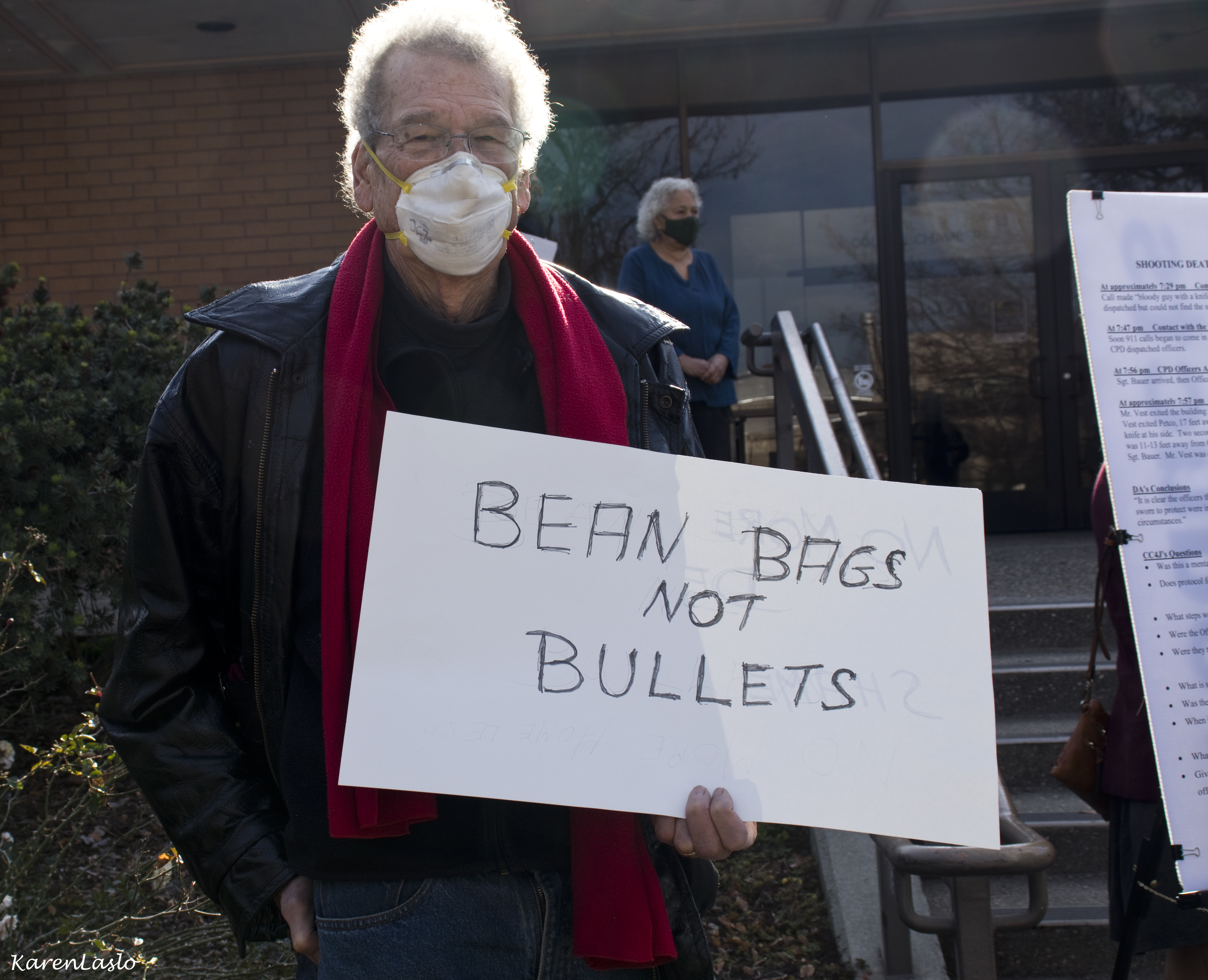
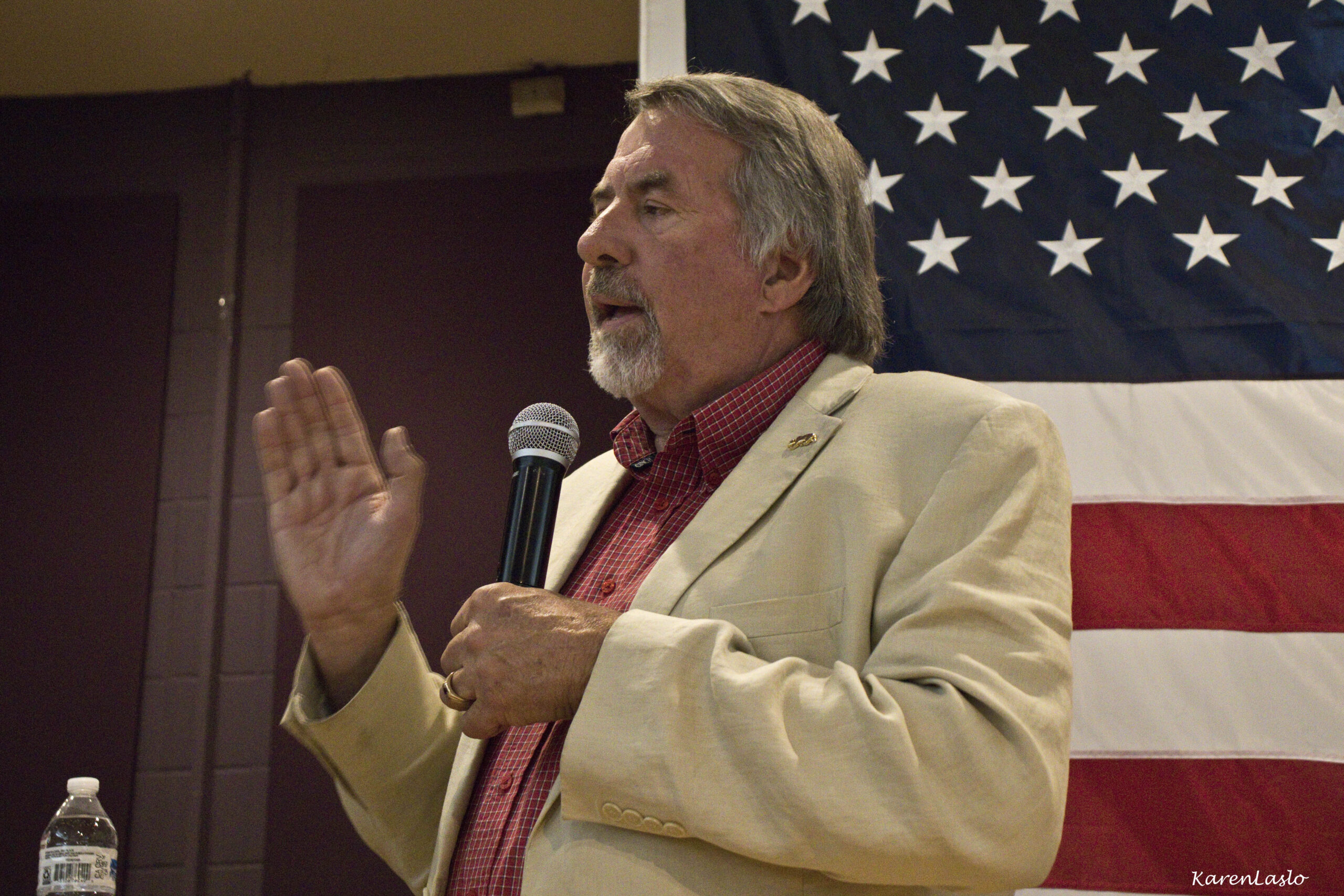
District 1 Congressman Doug LaMalfa starts the day early with a town hall in Chico. Photo courtesy of Karen Laslo.
At his first in-person town hall in eight years, District 1 Congressman Doug LaMalfa defended his support for the One Big Beautiful Act — as some members of his audience jeered and heckled him.
In fact, interruptions were relentless during the 90-minute town hall that began at 7:30 a.m. at Chico’s Elks Lodge. Despite the early hour, the meeting room filled quickly with 600 people with no seats left.
LaMalfa responded to a question about possible cuts to Medicaid. “When we’re talking about the people that really do need it and are eligible under the program, they’re not being cut,” the congressman said.
The so-called One Big Beautiful Bill, signed into law by President Trump on July 4, was promoted by the White House as a benefit to the working class. But some analysts say that the bill will slash federal funding for health care and food aid, largely by imposing work verification requirements on recipients and shifting cost burdens onto states.read more
Federal workers brace for downsizing; infrastructure cutbacks will affect District 1
by ChicoSol staff | Posted March 25, 2025
photo by Karen Laslo
Lyndall Ellingson
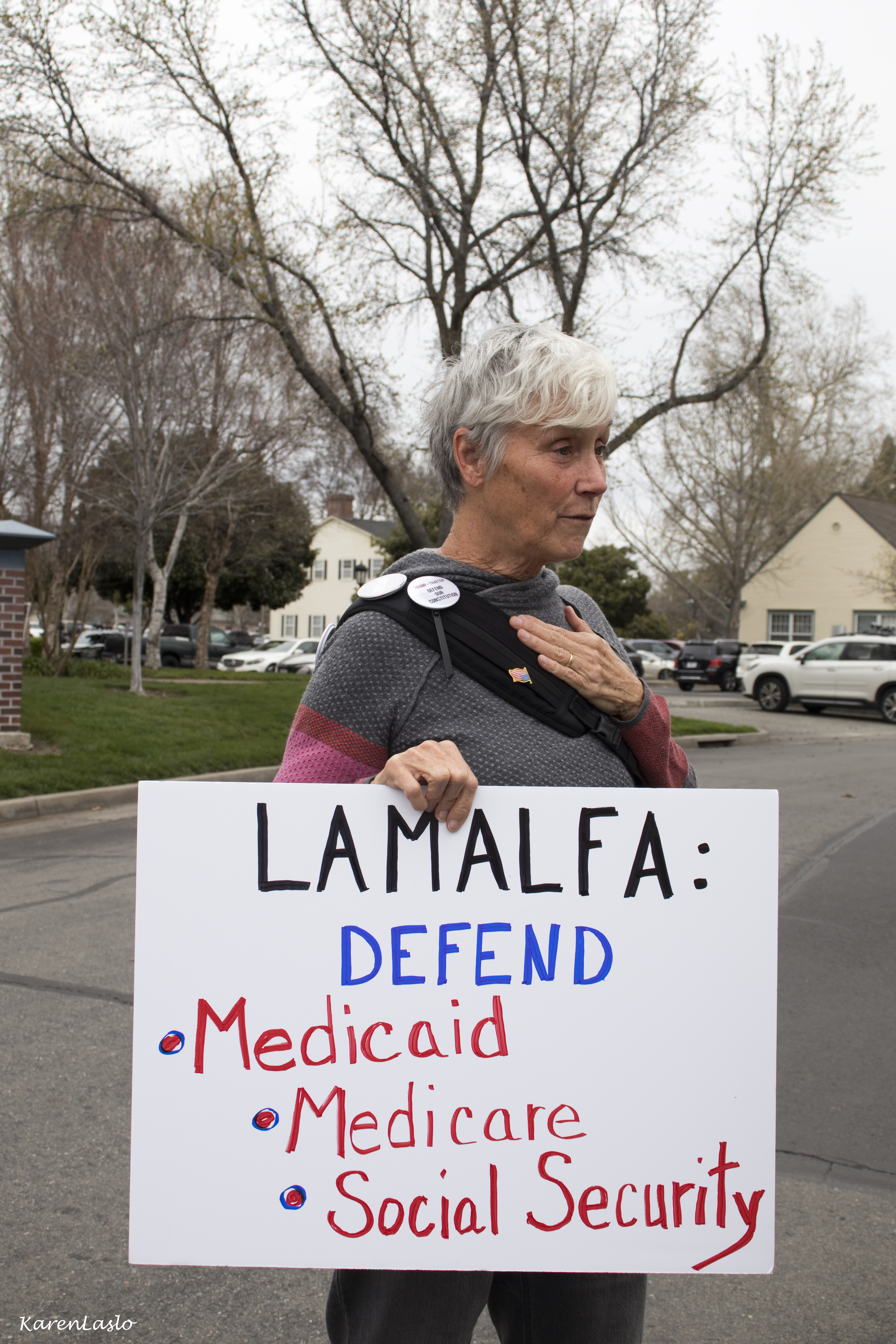
More than 200 people attended a weekly protest near 1st District Rep. Doug LaMalfa’s Chico office on March 21, demanding in-person town halls that haven’t taken place since 2017 and urging the Republican congressman to defend federal programs threatened with huge funding cutbacks.
The turnout was more than twice that of the protest a week earlier. Some passing cars honked in response to show support. There were few young people participating in what has been dubbed in some social media posts as the #FindLaMalfa protest, and has been organized by a coalition of activists from several groups.
(LaMalfa has since announced a “telephone town hall” to be held at 6 p.m. March 26. His office has told reporters that a phone conversation with the congressman will be open to registered voters with valid phone numbers in Butte, Glenn, Yuba, Sutter and Colusa counties, but there will be no call-in.)
Lyndall Ellingson, 66, a retired public health professor at Chico State, joined the protest to “demand that our elected representative Doug LaMalfa have a town hall [and] listen to his constituents about defending Medicaid, Medicare and Social Security.”
The Social Security Administration has said it will close some regional offices, cut positions and eliminate a system that allowed beneficiaries and applicants the chance to prove their identity by phone. As of March 31, it will be necessary to apply online or report to a local office.
In a March 23 interview with Chico’s Enterprise-Record, the congressman addressed reports there will be cuts to services and/or benefits. “It’s all nonsense,” he told the ER.
“…there is no Medicaid cuts. There is no Social Security cuts. There is no cuts to the VA system; the employee stuff, we’ve still got more work to do with that.”
But Ellingson said that although the funding for Social Security benefits has not yet been touched, the infrastructure that makes it possible for many recipients to apply and receive guidance is being undermined.
“They’ve shut down phone service, so people can no longer talk to a phone representative at Social Security about their benefits,” Ellingson said. “So that means if you can’t get through online — it could be your system, it could be your weak WiFi, it could be that you’re an elder and you’re not very digitally skilled — you have to actually go into an office — but they’re closing down the offices.”
Possible cuts to Medicaid worrisome
Ellingson also mentioned the controversial budget resolution recently passed by the House with LaMalfa’s vote in favor. It includes a proposed $880-billion cut in spending over the next 10 years.
Such a deep cut to spending by the committee that oversees Medicaid, analysts say, would impact that program, which provides health insurance to disabled and low-income people. In California, that program is known as Medi-Cal and covers more than one-third of the state’s population.
In a statement on his website, LaMalfa says: “This budget resolution is a critical step toward restoring fiscal responsibility and reining in Washington’s out-of-control spending.”
“The magnitude of the cuts is just extraordinary, and nothing in American history has been remotely this size,” said Stan Dorn, director of the Health Policy Project at UnidosUS, a Hispanic civil rights and advocacy organization, at a briefing hosted by Ethnic Media Services. “The closest previous cut … in 1981 … resulted in a 13% drop in Medicaid enrollment, and that would translate into a 9 million person loss today.”
Dorn said people of all races and ethnicities will be at risk, but “communities of color are especially vulnerable.” Over 20 million Latinos and 13 million African Americans have Medicaid as their source of health insurance today, he said.
“That includes almost 60% of all Black children, and more than one-third of all African American adults aged 65 and older. So these are folks who rely on Medicaid for nursing home care. And if Medicaid gets cut, where will they be?”
Ellingson, the public health professor, said low-income groups in general are more vulnerable and susceptible to these kinds of federal funding cuts. The 1st congressional district has a poverty rate of slightly more than 15 percent.
Chico VA workers on edge
Reports that the Department of Veterans Affairs (VA) plans major staff cutbacks — AP reports that an internal memo discusses plans to cut some 80,000 positions — have staff on edge in Chico.
“Everybody’s on pins and needles — even our leadership,” a local VA staffer, who asked not to be identified, told ChicoSol in a telephone interview. The staffer said she is less than two years from retirement and didn’t want to jeopardize her position by being identified in a news story. “We’re all pretty stressed out, and we all work beyond 40 hours a week.”
Some VA staffers working remotely have been ordered to return working at their workplaces by May 5, she said, but the Chico locale is already short on office space. They’ve been asked to send weekly emails explaining what they’ve accomplished. Some are “wondering if it’s worth working for the federal government,” she said.
“I believe we do really good work,” she said, “and people who don’t wash out, they don’t last. All of us are worried about our veterans, and we deal with many high-risk veterans.”
At Friday’s protest, Chico’s Margret Valdes, 56, focused on the Department of Government Efficiency (DOGE).
“I’m deeply upset and saddened and angry about the sweeping attack against our federal agencies in terms of all of the layoffs and firings and quote unquote reduction,” Valdes said.
“If we’re saving money, if we’re supposedly taking bloat out of the government, then we should be able to see an itemized tally list as to where these monies are going to be going and what services that they would be providing for the citizens.”
Valdes said her 88-year-old mother is not capable of getting on the internet to “figure out Social Security.” Instead, she wants to make a phone call to someone or visit the office to ask relevant questions. “When they start shutting down the infrastructure that would allow these services to flow effectively, then it’s effectively cutting Social Security,” Valdes said.
Valdes hopes LaMalfa can address issues “that are going to make an everyday impact on people’s lives.”
“That is why we would need a town hall so that we could voice our concerns,” Valdes said. “As we’ve seen in town halls across the country, when representatives have to face listening to what people really have to say, it’s pretty undeniable that what they’re trying to purport is the truth, or not.”
ChicoSol reached out to LaMalfa’s office for comment on whether an in-person town hall is in the works, and for a response to protesters, but the congressman couldn’t be reached by deadline.
Protest organizers say they’ll continue to congregate between 11 a.m. and 12 p.m. every Friday near LaMalfa’s Chico office at 20 Independence Circle.
Homelessness, de-escalation and diversity discussed
by Leslie Layton | Posted May 2, 2024
photo by Leslie Layton
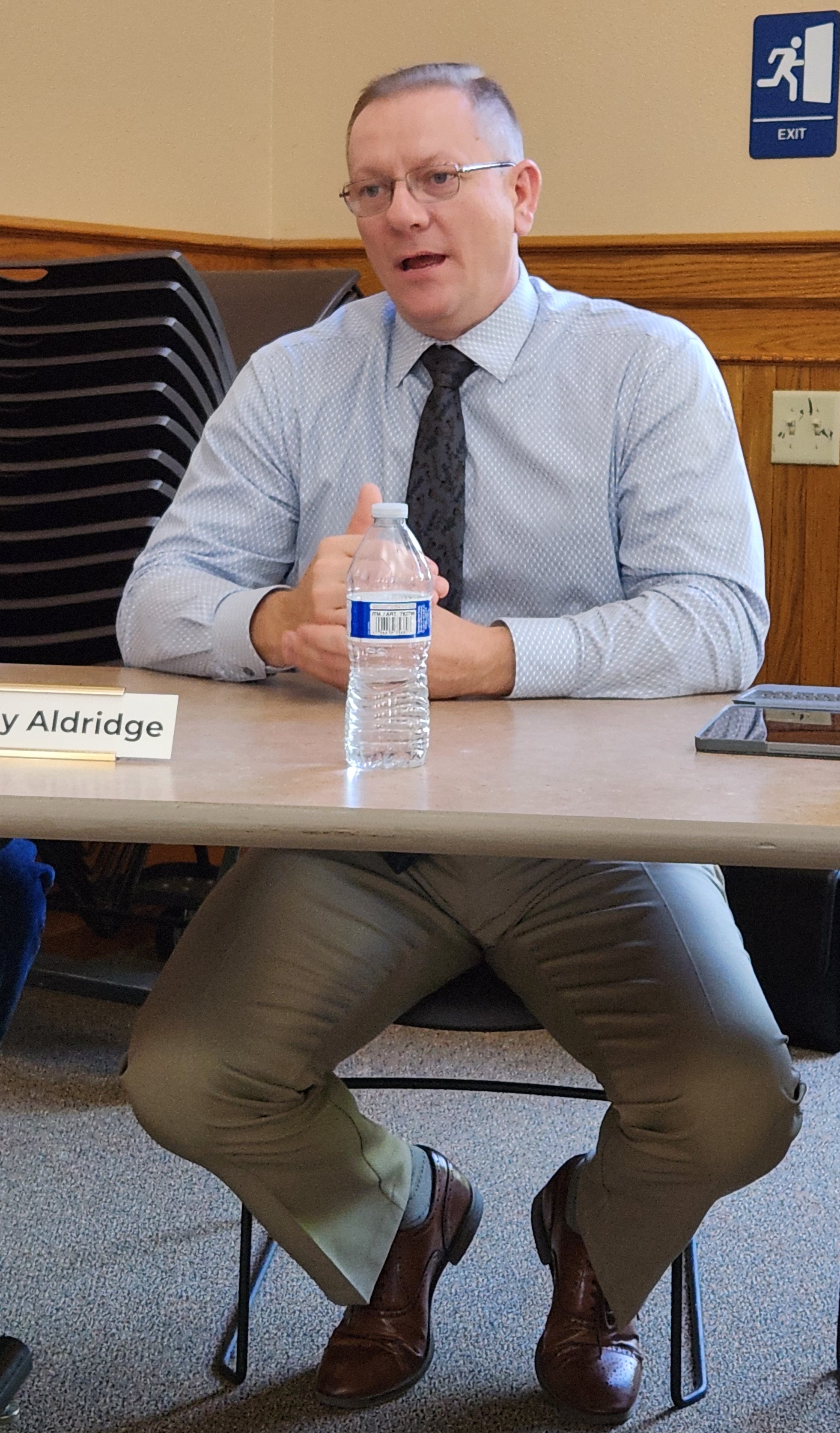
Chief Billy Aldridge at Chico PD’s first town hall.
In the first of two town halls to be held this year, Chico police addressed topics that emerged from the recent Community Survey as concerns, including homelessness and the department’s use of de-escalation techniques.
The May 1 town hall followed the recent release of results from the department’s Community Survey that received 797 responses from Chico-area residents. Most of the respondents were over 50 years old and a disproportionate number white. Almost 60 percent said the unhoused community was a major concern.
The new Police Community Advisory Board and Chief Billy Aldridge sat in a row facing an audience of about 20 people. Both the chief and board Chair Roger Efremsky said the public needs to better understand that officers can only remove pop-up homeless encampments under the parameters set by the Warren v. Chico lawsuit settlement.
Chico’s Robin Keehn asked whether a campground where unhoused people could stay would help officers as they move to dislodge campers from City streets.
Aldridge said another location where people could be referred would in fact help, but stressed that it would not be an “overnight fix” because the settlement doesn’t allow spontaneous and immediate police response.
“Would it certainly help us to have more locations? Yeah it would,” Aldridge said. “When we have a process that we’re mandated to follow, though, it doesn’t matter what we have out there. Even if we have the North State Shelter Team running a managed campground, we would still have to follow the orders of the settlement agreement as it’s currently stipulated.”
Another matter emerging in the survey was that of de-escalation; about 50% of respondents neither agreed or disagreed when asked if officers chose to de-escalate “contentious situations.”
About 36% agreed that officers de-escalate, and 14% disagreed.
Asked by this reporter for a response, the chief indicated it was a matter of better informing the public about the rigorous training in de-escalation he says his officers undergo.
Police reform advocate George Gold wasn’t satisfied. He says Chico PD doesn’t adhere to the recommendations in its own policy manual in situations that should be de-escalated, instead relying on weaponry.
“Chico police and other departments as well are endeavoring to change the definition of de-escalation,” he told ChicoSol. “If you pull a gun, you’re not de-escalating. You’re saying, ‘I’ve got the solution to this problem and it’s in my hand.’”
Gold the panel: “There should be a commitment by every single officer to de-escalation and how to do it. I don’t believe we have that today.”
Butte County District Attorney Mike Ramsey spoke, defending Chico PD’s conduct in general and its commitment to de-escalation in particular.
That came as a disappointment to two members of the audience, Eddie and Sheryl Sanchez. Eddie Sanchez is the father of Eddie “Gabe” Sanchez, a 34-year-old man who was killed by Chico police in 2015.
Ramsey and speakers who defended Chico PD’s de-escalation record “really got me upset,” Sanchez said after the town hall.
Sanchez noted that he spoke with officers by phone before his son was fatally shot nine years ago. He told a sergeant, “I heard that you got my boy there, give me 20 minutes to get there, I’ll hand him over to you,” Sanchez recalled. “Twenty minutes later he got killed. To me that was not de-escalation.”
Respondents to the Community Survey listed violent crime and mental health crises as their two top concerns after homelessness.
Aldridge said many respondents want to see Chico PD increase budget and staffing to better respond to crime and traffic violations. He noted that the state has mandated 24/7 behavioral crisis intervention and that is now in place in the county.
Aldridge said the mobile crisis team is “utilized on a daily basis.” Citizens needing help with someone in crisis can now call the 9-8-8 Suicide and Crisis Lifeline.
Some in the audience wanted to know how, in a future survey, a more diverse audience could be reached.
Butte County NAACP President Janet Goodson suggested use of local churches.
At the close of the event, Sandra Knight, a board member who represents the Native American community, noted that because of inter-generational trauma and other issues, many members of the “Native community would not be comfortable coming into this room.”
Aldridge hopes that board members will help the department reach their respective communities. He promised that all material gathered by the survey will be released to the public.
Leslie Layton is editor of ChicoSol. Contributing Editor Natalie Hanson contributed to this story.
The Chico Police Department, after facing years of scrutiny over transparency and accountability concerns, has launched an effort to improve its community image.
Chico PD’s administration has within the last six months jump-started several efforts to improve its public image, announcing today the results of its Community Survey, which can be found here.
Chief Billy Aldridge, who assumed leadership in December 2022, has re-organized the department’s Police Community Advisory Board (PCAB) that the City says is “working to enhance communication and transparency.” The board’s formation follows years of pressure from community members who want improvement in the public’s ability to air concerns and grievances.
The board and Aldridge decided to first administer the survey, which closed April 20. A town hall will be held from 6 p.m. to 8 p.m. May 1 at 441 Main St. when an overview of survey results will be presented, said Chico PD spokesperson Kelly DeLeon. She said the department received “just under 800 responses” to the survey.
Some of the members of the police reform groups that have formed in recent years say these efforts are hopeful, but others are concerned about whether they will lead to the change they’d like to see in department policies.
Aldridge did not respond to multiple efforts by email and phone for comment on this story.
Aldridge’s new advisory board now has 10 members who were chosen to reflect the various communities, including people of color, business owners, and religious and faith. The board meets on the first Monday of the month in proceedings that are closed to the public and not subject to the Brown Act.
Board Chair Roger Efremsky said that the public survey was the first thing the board needed to get a broad sense of what people think of the department and what actions may need to be taken.
The department has long been troubled by accusations of a lack of transparency, stemming in part from fatal shootings involving Chico police officers, such as the 2017 killings of Tyler Rushing and Desmond Phillips.
PCAB and the police reform challenge
One of the new advisory board members, Julian Zener, has been working with police reform organization Concerned Community for Justice (CC4J). He told ChicoSol that he thinks that Aldridge is open to the state’s push for more progressive policies — such as increasing engagement with the community and following the law to train officers on de-escalation and use of force.
“The teeth probably come not from local activities as much as from the state,” Zener said. “The state has generated an avalanche of new laws over the last few years related to law enforcement. They ban chokeholds, they have restrictions on use of force, decertifying police, upping the age of new hires.”
Those policies take time to implement and start with local leaders, he said.
Zener pointed out that the Advisory Board is not an oversight commission like some cities in California have. Those commissions hold meetings that are generally open to the public and subject to the Brown Act.
“It’s not an oversight committee at all, but it’s certainly better than nothing,” Zener said.
Board member Joseph Person said that people base their perception of Chico police on their experience and what they hear from others, and coming together to make communities safer requires the police do so as well.
Person is a longtime Chico resident who was raised in the city in the 1960s and returned home from Hawaii in the ’90s. He worked at Butte County Juvenile Hall and his brother worked for Chico PD until several years ago.
“Everyone (on the board) was chosen to represent a segment of the demographics in Chico, like myself representing the African-American community,” Person said. “The committee isn’t necessarily a watchdog over the police; we were formed to help the police get a better handle on how the department is seen and how [Aldridge] can better shape that to serve it in a better way. We’re more of a service dog.”
Person said that the chief seems open to working with Black community leaders such as the local NAACP chapter’s Janet and David Goodson.
“I think the chief is open to dialogue, and he’s asking for input, and I think that goes a long way,” he said.
Calls for reform
CC4J has met with Aldridge many times with a broad list of requests, including that the department increase training in implicit bias and de-escalation. CC4J has recommended overhauling the use-of-force and hiring and termination policies, creating a mental health intervention team, improving mental health support for officers and creating a community oversight board that could improve department accountability.
CC4J member and attorney Marty Dunlap told ChicoSol that she has seen some positive change from the police department, and the new Advisory Board is a step above the 2020 ad hoc committee, which she called “very disappointing.” This chief, she says, seems more open to feedback than the previous chiefs Mike O’Brien and Matt Madden.
Dunlap said she’d like to see a program that would divert mental health calls to social workers. She’d like to see a program that would encourage officers to get to know people in various neighborhoods — particularly in historically marginalized communities.
Where to spend tax dollars
Longtime CC4J member Ann Polivka said that many activists would like to see funding diverted from Chico PD to a 24/7 mobile crisis intervention team for mental health calls — which is done, for example, in the city of Oakland.
Chico PD’s budget allocation still makes up the largest share of City spending, even though that percentage has been reduced substantially by the influx of new sales tax revenue that has mostly been channeled into road repair. Chico PD officially consumes 37% of the City’s General Fund, although there are some uncounted police-related costs elsewhere in the budget.
“It’s clear that the City Council, financially, gives the police department an open checkbook with their increased salaries, their hiring bonuses, and rubber stamps whatever they want, as far as equipment goes,” Zener said.
In recent past years, Chico PD’s spending on surplus military equipment has been an irksome point for many activists, like Polivka.
Zener, though, said Aldridge has made some “valid arguments” for purchases of some items. “The chief makes the credible argument that some of this so-called military equipment actually has a defusing capability,” he said.
Zener said that every police car will soon be equipped with an AR-15 semi-automatic rifle, which he called a “devastating weapon,” but indicated he hasn’t opposed their adoption.
Polivka, meanwhile, said she’s requested that both the AR-15s and the Super-Sock Bean Bags be retired from service at Chico PD. Even the Bean Bags can be lethal, she added.
“We don’t think the police should be warriors in our town, which is not a combat zone,” Polivka said, adding that she believes the community should demand more accountability — that is, more specifics — in its military equipment policy and use reports.
Accountability at Chico PD
Polivka is also concerned that the investigations led by District Attorney Mike Ramsey into officer-involved killings aren’t holding police accountable in cases of possible misconduct. “The DA has backed up every single officer-involved shooting and death, saying that it was justified, all within the last 38 years,” she said.
Chico activist Melys Bonifacio has been working with the Justice for Desmond Phillips and other groups demanding police reform for years, and is concerned about national policies that govern local policing.
Bonifacio said that she wants to see qualified immunity abolished on a federal level, which protects officers from being held accountable for crimes they committed. The law should also hold police departments responsible for the handling of evidence in officer-involved killings.
Locally, Bonifacio said that she thinks it will take more than a receptive new chief to lead the department toward real change.
“The city approves police budgets with military equipment but does everything in its power to stop organizations like Safe Space from doing their job,” she said. “I do believe we are seeing more community oversight, but that is not a reflection of the current chief. It’s more so a reflection of the [nationwide] Black Lives Matter protests of 2020. People genuinely questioned why police conduct has been so bad in responding to situations.”
On the local level, Dunlap said much depends on interest in policy on the part of the City’s elected leaders.
“The real change comes from the city councilmembers,” Dunlap said. “It’s the elected people who make the decisions on policing in our community.”
This story was corrected on May 1 in the paragraph about Joseph Person’s background. Person worked at juvenile hall, not at a law firm as first stated.
Natalie Hanson is a contributing editor to ChicoSol. Editor Leslie Layton contributed reporting to this story.
There were two Republicans on the El Rey Theater stage for Saturday’s Chico forum on school gun violence — and only one was made of cardboard.
At center-stage throughout the program was a life-size cutout of a microphone-holding Rep. Doug LaMalfa, so real-looking that many in the audience at first thought the Richvale Republican was in attendance. Students organizing the event say LaMalfa was invited.
The one breathing Republican on stage for the Town Hall for Our Lives was congressional candidate Gregory Cheadle. He gained national notoriety when, in June 2016, then-presidential candidate Donald Trump pointed him out at a campaign rally crowd in Redding and said: “Oh, look at my African-American over here. Look at him. Are you the greatest?”
Cheadle, who said he was at the forum to learn and acted like it, was the panelist most resistant to more government restrictions as a solution to gun violence. Cheadle said he “would be lying through my teeth in this degenerate age” if he said he had a solution for mass shootings.
He noted that, as a former resident of East Oakland and Cleveland, he owned a gun and appreciated the need for self-protection.
But Cheadle also recalls that he “almost defecated my pants it was so powerful” the first time he shot a 30-06 rifle, recognizing the need for gun training and certain restrictions.
Cheadle said mass killers tend to be “young people hooked on some sick form of getting attention. We’re a violence-driven society. The Constitution isn’t the problem. The problem is with us as people.”
In addition to Cheadle, responding to student and audience questions were two LaMalfa opponents in the 1st Congressional District – Democratic hopeful Jessica Holcombe of Auburn and Green Party candidate Lewis Ebinger of Mount Shasta. Also part of the forum were Sonia Aery of Chico, a Democratic candidate in the 3rd state Assembly District, and Ali Meders-Knight, a Mechoopda tribal member.
The event was put on by NeverAgain Chico. Students on stage asking questions included Kailyn Erb, 19, a Chico State theater arts major; Makayla Sharkey, 17, a Chico High School junior; Evan Kerr, 16, an Inspire School of the Arts and Sciences junior; Lucinda Law, 15, a Chico High sophomore; and Jordan Michelena, 14, a Chico Junior High School eighth-grader.
During a break in Saturday’s forum, Michelena said she was a leader of the #Enough National School Walkout at Chico Junior on March 14. Demonstrating students at Chico Junior – which Michelena said numbered two-thirds of the student body – assembled at the school gym, where she spoke.
“I was telling the students the facts of what’s going on because in a couple of elections we’ll be able to vote,” said Michelena, who will attend Inspire High. “Soon enough the kids will be voting and making a change.”
Holcomb said that, if elected to Congress, her first piece of legislation would be for licensing and training requirements to buy guns.
“You have to get a license if you’re going fishing,” Holcomb said. “You can go in and buy a semi-automatic weapon (at a gun show) without ever even identifying yourself.”
While mass shootings deaths are widely publicized, “you don’t hear about the many children who are killed by accident by guns,” Holcomb added.
Ebinger said many citizens not at the forum “are driven by some sort of fear” that needs to be confronted and discussed.
“The racism is coming out, and I think this is a good thing,” Ebinger said. “We can live in the world in a beautiful way without the problem of guns and gun violence.”
Aery argued for a therapist rather than an armed guard in every school. She cited statistics that showed a decline in mass shootings in the U.S. during a period when assault-type rifles were banned.
“Don’t allow civilians to have weapons of mass murder,” Aery said. “There’s nothing in any constitution that allows that.”
One notion that student questioners seemed to find distasteful was that students begin wearing see-through backpacks to school as a safety measure. Meders-Knight wondered whether the promotion of such backpacks would be the National Rifle Association’s next big thing.
Chico State President Gayle Hutchinson attended a portion of the forum, fielding a couple of questions from the students and reading a prepared statement. In response to Erb’s question about the lack of any active-shooter drills at the university, Hutchinson said one such drill was planned in a couple of weeks. In the past, such drills for emergency personnel have taken place during the summer, but Hutchinson said the university wants to “do a better job of training while our students are here.”
She said the “open-campus” nature of a university makes “a lockdown a little trickier” than for a closed-campus high school.
During the event’s open-mic segment, Scott Huber, a candidate in the fall for a seat on the Chico City Council, advised the students that they had two courses of action for changing gun laws locally: Approaching the council either (1) before or (2) after the November election.
With a 4-3 conservative majority now in control of city policy, Huber said any gun reform was a “long shot” until a more liberal council is seated. Huber advocated for gun laws designed for Chico.
The NeverAgain Chico students said Chico Police Chief Mike O’Brien was unable to attend the forum but promised to meet with them soon.
Voters pack the Women's Club to question candidates
by ChicoSol staff | Posted January 29, 2018
alimedersknight
Several hundred people filled the Chico Women’s Club on Jan. 27 for The People’s Candidate Town Hall, where four candidates running for the seat of Rep. Doug LaMalfa participated in a forum. Ali Meders-Knight, a member of the Mechoopda tribe, opened the forum, calling for “ethical treatment of the environment” and reminding the audience that indigenous tribes maintained the region’s ecosystem successfully for thousands of years.
louis
Lewis Elbinger, a Green Party candidate, said we should combine "indigenous wisdom" with the best modern technology. Protecting the Dreamers, he said, is a "no-brainer" and Trump supporters who feel threatened should be engaged in dialogue. Check out his Facebook page here.
audreydenney
Audrey Denney, a Democrat, said police violence is a “problem of impunity" and officers should be prosecuted in cases of fatal shootings. She also said she would eliminate federal crop subsidies and work for a “farm policy that makes sense for all farmers.” Check out her website here.
martywalters
Marty Walters, a Democrat, responded to a question about police violence by noting that the federal government doesn’t regulate local law enforcement agencies. But she added that through training programs the “culture of policing can be changed.” Her website can be viewed here.
jessicaholcomb
Jessica Holcombe, a Democrat, said she’s a “huge advocate of Medicare for all,” adding, “We’re the only developed nation that doesn’t provide some form of universal health care for its citizens.” Eliminating the role of private insurance companies could lead to substantial savings, she said. Her website is here. Slideshow photos by Karen Laslo, reporting by Leslie Layton.