Why did Big Chico Creek turn chocolate?

Runoff brings up the sediment "problem"
by Leslie Layton | Posted May 15, 2025

photo by Karen Laslo

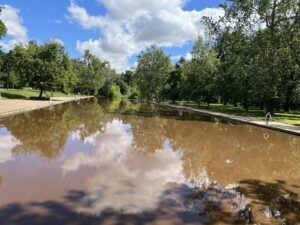
Sycamore Pool in the One Mile Recreation Area, which was built around Big Chico Creek, turned brown early this week.

Big Chico Creek turned chocolate brown earlier this week after a light May 12 rain washed vegetation and eroding bank sediment from the Park Fire burn scar into the water. Today the water look somewhat clearer.

Environmental studies professor Mark Stemen said the wash-off has environmental benefits, but also poses potential danger.

“We should be seeing this happen for a while,” Stemen said. The dry weather that followed rain “freed up much more sedimentation.”

Some of the sedimentation “will end up in the creek and provide good sediment for spawning.” But if there’s too much, he warned, “it could suffocate [salmon] eggs. One of the things that’s really striking is how much of our watershed has burned and destabilized the sediment.” read more

Policy critics: Chico’s Climate Action Plan neglected

Given weather-related disasters, does the City focus enough on climate change?
by Natalie Hanson | Posted August 13, 2024

photo by Leslie Layton
The City’s updated Climate Action Plan.

Butte County, facing the Camp Fire, the Dixie Fire, the Park Fire and extreme heat, has been on the frontlines of climate change in recent years. But the City of Chico has not made policies reflecting the urgency of these crises, some say.

Chico’s Climate Action Commission’s role has over time been cut dramatically, and the plans staff put together over years to help plan for a future of climate change have not been properly implemented, say some Chico residents. In their view, a lack of planning for climate change is symptomatic of the City’s unwillingness to make climate change the focus of policy or even fund the work to do so.

Community Development Director Brendan Vieg disagrees with this view, pointing to progress on plans like the Urban Forest Master Plan. “Combatting climate change provides an opportunity to build a healthy, equitable and resilient community,” Vieg states on the Climate Action Plan update (CAP) website page.

Climate Action Commission chair a critic
Climate Action Commission Chair Brian Scott Kress said that he doesn’t think the City’s strategies, as they stand today, properly incorporate an understanding of how to mitigate climate change or that the City prioritizes his panel’s work. “Our policies and approach to governing should reflect the immediacy of these challenges,” Kress said.

The Commission helped craft the CAP, which was completed in 2018 and updated in 2020. It contains measures to ensure the City meets the state goal of a 40% reduction in greenhouse gasses by 2030 and eliminates them by 2045.

While the City’s master plans for managing its urban forest, wildland vegetation and heat risks acknowledge climate’s role in past wildfires, the plans don’t contain a strong connection with climate change as a cause, Kress said. He finds that alarming because Chico is required to align with state targets for reducing greenhouse gas emissions to get certain kinds of state funding. Those funds cannot only help lower energy bills, improve transportation networks and electrify homes and businesses, but aid in mitigating dire climate consequences already underway in the region, Kress said.

“We should be adamant about integrating a climate lens into our actions – the consequences of inaction are already here,” Kress added. “Chico has the responsibility to become a model for resilience and proactive climate action, demonstrating effective strategies that can be replicated across the region, if not the country.”

The City Council changed the Commission from holding standing monthly meetings to meeting “as needed” in November 2023. City staff last called the Commission to meet in April with a limited agenda. Fewer meetings have limited the Commission’s ability to guide efforts to address climate change and keep the City on target to accomplish the CAP goals, he said.

Kress is a founder and principal at a Chico venture studio called Dayani that designs digital services to address climate change. He worries that many local elected officials do not discuss climate change or propose ways to address it within official strategies. The City Council has a lot of influence, as those elected leaders set the priorities and direction for staff.

“When we see local climate action, vulnerability, and scenario planning largely missing from crucial plans like our wildfire mitigation strategy, it’s clear that those plans are leaving our community members vulnerable to climate risks,” Kress said. “We need all our city leaders to be vocal, clear-eyed, and proactive about climate action.”

City official disagrees
Vieg, though, vouched for his team, noting that staff work hard to incorporate the Commission’s work — with consideration of the changing climate — into master plans.

Vieg said the City followed the CAP’s recommendation to implement an Urban Forest Master Plan to maintain a healthy urban forest for the next 40 years. The plan includes work to add to the City’s forest canopy, manage open spaces and natural resources and keep a public tree inventory. He also noted that the City’s Fire Department developed a Community Wildfire Protection Plan in 2022 to “assess wildfire threats, community preparedness, defensibility, and potential hazard mitigation measures.”

The City’s 2018 Climate Change Vulnerability Assessment contains lots of information about extreme heat and increased wildfire risks, and cites Bidwell Park’s woodland and savanna ecosystems as being most at risk of suffering the effects of climate change.

“Many of these areas are biologically rich in species and can be easily be disturbed by changes in the number of extreme heat days, heat waves, and overall increased temperatures,” according to the assessment.

Stemen: Climate not a City focus
However, Chico State professor of geology and environmental studies Mark Stemen says that mentioning climate change in City plans is not as effective as making it the focus of official policy.

Stemen has spent a lot of time with City staff to craft official plans. But he told ChicoSol that he’s worried that City leaders don’t take climate change seriously enough to use those plans to proactively handle the impacts of drought and extreme heat on the city and parks.

Stemen formerly sat on the Climate Action Commission. He said that since the pandemic began, the City has not financially supported efforts to reach stated climate goals. The City also hasn’t been completing reports on efforts to reduce greenhouse gas emissions, despite being required to do so under its CAP procedures. And the parks division does not file reports on any efforts to sequester carbon in its plans for managing public lands, he added.

Stemen said these problems point to an unwillingness to make climate change the center issue around which strategies revolve. For example, he said that Chico and Butte County officials do not name conditions arising from climate change — including hotter, longer, drier summers — as the real driver of catastrophic fires. The City hasn’t touched the Commission’s plan to handle extreme heat due to climate change, which has sat in Internal Affairs since 2021, he said.

Stemen also said the City has not made enough movement toward transitioning from fossil fuels and planning around vehicles and taking action on cutting greenhouse gas emissions.

“It’s easier to blame someone else than admit we’re the ones that are doing it,” Stemen said, referring to human-induced climate change.

Progress at the County
There’s some progress on the way, as Butte County this month announced that it will partner with a Rocklin firm to restart its own Community Choice Aggregation (CCA). The CCA is a program that allows cities, counties and other qualifying governmental entities to purchase and/or generate electricity for residents and businesses, Stemen said. (Chico hasn’t been sending its representative to the county’s CCA meetings, he said.)

That countywide effort will be crucial to stop taking a reactive approach to climate crises, and instead start learning from other cities’ work.

The City’s Climate Action Commission took notes from the city of Albany, Calif.’s work on issues like carbon sequestration, Stemen said. There’s no reason why the City can’t do as well, if not better, he added.

Although discussions locally in recent weeks have revolved around controlled burns as a method of wildfire prevention, efforts to address climate change require many types of proactive work, Stemen said. “We can’t just control burn our way out of climate change,” he added.

Natalie Hanson is a contributing editor to ChicoSol.

On the 3rd anniversary of the Camp Fire, a message to COP26

Allen Myers: "People are dying"
by Leslie Layton | Posted November 9, 2021

photo by Allen Myers

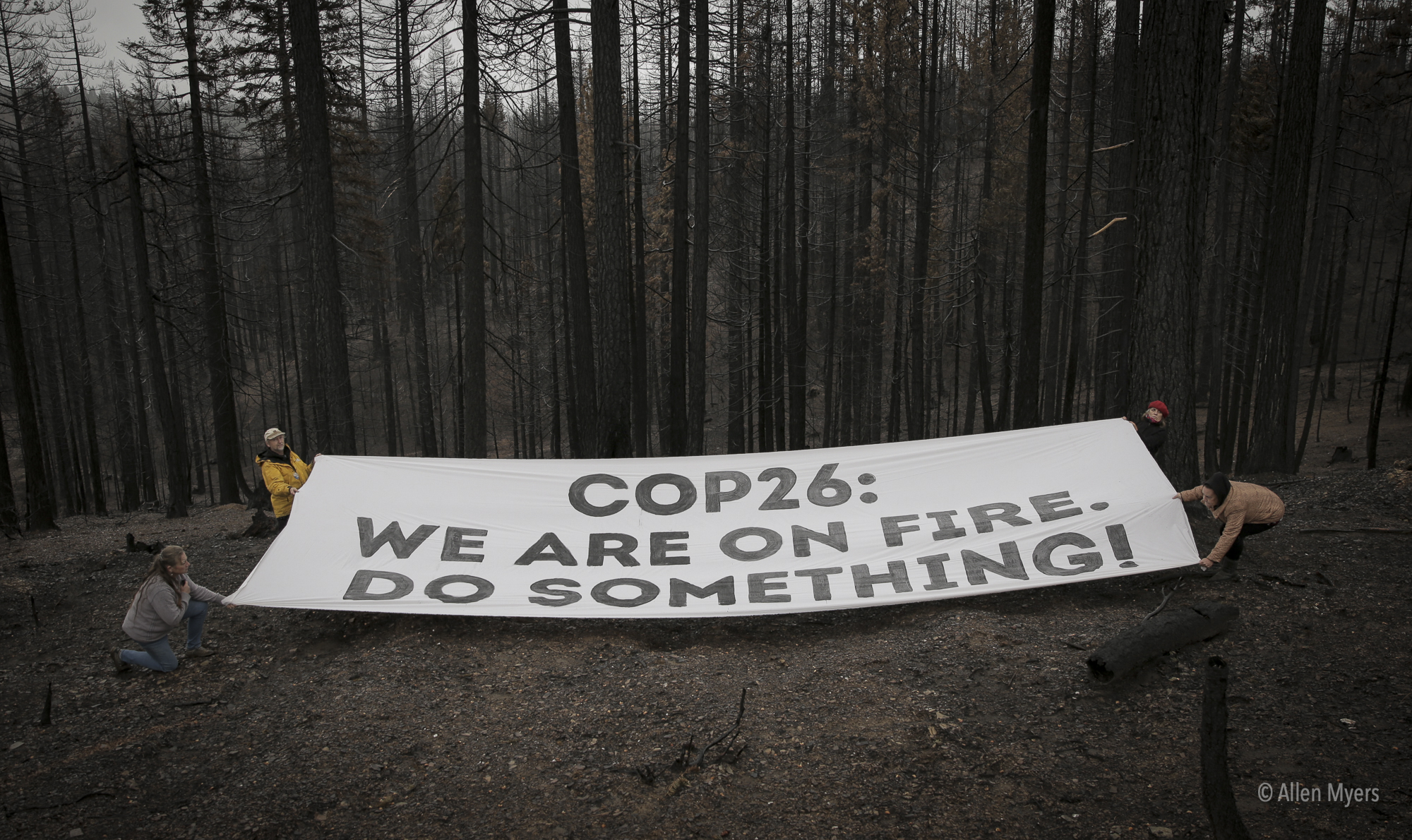
Several days prior to the third anniversary of the devastating Camp Fire, a group of Paradise residents and former residents hoisted a banner with their message to the world painted in charcoal: “COP26: WE ARE ON FIRE. DO SOMETHING!”

Gathered in the Plumas National Forest in the Dixie Fire burn scar on Nov. 6, the demonstrators said their message was directed to world leaders at COP26, the United Nations Climate Change Conference underway in Glasgow, Scotland. “The climate crisis is here. We are on fire,” said Allen Myers, executive director of nonprofit Regenerating Paradise.

Later, by phone, Myers said it wasn’t his intent to minimize the role of PG&E — the utility that owned the malfunctioning transmission line that ignited the Camp Fire.

“By highlighting climate change I do not want to minimize the lessons of mismanaged forests or the faults of PG&E,” Myers told ChicoSol.

Climate change, Myers pointed out, is acting as an accelerant in Western U.S. wildfires, making them burn hotter and larger. “We’re trying to connect to a large global population,” Myers said. “This is a moment where world leaders are gathering to talk about solutions. People are dying as a result of climate-driven wildfires.”

The banner was painted by activist/writer/artist David Solnit with charcoal from a home that was destroyed by the 2018 Camp Fire that killed 85 people.

Myers, a filmmaker and photographer who lost his Paradise home in the Camp Fire, was in Grizzly Flats taking pictures today — the third anniversary of the Camp Fire. Grizzly Flats was leveled earlier this year by the Caldor Fire. “It looks like Paradise did three years ago to the day,” Myers said. “There’s total devastation, blackened out forest. It’s jarring yet familiar.”

“The End of Oil?” It’s about time!

by Karen Laslo | Posted September 11, 2020

photo by Karen Laslo
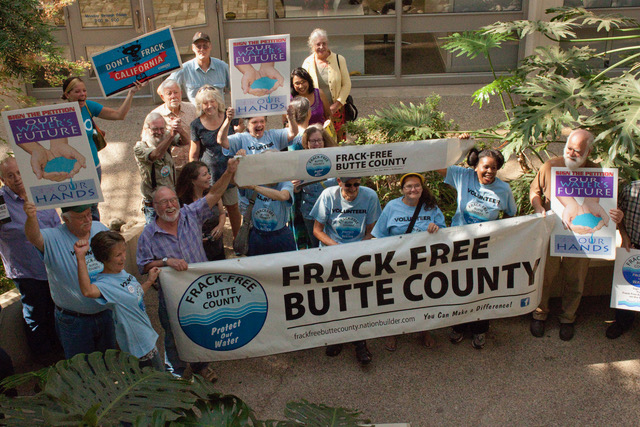
2019: Steve Marquadt from Chico’s Sunrise Movement (left) and Mary Kay Benson from 350 Butte County protesting congressional inaction on climate change at a town hall.

For years, environmental activists have been warning us about the most dire existential crisis of our lives: Climate Change. But despite their best efforts, very little has changed as people on all levels continue to behave as if there is no crisis, including many of the elected officials that we depend on for leadership and protection.

As a result of this inaction, all creatures, human and non-human, on this beautiful planet we call Earth, our only home, are in imminent peril of extinction.

And now, another deadly crisis has come upon us: The (Trump’s) Covid-19 pandemic. Trump, who is supposed to be our nation’s leader, made no plans to control the virus. His lies and absolute refusal to acknowledge the reality of how dangerous the virus would become if left unchecked made it much worse.

But while communities of desperate people across the country (and around the world) were locked down, losing their jobs, their local economies annihilated and thousands of people dying, Trump protected his big campaign contributors in the oil and gas industry with a gift of over $700 billion from the Paycheck Protection Program, a plan that was supposed to help the American people. The fossil fuel companies got money; we got sick.

Ironically, the cruel and greedy fossil fuel industry is contributing to the eventual demise of its own existence. For Trump and his oil and gas company buddies, “the end of oil” pandemic is upon them.

Check out this short segment of Democracy Now! titled “The End of Oil.”

It’ll blow your mind.

Protesters gather outside congressman’s pricey fundraising event

by ChicoSol staff | Posted July 31, 2018

photo by Karen Laslo

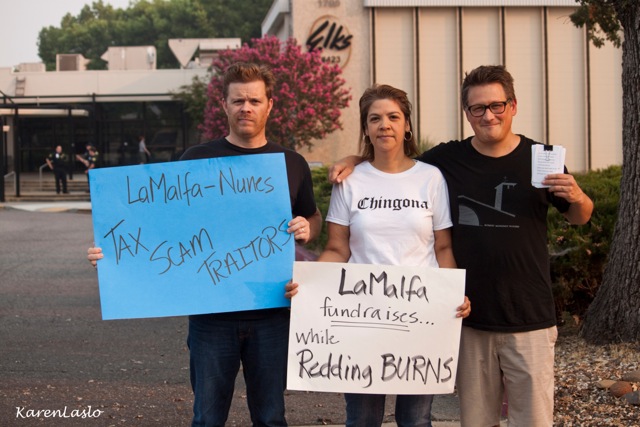
Wes Owens, Raeanne Flores-Owens and Micha Lehner were among those protesting the conservative District 1 congressman.

Chico’s Raeanne Flores-Owens protested with about 19 other people Monday, saying that while Rep. Doug LaMalfa (R-Richvale) was raising money for his re-election campaign, much of the Northern Sacramento Valley was burning. “We are covered in smoke, it’s hazy, our children can’t play outside,” she said of the Carr Fire’s impact.

The 110,000-acre Carr Fire has been identified as the most destructive fire in Shasta County’s history, and the weather system the fire is generating has been linked to climate change. Air quality in the northern valley today ranges from “unhealthy for sensitive groups” to “hazardous,” according to KRCR news.

Flores-Owens was one of the protesters outside the Manzanita Place event hall in Chico who oppose the Republican congressman’s position on climate change and his support for President Trump’s immigration and tax policies. LaMalfa’s staff, meanwhile, held a dinner that cost donors up to $5,400 for those who wanted to be “event chairs.” Congressman Devin Nunes (R-Tulare) was advertised as a guest at the round-table discussion and dinner.

“Climate change is happening and they are willfully ignoring that, and we, the 99 percent, are suffering because of it,” Flores-Owens said.

LaMalfa in 2016 criticized former President Barack Obama for his “misguided focus on climate change, which threatens to derail key sectors of the American economy.”