
Chico journalist sues DA over public records

Lawsuit claims law enforcement agencies withhold public documents
by Leslie Layton | Posted December 22, 2025
The lawsuit was filed Dec. 22, 2025.

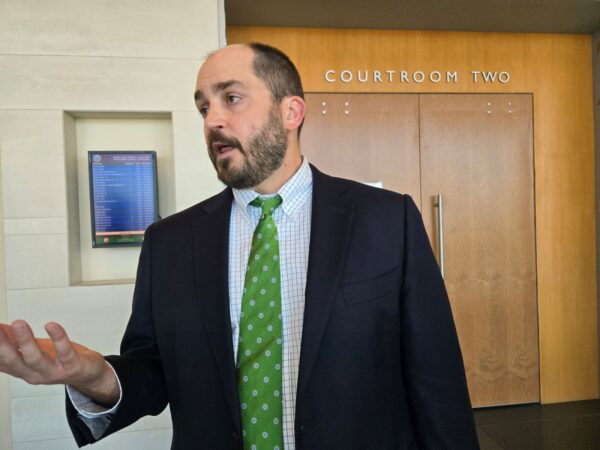
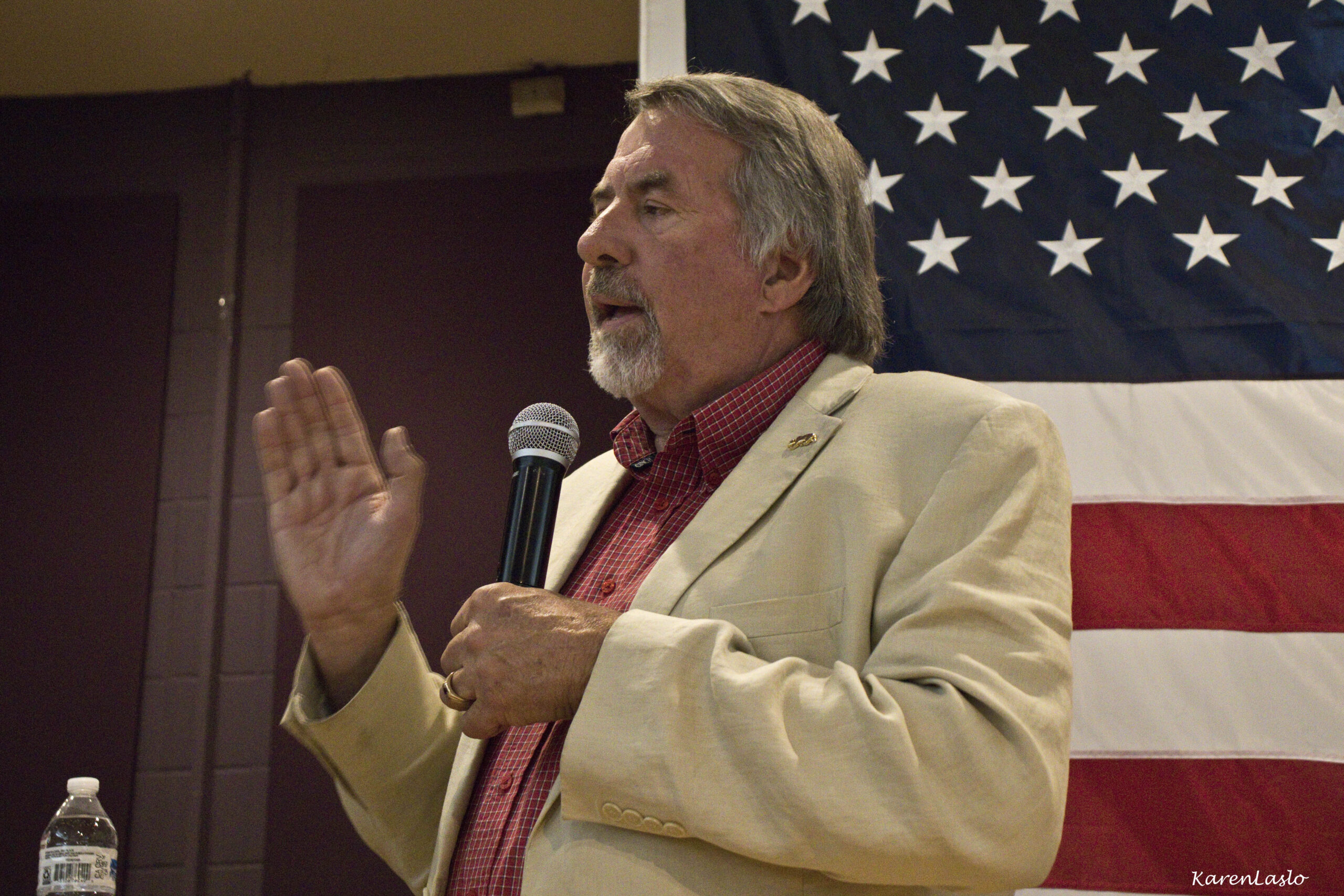
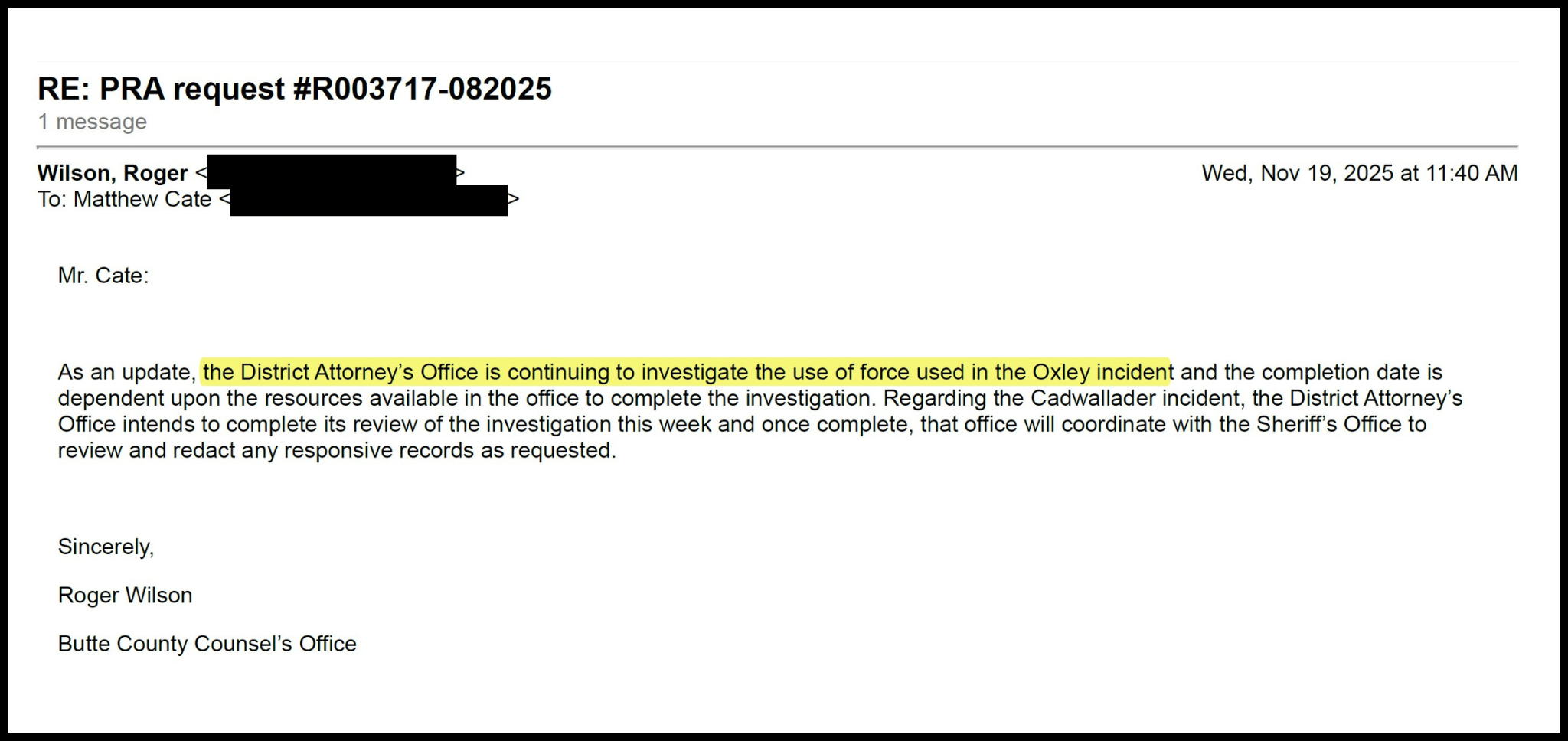
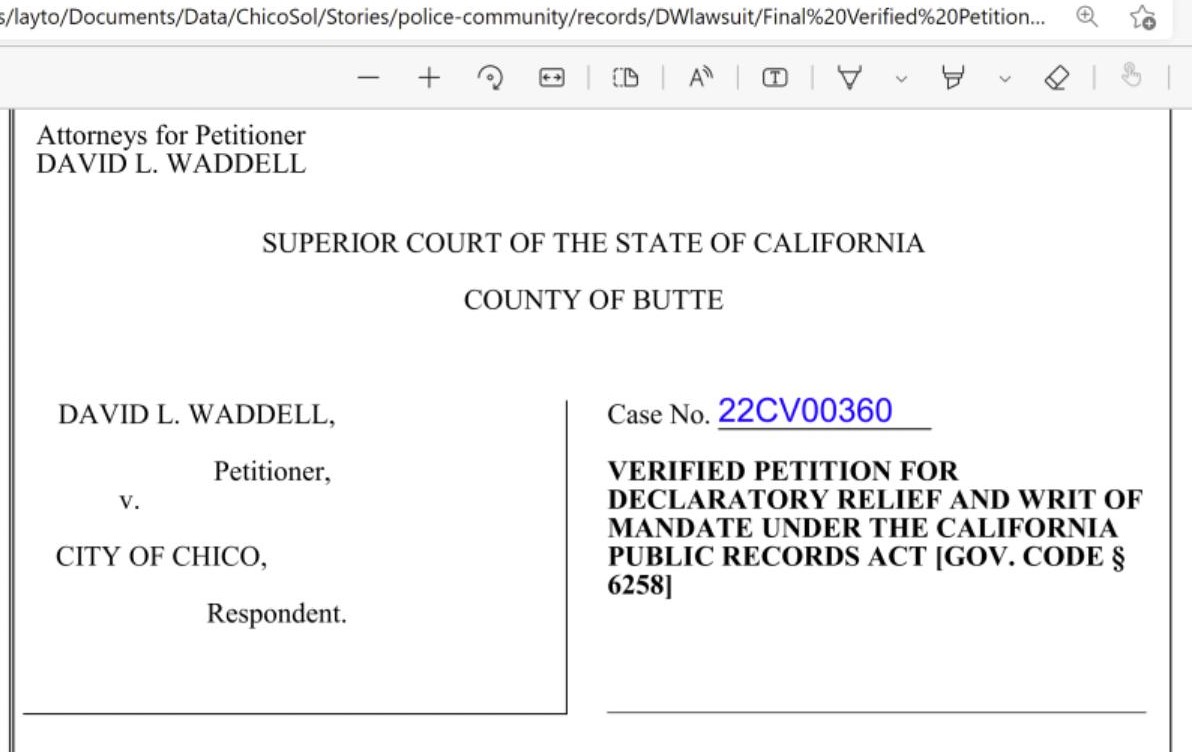
ChicoSol contributor Dave Waddell today sued Butte County District Attorney Mike Ramsey — as well as the Chico Police Department, the City of Chico and the sheriff — over withheld public records related to officer-involved shootings.

The lawsuit filed in Butte County Superior Court states that it “arises from the repeated and ongoing failure of the leadership of the law enforcement community” to comply with the California Public Records Act. read more

Court orders City to release documents in Tyler Rushing case

City's non-compliance with public records laws will cost taxpayers
by Leslie Layton | Posted July 9, 2024

photo by Leslie Layton
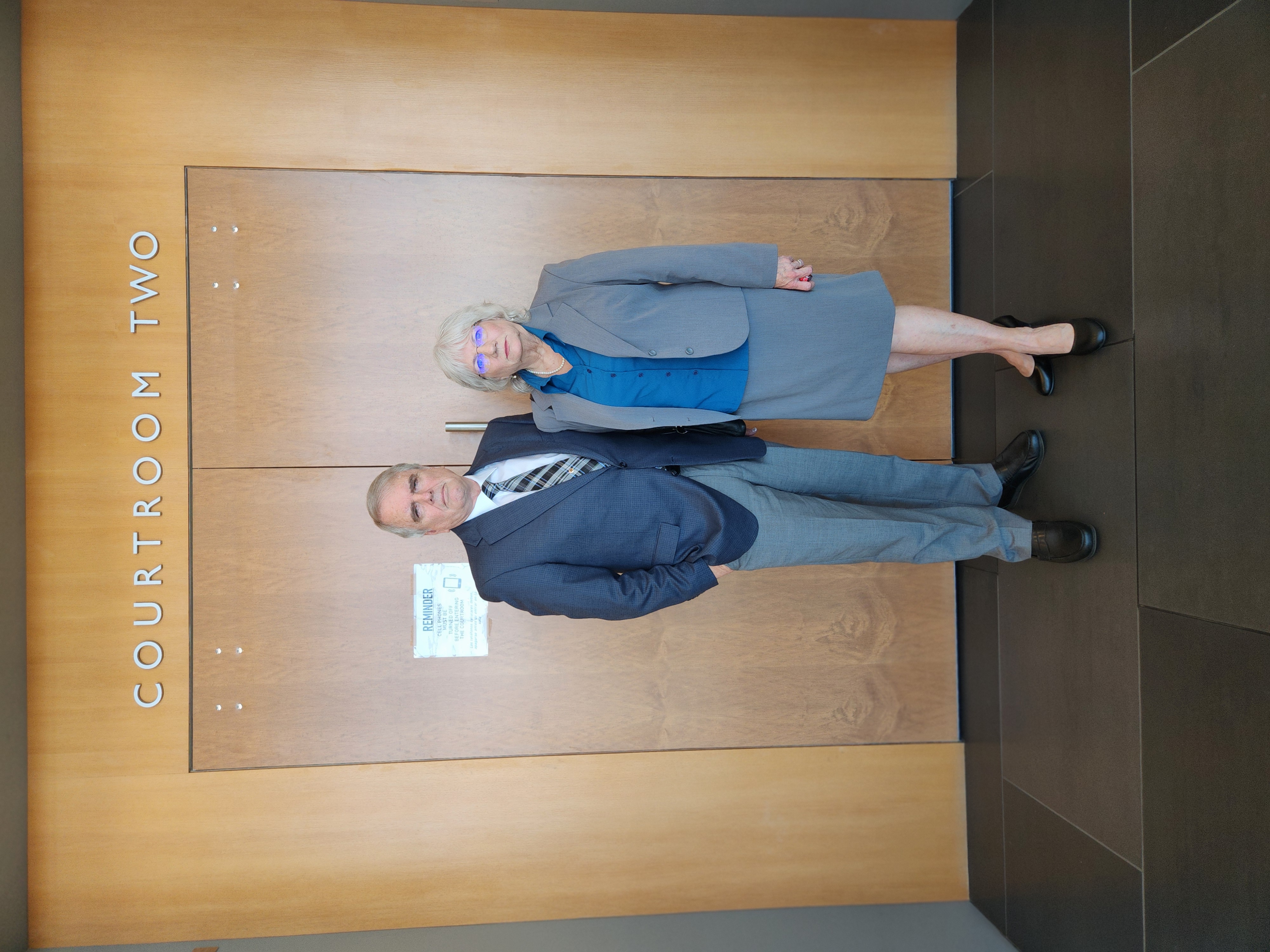
Scott & Paula Rushing after their July 8 hearing at the North Butte County Courthouse.

This story was updated at 2 p.m. today to add comments from both parties’ attorneys.

Shortly after taking under submission a public records dispute, Butte County Superior Court Judge Stephen Benson ruled July 8 that the City of Chico must release a PowerPoint presentation on the 2017 police killing of Tyler Rushing.

The ruling in favor of Tyler’s father, Scott Rushing of Ventura, requires that the City release requested information “without redactions.” Scott Rushing filed his request under the state’s Public Records Act almost 19 months ago on the premise that the PowerPoint appears to have been created for training purposes.

“… the public interest in access to the requested PowerPoint, which we understand summarizes the City’s understanding of how Mr. Rushing’s son passed on and describes policies adopted by the City in response to that tragedy, is overwhelming,” states Rushing attorney Aaron Field in a declaration to the court.

Judge Benson also ruled that the City must turn over another piece of information it has refused to provide – the names of the officers who were on Chico PD’s hostage or crisis negotiating team at the time.

Under the Public Records Act, the party that prevails — in this case Scott Rushing — can recover attorney fees and other legal costs. Field said he’ll try to resolve “informally” the recovery of his client’s legal fees from the City, but will “seek additional relief from the court” if that becomes necessary.

City Attorney John Lam sent an email statement to ChicoSol today that says: “Although we disagree with the Court’s ruling, the City respects the Court’s decision in matter. The City will evaluate its options moving forward.”

Tyler, who was 34, was first shot by a private security guard on July 23 almost seven years ago during an episode of unusual behavior outside a local title company. Tyler fled into the company bathroom bleeding, and when Chico PD officers arrived, they spent 20 or 30 minutes trying unsuccessfully to coax him out.

Tyler was then attacked by a Butte County Sheriff’s canine, Tig, and surrounded by Chico PD officers. Sgt. Scott Ruppel fired at him as he struggled against the dog and police and after he hit Ruppel with a ballpoint pen.

The Rushings have a civil case in federal court pending over the fatal shooting of Tyler. The civil rights case will go to trial Oct. 7 in U.S. District Court for the Eastern District in Sacramento.

In his ruling on the PowerPoint issue, Benson says the City failed to meet the “substantial burden” of proof needed to declare the document exempt from the Public Records Act (PRA) and specifically penal code 832.7(b).

“In this Court’s opinion, the City has a substantial burden considering the Legislature’s expressed intent under PC § 832.7(b) to increase public access to all documents concerning officer shootings, as well as published decisions emphasizing the importance of law enforcement transparency,” he writes.

Attorney Sharon Medellín, representing the City on the matter and speaking to the court over a conference call line at the July 8 hearing, argued that the PowerPoint should be exempt because it wasn’t part of the authoring officer’s “job responsibilities,” and was produced after the official investigation headed by District Attorney Mike Ramsey was concluded.

“It was one person’s opinion,” Medellín said, adding that the document’s disclosure would “discourage critical analysis [by law enforcement agencies] in the future.”

Benson wasn’t convinced that the argument had merit or relevance. “Indeed, it is almost impossible to imagine how this was not within the scope of employment,” he says. The judge writes that state law defines public records as “any writing containing information relating to the conduct of the public’s business …

“The City states there are recommendations and conclusions in the power point not adopted by the department,” the ruling states. “The fact that recommendations and conclusions were made evidence the fact that it was within the scope of employment and that it is more than just an incidental reference to agency business.”

In court, Field said that contrary to Medellín’s argument that disclosure would discourage critical analysis by agencies in the future, the opposite could be true. Disclosure would show that an agency took steps to address procedural issues and improve responses. “I believe in transparency personally,” he said, “and I believe transparency encourages agencies to improve themselves.”

Medellín told the judge that the names of Chico PD’s crisis negotiating team were irrelevant because the team “didn’t respond to the incident.” She said the names should be protected as an “issue of safety.”

Outside the courtroom, Field said: “I don’t have personal knowledge if [crisis negotiators] responded or not” when Tyler was shot, tasered and mauled. His client, he said, wants to know “whether they responded or not, and if not, why not?”

Benson wrote: “While Respondent [City of Chico] has expended effort in arguing why an exemption exists concerning the power point, Respondent has failed to separately explain why an exemption applies to the names of the CNT [crisis negotiating team.]”

Scott Rushing commented this morning on the ruling. “I’m just trying to get all the information I can regarding the death of my son,” he said, “and I believe that Chico PD should have released [the PowerPoint] to my legal team when it was created in November 2017.

“I’m concerned still about lack of transparency by City of Chico officials. I’ll be very critical of the City of Chico if they don’t comply with the ruling of court.”

City Attorney Lam’s email said: “Per the Court’s Judgement, the City has 60 days to comply with the public records request.”

Field said, though, that the court expects the documents to be released “forthwith” and the City has 60 days to advise the court of steps taken.

“We are grateful for the Court’s careful consideration of this case … which vindicates Mr. Rushing’s and the public’s rights of access,” Field said in an email statement. “We hope that [the documents] will also help the City and other communities minimize the likelihood of tragedies like Tyler’s death in future interactions between law enforcement officers and members of the public.”

Leslie Layton is editor of ChicoSol.

Waddell honored with Freedom of Information Award

SPJ NorCal comments on ChicoSol stories
by Leslie Layton | Posted March 17, 2022

photo courtesy of Jason Halley
Dave Waddell

ChicoSol contributor Dave Waddell was honored today – on Freedom of Information Day – as a “transparency champion” for work that accessed public records related to three killings involving the Chico Police Department.

Waddell received the Freedom of Information Award in the small Print and Digital division for ChicoSol stories on the killings of Desmond Phillips, Tyler Rushing and Stephen Vest. The 37th annual James Madison Freedom of Information competition awards were presented today by the Society of Professional Journalists Northern California (SPJ) chapter.

SPJ noted that Waddell used records and police body-cam recordings “that he fought for under California public records law, to investigate the official accounts of the circumstances around all three deaths.

“His reporting revealed that Rushing was in a deputy’s grasp when shot and raised questions about the use of force against Vest and the investigation into Phillips’ death.”

Waddell is the second ChicoSol collaborator to be honored by SPJ with a Freedom of Information Award. Intern Gabriel Sandoval won a 2018 award in the Student Journalist category.

“I am extremely honored to receive this award from such a prestigious organization as SPJ,” Waddell said. “The award affirms and highlights the important role that increasingly scarce publications such as ChicoSol.org play in a free society – publications beholden only to the public’s right to know within the dictates of good journalism. I consider the fight to obtain public records — and the disclosing of those records to the community – one of the highest callings in journalism.”

Before reporting for ChicoSol, Waddell was a newspaper reporter and editor for nearly 20 years. He also taught journalism at Chico State for two decades and was a longtime adviser to The Orion. He is working on a book about officer-involved killings in Butte County.

The San Francisco attorney who has assisted Waddell in his legal fight for records and nominated him for the award thanked ChicoSol for publishing investigative reporting and commented on the honor. “I am glad that Dave received this well-deserved recognition for his meticulous and illuminating reporting for ChicoSol last year,” said attorney Aaron Field.

Also honored this year – but in the Advocacy category — was a legal team representing journalists who faced “burdensome wait times for public records.” The team compelled the Oakland Police Department to reform their procedures for handling record requests.

A KQED-NPR team won in the Podcast Journalism category, using a new public records access law to report on officer misconduct.

The SPJ chapter noted that the United States’ fourth president, James Madison, was “the creative force behind the First Amendment” and his March 16 birthday falls in National Sunshine Week.

Leslie Layton is editor of ChicoSol.

Lawsuit alleges violations of public records laws

Writer sues City of Chico for access to documents on police killings
by Leslie Layton | Posted February 23, 2022

photo by Karen Waddell
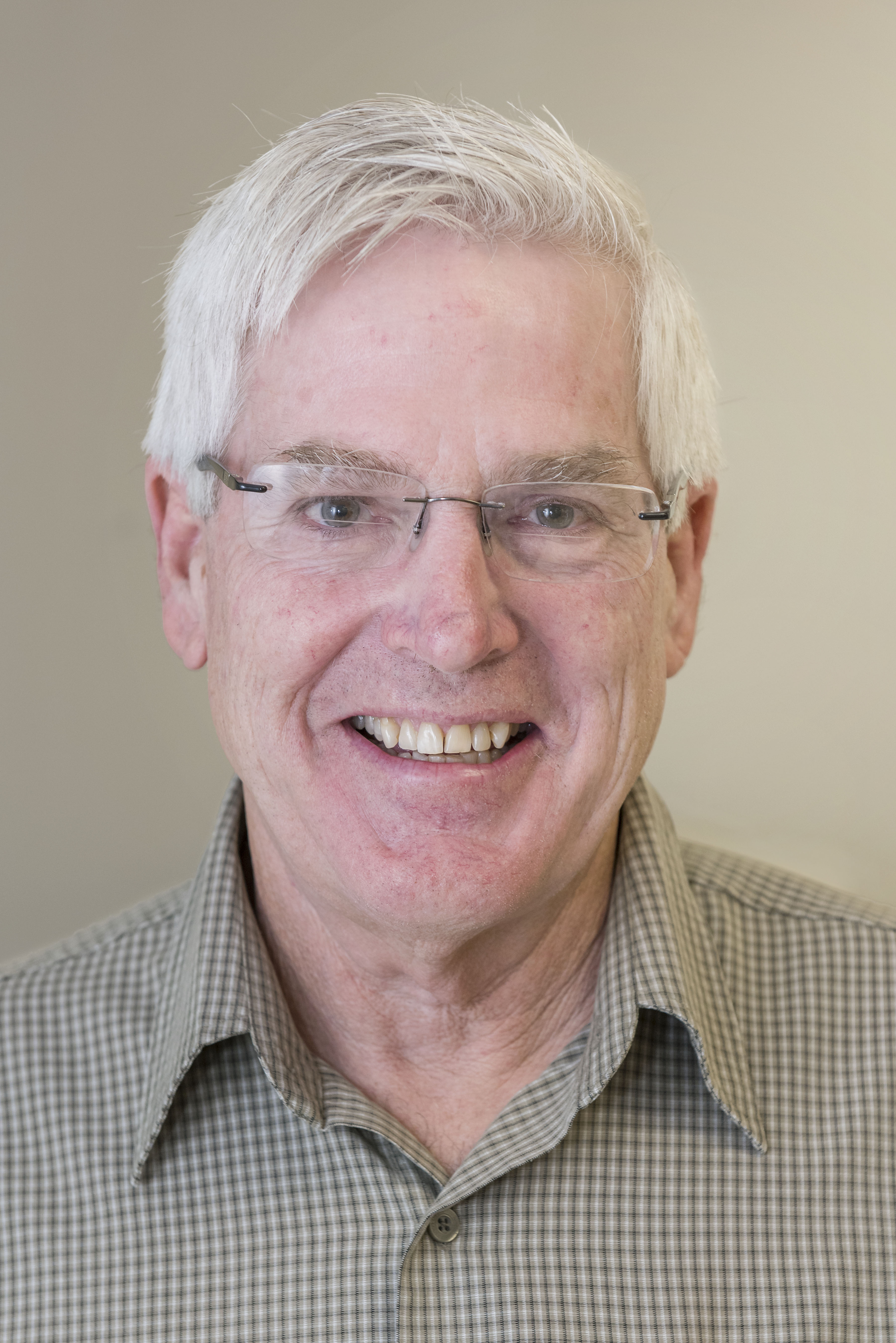
Writer Dave Waddell shows blacked-out pages that were sent him as part of an autopsy report. His attorney alleges “excessive” redacting.

The City of Chico may have lost or destroyed public records related to police killings, and has stonewalled for more than a year in response to record requests, says a lawsuit filed Feb. 18 against the City.

A lawsuit filed by ChicoSol contributing writer Dave Waddell in Butte County Superior Court says the City is in violation of the California Public Records Act because of its continual “withholding of records” as well as its “excessive redactions” in those records that have been released.

“The City has made it clear, by missing its own self-imposed deadlines, again and again, that it will not comply with the law …,” states the lawsuit filed on behalf of Waddell by his San Francisco attorney, Aaron Field.

Waddell said he made every possible effort to work with the City and avoid the step he has now taken.

“If you read the lawsuit, I think you’ll discover that we did everything except the Limbo to avoid suing, but as it turned out the City of Chico wouldn’t have it any other way,” Waddell said. “Instead of providing records as required under California’s sunshine laws, the Police Department apparently withheld, lost or destroyed, and excessively blacked out documents.”

The office of city attorney Vince Ewing said it had no comment on Waddell’s lawsuit, and asked on Feb. 22 whether Ewing had reviewed the suit, Executive Assistant Maxine Caudillo said, “No comment and you have a great day.”

The lawsuit asks for a “judicial declaration” that the City is in violation of state law, that the court demand full compliance with access laws and that the City cover all attorneys’ fees and costs incurred by Waddell, who previously served as news director of this publication and is now working on a book about Butte County law enforcement killings.

The City of Chico and the Chico Police Department have also been named in high-profile lawsuits, including the wrongful death lawsuit filed by the family of Tyler Rushing, who died almost five years ago after being shot by an armed security guard and Chico police officers. Chico PD has been sued by an African American, Donell Thomas, who alleges racial discrimination. It was a defendant in the lawsuit filed by Legal Services of Northern California over the City’s treatment of unhoused residents.

In a settlement agreement reached earlier this year in the homeless lawsuit, the City agreed to pay $650,000 to cover the costs of the many attorneys who worked on behalf of the eight plaintiffs.

In November, ChicoSol reported on Waddell’s frustration with both Chico PD and the Butte County District Attorney’s Office over non-compliance with public records laws. The lawsuit filed last week – Field said city attorneys received “courtesy copies” the evening of Feb. 22 – focuses on non-compliance by the City in turning over records related to the killings of Eddie Sanchez (2015), Desmond Phillips and Tyler Rushing (2017), and Stephen Vest (2020).

Attorney Field said the records should have been retained and made available by either Chico PD or other offices in the City of Chico. When the City indicated it hadn’t retained some records, Waddell agreed to wait until the City had re-acquired the records from Butte County.

Some records were then delivered to Waddell in November, but the City said it needed more time to review, redact and “roll out” the rest, many of which never came.

“For some reason, the City didn’t hold on to records as it was supposed to do,” Field said. “There was a continued moving of the goalpost for disclosure. This essentially amounts to a pattern of non-compliance with the Public Records Act.”

“We may come to understand what happened as the lawsuit progresses,” Field added.

Field noted that the California Supreme Court has said that “openness of government is essential to the functioning of democracy.” The need for transparency is “heightened” and “overwhelming,” he said, in cases involving the use of deadly force.

“There’s no greater exercise of government power than when the power is exercised to take someone’s life,” Field said.

The mystery of unretained records
In an 18-page lawsuit petition, Field provides a detailed timeline of record requests and responses that he says show his client has been “incredibly patient” with the City, and that raise questions about records that were apparently missing from City files. For example:

Nov. 15, 2020-Feb. 17, 2021: Waddell submits record requests for the four cases. A small number of records related to the recent killing of Vest and the other cases are sent in response.

June 14, 2021: The City says it has “disclosed all records in its possession”; it notes there may be more records related to the Vest case in the Butte County DA’s Office. Waddell then directs record requests to the county.

August 2021: The county says it is the “City’s responsibility to retain records related to its own police shooting investigations and to disclose them in response to Public Records Act requests when required.” The county re-sends many records to the City that appear to have been lost or discarded.

November 2021: The City delivers some records and promises more in December – but they never come.

Jan. 27, 2022: The City can’t yet release more records because staff have been “out sick.”

In addition, the lawsuit says there are redactions “unsupported by law.” In the Sanchez case, the City blacked out “large blocks of material, spanning many pages in some cases…” One of the redactions blacks out Sanchez’s “prior violations of law.”

A criminal record belonging to someone who has been killed by law enforcement officers could potentially be “really important to understand,” Field said.

In a Jan. 6 email to the City, Waddell discusses missing records with Deputy City Attorney Gloria Ramirez and notes that he has “run out of patience” given that he submitted the request in the year 2020 “and it is by now, as I’m sure you’re aware, the year 2022.” He notes that he hasn’t even received the victim’s autopsy report.

Ramirez responds in a Jan. 14 email, stating that Chico PD has a “limited number of sworn officers authorized to review and process sensitive records …”

Public records advocates argue that months of delays affect the newsworthiness of stories. “The City was required to allocate the resources necessary to comply with state law, which means timely processing Mr. Waddell’s requests and timely disclosing responsive records,” Field said.

Under legislation that took effect this year, public records must be disclosed within a 45-day period.

Field declined to say how much attorney fees might cost the City if his client prevails, noting that it would depend largely on how long it takes to reach an agreement or settlement. He said attorney fees would be under $100,000 at this point.

Waddell says the City is “preventing the public from getting all of the details about its officers’ killings.

“In my view, accountability and meaningful change do not occur in any agency so resistant to transparency,” Waddell said.

Leslie Layton is editor of ChicoSol.

Sheriff’s office responsive, Chico PD obstructive

Two agencies, two different responses to our public records request
by Dave Waddell | Posted December 30, 2019

photo by Karen Laslo

Chico Police Chief Mike O’Brien

Last March, I spoke at a League of Women Voters of Butte County forum having to do with public access to law enforcement records.

That Sunshine Week forum, which included Butte County Sheriff Kory Honea and police reformers Emily Alma and Margaret Swick, gave me an opportunity to vent a bit about the most secretive public agency I’ve dealt with as a journalist: the city of Chico.

At the forum I said something that, if anything, is even truer today: Chico city government has no respect for the people’s right to know.

That’s been the case when liberals have controlled the City Council; it’s been true when conservatives had the majority. It was true before the city quit having an on-staff city attorney in 2014. But the secrecy has been taken to new dimensions since Chico began renting legal services from a law firm based near Los Angeles. The firm, Alvarez-Glasman & Colvin, is practiced at keeping what should be public information hidden from Chico’s citizens. One example I cited at the forum was the contrived City Hall secrecy around Chico police officers’ gun-buying — at public expense but for the private ownership of the officers — at a gun shop owned by two Chico cops.

At the time of the forum, both the Butte County Sheriff’s Office and the Chico Police Department were denying requests made under Senate Bill 1421, which opens up most law enforcement records on shootings and certain types of misconduct to public scrutiny. This stonewalling was largely based on a police unions-concocted fiction that the law wasn’t intended to be retroactive prior to its Jan. 1, 2019, effective date.

In August, after courts had affirmed the retroactivity of SB1421, ChicoSol intern Alex Grant and Editor Leslie Layton sent the same basic letter to the city of Chico and the county of Butte seeking information under the new law. Both agencies promised to produce the requested documents. As it turned out, only the county really meant it.

Chico’s response arrived in October, a bit after the county’s, and was a mound of paperwork that purportedly regards the 2017 police shootings of Desmond Phillips and Tyler Rushing. Taken as whole, it’s a head-scratching potpourri of materials that bears little relation to what was asked for by ChicoSol journalists and what the public is entitled to see.

In its Phillips case response, Chico coughed up a total of 120 pages, of which 80 pages (two-thirds) were merely Chico PD policies, all of them easily obtainable without the need of a public records request.

That left just 40 pages that weren’t department policies, almost none having to do with the night Phillips, a 25-year-old black man in mental crisis, was riddled with bullets. Eleven pages dealt with a mental health call involving Phillips that occurred 2½ months before he was killed in his own living room on March 17, 2017, by officers Alex Fliehr and Jeremy Gagnebin.

Together, the two young officers fired 16 rounds within four seconds, hitting Phillips 11 times. One of the bullets – a particularly devastating one – was fired into Phillips’ body from a sharply downward angle. A police expert hired by attorneys for the Phillips family wrote that the killing appeared to be a “panic shooting” by Fliehr and a “sympathy shooting” by Gagnebin. Butte County District Attorney Mike Ramsey quickly ruled the killing legally justified.

Four months after the Phillips killing, Fliehr thought he saw the severely wounded Tyler Rushing move and proceeded to shoot him with a stun gun. At the time, Rushing lay on his stomach in his own blood and was either unconscious or already dead. No other officer saw Rushing move, and body camera video proved that he didn’t.

In contrast to Chico PD, the Butte County Sheriff’s Office provided hundreds of pages of relevant materials to ChicoSol — none of which were department policies – about its 2018 killing of Myra Micalizio. At least so far as SB 1421 is concerned, the sheriff’s office appears to be a law enforcement agency that takes its own adherence to the law seriously. The Chico Police Department, in stark contrast, is willing to brazenly violate that law to keep the public from knowing more about how its officers killed Desmond Phillips. Each agency’s response says a good deal about the honesty of its leadership – and about the true nature of its legal representation.

The most recent letter of lawyerly obstruction to ChicoSol from the city’s hired guns, very liberally paraphrased and condensed, went something like this: “We think you have everything you asked for. We can look for more records but with the holidays and the workload and all it won’t be until sometime in January or so.”

Oh, c’mon. Just go to the damn file that contains the ream of investigative reports that were written about the Phillips killing, make any required redactions of witness information, attach the redacted reports to an email, and send them to ChicoSol. That’s what the county has already done, months ago, and, to quote George Costanza, “it really didn’t take very long either.”

Among the paperwork provided to ChicoSol by the Sheriff’s Office were the following:

Coroner and medical examiner reports;
Investigative reports conducted by sheriff’s officers for internal review;
Investigative reports conducted by officers from outside the sheriff’s office for criminal review;
Reports on evidence from the scene, including Micalizio’s vehicle, her belongings, and the location of bullets and shell casings;
Written statements from witnesses to the shooting.

As a journalist who prefers to dig below the surface, I know that investigative reports may provide specific facts and details that make stories more complete and interesting. But not only that. These reports can uncover some inconvenient truths for the tidy little narratives often put out by authorities for public consumption.

For example, the official storyline was that Micalizio, who was obviously in mental crisis when killed, had disobeyed shouted orders to stop and tried to back her vehicle over deputy Charles Lair, who then shot her five times in the back through a side window. Lair was not hurt. Micalizio was accused of “attempted murder.”

As I’ve written about in more detail, Micalizio had gone out of her way to try to help a California Highway Patrol officer almost exactly 48 hours before she was shot dead. In parting that day, she told the officer to “stay safe.” The encounter, which the officer described as extraordinary, showed Micalizio’s reverent attitude toward law enforcement. There was no mention of the encounter in DA Ramsey’s quite extensive official report that found no criminal violations by deputies Lair and Mary Barker, the latter shooting wildly at Micalizio, including into an occupied trailer home.

Another fact not previously reported – and this too was absent from the information Ramsey allowed the public to know – has bugged me ever since I found it buried in one of those investigative reports: In being killed, Myra Micalizio bit off part of her tongue. That’s according to a statement to detectives by deputy Barker.

Consider how terrified someone must be to bite her own tongue in two. It’s a terror, I’m supposing, that is beyond the sane person’s ability to fathom. And it’s a terror that rendered Myra mentally disabled when killed in the name of Butte County.

Among the dissimilarities in the city’s and county’s responses are what’s shown of their internal affairs investigations. The county’s “bottom line” (Lair and Barker did nothing wrong) in the Micalizio killing is detailed in a three-page memorandum from an internal affairs sergeant to Sheriff Honea.

While it’s important to recognize that such investigations in Butte County, whether criminal or departmental, are conducted of, by and mostly for law enforcement personnel, the memo at least sets forth some basis for its findings.

The city of Chico, in contrast, provided only a one-page memorandum sent to Fliehr, the officer who fired at Desmond Phillips first and didn’t stop until he’d squeezed the trigger on his Glock full of hollow-point rounds nine times at close range. That Nov. 17, 2017, memo is from Deputy Police Chief Matt Madden, who, one supposes, is in line to succeed the increasingly uncommunicative Mike O’Brien as police chief. An identical single-page document was prepared for officer Gagnebin, who shot at Phillips seven times.

Madden’s memo lists the titles of nine different sections of Chico PD policies the officers could have violated, ending with this grammar-challenged sentence: “The investigation concluded that the above allegations are EXONERATED” (the word was bolded, capped and underlined.) Normally, “people,” not “allegations,” are the ones “exonerated.” That aside, it’s impossible to know which specific allegations were supposedly “investigated.”

Deputy Chief Madden’s memos to Fliehr and Gagnebin conclude as follows: “There will be no record of these allegations entered into your personnel file.”

And thus it was so ordered that the death of Desmond Phillips would be forever scrubbed from the official work histories of those who ended his young life so suddenly and so shockingly.

Whatever else might be said, it was an act consistent for a public agency with no respect for the people’s right to know.

Dave Waddell is a contributor to ChicoSol covering law enforcement in Butte County.