Tag: City Council
Council approves revised massage ordinance
Challenges to immigrant therapists remain
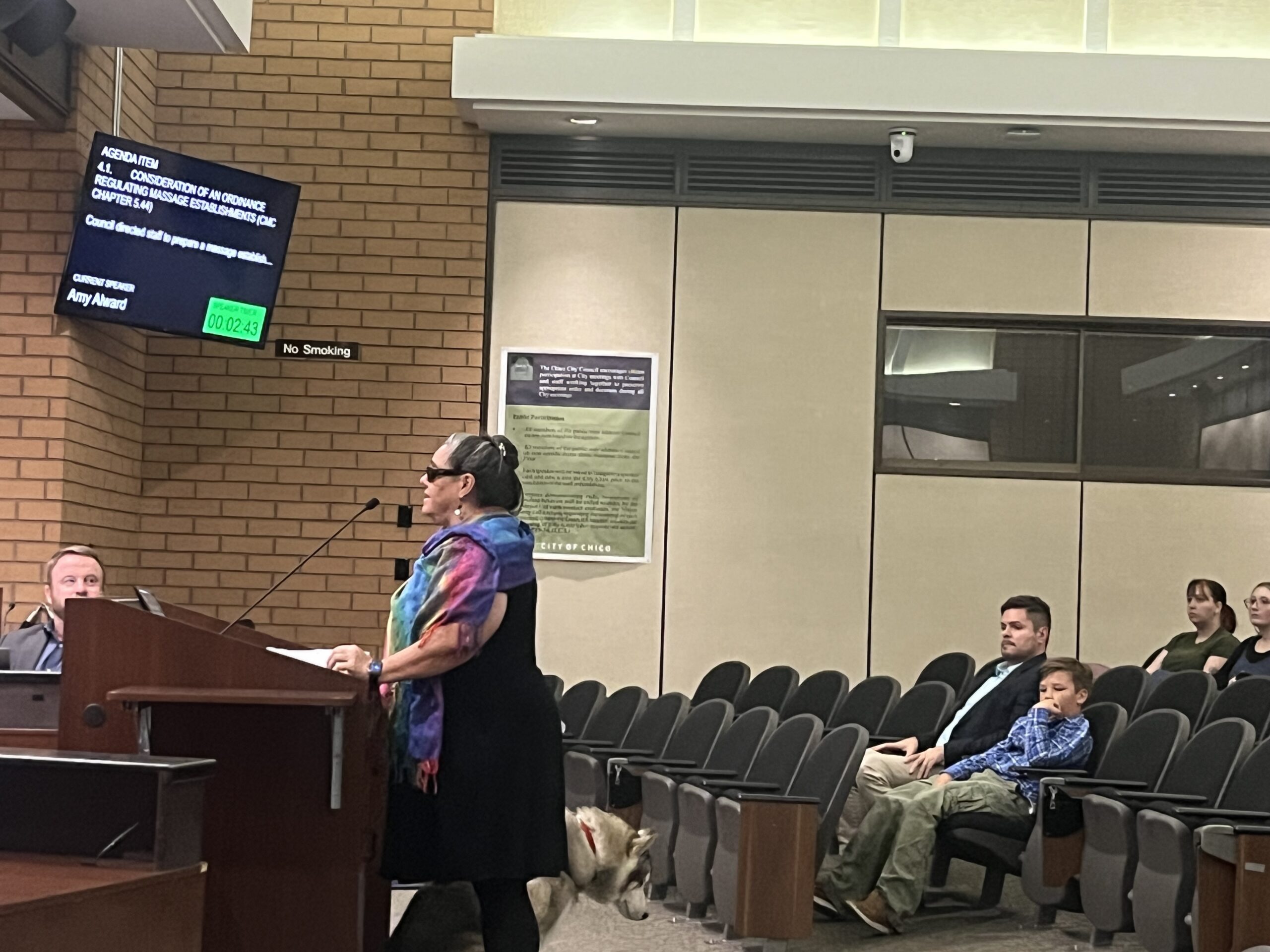
The Chico City Council unanimously approved Nov. 4 a new massage ordinance aimed at preventing human trafficking and illicit activity in local establishments. The ordinance establishes several operational standards for massage businesses and was developed after multiple rounds of community engagement.
Initially, the proposal required all massage practitioners to be certified by the California Massage Therapy Council (CAMTC).
After community feedback, the ordinance was revised to include several exemptions. Long-time practitioners can now receive a permanent exemption from CAMTC certification by providing proof of prior massage-related education and at least five years of work experience as massage therapists.
Council increases security, code enforcement at Alternative Camping Site
Unanimous Council vote increases nighttime security for the neighborhood
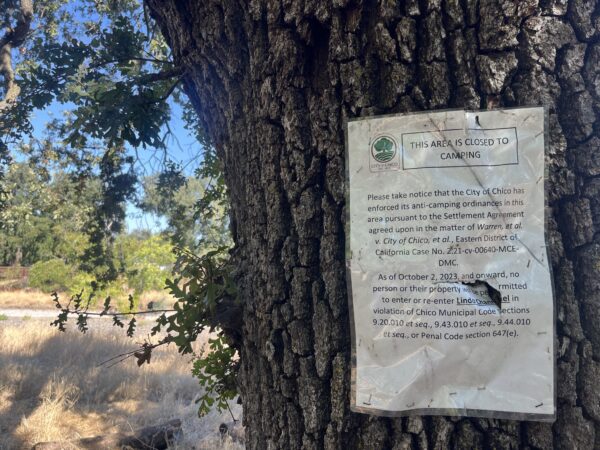
The Chico City Council voted Oct. 21 to increase visits by Jesus Center staff to the Alternative Camping Site from twice a week to seven days a week, and to have Armed Guard Private Security patrol not only the site, but also the nearby neighborhood.
The plan will be implemented for two months at the north Chico homeless encampment, after which time City staff will return to the Council with an assessment.
Meanwhile, the City will incorporate several new rules into the site’s code of conduct, require that residents who are now eligible for the Genesis pallet shelter relocate there, and provide pallet pads to help raise existing tents off the ground.
Massage ordinance could pose challenge to immigrant workers

The City Council considered a new ordinance that would establish several operational standards for the conduct of massage establishments at its Aug. 19 meeting.
Under the new ordinance, all massage practitioners would have to be certified by the state massage practitioner regulatory body, California Massage Therapy Council (CMTAC).
Code Enforcement Supervisor Charlene Durkin said the goal is to address prostitution and human trafficking in the industry.
South Park Drive stays open to cars
Council reverses previous decision
The Chico City Council voted 5-2 to reverse its decision to close the entire stretch of South Park Drive that runs parallel to Woodland Avenue to vehicular traffic.
In June, the Council had passed a plan to make this stretch in Lower Bidwell Park vehicle free. But car owners, residents and biking advocates all pushed back. Concerns included worsening traffic in the area, inconvenience for disabled people, and the loss of parking spaces on South Park Drive.
City Council gives the nod to more military equipment
Council remains divided on purchases by Chico PD
The City Council voted 4–3 to approve the Chico Police Department’s proposed purchase of more than half a million dollars in additional military equipment.
The acquisitions will include three drones, four remote-controlled cars, a launcher that can fire projectiles, two sniper rifles to replace two old ones, 15 police patrol rifles, and three incident command vehicles that can provide a mobile on-site platform for command, control and communications during major incidents.
The total estimated cost is $562,955, not including maintenance fees, according to Chico PD’s military equipment policy.
“Your continued approval will ensure that the community’s police department stands ready to protect them while also keeping your police officers safe,” Police Chief Billy Aldridge told councilmembers prior to the vote.
Aldridge also proposed purchasing a Boston Dynamics Agile Mobile Robot, contingent on securing grant funding.
“The purpose of those,” Aldridge said, “is they have multiple options for sensors on those – bomb detection, chemical detection, camera systems, audio systems – [so] you can put them into places where you wouldn’t necessarily want to put a human.
“And it’s a robot,” he said, “so no danger to a human in what they’re doing.”
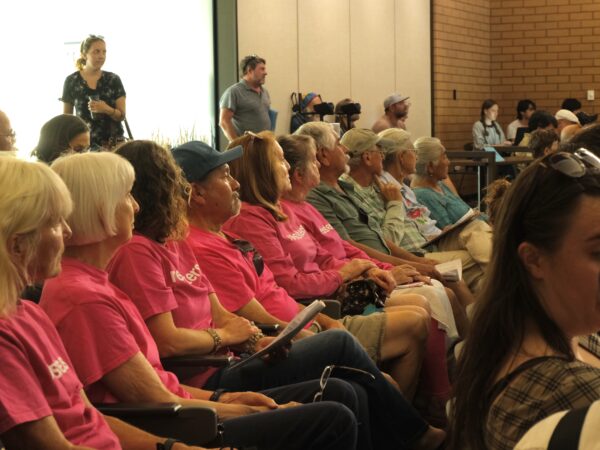
Several members of the community expressed their concern about the City’s purchase of military equipment during the public comment session.
“The goal of AB 481 is for elected officials to curb and regulate the militarizing of our police,” said Chico resident Margaret Swick. “It is not to celebrate the growth of a military-style arsenal,” she said.
Assembly Bill 481 was passed by the California Legislature and signed into law in 2021, in part to “give strong consideration to the public’s welfare, safety, civil rights, and civil liberties” the text states. The law calls for “meaningful public input” prior to the purchase of what it defines as military equipment, and requires California law enforcement agencies to obtain approval from their governing body for the funding, acquisition, or use of that equipment.
“Chico has plenty of issues we could solve by redirecting money to perhaps painting and improving crosswalks so that children, bicycles, and pedestrians are safe,” Swick added.
Diane Suzuki-Brobeck, a member of Concerned Community for Justice, voiced concern about the potential use of the equipment on peaceful protesters. She asked Aldridge to make a public statement “reassuring us that Chico PD will follow the law, … which restricts law enforcement’s use of less-lethal munitions to disperse protests, and also increases the frequency of mandatory use-of-force reporting.”
Councilmember Bryce Goldstein echoed her sentiment. “I’m also concerned in our current political climate about the potential for military equipment being used against people exercising their First Amendment rights,” she said.
Goldstein added that she supports public safety but wants to “make sure that we’re investing our taxpayer dollars into proactive public safety measures.”
Councilmember Tom van Overbeek expressed support for the purchase of the equipment: “My take on this … is that almost every one of those items, it protects … the police officers, and it protects citizens, because it gives you (the police) more non-lethal options when you’re dealing with a difficult situation.”
Councilmember and former Chico Police Chief Mike O’Brien said this equipment “mostly is defensive in nature and designed to save lives.”
After O’Brien motioned to approve all the items requested by Aldridge, Councilmember Katie Hawley introduced a substitute motion to remove several items from the acquisition list.
They included one of the three incident command vehicles, the police patrol rifles that “were only used once in 2024,” and the Boston Dynamics robot.
“Boston Dynamics is a $75,000 piece of equipment,” Hawley told ChicoSol on March 20. “Even if that is awarded with grant funds, upkeep and maintenance of that would be extremely expensive and specialized. It is an erroneous spending allowance in my opinion.”
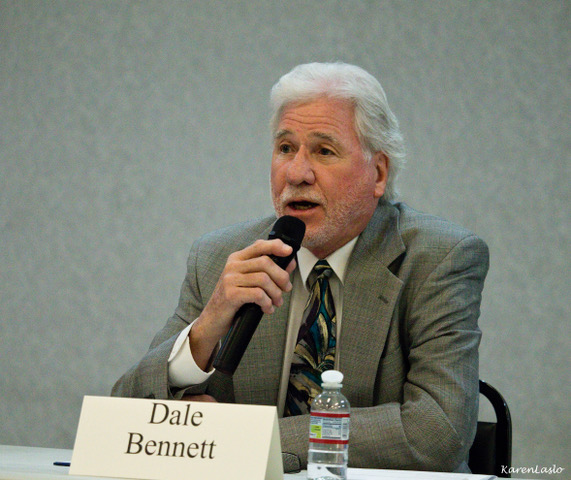
Hawley’s substitute motion failed 3–4, and O’Brien’s motion passed 4–3. Mayor Kasey Reynolds, Vice Mayor Dale Bennett and van Overbeek voted in favor of O’Brien’s motion.
During the March 31 community forum held by Chico PD to collect public opinions about the military equipment purchases, Aldridge said, “I disagree with the terminology that they use in this law (AB 481), because nothing that we have in our inventory is truly military equipment. It makes it sound like you went to the military and said, ‘Hey, can I buy your tank?’ But that’s not the case.”
According to Chico PD, most of the “military equipment” in their possession is commercially available and made for civilian or law enforcement use.
AB 481 designates in its text a dozen categories of items as “military equipment,” including any firearm or firearm accessory designed to launch explosive projectiles, “Flashbang” grenades and Humvees.
Aldridge specifically addressed concerns over the use of drones — one of the items mentioned in the law that Chico PD utilizes.
Anytime they’re launched, their flights are logged into so-called “air data,” which is posted on the police department’s website.
“Typically, they’ll do a report on why they flew that drone,” Aldridge said. “Then it goes through a review process for that supervisor, and then a manager who will review it, [and] say this was in policy or not in policy.
“Obviously, if we find someone out of policy,” Adridge said, “then we start the investigation into why they violated that policy.”
Yucheng Tang is a California Local News Fellow reporting for ChicoSol.