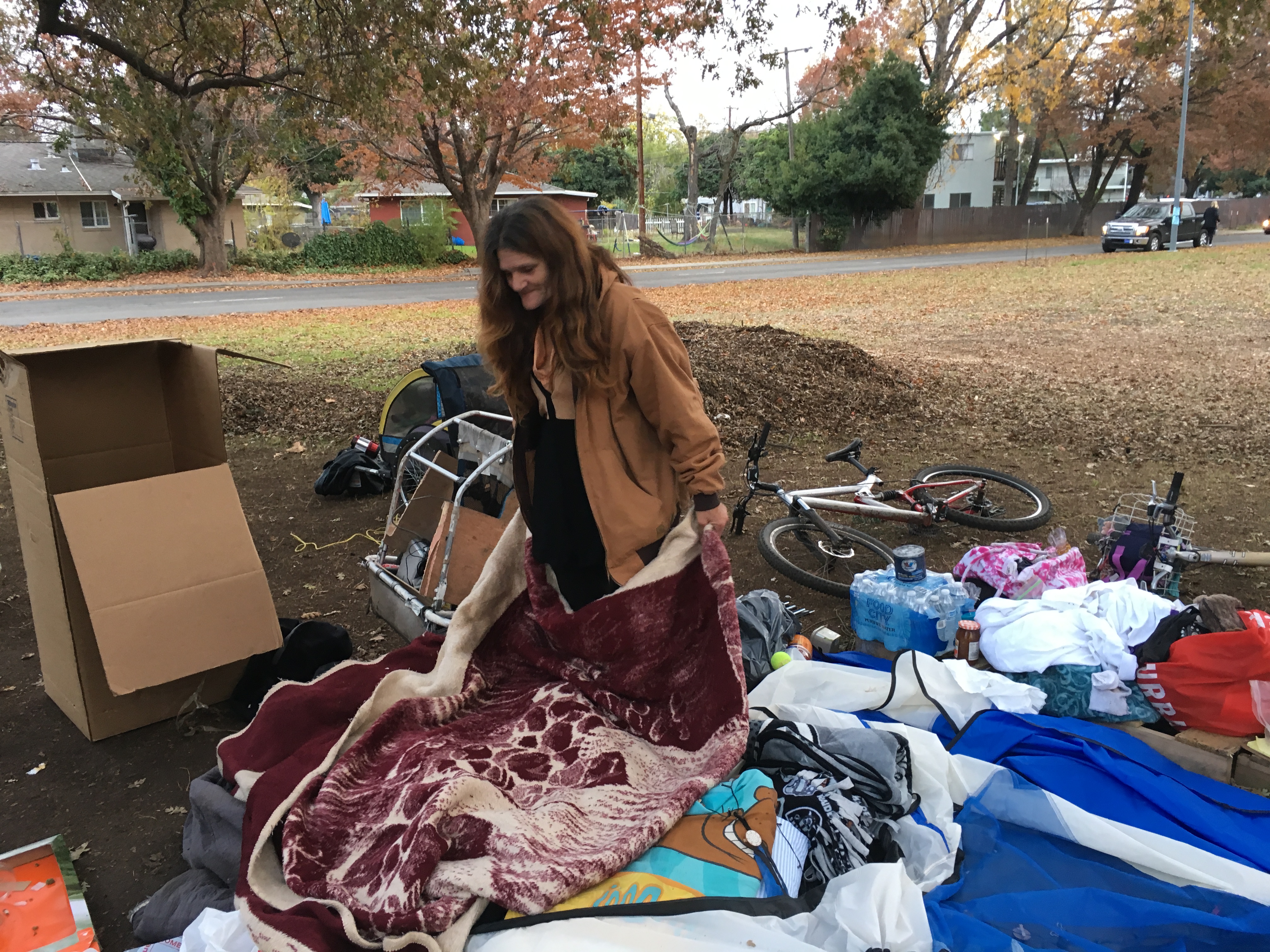
Brenda Sallee speaks at the Council meeting earlier this week. Photo by Yucheng Tang.
The City Council voted unanimously Sept. 17 to identify location and service options for the Cohasset and Eaton Roads camping site where unhoused people have lived for several years, sheltered only by tents. The Council’s motion directs staff to look at alternative locations, whether the camp could be split among smaller sites and possible collaboration with service providers.
The discussion was initiated by Councilmember Mike O’Brien after a resident living in the neighborhood brought up safety concerns at a recent meeting.
Erik Gustafson, Chico Public Works director, addressed the Council on challenges that Public Works has with the site and recent improvements that have been made. During public comment, neighborhood residents raised safety concerns about the north Chico campground and one camper, Brenda Sallee, spoke.read more
A frustrated mayor responds; an advocacy organization for the unhoused applauds ruling
by Yucheng Tang | Posted April 4, 2025
photo by Leslie Layton
The Comanche Creek encampment was removed years ago.
In September of last year, the City of Chico began another legal journey – this time an effort to exit the Warren v. Chico Settlement Agreement.
On March 31, the U.S. District Court for the Eastern District of California denied the City’s motion, which means the City has to abide by the five-year agreement that started in 2022 and ends in 2027.
The Settlement Agreement prohibits the City from enforcing anti-camping ordinances when adequate shelter is unavailable. In planning an eviction of unhoused campers from public spaces, the City must make a count of available shelter beds, advise plaintiff counsel Legal Services of Northern California (LSNC) and notice campers who will be assessed and referred elsewhere. Some City officials consider the process unnecessarily onerous.

The settlement was the result of a 2021 lawsuit against the City and its police department filed by Legal Services, a legal aid agency. The lawsuit argued that the City was violating the rights of homeless people when it razed encampments.
The order says that the City voluntarily entered the agreement and failed to demonstrate any changed circumstances that warrant the granting of relief.
Viewpoints on the ruling differ
Some City leaders and homeless advocates view this recent ruling in different ways.
After seven months of waiting for the court ruling, Chico Mayor Kasey Reynolds said she was disappointed that the City’s motion was denied.
“While we respect the judicial process, we firmly disagree with the Court’s ruling,” Reynolds said. “This will continue to limit the City’s ability to timely and effectively address the public safety issues in the City.”
In an emailed statement, Reynolds wrote that the City is reviewing the Court’s decision and evaluating its legal options going forward. “I would not rule out any possibility at this time, however cost and time will need to be carefully considered with any and all decisions made on the City’s behalf,” she said.
Reynolds also noted that this agenda falls into the “Existing Litigation” category, meaning that it will only be discussed in closed session rather than publicly at the City Council meeting.
LSNC, which represented the eight unsheltered people in the Warren v. Chico case, said it is pleased that the court held the City of Chico to the obligations it agreed to in the Settlement Agreement.
Will Knight, decriminalization director at the National Homelessness Law Center, views the recent Warren v. Chico ruling as good news. He is part of the team of attorneys and advocates dedicated to protecting the rights of the homeless and solving homelessness.
“Despite the shameful ruling in Grants Pass, it remains counterproductive, morally corrupt, and legally unwise for cities to arrest or fine people for living outside when they have nowhere else to go,” Knight said.
City watched U.S. Supreme Court ruling
The City’s motion followed the Supreme Court’s decision in the Grants Pass v. Johnson case, which overturned its previous ruling and allowed cities to evict and penalize individuals sleeping in public, even when no alternative public spaces or shelters are available.
“Instead of wasting taxpayer dollars by passing or enforcing laws that make it illegal to be homeless or reopening settled cases,” Knight said, “elected officials in Chico and across the country must focus on proven solutions to homelessness, like housing and care.”
But the Supreme Court’s ruling became one of the key arguments in the City of Chico’s motion.
The City contended that “it is inequitable for the Settlement Agreement to remain
unmodified because the decision in Grants Pass would not constrain their enforcement of the Anti-Camping Ordinances,” according to the judge’s order.
The court was not persuaded. “This is because defendants voluntarily entered into the Settlement Agreement, thereby agreeing to assume obligations beyond the minimum constitutional requirements, and did so for the purposes of resolving the litigation,” the order explains.
The court order also says that the City failed to demonstrate that some public safety issues, like fires and crimes, have worsened after entering the Settlement Agreement.
LSNC pointed out that “the overwhelming majority of unhoused people who have talked with us say they would stay at the Pallet Shelter if they were offered a spot, yet it is our understanding that the Shelter has never once filled since it opened.”
Members of the public indicated concern about the City’s approach to homelessness during the March 4 City Council meeting. Felix Mahootian protested the ongoing eviction sweeps launched by the City. “As it stands, the sweeps do nothing to help leverage folks out of homelessness who are there,” Mahootian said. “These are just enforcement, not preventive.”
In fact, despite the Settlement Agreement’s restrictions on ordinance enforcement, the City has published 15 notices of planned enforcement of camping ordinances since February 2024.
An unhoused man ChicoSol spoke with during the Feb. 27 eviction sweep at City Plaza said he didn’t know where to move his belongings. He said he might relocate to a parking lot or under tree cover for a few days. In the end, he said, he would return to City Plaza.
The man said he preferred the Genesis pallet shelter emergency housing over the Torre Community Shelter for its greater freedom. Though he had been repeatedly offered a Torres Shelter bed, he preferred to remain unsheltered.
“We look forward to continuing to work with the City to improve conditions and access to shelter for Chico’s unhoused residents, particularly by increasing opportunities for unhoused people to enter the Pallet Shelter,” says the LSNC statement.
Yucheng Tang is a California Local News Fellow reporting for ChicoSol.
U.S. District Court Judge Dale A. Drozd has denied the City of Chico’s motion for relief from final judgment in the case Warren v. Chico.
The case led to a settlement agreement in 2022 that prohibited the City from enforcing anti-camping ordinances when adequate shelter was unavailable. The City later sought to modify or terminate that agreement, citing changes in the law (the Grants Pass v. Johnson decision by the U.S. Supreme Court) and changed circumstances, such as public health and safety concerns.
The court order says the City failed to prove that some public safety issues, like fires and crimes, have worsened after entering the Settlement Agreement.
“It is undisputed by the parties that the number of fires attributable to homeless people in general has been reduced during the operation of the Settlement Agreement compared to the number that took place prior to their entry into the Settlement Agreement,” the order says. “…nor have they presented evidence showing that the level of crime in Chico has changed since their entry into that agreement.”
District 4 Councilmember Addison Winslow commented in an Instagram post.
“What the judge gave us is the resounding rejection of everything that the City claimed,” Winslow says.
“We can negotiate a plan that can outlast the Settlement Agreement so we find a way to really workably handle homelessness in our community,” Winslow said, “or we can sit and complain.”
The City of Chico plans to file a court motion next week asking for “relief” from the Warren v. Chico Settlement Agreement, an effort to give City leaders the latitude they seek to enforce anti-camping ordinances, conduct evictions and generally address homelessness.
As negotiations between the City and Legal Services of Northern California (LSNC) came to a crashing halt, the City today issued a press release that says “… with regard to the Warren Settlement Agreement itself, the City expects to file a motion to seek judicial relief” next week.
LSNC represents the homeless plaintiffs in the Warren lawsuit that was filed against this City in 2020.
The City released the July 31 LSNC letter that ChicoSol described in its Aug. 7 story here that proposed revisions to the agreement. It also released the City’s rejection of that proposal.
In an Aug. 7 letter from Attorney John Lam, the City says LSNC’s proposal “would unreasonably restrict the City’s governmental discretion to exercise the City’s constitutional police powers …” Lam wrote that the proposal requires “continued adherence to principles” that have been rejected in the June 28 U.S. Supreme Court ruling Grants Pass v. Johnson.
Dissenting Councilmember Addison Winslow released his statement that illustrates the starkly different views of how homelessness might be addressed, and warns that a “legal battle” will be costly.
“In this direction to refuse negotiations the City is committing to an uncertain legal battle which will exhaust city resources and those of the only legal defense organization in Chico that freely serves seniors and low-income tenants facing unlawful abuse by landlords,” Winslow states.
The City’s press release says that dispute resolution efforts between the two parties in the Warren lawsuit began in November 2023. The City says that one of its goals was to “gain the authority” to manage the Alternate Site campground at Eaton and Cohasset roads, which is for unhoused people who have been referred because they aren’t able to enter a shelter.
That site has increasingly been a focus of community concern, with outbreaks of illnesses, a sense of chaos and a lack of security. Campers complain they’re harassed and shot at by passersby. There are a couple of portable toilets, but there has been no management or provision of lighting and restrooms.
“This is a period of Chico’s history that will survive in infamy” — Addison Winslow
The City says it hasn’t had the ability to control “who is at the site,” and only since February 2023 has it had some control and a “limited ability to manage conduct at the site.”
“Predictably, this resulted in a lawless, chaotic situation that defies reasonable, normal standards for public safety, public health and common sense,” the City says.
The City released the “Implementation Agreement” that came out of the dispute resolution process “as it existed on June 26, 2024” – two days prior to the Grants Pass ruling — that was never signed or executed. It deals with processes to streamline evictions as well as modifications to the Alternate Site. Those modifications included the installation of lighting with surveillance cameras and pop-up shade structures.
The City nevertheless indicates the Settlement Agreement stopped it from making the changes that are needed; Winslow says that’s “disingenuous,” because campers also wanted controlled entry and rules.
The City is now installing lighting, and its press release goes on to list some new rules that bar, for example, most unauthorized entries and dogs off-leash.
“The dispute resolution process that began in November 2023 has now unsuccessfully concluded following the Grants Pass decision,” the City states.
Councilmember Winslow, who has most often been the single member of the panel to object to the majority decisions related to homelessness, defended LSNC’s July 31 revised settlement offer. That offer would allow the City to enforce all anti-camping ordinances with “no more than a three-day notice, while maintaining the practice of ensuring adequate shelter is available …” he states.
Winslow says that in the Aug. 6 closed sessions he “made a plea for us to retain the reasonable practices,” including, for example, involvement by social workers.
“Throughout the shadowy process of managing public policy on homelessness, I have found some of my colleagues on the Council motivated by a genuine resentment of the poor and those who defend them, and others by a belief that uncompromising repression is simply what the majority of Chico voters want,” he states.
(Mayor Andrew Coolidge had not returned a request from ChicoSol for comment on the issue at the time of this story’s posting.)
“This is a period of Chico’s history that will survive in infamy, just as we look back with shame on the persecution and expulsion of the Chico Chinese,” Winslow adds.